I have always hated the word studying. It brings up memories of fluorescent lights, uncomfortable plastic chairs, and the dry smell of old textbooks. For years, that was my only model for learning. I thought that if I wasn’t suffering, I wasn’t making progress. I would sit at my desk for hours, forcing myself to memorize verb tables until my eyes hurt.
The result? I quit. I quit every time.
I would go through a cycle of intense effort followed by total burnout. I realized that my brain treats “studying” as a chore. It is something I have to do, not something I want to do. If I wanted to finally reach fluency, I had to stop being a student and start being an explorer. I needed to build a system where the learning happened in the background of my life. I wanted it to feel as natural as breathing or drinking my morning coffee.
I finally reached a breakthrough when I realized How I Learned Faster Once I Stopped Overcomplicating Everything and shifted my focus away from academic perfection.
Here is exactly how I built a “stealth” learning system that took me further in six months than six years of traditional classes ever did.
The Death of the Desk
The first thing I did was get away from my desk. In my mind, the desk is for work. It is where I answer emails and manage my blogs. When I sit there, my brain is in “stress mode.”
I started moving my language activities to the places I actually enjoy being. I began doing my listening practice while I was brewing my morning V60 coffee. I turned the ritual of grinding beans and heating water into a five minute immersion session. Because I already love making coffee, the language practice became associated with pleasure.
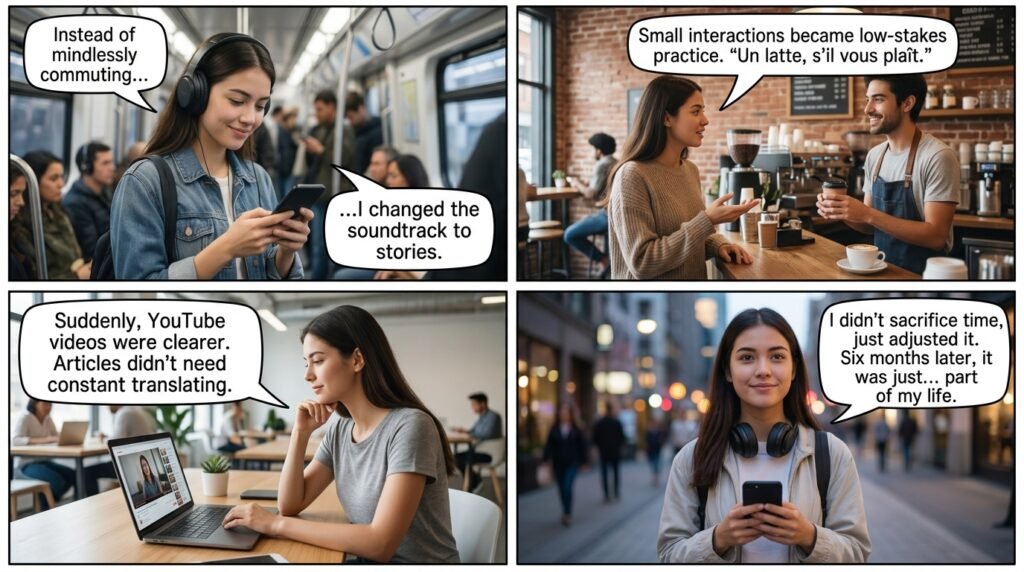
I stopped using a physical textbook as my primary source. Instead, I moved everything to my phone and my Kindle. This meant I could “study” while standing in line at the grocery store or sitting in the park. By removing the physical “office” environment, I removed the mental barrier to getting started.

The Hobby as the Curriculum
If you want to stay engaged, you have to talk about things you actually care about. Most textbooks teach you how to ask for the library or describe the color of a ball. I don’t care about libraries, and I rarely need to describe a ball.
I decided to make my hobbies the curriculum. I am deeply interested in traditional Japanese Irezumi art. I started looking up specific motifs like the serpent (hebi) or the kitsune in Japanese. I wasn’t just looking for the words; I was reading the folklore and the history behind the symbols.
Because I was genuinely curious about the tattoos, I worked harder to understand the sentences. My brain didn’t see it as “vocabulary practice.” It saw it as “discovering the meaning of a cool design.” When you use your interests as the bridge, the language becomes the key to a door you actually want to open.
This was a huge part of What I Focused On First When Learning a New Language because it made the initial hurdle much easier to jump over.
Changing My Digital Environment
We spend hours every day looking at our screens. I decided to stop fighting my screen addiction and start using it. I changed the language of my phone, but I did it gradually.
First, I changed my social media feeds. I followed accounts related to coffee culture and content creation in my target language. Now, when I open Instagram to waste time, I am forced to read captions and watch stories in the language I am learning.
I didn’t have to “find time” to study. I just replaced my unproductive scrolling with productive scrolling. It didn’t feel like work because it was still the same content I usually consume. I was just seeing it through a different lens.
I also started using “Language Reactor” on YouTube. It allows you to see dual subtitles and hover over words to see their meaning. I would watch a video about blog monetization or SEO strategies. I was learning professional skills and language skills at the same time. This is the definition of efficiency.
The Fifteen Minute Rule
One of the biggest mistakes people make is trying to do too much. They tell themselves they will study for an hour every night. Then, they have a long day at work, they are tired, and the idea of an hour feels like a mountain. So they do nothing.
I replaced the “Hour Rule” with the “Fifteen Minute Rule.” I told myself I only had to do fifteen minutes. Anyone can find fifteen minutes.
Most of the time, once I started, I would keep going for thirty or forty minutes. But on the days I was truly exhausted, I did my fifteen minutes and stopped. This prevented the guilt cycle that usually leads to quitting.
By keeping the barrier to entry low, I was able to maintain a streak for months. I realized that How I Built a Routine That Actually Worked for Me was more about consistency than intensity.

The Power of Passive Listening
I stopped trying to understand every single word. One of the most stressful parts of “studying” is the feeling that you are missing something. I decided to embrace the noise.
I started playing podcasts in the background while I was cleaning my apartment or walking the dog. I wasn’t “studying.” I was just letting the sounds of the language wash over me.
At first, it was just a blur of noise. But after a few weeks, I started to recognize the rhythm. I could tell where one word ended and another began. I started to pick out common words like “but,” “because,” and “today.”
This passive exposure trained my ears without any conscious effort. It felt like I was learning by osmosis. When I finally did sit down to look at a new grammar point, it felt familiar because I had already heard it a hundred times in the background.
Gamification Without the Apps
I know everyone talks about language apps, but I found that many of them felt too much like a chore. I wanted something more organic.
I started a “Discovery Journal.” Every time I found a word in the real world that I didn’t know, I would write it down. Maybe it was a word on a coffee bag or a term in a blog comment.
My “game” was to find three “Real World Words” every day. This turned my commute and my errands into a scavenger hunt. I wasn’t looking at a screen; I was looking at the world. It kept me alert and engaged. It made me realize that the language is everywhere if you are looking for it.
Speaking to the Wall
One of the biggest sources of anxiety is speaking to other people. We are afraid of looking stupid. We are afraid of making mistakes.
To bypass this, I started “Thinking Out Loud.” I would narrate my day as if I were a character in a movie. “I am going to the kitchen. I am making a cup of coffee. It is a sunny day.”
It sounds silly, but it works. It builds the muscle memory of speaking without the pressure of a listener. I could take as long as I wanted to find a word. I could repeat a sentence ten times until it sounded right.
By the time I actually spoke to a native speaker, I had already “said” thousands of sentences. My mouth was used to the shapes. My brain was used to the flow. The “studying” had happened in the privacy of my own home, disguised as a weird habit.
Using Music as a Memory Anchor
I have always found it easier to remember song lyrics than grammar rules. I decided to lean into that.
I created a playlist of songs I actually liked in the target language. I would listen to them on repeat until I could hum the melody. Then, I would look up the lyrics to just the chorus.
Songs use a lot of “colloquial” language—the way people actually speak. They also use rhyme and rhythm, which are powerful memory aids. I found that I could remember complex verb structures much more easily if they were part of a catchy song.
Now, when I’m trying to remember a specific tense, I often find myself singing a line from a song in my head. It’s like a cheat code for your memory.
The “No Translation” Rule
When I was “studying” the old way, I was constantly translating back and forth in my head. This is slow and exhausting. It makes your brain work twice as hard.
In my new system, I focused on images. If I learned the word for “coffee,” I didn’t think of the English word “coffee.” I pictured a steaming cup of dark liquid. I tried to connect the new sound directly to the physical object.
I stopped using bilingual dictionaries and started using Google Images. If I saw a new word, I would search for the image. Seeing a picture of a “kitsune” is much more powerful than reading the word “fox.” It creates a direct link in your brain that bypasses your native language.
Handling the Burnout
Even with a “non-study” system, you will have days where you just don’t want to do it. The old me would have forced myself to do it anyway, grown to hate the process, and eventually quit.
The new me has a “Rest Day” policy. If I am truly not feeling it, I take the day off. I don’t feel guilty. I don’t try to “catch up” the next day. I just accept that my brain needs a break.
Because the system doesn’t feel like work, these burnout days are much rarer. But when they do happen, I listen to them. This is a marathon, not a sprint. The goal is to still be doing this five years from now, not just five weeks from now.
The Results of the “Stealth” Method
After six months of this approach, I realized I had reached a level I never thought possible. I could watch a YouTube video and understand the main points. I could have a basic conversation with a barista. I could read an article about digital marketing without reaching for a dictionary every ten seconds.
The best part? I didn’t feel like I had sacrificed anything. I didn’t feel like I had “studied” for hundreds of hours. I had just lived my life in a slightly different way.
I had turned my hobbies, my phone, my commute, and my morning coffee into learning tools. I had built a system that was resilient, flexible, and fun.
How You Can Start Today
If you are tired of the traditional classroom approach, I want you to try one thing today. Pick one hobby you love. It doesn’t matter what it is—gaming, cooking, fashion, or fitness.
Go to YouTube and find one video about that hobby in your target language. Don’t worry about understanding everything. Just watch it. See if you can pick out three words.
That is the start of your new system. You aren’t studying. You are just watching a video about something you like. Do that every day for a week. See how it feels.
You don’t need a perfect plan. You don’t need expensive books. You just need a little bit of curiosity and the willingness to let the language into your life.
Stop being a student. Start being a speaker. The world is a much bigger place when you can understand more than one way of describing it. And the journey there doesn’t have to be a struggle. It can be the most rewarding part of your day.
Take a deep breath. Put down the highlighter. Pick up your coffee. Your language journey is just getting started, and this time, you’re going to enjoy the ride.
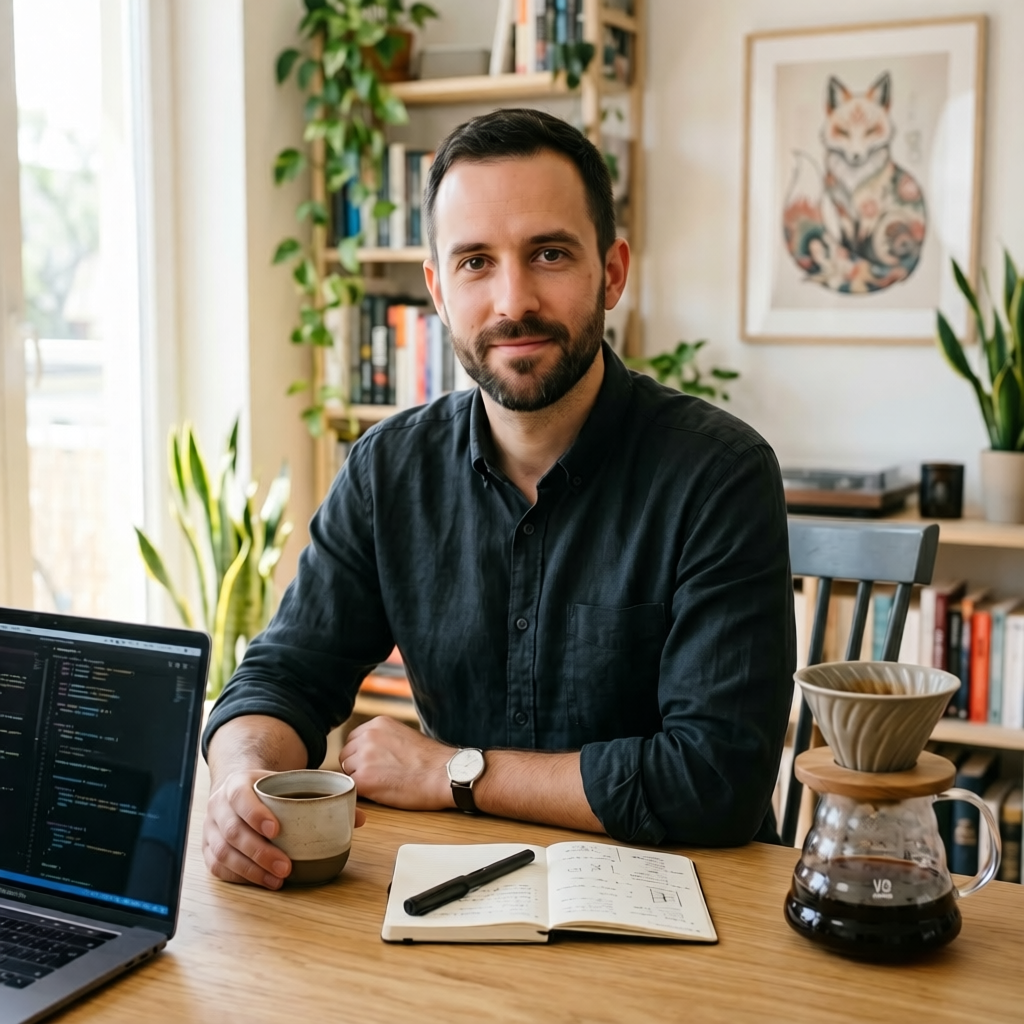
Gabriel Henrique is a language enthusiast and productivity writer. After testing countless study methods, he became obsessed with mastering new languages efficiently. He achieves this without burnout, without endless grammar drills, and without losing focus. At Blog The Curious, he shares everything he has learned along the way.