
I had a desk drawer full of dead notebooks. Every page looked exactly the same. They contained long, neat columns of foreign words on the left and native translations on the right. I color coded the verbs. I highlighted the exceptions. I spent hours building these lists.
Then I would go out into the real world. I would try to order food or ask a simple question. My mind would instantly go blank.
The words were in the notebook, but they were not in my head. I was doing a lot of writing, but I was doing zero actual learning. I felt completely defeated. I thought my memory was failing. I assumed I just lacked the natural talent required to speak another language.
The problem was not my brain. The human brain is a perfect retention machine when it actually cares about the information. My problem was my system. I was treating my mind like a filing cabinet. I thought I could just drop pieces of paper inside and retrieve them later.
I had to burn the old method to the ground. I stopped memorizing lists. I stopped staring at generic flashcards. I built a rigid, multi step system designed specifically to trick my brain into keeping the words forever. This system changed everything. It took me from a stuttering beginner to a confident speaker. Here is exactly how I built it and how you can copy it.
The Flaw in the Foundation
Before you build a new system, you must understand why the old one fails. The traditional way of learning vocabulary is completely backwards.
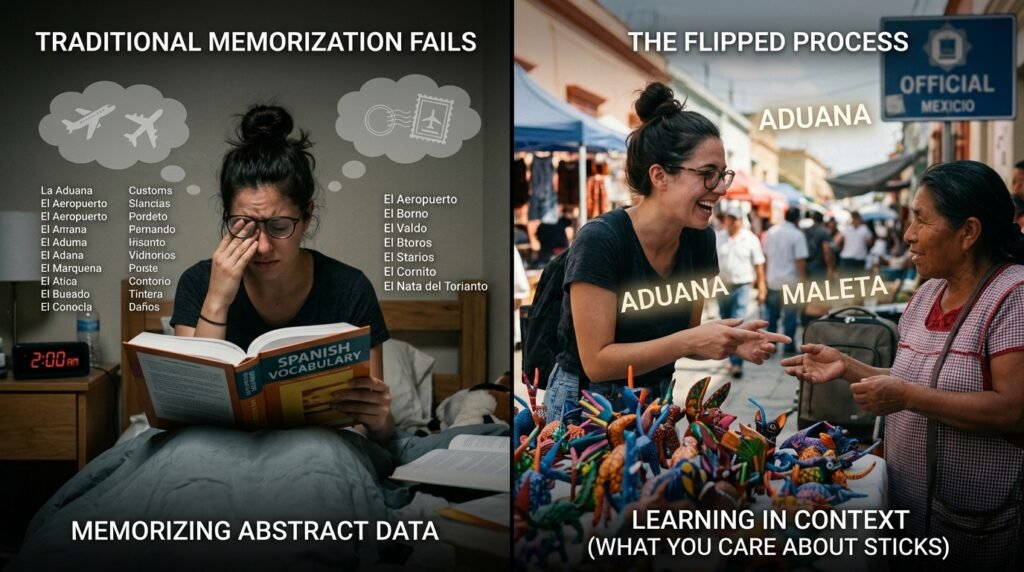
A textbook gives you a list of words to learn. The theme is usually something arbitrary like “The Airport” or “Animals at the Zoo.” You stare at the list. You repeat the words. You test yourself. You pass the test.
Three days later, you forget ninety percent of the list.
This happens because the human brain deletes abstract data. If you are sitting in your bedroom trying to memorize the word for “customs officer,” your brain knows you are not in danger. It knows you are not traveling. It tags the information as useless and dumps it while you sleep.
You cannot force your brain to care about random words. You have to learn words that your brain already cares about. You have to flip the process.
Phase 1: The Capture Habit
The first step of my system requires a pocket sized notebook. Not a digital app. A physical piece of paper and a pen. You carry this with you everywhere you go.
I completely stopped using pre made vocabulary lists. I decided my daily life would dictate what I needed to learn.
As I walked through my day, I paid attention to my internal monologue. I noticed the things I was thinking about, looking at, or trying to do. Whenever I hit a mental wall where I did not know how to express my current thought in the target language, I pulled out the notebook.
I wrote the thought down in my native language.
If I was making breakfast and could not find the spatula, I wrote down the word spatula. If I was stuck in traffic and felt frustrated, I wrote down the exact phrase I wanted to yell at the car in front of me. If I was tired at work, I wrote down a sentence about needing more sleep.
I collected these missing gaps all day long. By the time I went home, I had a list of ten to fifteen highly specific, extremely relevant thoughts.
Phase 2: Processing and Translation
The evening is when the real work happens. I sit down with my pocket notebook. I take the list of native thoughts and I translate them into the target language.
I do not just look up single words. I look up entire phrases.
If my note says “spatula,” I do not just write down the translation for the tool. I write down the full sentence. I translate “I cannot find the spatula to flip the eggs.”
This is the most critical rule of the system. Never learn a naked word. Always wrap it in a sentence. A word alone has no context. A word inside a sentence has grammar, structure, and meaning. Figuring this out was the core of The Method I Used to Learn Words in Context and it completely eliminated my translation delays.
When you learn the full chunk, you learn how the word behaves. You learn the prepositions that follow it. You learn how it sounds next to a verb. You give your brain a complete thought instead of a broken puzzle piece.
Phase 3: The Rule of Three
Once I have the correct translation for my new phrase, I move to the next phase. This is where I force the word deep into my long term memory.
I call it the Rule of Three. For every new target word or phrase I capture, I must immediately write three completely true sentences about my own life using that exact word.
They cannot be generic. They cannot be boring. They must be grounded in my reality.
Let us use the target word “to complain.” Sentence one: I complain when the neighbors play loud music at midnight. Sentence two: My brother always complains about the price of gas. Sentence three: I try not to complain when it rains on the weekend.
By writing three true sentences, I am actively manipulating the language. I am bending the new word to fit my actual life. I am building a personal relationship with the vocabulary. The brain registers the truth in the sentences and assigns a high value to the new word.
Phase 4: Vocal Activation
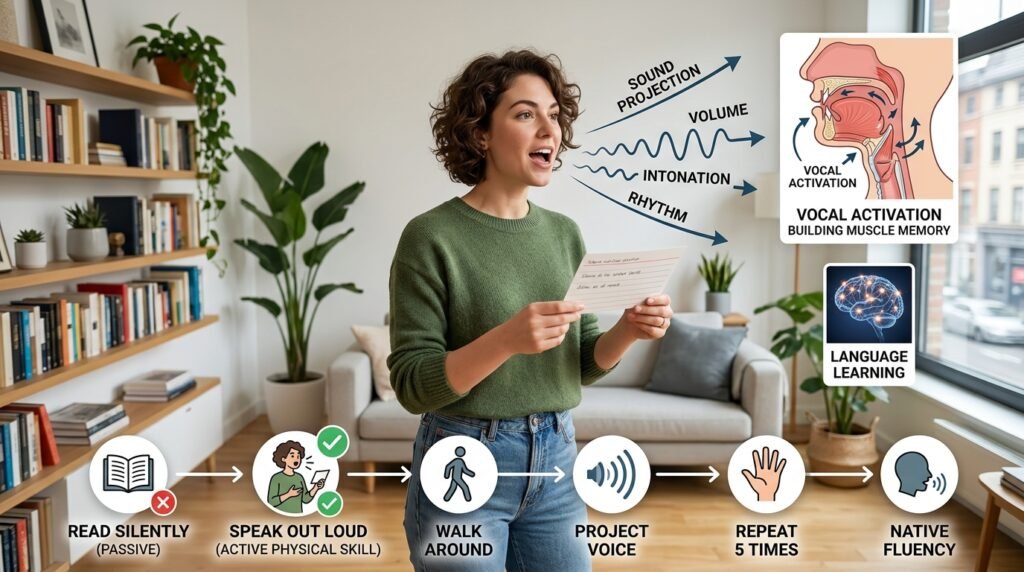
Writing is a passive skill. Speaking is an active physical skill. You cannot build a speaking vocabulary through writing alone. Your mouth has to learn how to move.
After I write my three true sentences, I stand up. I walk around the room. I say the sentences out loud at full volume.
I do not whisper. I project my voice. I try to sound exactly like a native speaker. I focus on the rhythm. I focus on the intonation.
I repeat each sentence five times. I want my vocal cords and my tongue to memorize the physical shape of the words. If you only ever read a word silently, you will stutter when you finally try to speak it. Your mouth will literally not know what to do. Vocal activation builds the physical muscle memory required for fluent speech.
Phase 5: The 24-Hour Deployment
This is the hardest part of the system. It is also the most effective.
Every new word I process in the evening must be deployed in the real world within twenty four hours. There are no exceptions.
If I learn a new adjective on Tuesday night, I have to find a way to use it by Wednesday night. I have to force it into a text message to a language partner. I have to steer a conversation with a tutor so I can use the word. If I have nobody to talk to, I have to post a comment on a foreign YouTube video using the word.
The word must leave my brain and enter the real world.
This creates a massive sense of urgency. I am not learning vocabulary for a hypothetical vacation next year. I am gathering tools that I must use tomorrow morning. This urgency was a massive part of How I Learned Words Faster by Changing My Approach because it forced me to be highly selective. If I knew I could not use a word tomorrow, I simply did not bother learning it today.
Phase 6: Strategic Digital Storage
After I capture, process, speak, and deploy the word, I finally move it to digital storage.
I use a spaced repetition flashcard app. However, I use it very differently than most people. I never download generic community decks. I only use the app to store the personal sentences I created myself.
The front of the digital card shows my native language sentence. The back shows the target language sentence.
I review these cards every single morning for ten minutes. I do not spend an hour swiping. I use the app strictly as a safety net. The app does not teach me the language. The app simply prevents me from forgetting the language I already taught myself.
Understanding the proper role of technology was the key to How I Combine Apps With Real Practice and prevented me from becoming a slave to my phone screen. The app is a backup drive. The real learning happens in the notebook and in my mouth.
Dealing with Stubborn Words
Even with a perfect system, some words refuse to stick. You will encounter words that just bounce off your brain. They look strange. They sound strange. You forget them immediately.
When I hit a stubborn word, I stop trying to force it. I use the ridiculous imagery method.
The human brain remembers absurd, vivid, emotional images flawlessly. If I cannot remember a specific noun, I invent a terrible story about it.
If the target word sounds slightly like the English word “hammer,” I will picture a giant, neon pink hammer smashing my car window. I will picture the glass shattering. I will attach the target word to that violent, bright image.
The weirder the image, the better it works. When I need the word later, I do not search for the letters. I search for the pink hammer. The image appears instantly, and the word is dragged along right behind it.
The Weekly Audit
A vocabulary system must be clean to be efficient. You cannot hoard words.
Every Sunday, I do a full audit of my digital flashcard deck. I look for the leeches. A leech is a word that I have failed to remember more than five times. It is clogging up the system. It is wasting my time.
I delete it.
I simply remove it from the deck. If a word is that difficult to remember, it means I do not have a strong enough personal connection to it yet. I let it go. If it is truly an important word, I will encounter it again naturally in the future. I refuse to waste mental energy fighting a word that is not ready to stick.
Keep your system lean. Only retain the words that serve your daily communication needs.
Building Your Own Sandbox
The beauty of this system is that it builds a custom language designed entirely around you.
If you are an engineer, your pocket notebook will fill up with technical terms and problem solving verbs. If you are a chef, your notebook will fill up with ingredients and sensory adjectives.
You end up building a highly specialized “sandbox” of vocabulary. You learn how to talk about yourself flawlessly.
This gives you massive confidence. When you meet a native speaker, they do not ask you about the zoo. They ask you about your life. They ask you about your job, your hobbies, and your opinions. Because you built your vocabulary system around those exact topics, you will have the answers ready to go.

The Power of Consistency
This system requires effort. It is not as easy as downloading an app and tapping a screen. It demands that you pay attention to your thoughts. It demands that you write things down. It demands that you speak out loud.
But it completely eliminates the cycle of forgetting.
When you spend thirty minutes working through this system, you secure those words for life. You do not have to relearn them next month. You build a permanent foundation.
Stop accepting failure as a natural part of the learning process. Your memory works perfectly fine. You just need to give your brain the right signals.
Start tomorrow morning. Put a pen and a small notebook in your pocket. Go about your day. Wait for the moment when you wish you knew how to say something. Write that thought down. You have just captured your very first word. Take it home, process it, speak it, and deploy it. The system works if you work the system.

Gabriel Henrique is a language enthusiast and productivity writer. After testing countless study methods, he became obsessed with mastering new languages efficiently. He achieves this without burnout, without endless grammar drills, and without losing focus. At Blog The Curious, he shares everything he has learned along the way.