
I stared at the bright screen of my laptop late on a Tuesday night. A heavy red X flashed across the page. I had just failed my fourth online grammar quiz of the week. I was desperately trying to master a complicated past tense structure. I knew the actual formula perfectly. I had written the conjugation rules down in my spiral notebook at least twenty times that month. But every single time I had to choose the right answer under a ticking clock, my mind went completely blank.
The frustration was heavy and physical. I closed the laptop instantly. I walked into the dark kitchen and poured a cold glass of water. I leaned against the counter and realized I was spending hours every week fighting a losing battle. I was not speaking the language. I was fighting it. I treated grammar like a stubborn enemy I had to defeat through brute force.
The academic rules felt like a massive maze designed specifically to trick me. Every irregular verb and every exception to a rule felt like a personal insult to my intelligence. I knew deep down that something had to change. I could not keep studying this way. It was draining my motivation entirely. It was making me hate the language I wanted to love.
I made a drastic decision right there in the kitchen. I decided to stop taking online quizzes. I deleted my digital flashcard decks filled with conjugation tables. I threw away my heavy workbooks. I changed my entire approach to grammar overnight.
The results of this shift were incredible. My daily accuracy improved naturally. My speaking speed doubled. The language finally started to feel comfortable in my mouth. Here is exactly how I changed my approach to see those massive results.
The Illusion of the Classroom
Traditional language classes teach you a very specific illusion. They teach you that language is an academic subject you can master by memorizing data. They break a beautiful, chaotic system of human communication down into sterile formulas.
When you sit in a classroom and fill in the blanks on a worksheet, you get a quick hit of dopamine. You finish a page of preposition exercises. You get a perfect score. You check a box and tell yourself you made serious progress today.
But real life conversations do not happen on paper. Real conversations are fast, messy, and entirely unpredictable.
If you stop an average native speaker on the street and ask them why they used a specific verb tense, they will usually shrug at you. They cannot explain the academic rule behind the sentence. They will simply tell you that any other way would sound weird.
I wanted that exact feeling. I wanted the language to sound right intuitively. To achieve that, I had to stop acting like a university linguist. I had to start acting like someone who actually lived and breathed the language.

Why Quizzes Train the Wrong Skill
Online quizzes give you a false sense of achievement. They test your ability to remember a rule in a highly controlled environment. They do not test your ability to generate organic thoughts.
When you take a multiple choice quiz, you are looking for a trick. You scan the written sentence for a specific keyword. You apply a memorized formula to that keyword. You click a button. You move on to the next question.
Real life does not give you four options to choose from. Real life requires you to generate vocabulary and syntax instantly out of thin air.
I realized these daily quizzes were training me to become a professional proofreader. They were not training me to become a confident speaker. I was getting exceptionally good at spotting errors in written text. I was completely terrible at forming my own sentences out loud.
I had to break this toxic habit. I had to stop looking at sentences as puzzles I needed to solve. I needed to start looking at sentences as simple vehicles for human connection. I outline the specific details of this early struggle in The Beginner Mistakes I Made and How I Fixed Them to show exactly why active studying often holds motivated learners back.
Moving to Passive Observation
I used to treat grammar as an aggressive, active subject. I thought I had to attack it directly every single day. I scheduled dedicated study hours strictly for syntax.
I changed this approach entirely. I turned grammar into a purely passive subject.
I stopped studying the rules directly. Instead, I started observing the language in its natural habitat. I shifted my focus entirely to consuming native content created for native speakers. I started reading fiction and watching documentaries.
When you read a good book, you see the past tense used correctly thousands of times. You see it in dozens of different emotional contexts. You see how different characters use it to express regret or joy.
Your brain slowly builds a massive mental map of the structure without any conscious effort on your part. This passive observation is incredibly powerful. It completely bypasses your internal critic. You are no longer worried about getting the answer wrong on a test. You are simply enjoying a compelling story.
Reading as a Grammar Tool
Reading quickly became my primary tool for grammar acquisition. Reading provides a perfect, stress free environment for your brain to recognize patterns.
When you speak to someone or listen to a podcast, the language disappears instantly. The words vanish into the air the second they are spoken. You do not have the time to stop and analyze the sentence structure.
When you read, the language sits perfectly still on the page. You control the pace completely. If a sentence uses a strange verb form, you can stop and look at it for a minute. You do not need to look up the rule in a heavy textbook. You just need to notice it and acknowledge it.
I started reading for thirty solid minutes every night before I went to sleep. I chose books that were slightly below my actual reading level. I wanted to read smoothly without stopping to check a dictionary every two minutes.
I noticed massive changes within just a few weeks. The sentence structures started to feel strangely familiar. I began anticipating the correct prepositions before I even read them. The grammar rules I had struggled to memorize for months were suddenly clicking into place naturally.
Killing the Translation Habit
One of the absolute biggest obstacles to good grammar is your native language.
When you learn a new language, your first instinct is to map the new rules directly onto your native rules. You try to translate sentences word for word. This strategy always leads to total disaster. Every single language has its own unique logic and rhythm.
I had a terrible habit of building a complex sentence in English first. Then, I would slowly swap out the English words for the target language words in my head. Finally, I would try to adjust the grammar to fit the new language before speaking.
This process is mentally exhausting. It also produces completely clunky and unnatural sentences.
You have to train your brain to accept the new logic directly. I detail the exact mental exercises I used to break this habit in How I Learned to Stop Translating in My Head because it is a critical step for real fluency.
You have to accept that sometimes, a language expresses an idea in a completely alien way. You cannot force English grammar onto another language. You have to surrender entirely to the new structure. You have to accept it without constantly questioning why it is different.

Fixing the Feedback Loop
You cannot improve your grammar if you do not know you are making mistakes. But you also cannot improve if you are constantly terrified of making mistakes. You need a highly balanced feedback loop.
I used to aggressively ask my language exchange partners to correct every single error I made. This was a catastrophic idea.
Our casual conversations became slow, painful, and awkward. I could barely finish a single thought without being interrupted and corrected. I lost all my speaking confidence. I started speaking less just to avoid the constant corrections.
I changed my approach entirely. I asked my partners to focus entirely on the flow of the conversation. I told them to ignore my minor grammar mistakes completely. I asked them to only correct me if my mistake completely destroyed the meaning of my sentence.
This small adjustment changed everything for me. The intense pressure vanished instantly. I started speaking freely and loudly. The conversations became genuinely enjoyable.
Interestingly, my grammar actually improved much faster. Because I was relaxed, my brain was able to easily access the vocabulary and structures I already knew. I started naturally correcting myself mid sentence. I built lasting confidence through positive interactions rather than negative corrections.
The Reference Manual Strategy
There is still a time and a place for studying grammar rules. But you should only study a rule when you have a specific, recurring problem in your daily life.
I stopped reading grammar books from front to back like novels. Instead, I started using them as reference manuals. I only opened a grammar book when I hit a specific wall in my actual communication.
For example, I noticed I was constantly struggling to express hypothetical situations. I kept using the completely wrong verb tenses when talking to my friends about things that might happen next year.
Instead of randomly studying different chapters, I executed a targeted strike. I opened my reference book to the specific chapter on conditional tenses. I read the short explanation. I looked at the three examples. I immediately wrote down five sentences relating to my own personal life using the new structure.
Then I closed the book completely. I did not study anything else that day. I took that one specific tool and started using it in my real conversations immediately.
I broke down this exact system in How I Fixed My Most Common Grammar Mistakes so you can see how to stop wasting your time on rules you do not actually need yet. This method makes studying highly efficient and incredibly personal.
Building an Ear for Syntax
Reading is absolutely fantastic for recognizing visual patterns. Audio is absolutely fantastic for building physical intuition.
Your ears are highly sensitive to correct grammar. Native speakers rarely know the actual rules of their language. They just know exactly what sounds right and exactly what sounds wrong. You can develop this exact same physical intuition through massive daily listening.
I started listening to podcasts while commuting to work and doing the dishes. I specifically chose conversational podcasts with two or three hosts talking naturally and laughing.
I focused heavily on the rhythm of the sentences. I listened closely to how the speakers paused for breath. I listened to how they stressed certain syllables to completely change the meaning of a phrase.
Over time, incorrect grammar started to physically sound wrong to me. If I tried to say a sentence with the wrong preposition out loud, my ears would catch it before my conscious brain did. It felt exactly like hitting a wrong note on a guitar.
This audio intuition is the ultimate goal of language learning. When you finally reach this point, you no longer have to think about grammar at all. Your mouth simply produces the right sounds automatically.
Writing to Solidify the Rules
Writing is the absolute perfect bridge between passive consumption and active conversation.
Speaking happens entirely too fast. You do not have the time to consciously construct a complex sentence while someone is staring at you. You have to rely entirely on your instinct.
Writing physically slows the entire process down. It gives you the incredible luxury of time. You can experiment freely with new sentence structures without the intense pressure of a real time conversation.
I started a strict daily journaling habit. I spent exactly ten minutes every evening writing about my day. I actively tried to use the new vocabulary and grammar patterns I had observed during my reading and listening sessions that week.
If I wanted to say something very specific but did not know the correct grammar, I stopped and looked it up. I researched the exact structure I needed to accurately express my specific thought.
This is incredibly effective for memory retention. Information sticks permanently to your brain when it is directly tied to a real personal experience. Learning the subjunctive mood just to pass a written test is incredibly boring. Learning the subjunctive mood so you can accurately write down a deep regret you have about your day is highly memorable.
Redefining Real Success
You have to completely change how you measure your language learning success.
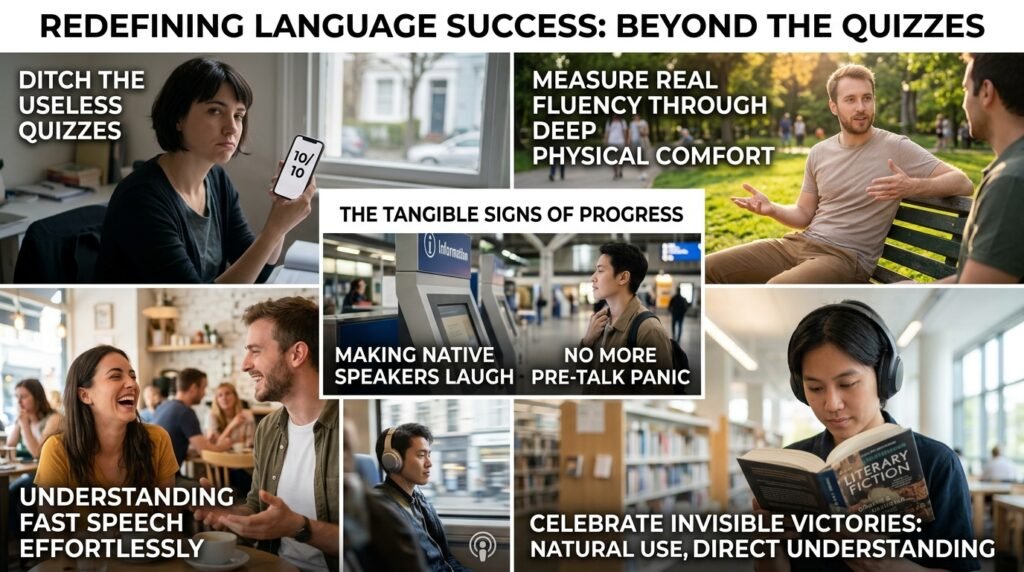
When you take online quizzes, your success is a concrete score out of ten. It is a very objective metric. It is also a completely useless metric for real life.
When you change your approach to natural acquisition, your daily progress becomes much harder to measure. You will not get a daily score on your phone. You will have to look for completely different signs of improvement.
I started tracking my progress purely through my physical comfort level.
I noticed when my hands stopped sweating before a conversation. I noticed when I could listen to a fast podcast for ten minutes without my mind wandering. I noticed when I made a subtle joke and the native speaker actually laughed out loud.
These are the real, tangible metrics of language success. True fluency is a feeling of deep comfort in the language. It is the ability to navigate a chaotic conversation without a sense of panic.
You need to celebrate the small, invisible victories. Celebrate the very first time you use a complex new tense correctly without thinking about it. Celebrate the first time you understand a long sentence in a novel without translating a single word in your head.
The Final Takeaway
Improving your grammar does not require more rigid discipline. It does not require longer, more painful study hours. It certainly does not require a higher level of intelligence.
It simply requires a fundamental shift in your daily perspective.
Stop treating the language like an academic subject you have to defeat. Stop trying to pass an invisible test. Treat the language like a simple tool for human connection. Treat it like a living, breathing organism.
Read compelling stories you actually enjoy. Listen to engaging podcasts that make you laugh out loud. Talk to real people about topics you actually care about. Write down your honest, unfiltered thoughts in a daily journal.
Let the grammar work silently in the background of your mind. Trust your brain’s natural, biological ability to find patterns. Surround yourself completely with the language and let the rules reveal themselves to you naturally over time.
Put away the heavy workbooks today. Delete the multiple choice quiz apps off your phone entirely. Go find a genuinely good book, get comfortable on the couch, and just start reading. Your grammar will improve exactly when you finally stop worrying about it.

Gabriel Henrique is a language enthusiast and productivity writer. After testing countless study methods, he became obsessed with mastering new languages efficiently. He achieves this without burnout, without endless grammar drills, and without losing focus. At Blog The Curious, he shares everything he has learned along the way.