
I sat in my quiet home office. I tapped the play button on my smartphone screen. The audio started playing. My stomach instantly dropped.
The voice coming out of the tiny speaker was horrible. It was high pitched. It sounded thin and weak. The foreign pronunciation was incredibly clunky. The rhythm was entirely broken. I sounded absolutely nothing like the intelligent, confident adult I believed myself to be. I sounded like a confused child stumbling through a dark room.
I immediately hit the stop button. I deleted the audio file. I wanted to throw my phone across the room. I felt a massive wave of intense embarrassment wash over me.
This physical cringe is a universal human experience. Nobody likes hearing their own voice on a recording. But when you are learning a foreign language, this natural hatred becomes a massive barrier. If you refuse to listen to your own mistakes, you can never fix them. You remain completely blind to your actual spoken level.
I knew I had to conquer this extreme discomfort. I had to face the brutal reality of my own audio. I completely changed my relationship with the voice recorder app. I turned it from an instrument of torture into my most valuable daily tool. Here is exactly how I got comfortable hearing my own voice.
The Biological Illusion of Sound
You have to understand exactly why you hate your recorded voice. It is not just a psychological issue. It is a strict biological reality.
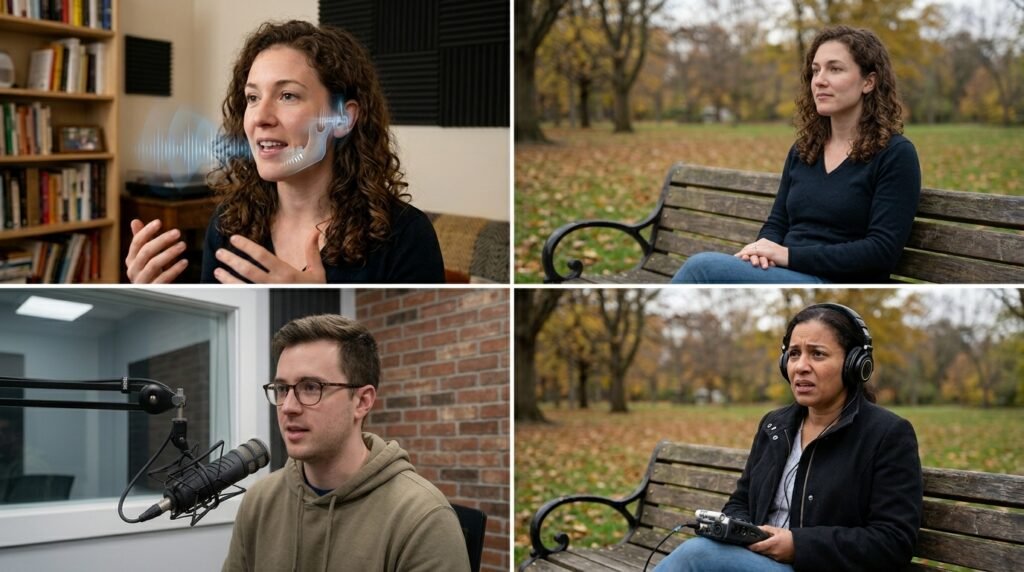
When you speak out loud, you do not just hear the sound traveling through the air. You also hear the sound vibrating directly through the dense bones of your skull. This bone conduction acts like a heavy bass filter. It makes your voice sound significantly deeper, richer, and more resonant inside your own head.
You spend your entire life listening to this rich, fake version of your voice.
When you listen to a digital recording, the bone conduction is completely gone. You hear exactly what the rest of the world hears. The voice sounds entirely alien. It lacks the heavy bass. It sounds thin and reedy. Your brain immediately rejects it. Your brain tells you that the recording is wrong.
You have to accept that the recording is correct. The microphone does not lie. The microphone is completely objective. You must kill the fake version of your voice in your head and make peace with the raw, objective data.
Creating the Private Laboratory
You cannot build audio confidence in public. If you are terrified of your own voice, trying to record yourself during a live conversation with a native speaker will completely paralyze you.
I moved my entire speaking practice behind a locked door. I needed absolute privacy. I needed a completely safe space to sound terrible.
Every morning, I brew a fresh cup of Ethiopian Guji coffee. I weigh the beans perfectly. I monitor the exact water temperature. I decided to use this quiet, focused morning routine as my audio laboratory. I closed the door to the kitchen. I made sure absolutely nobody was awake to hear me.
This total isolation removes the heavy fear of social judgment. I explain the exact mechanics of setting up this safe space in The Way I Practice Speaking When I’m Alone to ensure you can practice without any external pressure. You need a room where mistakes carry zero consequences.
The One Minute Daily Log
I did not start by recording long, complicated speeches. That is too much pressure. I kept the barrier to entry extremely low.
I opened the voice memo app on my phone. I hit record. I forced myself to speak for exactly one single minute.
I talked about completely mundane things. I talked about my work schedule for the day. I manage several digital blogs, so I described the articles I needed to write. I analyze NBA playoff statistics, so I talked about the specific point guard I was tracking for first-action metrics.
I did not write a script. I just forced the raw sentences out of my mouth. When the timer hit sixty seconds, I hit stop.
One minute is incredibly short. Anyone can survive one minute of awkward speaking. But one minute every single day builds a massive library of objective data over a month.
The Twenty Four Hour Delay Rule
The biggest mistake you can make is listening to the recording immediately after you speak.
If you listen immediately, your ego is still highly active. You remember exactly what you were trying to say. When the audio does not match your perfect internal thought, you get angry. You make excuses. You naturally defend your mistakes.
I created a strict twenty four hour delay rule.
I recorded a one minute log on Monday morning. I did not listen to it. I closed the app. On Tuesday morning, before I recorded my new log, I listened to Monday’s audio.
This simple time delay changes everything. After twenty four hours, your emotional connection to the audio completely vanishes. You forget the specific context. The voice on the recording no longer feels like you. It sounds like a total stranger.
When you listen to a stranger, your ego does not try to defend them. You become highly objective. You listen to the audio exactly like a cold, analytical scientist reviewing raw data.
Treating Audio Like Visual Data
I possess a deep interest in digital photography. I spend hours editing studio portraits. I zoom in heavily on the specific facial geometry. I use editing software to manipulate the lighting and recreate vintage aesthetics like the old Canon IXUS cameras.
When I edit a photo, I do not get emotional about a stray shadow or a bad pixel. I just fix it. The photo is just raw data.
I realized I needed to treat my recorded voice exactly like a digital photograph.
When I listened to my delayed audio log, I removed all emotion. I stopped judging my intelligence. I just listened for the bad pixels. I heard a swallowed consonant. I heard a lazy, sliding vowel. I heard a heavy pause where my grammar completely failed.
This clinical detachment completely cures the cringe. You stop feeling embarrassed. You start feeling highly curious. You start hunting for the mechanical flaws so you can fix them. I outline how this detachment speeds up your actual conversational speed in The Method That Helped Me Speak Without Overthinking because removing your ego completely clears your mental highway.
The Manual Transcription Process
Listening objectively is only the first step. You must force your brain to process the exact mistakes you are making.
I started transcribing my own terrible recordings.
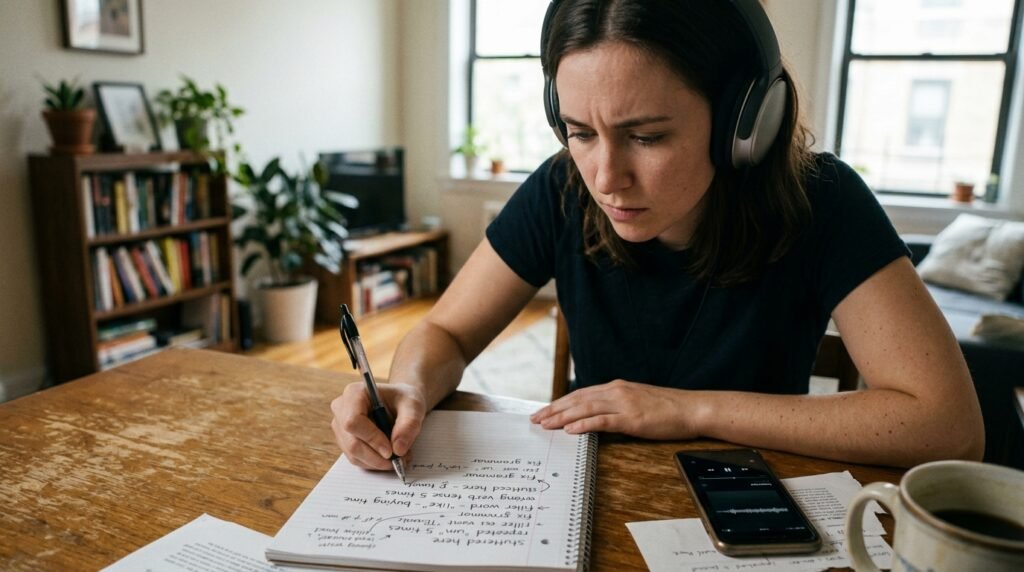
I sat at my desk with a piece of blank paper and a pen. I played my one minute audio log. I forced myself to physically write down every single word I said.
This is an incredibly painful exercise. You realize very quickly that your spoken grammar is much worse than your written grammar. You write down the exact moments where you stuttered. You write down the completely broken verb conjugations. You document the exact heavy filler words you used to buy time.
Writing the mistakes down on paper makes them concrete. They are no longer floating abstract noises in the air. They are physical targets written in black ink. You can look directly at the target and devise a plan to destroy it.
Targeting the Specific Weakness
Once I had my physical transcript, I highlighted the single worst mistake. I did not try to fix ten things at once. I picked one specific failure.
If I noticed I was constantly mispronouncing a specific vowel sound, that vowel became my sole focus for the entire next day.
I stood in front of my bathroom mirror. I watched my mouth closely. I practiced opening my jaw wider. I locked my lips into the correct shape. I repeated the correct vowel sound fifty times out loud. I forced my lazy facial muscles to build brand new physical habits.
You can find the exact mechanical adjustments you need to make in The Small Changes That Improved My Accent to ensure your mouth is actually moving correctly.
The next morning, I recorded my new one minute log. I paid absolute, strict attention to that specific vowel sound. When I listened to the playback twenty four hours later, I heard the slight improvement.
The Addictive Power of Measurable Progress
Hearing your own improvement completely destroys the fear of the recording.
When you hear your accent sound slightly sharper than it did last week, the cringe vanishes. It is replaced by intense motivation. You realize that your voice is not permanently fixed. You realize you have total control over the physical noises coming out of your mouth.
I started saving my audio logs in organized folders. At the end of the month, I played my very first recording from week one. Then I immediately played my newest recording from week four.
The contrast was absolutely massive. The week one audio sounded hesitant, muddy, and terrified. The week four audio sounded deliberate, clear, and grounded.
You cannot get this specific feeling of progress from a textbook. You cannot get it from a grammar quiz. You can only get it by facing the raw tape. The tape provides undeniable, concrete proof of your hard work.
Shadowing the Native Standard
Once I became comfortable hearing my own voice, I started comparing it directly to native speakers.
I downloaded short audio clips of native professionals telling stories. I put my heavy noise canceling headphones on. I listened to one sentence of the native audio. I paused the track. I hit record on my phone. I repeated the sentence exactly as I heard it.
Then I played both tracks back to back.
This is the ultimate test of auditory honesty. You hear the perfect, flowing native melody. Then you immediately hear your own blocky, stiff imitation.
I listened closely to the gaps. I noticed how the native speaker connected two specific words together smoothly. I noticed how I paused awkwardly between those exact same two words. I re-recorded my sentence. I forced my mouth to glide over the words exactly like the native speaker. I repeated this process until my audio track closely mirrored the rhythm of the native track.
Exposing the Fake Accent
The voice recorder is also the best tool for killing a fake accent.
Many beginners try to sound authentic by adding a dramatic, theatrical flair to their voice. They roll their consonants way too hard. They add strange inflections. They think they sound like a local.
When you listen to the playback, you instantly realize how ridiculous you sound. You hear the fake acting. It sounds like a terrible cartoon character.
The recording forces you to drop the theatrical performance. It forces you to return to a neutral, clear, and grounded tone. True authenticity comes from perfect mechanical execution, not dramatic acting. The tape strips away your bad acting immediately.
Normalizing the Sound of Your Voice
Repetition completely kills fear.
The first time you record yourself, you will hate it. The tenth time, you will dislike it. The hundredth time, you will feel completely bored.
Boredom is the ultimate goal. You want the sound of your own foreign voice to become so incredibly normal that it no longer triggers any emotional response in your brain.
When your voice becomes normal to you, a massive weight lifts off your shoulders. You stop self correcting constantly. You stop apologizing for your accent. You stop fearing the silence during a real conversation.
You simply accept your voice as the physical tool you use to communicate. It is not a reflection of your soul. It is not a test of your intelligence. It is just a mechanical noise you make to connect with another human being.
Stepping Into the Real World
After three solid months of daily recording, I finally went back to a local language exchange meetup.
I walked into the loud, crowded room. A native speaker approached me. He asked me a question.
I opened my mouth and spoke. I did not freeze. I did not panic. I heard my own voice echoing in the loud room, and I did not cringe.
I was completely comfortable with the noise coming out of my throat. I knew exactly what I sounded like. I knew my specific weaknesses, and I knew my specific strengths. There were absolutely no surprises.
The conversation flowed naturally. The native speaker responded. We talked for an hour. Because I was completely comfortable with my own voice, the native speaker felt completely comfortable listening to me. Confidence is highly contagious.

The Microphone is Waiting
You cannot skip this step. You cannot talk your way around it. You cannot read enough books to bypass it.
If you want to achieve true spoken fluency, you must learn to tolerate the sound of your own mistakes. You must harden your skin. You must become a cold, objective analyst of your own facial muscles.
Take your smartphone out right now. Open the voice memo application. Press the red record button. Talk for exactly sixty seconds about your plans for tomorrow. Press stop.
Do not listen to it today. Put the phone away. Tomorrow morning, listen to the tape. Write down your worst mistake. Fix it. Record yourself again.
Repeat this boring, uncomfortable process every single day. The heavy cringe will eventually fade entirely. It will be replaced by the sharp, clear, undeniable sound of your own real progress.
Gabriel Henrique is a language enthusiast and productivity writer. After testing countless study methods, he became obsessed with mastering new languages efficiently. He achieves this without burnout, without endless grammar drills, and without losing focus. At Blog The Curious, he shares everything he has learned along the way.