
I sat in a loud coffee shop staring blankly at the person sitting across from me. A native speaker had just asked me a very simple question about my weekend. I knew the answer. I possessed the exact vocabulary words. But my brain immediately pulled out a massive mental whiteboard.
I started writing the sentence in my head. I checked the verb tense. I checked the noun gender. I verified the prepositions to make sure they were perfectly accurate. Five seconds passed in total silence. By the time I finally opened my mouth to deliver my flawless sentence, the conversation had completely moved on. The native speaker looked confused. I felt entirely stupid.
This was my daily reality. I was trapped in a heavy cycle of severe overthinking. I treated every spoken sentence like a strict university exam. I wanted to sound highly intelligent. I wanted to prove my academic knowledge. This massive ego completely destroyed my ability to communicate naturally.
You cannot calculate a language in real time. The human brain is simply not fast enough to assemble complex grammar rules during a rapid, unscripted face to face conversation. You must bypass the analytical brain entirely. You have to turn speaking into a raw physical reflex. I threw away my heavy textbooks. I built a brand new behavioral system. Here is the exact method I used to completely stop overthinking and finally speak freely.
The Curse of the Mental Whiteboard
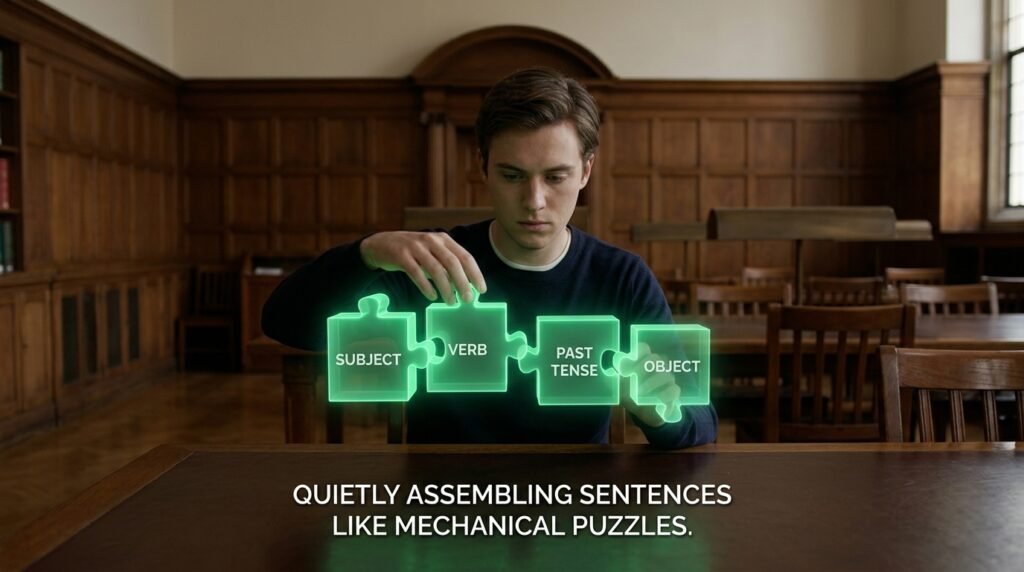
When you study grammar rules quietly at a wooden desk, you build a very dangerous mental habit. You learn to assemble sentences exactly like mechanical puzzles. You take a subject. You find an action verb. You calculate the exact time of the action to find the right conjugation. You glue the pieces together carefully.
This mechanical process works perfectly for writing. I write long, detailed articles for several digital blogs. I manage content networks. I have plenty of time to edit my words on a screen. I can erase a bad sentence and rewrite it three times before anyone sees it. The mental whiteboard is a fantastic tool for written content.
The mental whiteboard is completely fatal for spoken communication.
A live conversation moves at roughly one hundred and fifty words per minute. You absolutely cannot run a complex mathematical equation for every single word. If you try to calculate the grammar live, you will freeze. You will stutter. You will panic. Your brain will overload and shut down completely.
I had to actively destroy the mental whiteboard. I had to train myself to speak long before I was fully ready. I had to learn how to jump out of the airplane without checking my parachute three different times.
The Power of Prefabricated Blocks
You overthink because you are trying to build every single sentence from absolute scratch.
Imagine trying to build a brick house by molding every single brick out of wet clay right on the construction site. It would take years. Smart builders do not make the bricks on site. They buy prefabricated walls. They just lift the heavy walls into place.
You must do the exact same thing with your spoken language. I stopped learning individual vocabulary words. I stopped trying to glue them together with raw grammar rules. I realized that How I Learned Phrases Instead of Isolated Words completely changed my speed.
I started collecting massive blocks of language. I memorized entire sentences as single units of continuous sound.
I learned exactly how to say “I have no idea what you are talking about right now.” I did not analyze the sentence. I did not care about the specific verb conjugations buried inside it. I just treated that entire block of words as one giant vocabulary item.
When a native speaker confused me, I did not have to think. I did not have to calculate a grammatical response. I just deployed the prefabricated block instantly. The words fired out of my mouth automatically on pure reflex. I bought myself five seconds of breathing room without doing any heavy mental lifting.
The Sixty Second Sprint Protocol
To stop overthinking forever, you must force your brain to move significantly faster than its own internal critic.
Your internal critic is the quiet voice in your head that constantly searches for mistakes. It is the voice that tells you to stop and correct your pronunciation. You must outrun this voice.
I developed a strict daily physical exercise. I called it the sixty second sprint.
I stood in my home office. I picked a highly familiar topic. I spend hours analyzing NBA playoff statistics and tracking player prop betting markets. I decided to talk about a specific point guard.
I set a digital timer on my phone for exactly one minute. I hit the start button.
I forced myself to talk out loud about the basketball statistics at absolute maximum speed. I spoke as fast as humanly possible. I completely ignored my grammar. I ignored my sloppy pronunciation. I ignored the logical structure of my argument. The only acceptable metric for success was continuous, rapid physical noise.
If I forgot a vital word, I was absolutely not allowed to pause. I had to talk rapidly around the missing word using much simpler vocabulary.
This intense drill forces your brain into a state of sheer panic. It completely short circuits the internal critic. The analytical brain simply cannot keep up with the physical speed of your mouth. After doing five sprints in a row, my brain finally surrendered. It stopped trying to control the grammar. It just let the words flow out purely on reflex.
Embracing the Ugly Sentence
Overthinking is heavily driven by your own perfectionism. You want to sound like a native poet. You want to use beautiful, complex adjectives. You want to use advanced conditional clauses to show off your knowledge.
This perfectionism is a heavy steel chain around your neck.
I decided to completely lower my daily standards. I created the ugly sentence rule.
When I felt my brain starting to freeze during a live conversation, I immediately abandoned my complex thought. I stripped the idea down to its absolute bare bones. I used the ugliest, simplest grammar possible.
Instead of trying to say, “I would have attended the meeting if I had known the schedule earlier,” I threw the entire sentence away. I said, “I did not know the time. I did not go.”
It sounds exactly like a caveman. It is not elegant. But it is highly effective. The communication survives perfectly. The other person understands exactly what you mean immediately.
When you give yourself total permission to speak in ugly sentences, the heavy pressure vanishes. You stop overthinking because you no longer care about being perfectly correct. You only care about keeping the conversation alive.
Anchoring to Physical Reality
Language usually lives in the abstract parts of your brain. Abstract thoughts are very easy to overthink. You get lost in the endless possibilities of sentence structure.
You have to pull the language out of the abstract clouds and anchor it firmly to physical reality.
I started doing this with my morning routine. I am deeply obsessed with specialty coffee. I use a specific V60 pour over method. I measure Ethiopian heirloom beans on a digital scale. I monitor the exact temperature of the water with a gooseneck kettle.
While I executed this precise physical routine, I narrated my actions out loud in my target language. I described the heat of the water. I described the smell of the roasted beans. I named the exact physical objects I was touching.
This completely grounds your mind. You cannot overthink a paper coffee filter. It is right there in your physical hand. You attach the foreign word directly to the physical object. You completely bypass the English translation process.
When you link language to physical actions, speaking becomes exactly like driving a car. You do not overthink how to turn the steering wheel. Your hands just do it. Your mouth must learn to do the exact same thing. Building this specific physical connection is exactly The Habit That Made Speaking Feel Easier for me every single day.

The Distraction Technique
Sometimes you cannot outrun your own brain. Your analytical mind will constantly try to take over the conversation and ruin your rhythm.
I learned to use a physical distraction technique to break this mental loop.
When I sat across from a native speaker and felt my brain starting to calculate grammar rules heavily, I gave my body a secondary physical task.
I held a small metal coin in my pocket. I rolled the coin aggressively across my fingers. I focused a massive amount of mental energy on the physical sensation of the cold metal.
This sounds completely bizarre, but it works flawlessly. The human brain has a strictly limited amount of processing power. By forcing my brain to focus heavily on the physical coin, I stole energy away from the internal grammar critic.
The critic did not have enough remaining power to overanalyze my sentences. My mouth was left alone to execute the language on pure reflex.
You can use any physical distraction. You can tap your foot to a specific rhythm. You can press your thumb hard against your index finger. You just need a physical anchor to pull your brain out of the abstract grammar clouds and back down to the solid ground.
Shifting the Conversational Burden
You overthink because you feel entirely responsible for the success of the conversation. You feel like you are standing on a stage giving a solo performance to a harsh audience.
You must learn to aggressively shift the burden back to the other person.
Conversations are a shared game. You do not have to hold the ball the entire time.
I started memorizing universal, open ended questions. When I felt myself starting to panic and overthink my next sentence, I completely abandoned my thought. I immediately threw a question directly at the native speaker.
I asked, “What is your exact opinion on this?” I asked, “Have you ever experienced anything like that?”
People absolutely love talking about themselves. When you ask a good question, the native speaker will gladly take over. They will speak continuously for three solid minutes.
This gives your brain a massive vacation. You get to step out of the heavy spotlight. You can take a deep breath. You can listen passively. You completely break the cycle of panic. You regain control of your heart rate. By the time they finish speaking, you are calm, grounded, and ready to reply naturally.
The Brutality of the Voice Recorder
A massive part of overthinking comes from an intense fear of sounding stupid. You are terrified of making a clumsy mistake in public.
You have to confront this exact fear in absolute private. You have to actively destroy the fear of your own mistakes.
I started using the digital voice recorder on my smartphone. Every single night, I sat at my desk and recorded myself speaking for two continuous minutes. I picked a random topic. I forced the raw, unedited sentences out of my mouth.
Then, I hit stop. I forced myself to listen to the playback immediately.
The first few weeks were absolute psychological torture. My voice sounded thin and weak. My grammar was full of terrible errors. I cringed heavily at my own hesitation.
But this daily exposure therapy cured my fear entirely.
I realized that my mistakes were not fatal. The sky did not fall. I sounded clumsy, but I was still communicating successfully. The objective data from the recorder stripped away my massive ego. It proved that my worst case scenario was actually completely survivable.
Once I became totally comfortable listening to my own terrible mistakes in private, I completely stopped fearing them in public. I stopped overthinking my sentences because the fear of failure no longer controlled my brain.
Letting Go of the English Blueprint
The ultimate form of overthinking is internal translation.
You build a perfect, highly sophisticated blueprint of a sentence in English. Then you try to perfectly translate that complex blueprint into the foreign language.
This is an impossible task. The languages do not map together perfectly. The idioms are different. The word order is completely different. The cultural context does not match.
You must completely throw away the English blueprint.
I stopped trying to translate my deep thoughts. I forced myself to start with the foreign words I actually possessed. I looked at the tiny pile of foreign vocabulary in my brain. I asked myself exactly what I could build with those specific pieces.
I stopped trying to build a massive mansion. I just built a simple wooden cabin.
I realized How I Learned Faster Once I Stopped Overcomplicating Everything was by completely abandoning my native language during practice.
I accepted the severe limitations of my new vocabulary. I worked entirely within those strict boundaries.
When you stop trying to force English concepts into foreign molds, the heavy mental friction disappears. You start thinking directly in the simple, raw shapes of the new language.

The Ultimate Goal is Connection
You have to constantly remind yourself exactly why you are learning this language.
You are not trying to pass a strict university exam. You are not trying to write a perfect legal document. You are just trying to connect with another human being.
The native speaker sitting across from you does not care about your perfect verb conjugations. They do not care if you use the wrong gender for a specific noun. They are not grading your performance on a clipboard.
They just want to understand your story. They want to know what makes you laugh. They want to know your raw opinions.
Overthinking builds a massive, invisible wall between you and the other person. It makes you sound robotic. It makes you sound distant and completely cold.
When you finally let go of the grammar rules, the wall completely collapses. Your mistakes actually make you more human. Your clumsy sentences make you highly approachable. Your vulnerability builds instant, deep trust with the native speaker.
Stop preparing your sentences in advance. Stop calculating the perfect grammatical response. Walk into the loud coffee shop, look the person directly in the eye, and just open your mouth. Trust your physical reflexes entirely. Let the messy, broken, beautiful words fall out. The conversation will survive, and you will finally experience true, effortless fluency.

Gabriel Henrique is a language enthusiast and productivity writer. After testing countless study methods, he became obsessed with mastering new languages efficiently. He achieves this without burnout, without endless grammar drills, and without losing focus. At Blog The Curious, he shares everything he has learned along the way.