
I evaluate digital software for a living. I manage a network of specialized publishing websites. I constantly audit content management systems, analytics dashboards, and server hosting platforms. I know exactly how developers build software to trap your attention. When I decided to learn a foreign language, I approached the mobile application market with extreme suspicion.
The app stores are completely flooded with language learning tools. They all make the exact same massive promises. They all claim you will be fluent in three weeks. They all feature bright colors and aggressive marketing campaigns.
I downloaded dozens of them. I tested them rigorously. I deleted almost all of them.
Ninety percent of the language applications on the market are completely useless. They are built for entertainment, not for education. They are designed to sell subscription renewals. If you choose the wrong tool, you will waste hundreds of hours of your valuable time. I built a ruthless, mechanical filter to evaluate new software. I refuse to install anything on my smartphone unless it passes this strict set of tests. Here is exactly what I look for before choosing a language app.
The Gamification Penalty
The very first thing I look at is the user interface. I look for the presence of digital slot machine mechanics.
Does the application use bright, flashing gems? Does it have a cartoon mascot that cries when you miss a day? Does it place you on a competitive leaderboard against random strangers?
If the answer is yes, I delete the application immediately.
Gamification is a toxic distraction. Developers use psychological engineering to keep you addicted to the interface. They want you to care more about maintaining a meaningless digital streak than actually learning the language. I am an adult professional. I do not need a cartoon owl to validate my daily efforts. I need a tool that respects my time. I strongly favor brutal, minimalist interfaces. The software should present the data cleanly and get out of my way completely.

The Custom Data Requirement
This is the absolute most important feature of any language tool. I must have the ability to input my own raw data.
Most popular applications force you onto a rigid, prepackaged curriculum. They force you to learn how to order an apple or how to ask for directions to the swimming pool. I have absolutely zero interest in this generic vocabulary.
I run complex statistical models for professional basketball games. I track first action NBA playoff statistics. I calculate point spreads and rebounding probabilities. I also study digital photography. I analyze the retro aesthetic of 35mm film lenses and Canon IXUS flashes.
I need to learn the foreign vocabulary for these highly specific passions. If an application does not allow me to build my own custom flashcards, it is entirely useless to me. I need an empty database. I want to source my wild data from the real world and feed it directly into the machine. If the software locks me into their boring default lists, it completely fails my test.
The Multiple Choice Ban
I actively hunt for the specific testing mechanics the application uses. I despise multiple choice questions.
Multiple choice is a dangerous illusion. When you see four possible answers on a screen, your brain uses passive recognition. You do not actually remember the word. You just recognize the correct shape of the letters. It requires almost zero mental effort.
In a real human conversation, nobody gives you a list of four options. You have to generate the word from absolute scratch.
I only choose applications that demand active recall. The software must show me a blank screen. It must force me to physically type the answer out on my keyboard. It must force me to speak the answer out loud before it reveals the solution. Active recall burns massive amounts of mental glucose. It is highly uncomfortable. That discomfort proves the tool is actually forcing your brain to grow.
The Transparent Algorithm
I am a data analyst. I trust cold mathematics. I do not trust hidden, proprietary algorithms.
When I evaluate a vocabulary tool, I look strictly for Spaced Repetition System mechanics. The software must track my memory retention curve. It must show me a difficult word frequently. It must hide an easy word for months.
More importantly, the software must allow me to see and manipulate the underlying math. I want to adjust the intervals. If the application hides its scheduling algorithm behind a friendly “magic review” button, I reject it. I need to know exactly why the software is showing me a specific word on a specific day. Transparency is absolutely mandatory for long term trust. I detailed the exact mathematical settings I use in The App Features That Actually Made a Difference to ensure the software serves my specific memory speed.
Real Native Audio Fidelity
Most applications use robotic text to speech technology. It is incredibly cheap for the developers to produce. It is also completely devastating to your physical pronunciation.
Robotic audio lacks the natural human melody. It pronounces every single consonant with brutal, unnatural sharpness. It does not teach you how to blend words together. If you mimic a robot, you will sound exactly like a robot.
I carefully audit the audio quality before committing to an app. The software must feature high quality recordings of real, living native speakers. I need to hear the subtle local hesitation sounds. I need to hear the natural slurring of the vowels. If the application uses computer generated voices, I immediately uninstall it. Your ears deserve authentic data.
The Exportability Clause
I manage websites. I understand the danger of a walled garden.
Many software companies want to lock your data inside their specific ecosystem. They want to hold your progress hostage so you never cancel your subscription.
I refuse to invest hundreds of hours building a custom vocabulary deck if I cannot easily export it. I look for a simple export button. Can I download my data as a raw CSV text file? Can I move my flashcards to a completely different software platform if this company goes bankrupt tomorrow?
If the application traps my data, it fails the test. You must maintain total ownership of your personal learning database.

Integration with Mobile Automation
I rely heavily on mobile task automation. I use iOS Shortcuts to manage my busy daily schedule. My language application must play nicely with these automated scripts.
I wake up every morning and brew Ethiopian Sidamo coffee. I use a strict V60 pour over method. I use a gooseneck kettle. I want my language app to open automatically the exact moment I place my coffee cup on the desk.
I check if the app supports deep linking. I check if it integrates with my phone’s shortcut system. I want to build a seamless environment where the software launches itself exactly when I need it. If the app requires ten different manual taps just to reach the study screen, it creates too much daily friction. I heavily explain this exact setup process in How I Avoid Wasting Time With Ineffective Apps to show you how to bypass bad user interfaces entirely.
The Contextual Sentence Capability
I never learn isolated vocabulary words. Isolated words are fragile and completely useless. I only learn full sentences.
I check the text formatting limits of the application. Does the software restrict me to short, single word inputs? Can I paste a long, complex paragraph into the flashcard? Can I highlight a specific verb inside that paragraph?
I need a tool that allows me to learn words strictly within their natural context. I want to see the prepositions. I want to see the exact grammatical structure surrounding the target word. A good application must handle heavy text inputs without crashing or ruining the visual layout on my small screen.
True Offline Functionality
I travel frequently. I often study in coffee shops with terrible internet connections.
Many modern applications are entirely cloud based. They require a constant, high speed data connection to load the next question. If you lose your signal, the application completely freezes.
This is a massive design flaw. Your study routine should never rely on the strength of a local cell tower.
I strictly require true offline functionality. I must be able to download my entire database directly to my local hard drive. I must be able to complete a full thirty minute study session while my phone is completely disconnected from the internet. Offline capability also allows me to use strict airplane mode, which blocks all incoming email distractions.
The Pricing Model
I am willing to pay for high quality software. Good developers deserve to be compensated for their hard work. But I violently reject predatory pricing models.
I hate monthly subscriptions. Subscriptions create an endless financial bleed. They pressure you to use the app constantly just to justify the recurring cost.
I actively hunt for applications that offer a single, one time purchase price. I want to buy the tool exactly like I buy a physical hammer. I pay for it once, I own it forever, and I use it whenever I need it. If an app hides its core features behind a massive monthly paywall, I immediately look for an open source alternative.
The Visual Anchor Support
I am highly visual. I do not want to translate foreign words into English. I want to link the foreign word directly to a physical object.
I need an application that supports heavy image integration. I want to take a high resolution macro photograph of my 35mm camera lens. I want to attach that image directly to the flashcard. When I see the foreign word, I want to look at the glass and metal, completely bypassing my native English.
The software must handle image uploads quickly and cleanly. It should not compress the images into blurry, unrecognizable pixels. Visual anchoring is crucial for thinking directly in the target language.
Absence of Social Features
Language learning is a highly personal, deeply solitary pursuit during the early stages. I do not need social networking features inside my study tools.
I do not want to see a news feed of what other students are studying. I do not want a built in chat room. I do not want the ability to leave comments on digital flashcards.
Social features are just another form of digital distraction. They give you the illusion of studying while you are actually just wasting time chatting with strangers. I look for applications that offer a completely solitary, isolated environment. I only interact with real people when I step outside into the real world.
The Diagnostic Capability
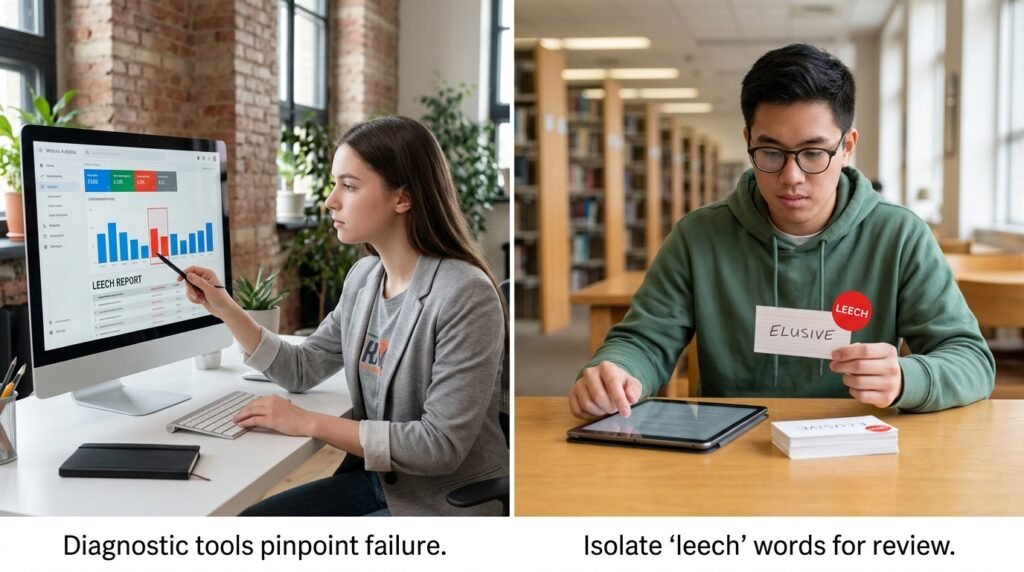
A good tool should tell you exactly where you are failing.
I analyze website traffic data daily. I need to know which articles perform well and which articles fail. I apply this exact logic to my vocabulary.
I look for applications that provide raw diagnostic statistics. I want to see a list of my “leech” words. A leech is a word that I constantly forget, no matter how many times I review it. The software should automatically identify these leeches and isolate them for me. This allows me to completely rethink my approach to that specific word. I can change the image. I can write a new context sentence. Without diagnostic data, you will repeat the exact same mistakes for years.
The Clear Exit Strategy
The final and most critical test is the exit strategy.
A great language application knows that it is a temporary tool. It should not try to trap you forever. It should exist purely to prepare you for the chaotic real world.
I used the strict principles found in I Tried Several Language Apps — Here’s What Actually Helped Me to define my exact graduation date.
I ask myself a simple question before I download any software. What is the ultimate goal of using this specific tool? If the goal is just to finish all the digital levels, the tool is a toy. If the goal is to master the top two thousand words so I can finally read a physical newspaper, the tool is a weapon.
I only install weapons on my phone.
I look for tools that do one specific job flawlessly. I use a dedicated SRS flashcard app for vocabulary. I use a dedicated podcast player for native audio. I do not trust “all in one” platforms that try to teach grammar, speaking, and reading simultaneously. They do everything poorly.
Audit your digital home screen today. Delete the flashing games. Delete the cartoon mascots. Find the cold, raw, highly efficient tools that allow you to upload your own passions. Demand transparency. Demand offline access. When you finally stop playing mobile games and start treating your software like serious heavy machinery, your real world fluency will accelerate with terrifying speed.

Gabriel Henrique is a language enthusiast and productivity writer. After testing countless study methods, he became obsessed with mastering new languages efficiently. He achieves this without burnout, without endless grammar drills, and without losing focus. At Blog The Curious, he shares everything he has learned along the way.