
I stared at the glowing screen of my smartphone. The application flashed a bright green animation. A cheerful digital sound effect played through the speaker. The screen proudly announced that my daily learning streak had just hit two hundred consecutive days. I felt a massive surge of accomplishment. I locked the phone and put it in my pocket. I felt completely prepared to conquer the world.
Later that exact same afternoon, I tried to watch a post game interview with a professional basketball player. The interview was conducted entirely in my target language.
The player spoke rapidly. The sports reporter fired back rapid questions. The words blurred together into a muddy, chaotic stream of noise. My brain panicked. I recognized absolutely nothing. The massive vocabulary I had carefully built inside my phone completely vanished. My two hundred days of perfect digital consistency meant absolutely zero in the real world.
I experienced a brutal reality check. I had spent six months staring at a screen every single day, but I could not understand a basic sports interview. I sat down at my desk and analyzed my entire routine. I realized I was not actually learning a language. I was playing a highly addictive mobile game. I had made one critical, devastating mistake from the very beginning. I treated the application as the final destination instead of a temporary vehicle. Here is exactly how I diagnosed my massive failure and completely rebuilt my study system.
The Illusion of Gamification
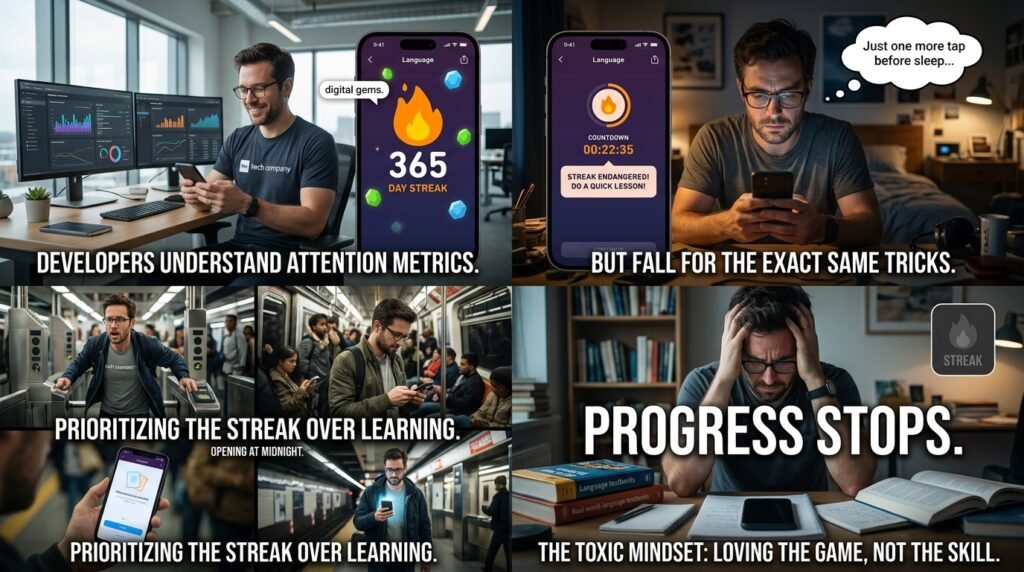
Software developers are absolute masters of psychological engineering. They know exactly how to keep your eyes glued to the screen.
They use gamification to hijack your attention. They build leaderboards. They award you digital gems for completing simple lessons. They send you aggressive push notifications if you are about to lose your daily streak.
I manage a complex network of digital publishing websites. I track user retention metrics for a living. I know exactly how these systems are built to manipulate human behavior. Yet, I fell for the exact same tricks. I started prioritizing my digital streak over actual fluency. I found myself opening the application at midnight just to tap a few buttons and satisfy the algorithm before I went to sleep.
I did not care about learning new vocabulary. I only cared about keeping the digital fire icon lit on my home screen. This is a toxic mindset. When you care more about the game than the skill, your progress completely stops. You optimize for the lowest possible effort just to maintain the streak.
The Multiple Choice Mirage
The core mechanic of most popular language applications is the multiple choice question.
The screen shows you a picture of a house. It asks you to select the correct foreign word from a list of four options. You tap the correct option. The app tells you that you are brilliant.
This creates a massive illusion of competence. When you see four possible answers on a screen, your brain takes the path of absolute least resistance. You do not actually recall the word from your deep memory. You simply recognize the correct shape of the letters. You use the process of elimination.
Passive recognition is completely useless in the real world. In a live human conversation, nobody provides a drop down menu of four possible verbs. You have to pull the exact word out of thin air. You must generate the language from absolute scratch. Multiple choice questions train your brain to be a lazy test taker. They completely fail to train your brain to be an active speaker.
Starving for Relevant Context
Default application curriculums are designed for the masses. They teach generic vocabulary. They teach you how to say the cat drinks milk. They teach you how to ask for directions to a public library.
I do not care about generic cats. I do not care about public libraries. My brain actively deletes information that it deems irrelevant to my daily survival.
I am deeply passionate about specialty coffee. I use a strict V60 pour over method every morning. I weigh Ethiopian Sidamo beans perfectly on a digital scale. I monitor the water flow with a precise gooseneck kettle. I am also obsessed with professional basketball. I analyze first action NBA playoff statistics. I calculate point spreads and rebounding probabilities.
I needed to know how to express these specific, highly technical passions. The application completely failed me. It locked me inside a child’s vocabulary list. I realized that building a personalized database was exactly The Vocabulary System That Finally Worked for Me when I decided to dump the default lists completely.
When you do not control the vocabulary, the software controls you. You must source your own wild data from the real world. You must feed the machine the words you actually want to speak.
The Artificial Audio Trap
Language applications feature pristine audio recordings. A professional voice actor reads a sentence perfectly in a completely silent studio. Every single consonant is sharp. Every single vowel is perfectly rounded.
Real human beings never speak like voice actors.
Real people mumble. They slur their words together. They speak incredibly fast. They use local hesitation sounds. They overlap their sentences.
Because I exclusively used the application for my listening practice, my ears became incredibly lazy. I was perfectly trained to understand a slow, robotic voice. I was completely deaf to the messy reality of native speech.
I had to completely abandon the artificial audio. I started listening to unscripted, highly conversational podcasts recorded by native speakers. The speed was terrifying at first. My brain completely crashed. But I forced my ears to adjust to the brutal native velocity. You cannot prepare for a hurricane by sitting in front of a quiet desk fan.
The Production Deficit
Applications train you to be a passive consumer. You consume puzzles. You consume multiple choice quizzes. You fill in the blanks.
Fluency requires you to be a rapid creator. You have to generate spontaneous thoughts.
I realized my massive mistake when I tried to write a simple email in my target language. I stared at a completely blank screen. Without the colorful hints and digital buttons to guide me, my mind went entirely blank. I forgot the most basic verb conjugations. I could not string three words together.
This production deficit happens because the application does all the heavy lifting for you. It provides the sentence structure. It provides the context. You just tap the final piece into place.
I started forcing myself into a creator mindset. I opened a blank text document every single day. I forced myself to write a short paragraph about my plans for the weekend. I pulled the language out of my own brain from absolute scratch. This simulated the exact pressure of a real conversation.

The Overcrowded Home Screen
During the peak of my app obsession, I had an entire folder on my phone dedicated to language tools.
I had an app for grammar. I had an app for reading short stories. I had an app for connecting with native tutors. I had an app for verb conjugations.
Having too many options creates massive decision fatigue. Every morning, I spent ten minutes just trying to decide which application to open. That decision drained my mental energy before I even started studying. I was spreading my focus far too thin.
I had to sit down and map out exactly How I Avoid Wasting Time With Ineffective Apps to clean up my digital environment permanently.
I executed a ruthless digital purge. I deleted every single application except one. I kept a single, brutal spaced repetition flashcard tool. I stripped my environment down to the absolute bare minimum. One highly effective tool used daily is infinitely better than ten mediocre tools used occasionally.
Relying on Pure Willpower
My initial study plan relied entirely on human willpower. I promised myself I would study for one hour every evening after work.
This was a massive structural mistake. Willpower is a finite resource. You wake up with a full battery. Every single decision you make during the day drains that battery. By the time I finished my professional work, my battery was completely empty. I drafted legal policies. I analyzed website traffic. My brain was completely fried.
When evening arrived, I looked at the language app and felt total exhaustion. I chose the couch and the television every single time.
I stopped relying on willpower entirely. I moved my study session to the absolute beginning of the day. I anchored the application directly to my morning coffee routine. I automated my smartphone to block all emails and open the flashcard app automatically at seven o’clock. I completely removed the burden of choice.
The Failure to Bridge the Gap
The absolute biggest mistake I made was treating the application as a sealed environment.
I believed the marketing slogans. I believed that if I just finished the digital tree, I would step outside and magically speak the language perfectly.
This is a dangerous fantasy. An application is exactly like a flight simulator. A flight simulator teaches you what the buttons do. It teaches you the theory of aerodynamics. But sitting in a simulator does not make you a real pilot. You still have to get inside a real metal airplane and fly it through a real storm.
I never built a bridge between the digital data and the physical world. I kept the words locked inside my phone.
I changed this immediately. When the application taught me a new word, I forced myself to use it in the real world that exact same day. If I learned the word for temperature, I physically touched my gooseneck kettle and said the word out loud. I forced the digital data to do physical work.
The Fear of Messy Reality
The application was a safe space. When I made a mistake in the app, nobody laughed at me. The screen just gently prompted me to try again.
This safety built a massive fear of the messy real world. I was terrified of looking stupid in front of a native speaker. I stayed in the app because I wanted to be perfectly prepared before I ever opened my mouth.
You will never be perfectly prepared. Perfection is a complete illusion.
I had to embrace the inevitable awkwardness of human communication. I walked into local cafes and forced myself to order in the target language. I stumbled. I used the wrong verb tenses. I confused the cashiers. But I survived. The physical stress of a live interaction forces your brain to adapt incredibly fast. The app cannot simulate a racing heart. You must step into the fire.
Ignoring Visual Anchors
I am highly visual. I spend hours editing digital photography. I focus on high precision identity likeness. I study the retro aesthetics of 35mm film lenses.
My language application ignored this entirely. It forced me to translate foreign words into English text.
Translating adds a heavy, unnecessary step to your mental processing chain. You hear the foreign word. You translate it to English. You visualize the concept. Then you respond. This process is far too slow for a real conversation.
I stopped using English completely. I built a custom flashcard deck using only high resolution photographs. I used macro photos of my camera equipment. I used photos of my coffee setup. I linked the foreign sound directly to the physical object, completely bypassing my native language.
Misunderstanding the Purpose of Grammar
The application taught grammar through rigid rules. It gave me charts of verb conjugations. It made me memorize the rules before it ever showed me how the language was actually used.
This is the exact opposite of how human brains naturally acquire language. You do not learn to ride a bicycle by reading a physics textbook about balance. You get on the bicycle and you pedal.
I stopped trying to memorize grammar charts. I started memorizing massive blocks of language. I memorized full, complete sentences as single units of continuous sound. I learned how the grammar actually behaved in the wild. I stopped calculating the rules and started trusting my physical reflexes.

The Ultimate Realization
I spent months doing everything completely wrong. I was a professional student serving a software algorithm. I was highly productive, but entirely ineffective.
I ultimately discovered How I Learned Faster Once I Stopped Overcomplicating Everything and embraced a brutal, minimalist approach.
I stopped chasing digital gems. I turned off the leaderboards. I deleted the multiple choice games. I stripped my environment down to a raw, ugly flashcard system. I filled that system with highly technical vocabulary about basketball and digital publishing. I anchored the habit to my morning coffee.
Most importantly, I accepted that the application is just a starter motor. It provides the initial spark. It helps me memorize a raw piece of data. The actual learning happens the exact moment I close the application.
The real learning happens when I read a complex article. The real learning happens when I listen to a messy, unscripted podcast. The real learning happens when I embarrass myself in a crowded room.
Stop playing the digital game. Your streak does not matter. Your leaderboard rank does not matter. The only metric that actually counts is your ability to transfer a thought from your brain into the real world. Put the phone down, walk outside, and force yourself to speak. The software built the bridge, but you must physically cross it entirely on your own.

Gabriel Henrique is a language enthusiast and productivity writer. After testing countless study methods, he became obsessed with mastering new languages efficiently. He achieves this without burnout, without endless grammar drills, and without losing focus. At Blog The Curious, he shares everything he has learned along the way.