
I remember the exact moment I felt like I was drowning in words. I was sitting at my desk, surrounded by open browser tabs for my various niche blogs, and I decided to look up the “top 5,000 most common words” for the language I was learning. As a digital publisher, I am used to managing large amounts of data, but staring at that spreadsheet made my stomach sink. It felt like I was trying to memorize a phone book.
The sheer volume of what I didn’t know was paralyzing. I would learn ten words on a Monday, and by Wednesday, seven of them had evaporated. I felt like a failure. I assumed my brain just wasn’t “wired” for languages. I was treating vocabulary like a school subject—something to be conquered through brute force and repetition.
Everything changed when I realized that my brain isn’t a hard drive; it’s a filter. It is designed to forget information that it deems useless. To build a vocabulary without losing my mind, I had to stop being a “word collector” and start being a “word user.” I had to move away from abstract lists and start anchoring sounds to my real, daily life.
Here is the strategy that allowed me to grow my vocabulary steadily while keeping my stress levels at zero.
The Quality Over Quantity Shift
The biggest hurdle in the beginning is the “more is better” trap. We think that if we just know more words, we will be more fluent. But fluency isn’t about the size of your dictionary; it’s about the speed of your recall.
I spent far too long trying to learn “just in case” words. These are the words you learn because a textbook tells you to, but you might not use them for years—words like “skyscraper” or “bankruptcy” when you are still trying to figure out how to order a sandwich. I had to admit that The Mistake I Was Making With Vocabulary (And How I Fixed It) was largely due to my obsession with quantity over quality.
I shifted my focus to “just in time” words. I stopped learning words in a vacuum and started learning words that I actually needed to describe my day. This simple change removed the overwhelm immediately. I wasn’t looking at a list of 5,000 words anymore. I was looking at the five words I needed to explain my morning coffee routine.

Sensory Anchoring: The Coffee Lab Method
I am a massive enthusiast of Ethiopian specialty coffee. My morning ritual is my favorite part of the day. I carefully weigh out 20 grams of Guji or Yirgacheffe beans, obsessing over the floral notes and the specific acidity that comes from a natural process brew.
I decided to turn this ritual into my primary vocabulary laboratory. Instead of sitting at a desk with flashcards, I began narrating my coffee process out loud. I’d describe the “bloom,” the temperature of the water, and the way the aroma filled the room.
Because I was physically touching the beans, smelling the coffee, and feeling the heat of the kettle, the words became anchored to my senses. My brain didn’t have to “memorize” the word for hot or floral; it just associated the sound with the physical experience. This was a massive part of How I Turned Everyday Moments Into Vocabulary Practice because it made the learning feel like a natural extension of my hobby rather than a chore.
When you link a new word to a physical sensation, you are giving your brain a shortcut. You are moving the word from the “abstract data” folder to the “useful tools” folder.
Using High-Focus Passion Projects
If you want to remember words without feeling overwhelmed, you have to follow your curiosity. I spend a lot of time analyzing NBA performance statistics. I’m looking at first-quarter milestones, rebounds, and assist percentages for betting analysis. When I’m checking the status of players like Jalen Duren or Jarrett Allen, my focus is intense. I have “skin in the game.”
I started doing this analysis in my target language. I’d read injury reports and listen to sports podcasts where analysts argued about defensive ratings.
Because I was already emotionally invested in the outcome, my brain prioritized the vocabulary. I didn’t have to force myself to learn the word for “hamstring” or “probability.” I wanted to know those words so I could make better decisions.
I did the same with my interest in Brazilian soccer. As a fan who follows the rivalry between Flamengo and Vasco, I dove into the fan forums. The language there is raw, passionate, and full of slang. Learning how to express frustration after a Vasco loss felt important because it allowed me to connect with a community. When you have a “why” behind the word, the “how” becomes effortless.
The Power of the “Internal Narrator”
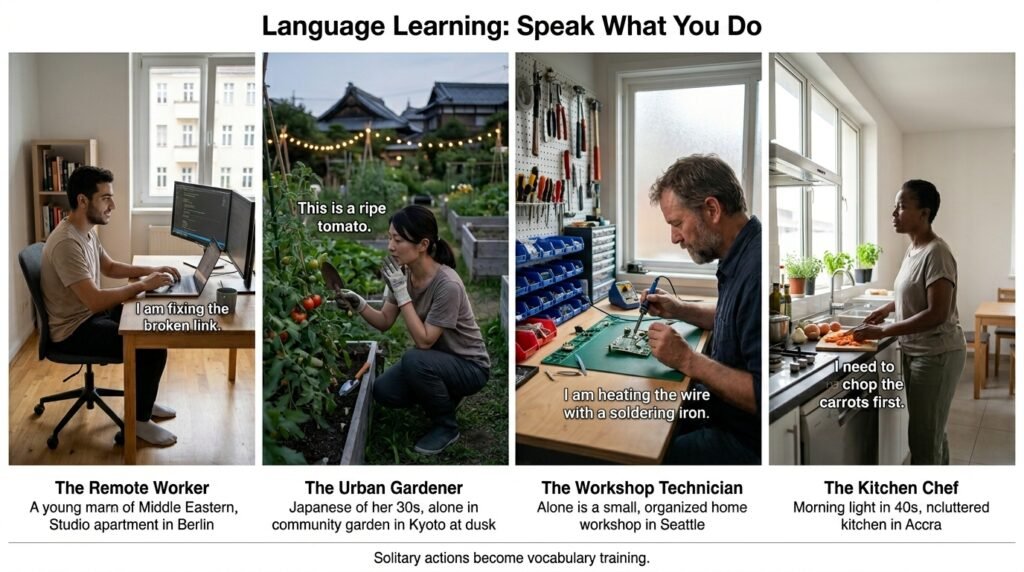
As a digital publisher managing sites like coffeenerdlab.com and thebrightlance.com, I spend hours at my monitor. My work involves SEO, content strategy, and digital automation. This can be a very solitary job, which is actually a superpower for a language learner.
I started becoming my own commentator. As I worked on an article or adjusted an internal link, I would talk to myself about what I was doing.
-
“I am opening the editor.”
-
“I am searching for a better keyword.”
-
“I need to fix this broken link.”
This practice forced me to find the “workhorse” words—the boring but essential verbs and nouns of my daily life. It exposed the gaps in my vocabulary immediately. If I didn’t know the word for “keyboard” or “schedule,” I’d look it up, use it in my narration, and because it was tied to a physical task I was performing, it stuck.
I realized that What Helped Me Actually Use the Words I Learned was this constant, low-pressure output. I wasn’t performing for anyone; I was just training my mouth and brain to work together.
The “Island of Fluency” Strategy
To avoid feeling overwhelmed, I stopped trying to learn the “whole” language. Instead, I built “islands.”
An island is a specific topic that you can talk about comfortably for two or three minutes. My first island was coffee. My second island was my job as a publisher. My third was NBA statistics.
I focused all my vocabulary efforts on these islands. Once an island was built, I felt a massive sense of accomplishment. I might not have been able to discuss politics, but I could explain exactly why I prefer a light roast Ethiopian bean.
This “modular” approach to vocabulary is much more motivating than trying to be a generalist. It gives you immediate “functional fluency.” You can actually go out and have a specific conversation, which builds the confidence you need to tackle the next island.
Designing a “Language-First” Digital Environment
Since I work in digital automation, I’m always looking for ways to make my tools work for me. I realized that my smartphone was a goldmine for “passive” vocabulary growth.
I made a few non-negotiable changes:
-
The Phone Interface: I changed the language of my phone. This forced me to learn words like “Settings,” “Edit,” “Upload,” and “Cloud” through pure necessity.
-
Social Media Curation: I followed twenty creators in my target language who talk about SEO, AI-assisted image generation, and tattoo art (another one of my niche interests). Now, my “mindless scrolling” time is actually immersion time.
-
The Mobile Workflow: I use mobile productivity apps to jot down “gap words” as they occur to me during the day. I don’t stop my work to study them; I just capture them. Every evening, I spend five minutes reviewing those five to ten words.
By surrounding myself with the language, I stopped having to “find time” to study. The language was just there, integrated into the tools I use to run my business.
Forgetting as a Survival Skill
One of the best things I did for my mental health was accepting that forgetting is part of the process. I used to get so angry with myself when I’d forget a word I learned yesterday.
Now, I understand the “Forgetting Curve.” Your brain needs to forget a word a few times before it decides to keep it forever. Every time you forget and then “re-discover” a word, the neural pathway gets a little bit stronger.
I stopped aiming for 100% retention. I started aiming for “persistence.” If I forget a word, I stay curious. I look it up again, laugh at the mistake, and move on. This lack of stress is actually what allowed my retention to improve. When your brain is relaxed and curious, it learns much faster than when it is stressed and pressured.
Building the “Utility Belt” of Phrases
I stopped learning isolated words and started learning “chunks.” This is a massive secret to avoiding overwhelm.
Instead of learning the word “decision,” I learned the phrase “to make a decision.” Instead of learning “time,” I learned “to run out of time.”
Learning words in these natural clusters is easier for the brain because it provides immediate context. It also makes you sound much more natural when you speak. You aren’t stumbling to put words together like a puzzle; you are deploying pre-built tools from your utility belt.
I focused on the “connectors”—words like “actually,” “however,” “besides,” and “it depends.” These are the glue of a language. Once I mastered the glue, the individual words started to feel much less important. I could communicate complex ideas even with a limited vocabulary because I knew how to connect the pieces.
The Role of Visual Identity
I’ve always been interested in AI-assisted image generation and identity preservation. I’ve spent hours working on Kitsune-themed tattoo designs, focusing on the symbolism of the fox and the Sakura petals.
I used this visual passion to help my vocabulary. I’d search for art descriptions and tutorials in my target language. Because the imagery was so vivid and meaningful to me, the words felt “heavy.” They had weight and color.
When you connect a word to a visual identity that you find beautiful or interesting, you aren’t just memorizing a sound; you are adopting a piece of art. My brain was much more willing to store words related to Kitsune folklore than it was to store words from a generic “Lesson 1: Greetings” chapter.

Conclusion: Making the Language Yours
The secret to building a vocabulary without feeling overwhelmed is to stop being a student and start being an explorer.
Don’t look at the mountain of words you don’t know. Look at the small, beautiful things you want to talk about today. Whether it’s the floral notes in your morning Guji coffee, the defensive rating of Jalen Duren, or the meta description of your latest blog post—start there.
Anchor your words to your senses. Narrate your life. Follow your obsessions. Use your digital tools to create an immersion environment that requires zero willpower.
Language is not a test to be passed; it’s a world to be lived in. When you make the vocabulary personal, it stops being overwhelming and starts being empowering. You aren’t just learning “words”; you are building a new version of yourself, one conversation at a time.
The Firehose of vocabulary will never stop, but you can learn how to dance in the rain. Stop collecting, start using, and watch how quickly your world opens up.

Gabriel Henrique is a language enthusiast and productivity writer. After testing countless study methods, he became obsessed with mastering new languages efficiently. He achieves this without burnout, without endless grammar drills, and without losing focus. At Blog The Curious, he shares everything he has learned along the way.