
I thought I was doing everything right. I bought the flashcards. I downloaded the top rated apps. I dedicated forty five minutes every single evening to memorizing lists of nouns, verbs, and adjectives. My vocabulary tracker told me I knew over two thousand words. I felt incredibly proud.
Then I tried to speak.
I was at a local market abroad, trying to buy some fruit. The vendor asked me a simple question about how ripe I wanted the tomatoes. My brain completely froze. I had the two thousand words filed away somewhere in my head, but I could not access a single one. I stuttered, pointed at a red tomato, and walked away feeling deeply embarrassed.
That was the exact moment I realized my study routine was fundamentally broken. I was working incredibly hard, but I was building a useless skill. I was training my brain to pass a written vocabulary test. I was not training my brain to communicate.
This realization forced me to tear down my entire study method. I had to face the reality of my failure. I was making one massive, critical mistake with how I acquired new words. Once I identified this error and changed my approach, my fluency skyrocketed.
Here is the exact mistake I was making and the step by step process I used to fix it.
The Hoarding Mistake
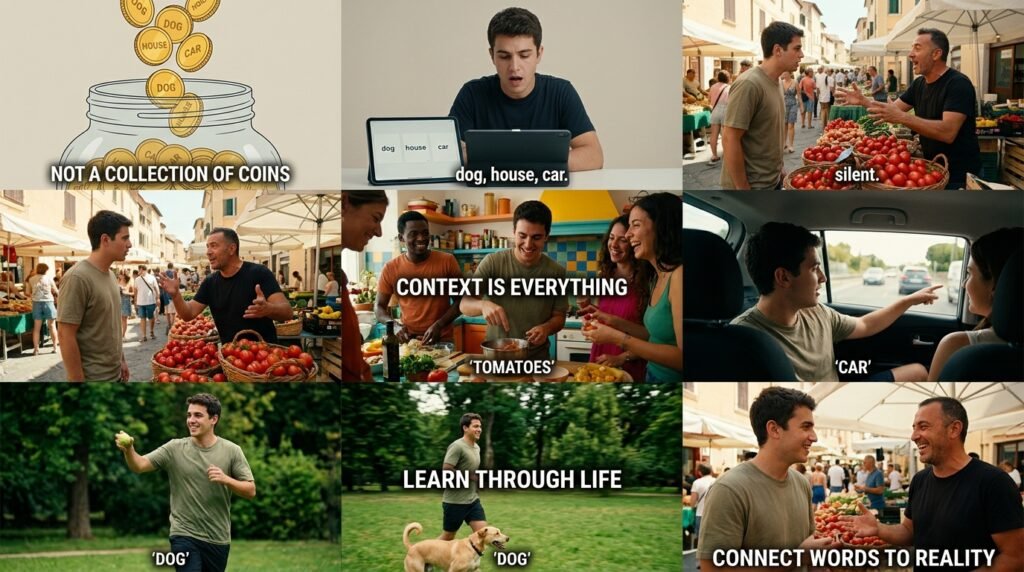
My primary mistake was treating vocabulary like a collection of coins. I wanted to gather as many as possible. I believed that volume equaled fluency.
I would find a list of the one thousand most common words and just start hammering them into my brain. I used rote memorization. I would look at the English word “dog” and repeat the foreign equivalent ten times. Then I would move to “house.” Then “car.”
This method creates a massive illusion of progress. When you test yourself at the end of the hour, you get a perfect score. You feel a dopamine hit. You think you are learning.
But the human brain does not store language like a dictionary. It stores language as a web of interconnected experiences, sounds, and physical contexts. By stripping the context away and learning isolated words, I was creating “dead” vocabulary. The words had no life, no emotional weight, and no connection to my actual reality.
When the vendor asked me about the tomatoes, my brain did not know how to retrieve the word for “ripe” because I had only ever seen it on a sterile white screen. I had never heard it spoken. I had never used it in a sentence. It was useless data.
The Translation Trap
The second part of this mistake was my heavy reliance on my native language. By using flashcards with English on one side and the target language on the other, I was hardwiring a translation step into my thought process.
If I wanted to say “The water is cold,” my brain had to do three things. First, build the sentence in English. Second, translate each individual word. Third, put them together using foreign grammar rules.
This process takes about three seconds. In a real conversation, three seconds is an eternity. The other person assumes you did not understand. They repeat themselves, or they switch to English. The conversation dies.
You cannot translate your way to fluency. You have to learn how to map concepts directly to the new language. You have to bypass your native tongue entirely.
Fix 1: Contextual Acquisition
I threw away my flashcards. I deleted the apps that focused on single word translation. I decided I would never learn a naked word again.
Every new word had to come wrapped in a sentence. If I wanted to learn the word for “window,” I did not write down the translation. I wrote down a full phrase. “Open the window, it is hot.”
This immediately solved the translation lag. I was no longer piecing sentences together like a puzzle. I was downloading entire, functional thoughts. I detailed this shift when I wrote about How I Learned Phrases Instead of Isolated Words and explained how it completely rewired my speaking rhythm.
Phrases give your brain context. They show you how the word behaves in the wild. You learn the prepositions that belong with it. You learn the gender of the noun naturally. You learn the grammar without having to study a rulebook.
Fix 2: The Ruthless Relevancy Filter
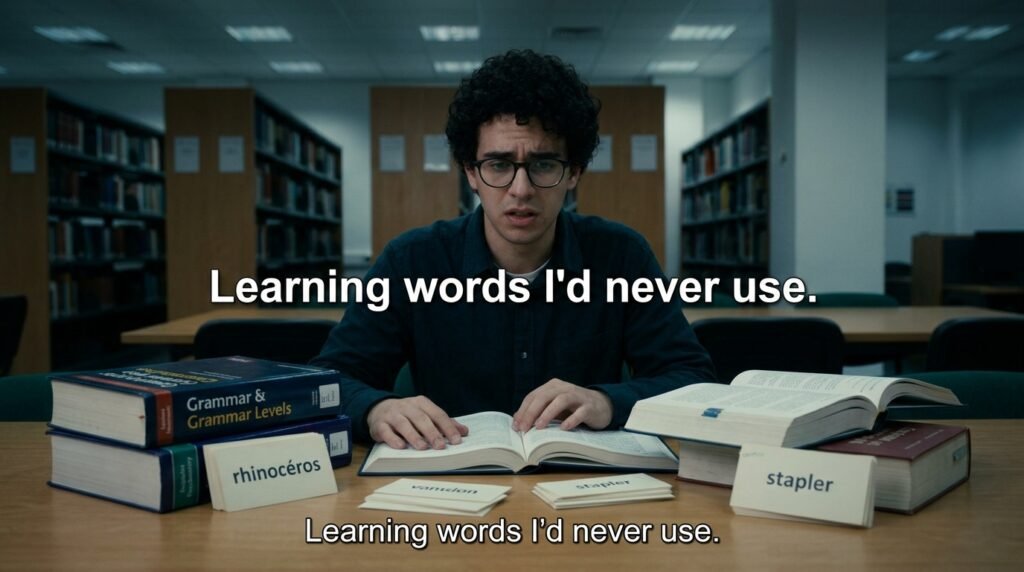
My old method involved learning words I would never actually use. I spent time memorizing the names of zoo animals and obscure office supplies. I was preparing for situations that would likely never happen.
I changed my filter. I started acting ruthlessly selfish with my vocabulary. I only learned words that I needed to describe my specific daily life.
I started carrying a small notebook. As I went about my day, I noticed the things I thought about or talked about in English.
-
I need to schedule a meeting for Tuesday.
-
My lower back hurts from sitting too long.
-
I need to buy olive oil on the way home.
I wrote these thoughts down. Then, during my study time, I figured out how to say those exact sentences in my target language. This process is exactly How I Learned Words Faster by Changing My Approach because it made the language highly personal.
When you learn words that describe your actual reality, you get to practice them every single day. I did not have to manufacture artificial practice scenarios. My life became the practice scenario.
Fix 3: Forcing the Output
The most damaging part of my old routine was the complete lack of output. I was consuming language, but I was never producing it. I expected the words to magically fall out of my mouth when the time came.
Language is a physical skill. Your mouth, tongue, and vocal cords have to learn new shapes and movements. You cannot learn to play the guitar by reading a book about chords. You have to put your hands on the strings.
I instituted a new rule. I had to speak every new phrase out loud at least ten times. I had to feel the rhythm of it.
I started talking to myself in the shower. I started narrating my cooking process. “I am chopping the onions. I am heating the pan.” I made myself look ridiculous, but I was finally building muscle memory.
When you force the words out of your mouth, you immediately discover what you do not know. You hit roadblocks. You realize you forgot the verb conjugation. This frustration is actually the best teacher. It highlights your weak spots so you can fix them.
Fix 4: Visual and Emotional Anchoring
We remember things that evoke emotion or strong imagery. I stopped using English definitions to remember words. I started using mental pictures.
If I wanted to learn the word for “heavy,” I did not think of the English letters. I closed my eyes and pictured myself trying to lift a massive, concrete block. I imagined the strain in my arms. I felt the imaginary weight. Then, while holding that mental image, I said the foreign word out loud.
This bypasses the translation step. You are linking the concept directly to the new sound. It creates a stronger, more resilient memory.
I also used emotion. If I learned a word related to anger, I would furrow my brow, tense my shoulders, and say the word with a harsh tone. I tied the vocabulary to my nervous system. This technique is the foundation of The Way I Practice Words That Actually Stick and it dramatically reduced my forgetting curve.
Fix 5: Spaced Repetition for Sentences
I did not abandon digital tools entirely. I just changed how I used them. I started using a Spaced Repetition System. This is a flashcard program that shows you information just before you are about to forget it.
But instead of putting single words on the cards, I put my personal, context heavy sentences.
-
Front of card: A picture of an open window and a thermometer showing high heat.
-
Back of card: Audio of a native speaker saying “Open the window, it is hot,” along with the text in the target language.
When I reviewed my cards, I did not just read them. I read them out loud. I tried to mimic the accent and the intonation of the audio.
This turned my daily review into a speaking exercise. I was practicing full sentences. I was reinforcing grammar naturally. I was training my ear and my mouth at the same time.
The Reality of the Plateau
It is important to understand that fixing this mistake does not lead to instant perfection. Language learning is inherently messy. You will still forget words. You will still stumble over your sentences.
The difference is how you recover. Under my old method, forgetting a word meant total conversational collapse. I had no backup plan.
Under my new method, I had context. If I forgot the specific noun for “tomato,” I still had the verbs and adjectives around it. I could say, “I want the red, round vegetable for a salad.” People understood me. I kept the conversation alive.
Creating a Language Environment
To cement this new approach, I had to surround myself with the language. I could no longer treat studying as a separate activity that only happened at my desk.
I changed the language on my phone. I started listening to podcasts while driving. I watched news broadcasts while making breakfast.
I flooded my brain with comprehensible input. I needed to hear the phrases I was learning in the real world. Every time I heard a native speaker use one of my personal phrases, it reinforced the memory. It proved to my brain that the information was valid and necessary.
The Psychological Shift
The biggest change was internal. I stopped viewing myself as a student trying to memorize a textbook. I started viewing myself as a child learning to navigate the world.
Children do not learn from vocabulary lists. They point at things. They mimic their parents. They learn words because they need them to get what they want. They want milk, so they learn the word for milk.
I adopted this primal approach. I only sought out the words I desperately needed to express my thoughts. I let my curiosity drive my learning, rather than a predetermined syllabus.
The Results
Six months after I burned my vocabulary lists, I went back to the same market. I approached a different fruit vendor.
I did not have to search my mental dictionary. I did not have to translate from English. I just opened my mouth and asked for three ripe apples. The vendor handed them to me, told me the price, and we had a brief exchange about the weather.
It was a mundane conversation. It was ordinary. But to me, it was a massive victory.
I had communicated. The words were no longer abstract data points on a screen. They were living tools that I used to interact with another human being.

Conclusion
If you are currently staring at a list of two hundred words, trying to drill them into your head, please stop. You are wasting your time. You are building a house on sand.
Throw the list away. Pick five things you actually want to talk about today. Figure out the full sentences you need to express those things. Say them out loud. Use pictures. Use emotion.
Stop hoarding words you will never use. Start building a utility belt of phrases that fit your actual life. The moment you stop treating a language like a math test and start treating it like a tool for connection, everything changes. The frustration disappears. The words stick. You finally start speaking.
Take a deep breath. Close the app. Go look out your window and describe exactly what you see in your new language. That is where real learning begins.

Gabriel Henrique is a language enthusiast and productivity writer. After testing countless study methods, he became obsessed with mastering new languages efficiently. He achieves this without burnout, without endless grammar drills, and without losing focus. At Blog The Curious, he shares everything he has learned along the way.