
You know the feeling perfectly. You spend thirty minutes memorizing a list of foreign words. You nail every single flashcard. You feel a massive surge of confidence. You close your notebook and go to sleep. The next morning, you try to recall just one of those words to describe your breakfast.
Nothing happens.
Your mind is completely blank. The word is gone. It feels like you poured water into a bucket full of holes. I lived in this exact cycle of frustration for years. I assumed I just had a terrible memory. I thought my brain was fundamentally broken for language learning.
The truth was much simpler. My memory was fine. My practice method was completely wrong.
I was treating language like a string of abstract computer code. I was trying to force raw data into my brain through sheer repetition. But the human brain does not care about abstract data. It is a survival machine. It only holds onto information that is physical, emotional, or immediately useful.
I decided to stop fighting my biology. I completely rebuilt my study routine from the ground up. I stopped trying to memorize words. I started anchoring them to my actual life. Here is the exact practice method I use to make vocabulary permanent.
Escaping the Blank Screen
The first thing I did was delete my generic flashcard apps. Staring at a black and white screen is the absolute worst way to learn a living language. There is no context. There is no texture. There is no life.
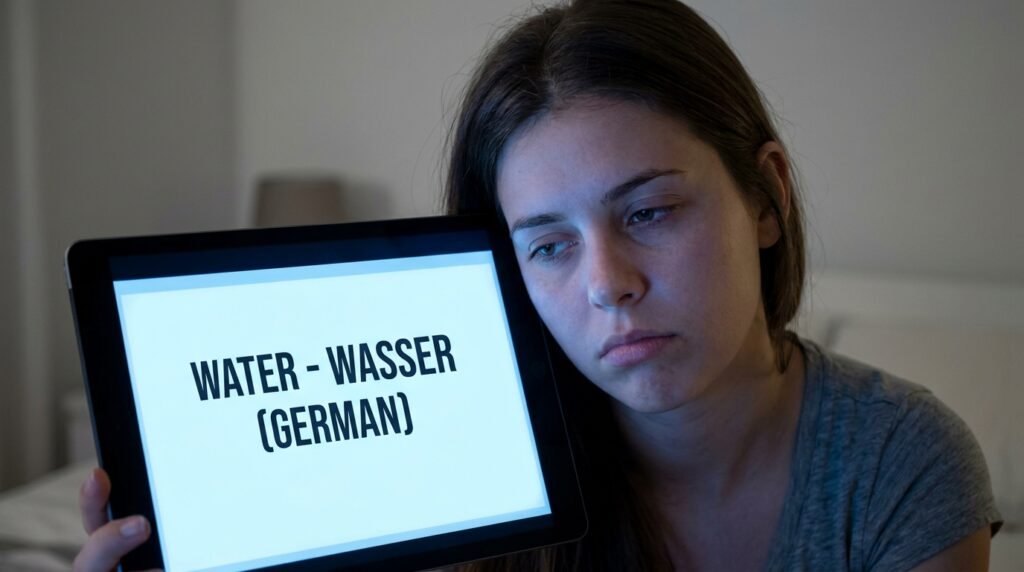
When you look at the word for “water” on a screen, your brain sees pixels. It does not feel thirst. It does not feel wetness. It just sees a shape to memorize for a test. Your brain knows the test does not matter for your survival. It deletes the shape by the next morning.
I realized I had to figure out How I Learned Words Faster by Changing My Approach and that meant getting away from the desk. I needed to put the words into my physical environment. I had to prove to my nervous system that these words were real tools.
The Physical Anchor Routine
We remember physical sensations infinitely better than we remember text. You will never forget the smell of a campfire or the taste of a bitter lemon. I decided to attach my new vocabulary directly to my daily physical habits.
I am a massive coffee enthusiast. My morning routine is sacred. I do not just push a button on a machine. I carefully weigh out Ethiopian Landrace beans. I look for specific Guji or Yirgacheffe roasts. I love the natural process beans for their wild, fruity notes.
This ten minute brewing process is my primary vocabulary laboratory.
I stopped brewing in silence. I started narrating every single physical action in my target language. I grab the kettle and feel the heat radiating from the metal. I say the foreign word for “hot” out loud. I smell the jasmine notes blooming from the wet grounds. I say the word for “fragrant.” I pour the water and watch the dark liquid drip. I say the verb for “to pour.”
I am not memorizing a definition. I am linking a sound to a direct, physical experience. This sensory immersion is exactly How I Turned Everyday Moments Into Vocabulary Practice because my kitchen became an interactive classroom. My brain anchors the vocabulary to the heat, the smell, and the movement.
High Stakes Information Gathering
The brain locks onto information that has real consequences. If a word protects your money, your safety, or your ego, you will remember it instantly. Flashcards have zero consequences. If you fail a flashcard, nothing happens.
I needed to introduce stakes into my practice. I follow the NBA very closely. I use deep performance statistics for sports betting analysis. I am constantly hunting for early game milestones. I track first basket probabilities, rebound rates, and assist numbers for players.
I started doing my statistical analysis entirely in my target language.
I found foreign sports blogs and podcasts. I read the daily injury reports in the new language. This completely changed the way I absorbed the words. The focus was intense. If I misunderstood a word about a player missing a practice, my analysis would be wrong. My wager would be at risk.
The adrenaline of the wager acts as a superglue for the vocabulary. I do not have to review the word for “ankle sprain” twenty times. I look it up once. I use it to adjust my stats. The word is now permanent. You can apply this to anything you care deeply about. Find information you desperately need and consume it only in your target language.
Visual Prompts and Identity Design
I have a deep interest in digital editing and AI image generation. I spend hours working on intricate designs. I love creating Kitsune themed art. I focus heavily on identity preservation across different images. I am obsessed with getting the exact shading right on a Sakura petal or a fox mask.
I turned this highly visual hobby into a vocabulary engine.
I started writing my image generation prompts in the foreign language. If I wanted the AI to change the lighting from a harsh neon to a soft sunset, I had to find the exact foreign adjectives. I typed the words. The AI generated the image. I received instant visual feedback.
If I used the wrong word, the image looked wrong. I had to correct it. This loop of typing a foreign word and seeing a beautiful, vivid image appear directly links the vocabulary to the visual cortex. I bypass my native language entirely. I do not translate the word “orange.” I just see the glowing orange fur of the Kitsune design.
The Friction of the Forum
Polite conversation is boring. Textbooks teach you how to politely ask for directions to the library. No one remembers those phrases because there is no passion behind them.
You remember the words you use when you are angry, excited, or defending your pride.
I follow Brazilian professional soccer. The rivalry between Vasco and Flamengo is legendary. The fan culture is loud and relentless. I take my target vocabulary and I go straight to the fan forums.
I read the arguments. I write my own opinions. If Vasco loses a game because of a bad referee call, the comments are explosive. I try to express my own frustration using the words I learned that week.
Arguing forces you to recall words under extreme mental pressure. You have to think fast. You want to make a sharp point. You learn the actual slang. You learn how native speakers insult bad calls and praise good plays. This friction is incredible for retention. You are practicing the living, breathing language of the street.

The Rule of Immediate Utility
I used to hoard words. I would learn the names of random farm animals or obscure office supplies just in case I ever needed them. I never needed them. I forgot them all.
I instituted a ruthless filter for my practice routine. I call it the rule of immediate utility. If I cannot use a word today, I refuse to learn it.
I am a digital publisher. I manage content for several niche blogs. I optimize articles for SEO. I tweak privacy policies and terms of service. I work with task management apps to streamline my day.
I only learn the vocabulary that describes my actual daily grind. I learned the words for “keyboard,” “publish,” “link,” and “schedule.” I talk to myself while I work. I narrate the process of uploading an article. I state out loud that I am checking the conversion rates.
Setting a strict boundary on what I allow into my brain was The Small Change That Improved My Word Retention and stopped the endless cycle of forgetting. I only practice the tools I actually pick up and use every eight hours.
Micro Sessions Over Marathons
The one hour study block is a myth. Nobody has the focus to stare at a language book for sixty unbroken minutes after a long workday. Your attention span collapses after fifteen minutes.
I stopped carving out massive blocks of time. I shifted entirely to micro sessions.
I use my phone to capture tiny gaps in my schedule. When I am waiting for water to boil, I practice three words. When I am standing in line at the grocery store, I recall one specific phrase. When a file is uploading to a server, I run through a short mental sentence.
These one minute bursts of practice are incredibly powerful. They keep the language active in the front of your mind all day long. The frequency matters far more than the duration. Recalling a word six different times for ten seconds each is infinitely more effective than staring at that same word for ten straight minutes.
The Output Mandate
You cannot practice a word silently in your head. Reading a word does not teach your mouth how to say it. Speaking is a complex physical coordination of your tongue, lips, and vocal cords.
Every single time I practice a word, I force it out of my mouth.
I have to hear the sound vibrate in my throat. I have to feel where my tongue strikes the roof of my mouth. If I am sitting alone in my office, I say it at full volume. If I am in public, I whisper it under my breath.
This physical repetition builds muscle memory. When you are finally standing in front of a native speaker, you do not want your brain to do all the work. You want your mouth muscles to take over automatically. You achieve that by physically speaking every single word you practice.
Embracing the Struggle of Recall
When you forget a word, your first instinct is to look at the translation immediately. You want to relieve the frustration. You want the easy answer.
Stop doing this. The frustration is the exact mechanism of growth.
When you try to recall a word and hit a mental wall, your brain sends a signal. It realizes there is a gap in the network. It heightens its focus. You must let yourself struggle for at least ten seconds. Try to picture the environment where you learned it. Try to remember the first letter.
When you finally look up the word after a period of intense struggle, the brain locks onto it. It acts like a sigh of relief. The neural pathway tears slightly during the struggle, and it grows back much stronger when you find the answer. Do not cheat the struggle. It is the most valuable part of the practice.
The Teaching Technique
The absolute highest level of practice is teaching. When you try to explain a concept to someone else, you instantly expose all your own weak points. You cannot hide behind passive recognition. You have to produce clear, structured thoughts.
I do not have a classroom, so I teach an empty room.
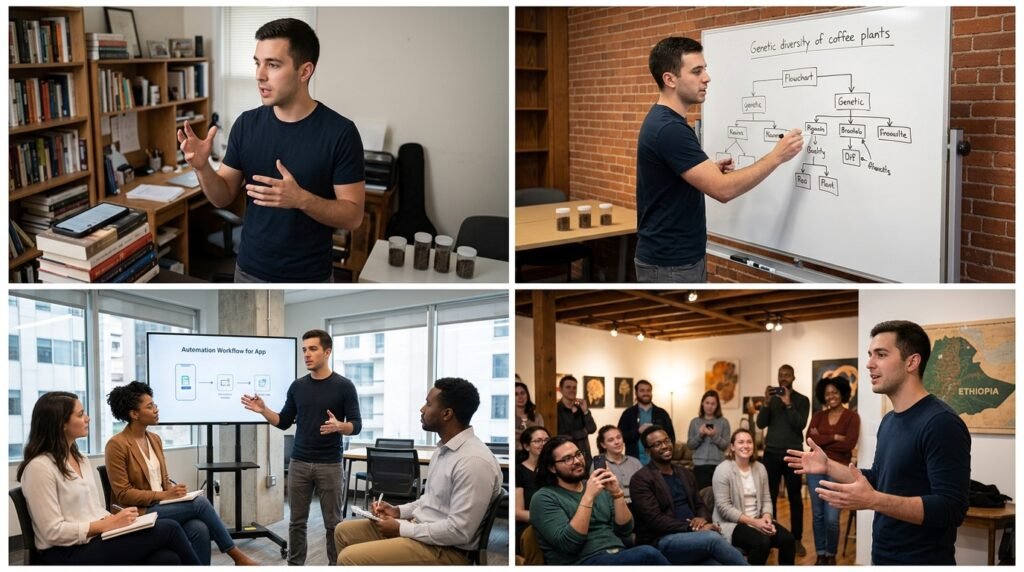
I stand up in my office and deliver a short presentation in my target language. I will pick a complex topic I know intimately. I will explain the genetic diversity of Ethiopian coffee beans. I will outline the workflow for automating a mobile note taking app.
I force myself to speak continuously for three minutes. When I hit a word I do not know, I pause, look it up on my phone, say it out loud, and weave it directly into the lecture. Teaching forces you to connect the isolated words into a flowing narrative. It proves to you that you actually possess the vocabulary.
Moving Forward
Stop staring at black and white text. Your brain deserves better. It craves reality.
If you want words to stick permanently, you must drag them into your physical world. Make the vocabulary sweat. Make it work for its place in your memory. Tie it to the heat of your morning coffee. Anchor it to the adrenaline of a sports wager. Link it to the vivid colors of an image design.
A word is a living tool. You do not master a tool by looking at it in a box. You master it by picking it up and building something. Start building today. Walk into your kitchen, grab an object, and announce its name to the room. That is where real fluency begins.

Gabriel Henrique is a language enthusiast and productivity writer. After testing countless study methods, he became obsessed with mastering new languages efficiently. He achieves this without burnout, without endless grammar drills, and without losing focus. At Blog The Curious, he shares everything he has learned along the way.