
You sit down at your desk. You open your notebook. You spend forty minutes staring at a fresh list of foreign words. You cover the English side. You test yourself. You get every single one correct. You feel a massive wave of accomplishment. You close the book. You go to sleep feeling like a language genius.
The next morning arrives. You try to recall the word for kitchen while making breakfast. Your mind goes completely blank. The word has vanished. You try to remember the verb for to walk while heading out the door. Nothing happens. The vocabulary you perfectly memorized twelve hours ago has evaporated into thin air.
I lived in this frustrating cycle for a very long time. I believed my memory was broken. I assumed I simply lacked the natural talent required to hold onto a new language. I was putting in the hours. I was doing the hard work. Yet my brain was acting like a leaky bucket. No matter how much vocabulary I poured in, the bucket was always empty by the next day.
The problem was not my brain. The problem was my definition of learning. I was treating my mind like a digital hard drive. I thought I could just upload abstract text files and expect them to stay there forever. The human brain is an organic survival machine. It ruthlessly deletes any information it considers useless.
I had to trick my brain into believing these new words were essential for my daily survival. I made one small shift in my daily routine. This single adjustment completely stopped the forgetting cycle. It turned my temporary memorization into permanent knowledge.
The Flaw of the Abstract Word
To understand the solution, you must understand why the traditional method fails. When you look at a flashcard, you see two pieces of data. You see a foreign sound and a native translation. There is no context. There is no physical environment. There is no emotion.
Your brain looks at this abstract pairing and tags it as low priority. You are not holding an object. You are not interacting with a human being. You are just staring at ink on a page or pixels on a screen. Because the information lacks physical reality, your brain discards it the moment you focus your attention on something else.
I realized I needed a completely different strategy. I had to destroy the vacuum. I had to stop isolating words. I had to force every single new piece of vocabulary into my immediate, physical reality. The separation between the classroom and the living room had to disappear.
If a word only exists on your phone screen, it will die on your phone screen. A word must live in your hands. It must live in your daily habits. It must be attached to the things you actually care about. If you do not care about the context, you will never remember the vocabulary.

The One Personal Sentence Rule
The small change I implemented is called the One Personal Sentence Rule.
The rule is incredibly simple. I am no longer allowed to learn a word in isolation. The exact moment I encounter a new word, I must immediately create one sentence using that word. There is a strict catch. The sentence cannot be a generic textbook example. It must be a highly specific, completely true statement about my own life. It must relate to my own interests or my exact physical environment.
If I learn the word for heavy, I do not write that the box is heavy. That is a boring, abstract concept. My brain does not care about a generic box.
Instead, I look around my office. I pick up my laptop. I write that my silver laptop feels heavy today.
This forces my brain to connect the new foreign sound to a physical object I am holding. It connects the word to my personal reality. The abstract data instantly becomes a tangible tool. The neural pathway is immediately much stronger because it is grounded in truth.
Anchoring Words to Sensory Rituals
We remember physical sensations much better than we remember text. Your brain is wired to recall smells, tastes, and textures. I decided to anchor my vocabulary practice to my most sensory rich daily habits.
My morning coffee routine is sacred. I am highly specific about my brew. I weigh out exactly twenty grams of Ethiopian Landrace beans. I typically choose a Guji or Yirgacheffe variety. I love the complex floral notes. I use a natural process bean to get that bright, fruity acidity.
This ten minute brewing process is my daily vocabulary laboratory.
When I need to practice descriptive adjectives or process verbs, I bring them to the kitchen. I do not review them on a screen. I say them out loud while I execute my coffee ritual.
I feel the heat of the kettle. I say the target word for hot or boiling. I smell the jasmine and peach aroma blooming from the wet grounds. I say the target word for fragrant or sweet. I watch the dark liquid drip into the carafe. I use the target verb for to extract or to pour.
I am hardwiring the vocabulary into my nervous system. I am linking the foreign sounds directly to the physical heat on my hands. I am linking them to the bitter taste on my tongue. The brain cannot delete these words because they are glued to a powerful physical experience.
High Stakes Information Gathering
Boredom destroys memory. If you do not care about the topic, your brain will not retain the vocabulary. You have to attach the language to something that naturally holds your complete attention.
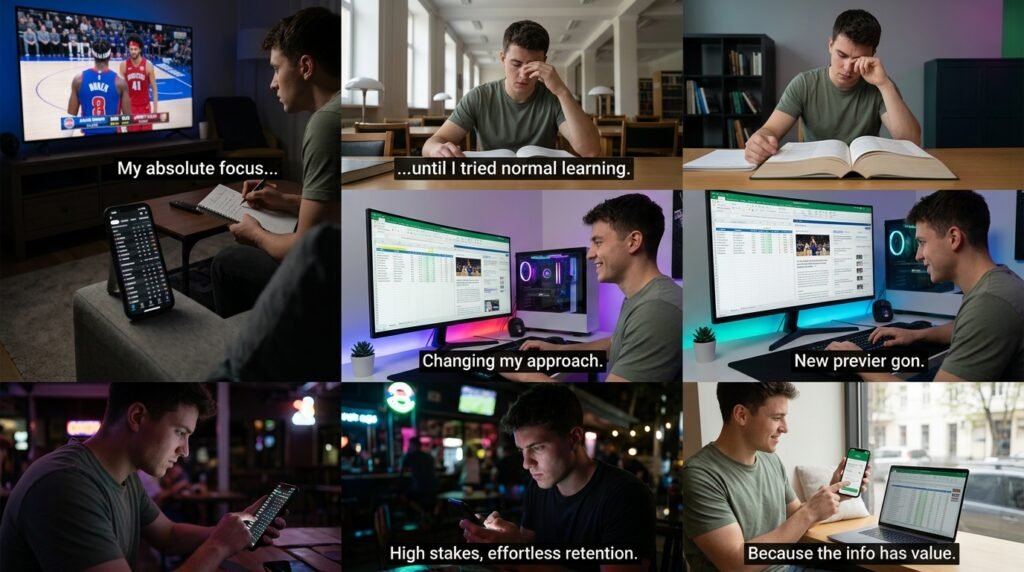
I follow professional basketball very closely. I do not just casually watch the games. I run detailed performance statistics for betting analysis. I track early game milestones. I look for specific first basket probabilities. I analyze the rebound numbers for aggressive players like Jalen Duren and Jarrett Allen.
When money is on the line, my focus is absolute. I decided to leverage this intense focus for my language learning. I knew that figuring out How I Learned Words Faster by Changing My Approach required eliminating all boring content. I moved my entire statistical analysis process into my target language.
I stopped reading English injury reports. I started finding foreign sports blogs and data platforms. If I encounter a new word in a sports article, I do not just write it down. I immediately use it in my statistical spreadsheet.
If I learn the word for injury or probability, I apply it directly to my analysis for the upcoming game. The adrenaline of the wager acts as a chemical fixative for the memory. My brain knows that misunderstanding a word could lead to a bad decision. The stakes are real. Because the information has genuine value, the retention is almost effortless.
Emotional Anchoring Through Rivalry
Emotion is another massive trigger for long term memory. You never forget the exact words someone says to you during a heated argument. You remember the language of joy and the language of frustration perfectly.
I use my love for Brazilian soccer to generate this emotional anchor. I follow the intense rivalry between Vasco and Flamengo. The fan culture is aggressive, loud, and deeply passionate.
When I want to learn vocabulary related to emotion, conflict, or victory, I go straight to the fan forums. I read the post game arguments. I find the exact words native speakers use to express their anger over a terrible referee decision. I find the words they use for absolute joy over a last minute goal.
I then take my new words and write my own comments. If Vasco loses a heartbreaking match, I use my new vocabulary to vent my frustration in the forum. Discovering The Vocabulary System That Finally Worked for Me meant realizing that arguments are the best memory aids.
The words stick immediately. They are no longer academic concepts. They are emotional weapons. When you use a language to defend your team or celebrate a victory, you bypass the logical brain. You encode the words directly into your emotional center.
Transforming the Workspace
As a digital publisher, I spend a massive portion of my day managing niche websites. I handle content for domains like thebrightlance.com and coffeenerdlab.com. I optimize posts for search engines. I build internal link structures. I use mobile productivity apps to automate repetitive tasks.
I realized I was spending eight hours a day operating entirely in English. This was a massive wasted opportunity.
I applied the One Personal Sentence rule to my professional life. When I learn technical vocabulary, action verbs, or organizational nouns, I immediately apply them to my daily workflow.
If I learn the verb to schedule, I do not write a generic sentence. I look at my task management app. I say out loud that I need to schedule the new article for tomorrow morning.
If I learn the word broken, I look at my site audit. I say that I must fix this broken internal link.
By connecting the language to my income and my professional identity, the words gain immediate utility. They become the tools I use to navigate my career. This constant, functional repetition throughout the workday ensures the vocabulary remains highly active in my mind.
Visualizing Memory with Art
Some words are incredibly difficult to anchor to physical actions. Abstract nouns and highly specific visual descriptors require a different approach. For these stubborn words, I use visual generation.
I have a deep fascination with AI assisted image generation. I spend hours crafting highly detailed prompts. I focus heavily on Kitsune themed tattoo designs. I work on preserving facial identity. I manipulate specific color palettes like the vibrant orange of a fox coat or the soft pink of Sakura petals.
I use this creative hobby as a visual memory palace. Seeing How I Turned Small Daily Practice Into Real Progress is easy when you produce beautiful art in the process.
If I am struggling to remember a color, a shape, or a spatial direction, I write my image prompts entirely in the foreign language. I type the target words into the generator. I wait for the image to render.
This provides instant, vivid feedback. If I use the word correctly, I see a beautiful representation of that exact concept on my screen. I am directly linking the foreign sound to a highly specific visual output. I am bypassing English translation entirely. I do not think of the English word for red. I just see the specific crimson shade I requested in my prompt.
Breaking the Translation Habit
One hidden benefit of the personal sentence rule is that it naturally destroys your reliance on translation.
When you learn words through generic flashcards, you hardwire a translation step into your brain. You see the foreign word. You translate it to English. You understand the concept. This process is far too slow for real conversation.
When you anchor a word to a physical object in your room, you cut out the middleman. When you link it to a taste on your tongue or a specific task on your computer screen, you bind the foreign word directly to the raw concept.
When I look at my coffee cup now, my brain does not pull up the English word first. It pulls up the target language word simultaneously. The connection is direct. This direct connection is the absolute foundation of speaking quickly and naturally.
You stop being a translator. You start being a speaker. You start thinking in the language because the language is now fundamentally tied to the objects in your daily life. The words no longer require conscious effort to retrieve. They just appear.
The Micro Habit Effect
Real progress comes from tiny, consistent actions scattered throughout your normal day. Huge study blocks often lead to burnout and fatigue. Fatigue kills retention.
The One Personal Sentence rule takes exactly five seconds to execute. You look at a word. You look at your life. You connect the two.
You do this while waiting for water to boil. You do this while sitting in traffic. You do this while formatting a blog post. These five second investments compound massively over time. They keep the language warm in your brain. They prevent the vocabulary from gathering dust in the back of your mind.
You do not need to carve out a dedicated hour for language learning. You just need to sprinkle the vocabulary over the activities you are already doing. This frictionless approach guarantees consistency. Consistency is the only metric that matters in language acquisition. If you do it every single day, you cannot fail.

How to Make the Change Today
You can implement this small change immediately. You do not need a new app. You do not need a new textbook. You just need to change your relationship with the words in front of you.
The next time you sit down with a vocabulary list, throw away the generic examples. Look at the first word on your list. Look up from your screen. Look at the room you are sitting in. Look at the tasks on your desk. Think about the hobbies you enjoy.
Force that word into your reality. Write one completely true sentence about your life using that exact word. Say it out loud. Feel the truth of the sentence.
If the word is loud, do not think about a generic loud noise. Think about the loud construction outside your specific window. Think about the loud cheering on the soccer forum you read.
Make the language yours. Language is not a sterile subject to be studied in a laboratory. It is a messy, vibrant tool meant to describe the human experience. When you stop treating words like abstract data and start treating them like lenses to view your own life, your memory will stop failing you.
The words will finally stick. The blank stares will become a thing of the past. Your brain will hold onto the language because the language has finally become a vital part of your everyday survival.

Gabriel Henrique is a language enthusiast and productivity writer. After testing countless study methods, he became obsessed with mastering new languages efficiently. He achieves this without burnout, without endless grammar drills, and without losing focus. At Blog The Curious, he shares everything he has learned along the way.