
I started learning my target language with massive ambition. I wanted to debate philosophy and discuss foreign art films within six months. I bought the thickest, heaviest grammar book I could find at the local bookstore. I skipped the early chapters completely. I thought basic greetings and simple vocabulary were beneath my intelligence level. I jumped straight into the past perfect tense and complex conditional clauses.
Three weeks later, I tried to have a basic conversation with a native speaker at a coffee shop. I simply wanted to ask for a dark roast coffee with a little bit of cold milk. I completely froze. I stood at the counter in total silence. I knew how to conjugate highly complex irregular verbs in the subjunctive mood. I did not know how to say the word “want” in the present tense.
My unchecked ambition completely destroyed my progress. I tried to build a massive, heavy house on a foundation of loose sand. The house collapsed immediately under the slight pressure of a real human interaction. I realized I had to start completely over from scratch. I had to drop my ego entirely. I had to build a rock solid grammatical foundation. Here is the exact strategy I used to build that unbreakable foundation.
The Illusion of Advanced Grammar
The language learning industry constantly sells you speed. They promise total fluency in thirty days. They give you gamified apps that push you to level up as fast as possible. This is a complete lie. Speed is the absolute worst enemy of a strong foundation.
When you rush through the basics, you create an illusion of competence. You pass a quick multiple choice test on a screen. You feel smart. But you are not actually learning the language. You are just memorizing short term trivia.
Advanced grammar is highly seductive. It makes you feel intelligent. You want to use beautiful, poetic sentences. You want to impress native speakers with your massive vocabulary. You have to kill this desire completely. You do not need to impress anyone. You need to survive.
You must view the language strictly as a survival tool during your first six months. You do not need poetry to survive. You need strong, ugly, reliable tools. You need concrete and steel.

Defining the Concrete Base
What actually constitutes a strong grammatical foundation? It is not a long list of academic rules. It is a very small, highly functional set of core patterns.
I stopped looking at the entire language as a massive ocean. I narrowed my vision down to a tiny swimming pool. I identified the absolute core pillars of human communication.
You need to know how to identify yourself. You need to know how to ask a direct question. You need to know how to state a basic need. You need to know how to agree and disagree. That is your entire foundation. Everything else is completely optional in the beginning.
I stopped studying completely random vocabulary lists. I stopped learning the names of exotic animals and complex professional titles. I made a strict priority list of what actually mattered. I detail this exact prioritization process in What I Focused On First When Learning a New Language so you can completely cut out the useless noise. I focused exclusively on the one hundred most common words in the language. I refused to learn word number one hundred and one until the first hundred were perfect.
The Absolute Dominance of the Present Tense
Textbooks introduce the past tense and the future tense way too early. They overwhelm your brain with different timeframes before you even know how to exist in the present moment.
I made a radical decision. I decided to live exclusively in the present tense for three entire months.
I completely ignored the past tense. I completely ignored the future tense. I put all my mental energy into mastering the present tense perfectly. This lowered my mental processing load massively. When I wanted to speak, I did not have to calculate time. I only had to calculate the action.
You can actually hack the entire language using only the present tense. If I wanted to talk about the future, I did not use the future conjugation. I used the present tense and added a specific time marker. I said, “I go to the store tomorrow.” If I wanted to talk about the past, I said, “I go to the store yesterday.”
This sounds terrible to a strict grammar teacher. It sounds incorrect. But to a native speaker on the street, it is completely understandable. They know exactly what you mean. You successfully transfer the idea. You survive the conversation. Mastering the present tense first gives you a massive anchor point.
Mastering the Power Verbs
Not all verbs are created equal. Some verbs do massive amounts of heavy lifting. I call these the power verbs.
There are five absolute power verbs in almost every language. To be. To have. To want. To need. To go.
These five verbs represent ninety percent of your daily human desires. If you master these five verbs, you can navigate almost any basic situation in a foreign country.
I drilled these five verbs aggressively. I did not just read them. I wrote them out by hand hundreds of times. I spoke them out loud to my empty kitchen. I practiced conjugating them for every single subject pronoun. I am. You are. He is. We are. They are.
I practiced them until I could say them backwards. I practiced them until they became pure physical reflexes. I did not want to think about these verbs ever again. I wanted my mouth to produce them automatically the second my brain needed them. These power verbs are the thick steel beams of your grammatical foundation.
Word Order is Everything
Vocabulary words are just loose bricks. Word order is the wet cement that holds the bricks together. If you have the best bricks in the world but your cement is weak, your wall will fall down.
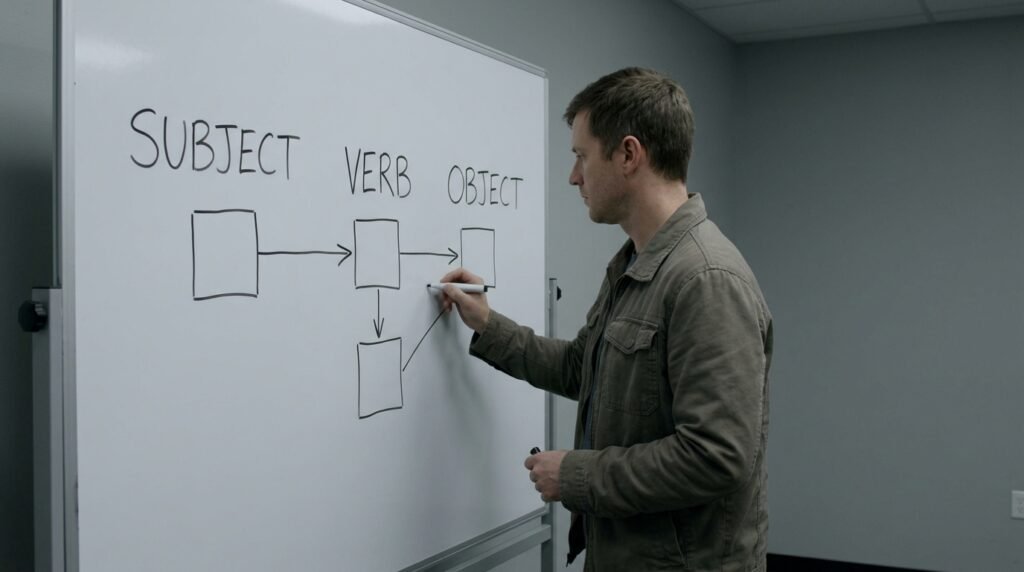
Every language has a strict core word order. In English, it is Subject, Verb, Object. The boy kicks the ball.
I studied the strict word order of my target language intensely. I did not try to make long, elegant sentences. I made the shortest, ugliest sentences possible. I stuck strictly to the rigid core formula.
I practiced this formula relentlessly. Subject. Verb. Object. I am eating an apple. He is driving a car. We are watching a movie.
I refused to invert the word order. I refused to use passive voice. I kept the architecture completely uniform. This strict repetition burned the correct structural pattern deep into my subconscious mind. It trained my ears to expect the words in a very specific sequence. Eventually, incorrect word order started to sound physically wrong to me.
Ignoring the Decorative Wallpaper
When you build a new house, you do not hang the decorative wallpaper before you pour the concrete foundation. That would be completely stupid.
Adjectives and adverbs are the decorative wallpaper of language. They make sentences look pretty. They add rich detail. They are also entirely unnecessary for basic survival.
I stopped trying to use adjectives completely. I did not care about describing a car as a “beautiful, fast, red sports car.” I just called it “a car.”
I stripped all the decoration out of my speech. I sounded like a robot. I sounded like a very direct caveman. I embraced this phase. I knew I was building raw structural strength.
When you remove all the adjectives and adverbs, you have nowhere to hide. You are forced to rely entirely on your core verbs and your basic nouns. This reveals the exact weak points in your foundation. You fix those weak points fast. You add the pretty wallpaper much later, only when the walls are strong enough to support it.
The Drill of Overlearning
Most people stop practicing a grammar rule the exact second they understand it logically. They pass a written quiz, and they immediately move on to the next chapter.
This is a fatal mistake. Logical understanding disappears under pressure.
You do not want to learn the basics. You want to completely overlearn the basics. You want to practice the rule thousands of times past the point of basic understanding. You want to practice until it becomes incredibly boring.
I took basic present tense sentences and repeated them out loud every single day. I practiced them in the shower. I practiced them while driving my car. I practiced them until I was completely sick of hearing my own voice.
Overlearning pushes the grammar rule out of your slow, conscious mind and drops it permanently into your fast, unconscious muscle memory. When a native speaker asks you a fast question, you do not have time to consciously think. You have to rely entirely on your overlearned reflexes. I break down exactly how to transition these basic drills into real world speed in The Routine That Helped Me Go From Zero to Basic Conversations so you can survive the pressure of native speakers.
The Pressure Test
You do not know if your foundation is strong until you actually test it under extreme stress. Sitting alone in a quiet bedroom is not a real test.
I forced myself into high pressure situations. I went to busy restaurants during the loud lunch rush. I walked up to the counter and ordered a complex meal in my target language.
The environment was chaotic. The cashier spoke incredibly fast. The line behind me was long and impatient. My heart rate spiked. My adrenaline flooded my system.
Under that intense stress, my brain immediately abandoned all the advanced grammar rules I had briefly studied. It fell back entirely on the foundation. I relied completely on my power verbs. I relied completely on the strict, simple word order I had overlearned.
The foundation held firm. I successfully ordered the food. I did not stutter. I did not freeze. I used ugly, simple sentences, but the communication was perfectly flawless. That successful pressure test proved that my concrete was finally dry.
Building an Unbreakable System
You cannot build a foundation with occasional effort. You cannot study for four hours on a Sunday and ignore the language for the rest of the week. Concrete needs steady, consistent curing time.
I built a highly rigid daily system. I refused to rely on sudden bursts of motivation. Motivation is an unreliable emotion. I relied entirely on cold discipline.
I dedicated exactly thirty minutes every single day to foundation work. No matter how tired I was, no matter how busy my schedule became, I executed my daily drills. I wrote out my power verbs. I spoke my basic sentence structures out loud.
Consistency tells your brain that the language is a permanent feature of your environment. Your brain stops resisting the new rules and starts adapting to them. You must build a system that guarantees daily contact with the core pillars. I share the exact mechanics of this daily integration in How I Built a Learning System That Didn’t Feel Like Studying so you can lock your habits into place automatically.
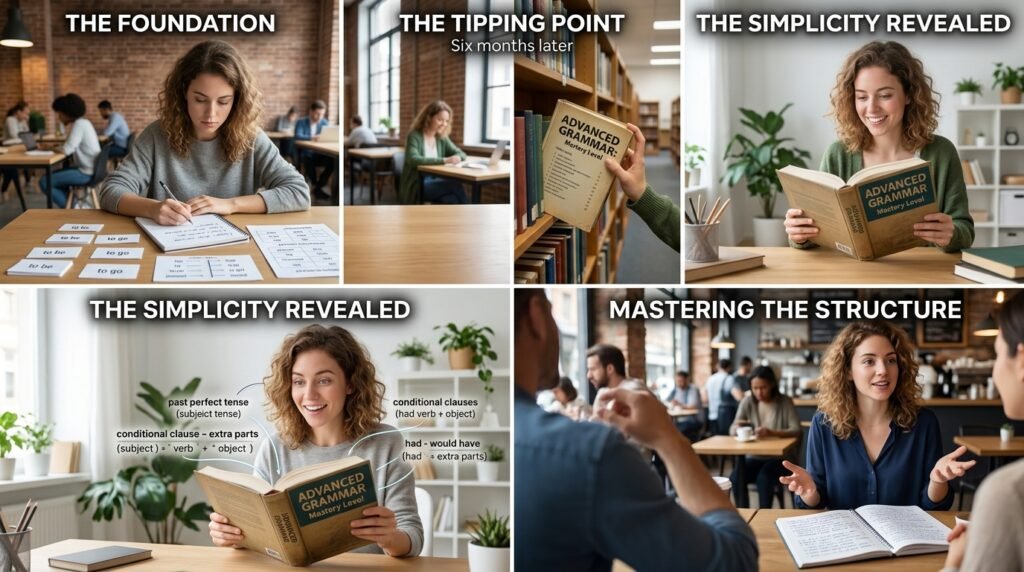
The Tipping Point of Advanced Grammar
A beautiful thing happens when you spend six months strictly building your foundation. You reach a massive tipping point.
When I finally felt completely comfortable with the core verbs, the present tense, and the basic word order, I picked my heavy grammar book back off the shelf. I finally opened the advanced chapters.
I started reading about the past perfect tense and the complex conditional clauses.
I was completely shocked. The advanced rules did not feel complicated anymore. They felt incredibly simple.
Because my brain was no longer struggling to process basic word order, I had massive amounts of free mental energy. I could easily understand the new advanced concepts because they were just slight variations of the core foundation I already mastered perfectly.
Advanced grammar is just basic grammar with a few extra moving parts. If your base is completely solid, adding those extra parts takes almost zero effort. The heavy textbook suddenly read like a simple instruction manual. The massive wall of confusion completely disappeared.
Never Abandoning the Base
Even as I became highly fluent and comfortable with advanced grammar, I never abandoned my foundation.
Professional athletes do not stop practicing the basic fundamentals just because they make it to the championship game. A professional basketball player still shoots basic free throws every single day. A professional boxer still practices basic footwork every single morning.
I still run my basic grammar drills. When I feel myself getting sloppy or confused during a conversation, I immediately retreat back to the foundation. I stop using complex clauses. I drop the fancy adjectives. I return directly to my core power verbs and my rigid word order.
The foundation is your permanent safe zone. It is the place you retreat to when the conversation gets too chaotic.
Stop rushing the process. Stop trying to impress people with big words you cannot properly string together. Drop your ego entirely. Go back to chapter one. Master the absolute basics until they are incredibly boring. Pour the concrete thick and let it dry completely. A strong foundation is the only thing that will keep your language skills standing when the real world pressure hits you.

Gabriel Henrique is a language enthusiast and productivity writer. After testing countless study methods, he became obsessed with mastering new languages efficiently. He achieves this without burnout, without endless grammar drills, and without losing focus. At Blog The Curious, he shares everything he has learned along the way.