
I sat at my desk on a rainy Tuesday evening. I opened my language textbook to chapter four. The main topic was the subjunctive mood. I read the first paragraph. I immediately felt my eyelids get heavy. The text was incredibly dry. It felt exactly like reading a complicated legal document.
I forced myself to read the examples. They were terrible. A man named David was going to the bank. A woman named Sarah wanted an apple. The sentences were perfectly correct. They were also the most boring sentences ever constructed by human beings. I lasted exactly ten minutes before I closed the book and walked away.
Grammar has a terrible reputation. We view it as the worst part of learning a language. We see it as a painful chore. We treat it like eating boiled vegetables. You force it down because you think it is good for you.
I knew I could not survive months of this boredom. I needed a completely new approach. I had to find a way to make the structural rules of the language actually interesting. I decided to completely change my perspective. I stopped treating grammar like an academic punishment. I started treating it like a creative tool. Here is exactly how I made grammar feel significantly less boring.
The Film Camera Realization
I own an old mechanical film camera. When I first bought it, I tried to read the technical manual. It was a massive booklet filled with charts about aperture, shutter speed, and ISO ratings. It was completely unbearable. I fell asleep trying to memorize the mathematical relationship between light and exposure times.
Then I took the camera outside. I went to a busy street festival. I pointed the lens at a musician playing a saxophone. I manually adjusted the dials until the image looked perfect in the viewfinder. I clicked the heavy metal shutter.
In that exact moment, the boring technical manual made perfect sense. The rules were no longer abstract math equations. They were physical tools I used to capture a beautiful piece of art.
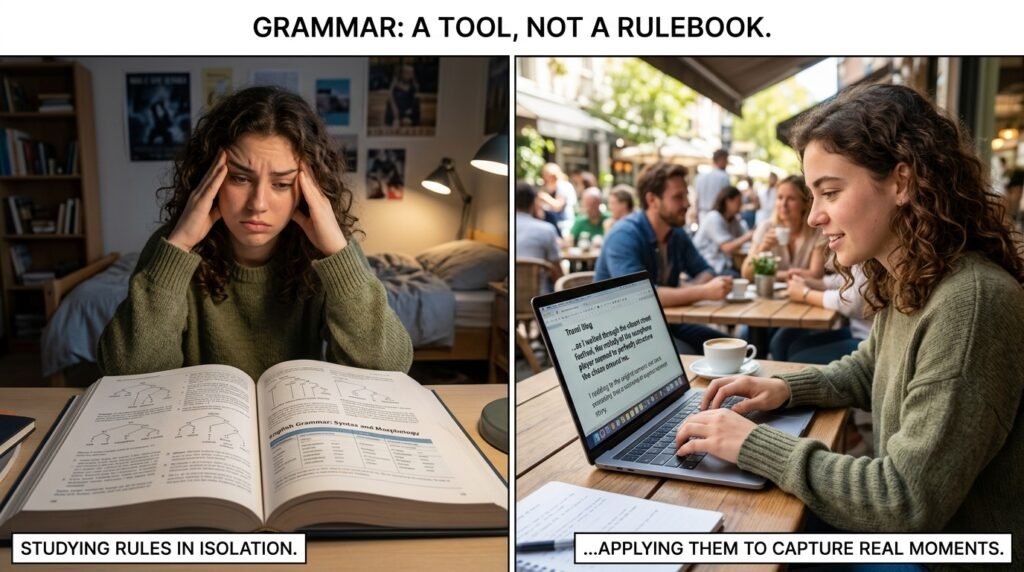
Grammar is the exact same thing. Reading a grammar manual in your bedroom is miserable. It lacks all context. The rules only become interesting when you use them to capture something real. I completely stopped reading the grammar manual. I took the rules outside into the real world.
Ditching the Artificial Dialogues
The fastest way to kill your motivation is to study sentences you do not care about. Traditional textbooks are filled with sterile, artificial dialogues. Your brain deletes these dialogues instantly. It knows you will never need to ask Sarah about her apple at the bank.
I completely threw away the artificial examples. I replaced them entirely with real sentences from my own life.
If a textbook tried to teach me the future tense using a story about a train schedule, I ignored it. I took the underlying rule and immediately applied it to myself. I wrote a sentence about my actual plans for the weekend. I wrote down the exact restaurant I was going to visit. I wrote down the food I was going to order.
Your brain pays absolute attention when the subject is you. By injecting my personal life into the grammar exercises, the boredom vanished. I was no longer studying a foreign concept. I was simply writing my own autobiography in a different code. I explain the mechanics of building this personal framework in How I Built a Learning System That Didn’t Feel Like Studying because it shifts your entire mindset.
Injecting Pure Absurdity
Human memory is highly tied to emotion and surprise. We remember things that are strange, funny, or completely absurd. We immediately forget things that are normal and safe.
I decided to stop making safe sentences. I started actively making absurd sentences.
When I needed to practice conditional verb tenses, I did not write about the weather. I wrote about an alien invasion. I wrote sentences like, “If the aliens land tomorrow, I will offer them a slice of pepperoni pizza.”
I used the exact same grammar rule required by the textbook. But I wrapped it in an incredibly stupid, funny scenario. The absurdity made my brain light up. I laughed out loud while writing my practice sentences.
You cannot be bored when you are actively trying to make yourself laugh. The weirder the sentence, the faster the grammar rule sticks permanently in your memory. I turned every boring grammar drill into a creative comedy writing exercise.
Arguing with Strangers Online
Grammar feels useless when there are no actual stakes. If you fill in a blank space on a worksheet, nothing happens. Nobody cares. The lack of stakes makes the process feel incredibly dull.
You have to create real stakes. You need a situation where your words actually matter.
I found a powerful way to do this. I started visiting online forums and comment sections in my target language. I found discussions about movies, music, and food. I actively looked for opinions I strongly disagreed with.
Then, I jumped into the argument.
Arguing forces you to use highly precise grammar. You want to make your point perfectly clear. You want to sound intelligent. You want to prove the other person wrong. The stakes are suddenly very real. Your pride is on the line.
I would spend twenty minutes crafting the perfect response. I checked my verb tenses. I made sure my prepositions were correct. I learned advanced persuasive grammar structures just so I could win a silly argument about a movie plot. The boredom disappeared entirely because my adrenaline was pumping.
Changing the Input Channel
You cannot learn to love grammar if you only consume boring media. If you read news articles about economic policy, you will hate the language. You must find input that naturally hooks your attention.
I completely stopped reading formal language materials. I switched my input channel to things I actually enjoyed in my native language.
I love fast paced thriller novels. I started reading thrillers translated into my target language. The grammar in these books is entirely different from a textbook. Authors use short, punchy sentences. They use slang. They use intense verbs.
I learned how the past perfect tense works by reading a scene where a detective realizes the killer was already inside the house. The grammar was tied directly to a moment of intense suspense. I did not even realize I was studying. I just wanted to know what happened on the next page. Finding the right input is critical. I talk deeply about integrating these specific choices in How I Made Learning a Language Part of My Daily Life to help you surround yourself with better content.
The Power of Music and Lyrics
Music is the ultimate weapon against boredom. Music naturally hacks the human brain. It bypasses the logical filters and plants patterns directly into your memory.
I stopped listening to dry audio lessons. I started listening to popular bands from the target country. I found songs with aggressive energy and catchy melodies.
I pulled up the lyrics on my computer screen. I listened to the song and read the words at the exact same time. I noticed how the singers bent the grammar rules to fit the rhythm. I saw how they naturally contracted words.
When I found a grammar structure I did not understand, I translated that specific line of the song. The rule instantly made sense. Furthermore, I never forgot it. The grammar rule was permanently attached to the melody. If I forgot the conjugation during a live conversation, I just hummed the song in my head to find the correct ending.

Roleplaying and Alter Egos
You feel intense pressure when you speak as yourself. You worry about sounding foolish. This pressure makes you rely on safe, boring, rigid sentences.
I discovered a very strange but highly effective trick. I created an alter ego.
When I practiced speaking alone in my room, I did not speak as myself. I pretended to be a completely different character. Sometimes I pretended to be a snobby food critic reviewing a terrible meal. Sometimes I pretended to be a highly stressed politician giving a press conference.
Taking on a character removes your personal ego from the equation. It liberates you. You start experimenting with the language. A snobby food critic uses very different grammar than a stressed politician.
By playing these different roles, I forced myself to use a massive variety of sentence structures. I practiced formal commands. I practiced the subjunctive mood to express outrage. It turned a boring speaking drill into a highly entertaining acting class.
Translating Deeply Personal Thoughts
Textbooks keep you completely on the surface of the language. They teach you how to ask for directions to the train station. They never teach you how to express your actual human soul.
I decided to take grammar to the deepest level possible. I started a daily journal of my most honest, unfiltered thoughts.
I wrote about my actual fears. I wrote about my specific frustrations with my career. I wrote about the things that made me genuinely happy that day.
When you try to express a complex emotional thought, you quickly realize your basic grammar is not enough. You need advanced tools. You need subtle shades of meaning.
I actively hunted for the grammar rules that would allow me to express my exact feelings. I learned conditional tenses so I could write about my regrets. I learned advanced adjectives to describe my exact mood. The grammar became a deeply personal tool for self discovery. It is completely impossible to be bored when you are writing about your own hidden emotions.
Teaching the Empty Room
We hate studying because it is a passive activity. You sit silently and let information wash over you. The brain checks out.
To make grammar interesting, you have to make it an active performance. The best way to learn a concept is to immediately teach it to someone else.
I did not have any students. So I taught the empty room.
Whenever I learned a new grammar rule, I stood up from my desk. I paced back and forth. I pretended I was a professor lecturing a room full of beginners. I explained the rule out loud. I used my hands. I drew imaginary diagrams in the air.
I forced myself to explain the concept simply and clearly. If I stumbled over my words during the lecture, I knew I did not truly understand the rule yet. I went back to the source, figured out the missing piece, and gave the lecture again.
Speaking the rules out loud brings them to life. It forces your physical mouth to get involved in the process. It turns a silent reading session into a dynamic physical activity. I share more physical speaking habits like this in The Strategy That Helped Me Speak More Naturally so you can build your vocal confidence.
Embracing the Chaos of Slang
Formal grammar is highly rigid. It is a set of strict laws. Laws are inherently boring.
Spoken language is a completely different animal. Spoken language breaks the laws constantly. Native speakers mash words together. They invent new verb endings. They use heavy slang that defies all textbook logic.
I stopped ignoring the slang. I aggressively leaned into the chaos.
I started watching street interviews on YouTube. I listened to how normal people on the sidewalk actually spoke. I wrote down the weird, grammatically incorrect phrases they used. I actively studied how they broke the rules.
Learning how to break the rules is incredibly fun. It feels rebellious. It gives you a much deeper understanding of the actual culture. You realize that grammar is not a prison. It is just a general guideline that native speakers ignore whenever they feel like it.
When you learn the street slang, you stop sounding like a robot. You start sounding like a real human being. The language immediately becomes vibrant and completely unpredictable.
Letting Go of Perfect Accuracy
The absolute main reason grammar feels boring is the heavy expectation of perfection. You view every sentence as a test you have to pass. You constantly check your work for errors. You drain all the joy out of the communication.
I had to actively destroy my desire for perfect accuracy.
I set a new goal. My goal was no longer to speak perfectly. My goal was simply to be understood. If I used the wrong gender for a noun, but the other person laughed at my joke anyway, I counted it as a massive victory.
I prioritized the speed of the conversation over the strict rules of the syntax. I stopped stopping myself. I just let the words flow out of my mouth.
This simple mental shift changed everything. The heavy pressure vanished completely. I stopped fearing the language. I started playing with it. I realized the grammar mistakes were not failures. They were just part of the messy, fun process of connecting with another person.

Grammar is Just a Vehicle
You do not care about the internal combustion engine of your car. You do not read the mechanical schematics of the transmission. You just want to drive to the beach. You only care about the vehicle because of where it can take you.
Grammar is exactly the same thing. Stop treating it like an engine you have to rebuild from scratch. Stop staring at the abstract parts.
Focus entirely on the destination. Focus on the funny story you want to tell your friend. Focus on the intense argument you want to have about your favorite movie. Focus on the raw emotion you want to express in your journal.
When you focus deeply on the actual message, the grammar naturally fades into the background. It stops being a boring wall blocking your path. It becomes the invisible vehicle that carries your thoughts directly into the mind of another human being. Get in the car, ignore the engine, and just start driving.

Gabriel Henrique is a language enthusiast and productivity writer. After testing countless study methods, he became obsessed with mastering new languages efficiently. He achieves this without burnout, without endless grammar drills, and without losing focus. At Blog The Curious, he shares everything he has learned along the way.