
I watched the native speaker smile politely and lean forward. He squinted his eyes slightly. He asked me to repeat myself for the third time.
I was incredibly frustrated. I knew the sentence I was trying to say was grammatically flawless. I had spent hours memorizing the exact vocabulary words. I knew the correct verb conjugations. But the person standing directly in front of me could not understand a single thing coming out of my mouth.
My words were a blurry, jumbled mess. I was mumbling.
I realized that knowing a language mentally is entirely different from producing it physically. Your brain can hold thousands of foreign words. But if your mouth, tongue, and jaw do not know how to shape those words into clear sounds, your knowledge is completely useless. You remain trapped inside your own head.
I decided to stop studying grammar books and start treating my mouth like a mechanical instrument. I needed to build physical strength and coordination. I built a strict daily routine of physical vocal drills. Here are the exact exercises that helped me strip away the mumbling and finally speak with absolute clarity.
The Pen Resistance Drill
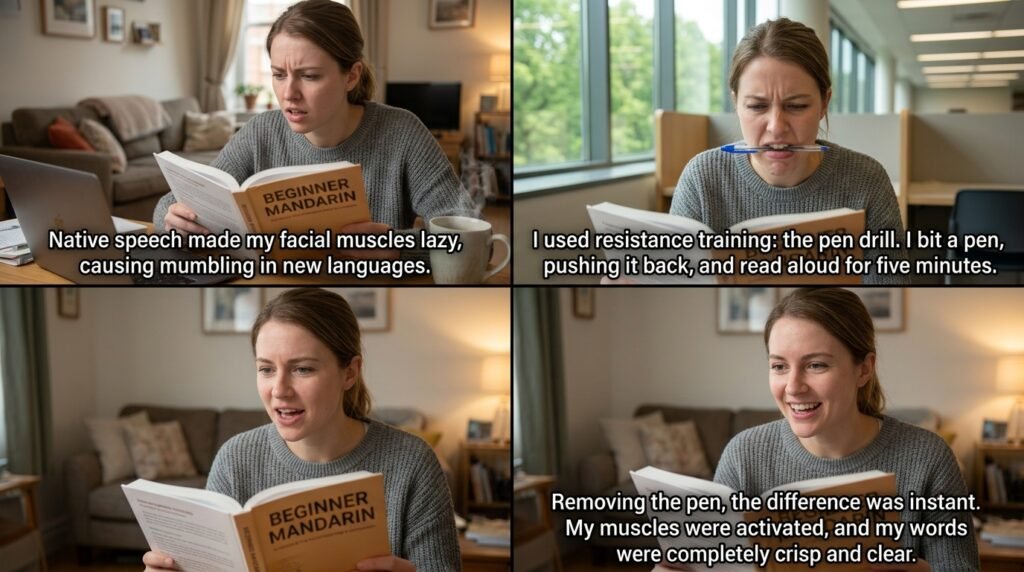
Your native language makes your facial muscles incredibly lazy. You have been making the exact same sounds for your entire life. Your mouth takes shortcuts. It barely opens when you speak.
When you learn a new language, you demand completely new movements from your facial muscles. Your lazy native muscles simply cannot handle the workload. They try to take shortcuts, and the result is a heavy, unintelligible mumble.
You have to force your muscles to work harder. I used a classic actor’s technique called the pen drill.
I took a clean, standard plastic pen. I placed it horizontally across my mouth. I bit down on it gently with my teeth. I pushed it as far back into the corners of my mouth as it would comfortably go.
Then, I picked up a book written in my target language. I forced myself to read a paragraph out loud with the pen locked in my teeth.
This is incredibly difficult. Your tongue is trapped. Your lips cannot close completely. To make any recognizable sounds, you have to work ten times harder. You have to aggressively push your tongue against the pen. You have to stretch your lips into highly unnatural shapes.
I sounded ridiculous. I drooled on my desk. But I kept reading out loud for five solid minutes.
When I finally removed the pen and read the same paragraph again, the difference was shocking. My mouth felt incredibly light and fast. My tongue was snapping into position with sharp precision. The heavy resistance training had instantly activated all the lazy muscles in my face. My words came out completely crisp and entirely clear.
Vowel Isolation Targeting
Beginners constantly obsess over difficult consonants. They spend weeks trying to figure out how to roll their tongue or make a harsh scraping sound in their throat. They completely ignore the vowels.
This is a massive mistake. Consonants provide the structure of a word, but vowels carry the actual sound. Vowels provide the volume, the tone, and the clarity. If your vowels are muddy, your entire sentence becomes a muddy swamp.
English vowels are notoriously lazy. They glide around in the mouth. They often collapse into a neutral, relaxed sound called a schwa. Many foreign languages demand incredibly pure, rigid vowels. You cannot glide into them. You must hit them sharply.
I started an exercise called vowel isolation. I took a short, ten word sentence in my target language. I completely removed all the consonants from the sentence. I wrote down only the vowels on a piece of paper.
I stood in front of the mirror and read only the vowels out loud.
I focused intensely on the exact shape of my mouth for every single vowel. If an “O” sound required my lips to be perfectly round, I forced my lips into a tight circle. If an “A” sound required my jaw to drop, I forced my jaw to open wide. I refused to let my mouth relax into its lazy English habits. I explain how to map out these specific vocal shifts in The Small Changes That Improved My Accent because the vowels are the true secret to sounding local.
Once I could successfully transition between the pure vowels smoothly, I added the consonants back into the sentence. The clarity was massive. The words rang out like clear bells because the underlying vowel structure was completely solid.
The Over-Articulation Protocol
We mumble because we want to speak fast. We think speed equals fluency. So we rush to the end of our sentences, swallowing syllables and smashing words together carelessly.
To speak clearly, you have to deliberately break this habit of speed. You have to teach your mouth exactly where every single boundary of a word actually exists.
I used an exercise called over-articulation.
I took a news article written in my target language. I read it out loud at an incredibly slow, agonizing pace.
I focused on pronouncing every single letter of every single word. If a word ended in a sharp “T” sound, I made sure that “T” popped loudly in the empty room. I did not drop a single syllable. I moved my jaw violently. I stretched my facial muscles to their absolute physical limits.
I sounded exactly like a malfunctioning robot. It was a completely unnatural way to speak.
But this extreme exaggeration serves a vital purpose. It forces your brain to acknowledge the full architecture of the vocabulary. It builds deep, concrete muscle memory for the complex sounds you usually skip over.
When you over-articulate in private, your normal speech automatically becomes sharper in public. You naturally dial back the exaggeration when you talk to a real person, but the residual muscle memory keeps your words from collapsing back into a mumble.
Minimal Pairs Boxing
Your ears are currently lying to you. Your brain is heavily trained to filter foreign sounds through your native language. When you hear a new foreign consonant, your brain immediately tries to map it to the closest English equivalent.
If you cannot accurately hear the difference between two sounds, you will never be able to produce the difference clearly. Native speakers will constantly misunderstand you.
I attacked this problem using minimal pairs. A minimal pair is a set of two words that differ by only one single sound. For example, in English, the words “bat” and “pat” are a minimal pair.
Every language has specific minimal pairs that drive foreigners completely crazy. They sound absolutely identical to an untrained ear. But to a native speaker, mixing them up completely changes the meaning of your sentence.
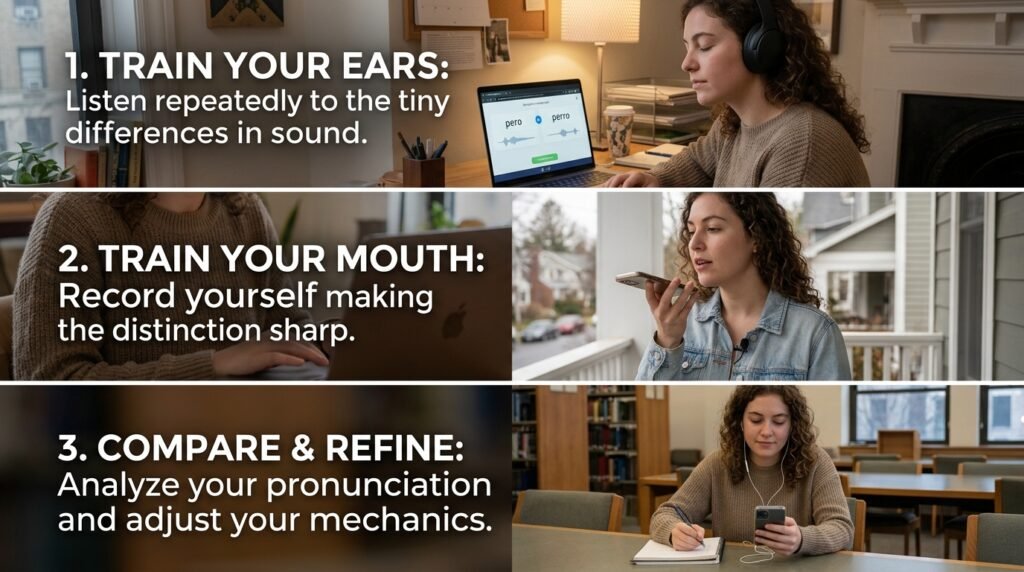
I hunted down the most difficult minimal pairs in my target language. I created audio flashcards. I listened to the two words back to back hundreds of times. I closed my eyes and focused intensely on the tiny, microscopic differences in breath, pitch, and tongue placement.
Then, I fought back. I recorded myself saying the two words. I tried to make the distinction as sharp and obvious as possible. I forced my tongue forward for one word and pulled it back for the other. I practiced this drill religiously. I detail the mechanics of setting up this routine in How I Practiced Pronunciation Every Day so you can build your own minimal pair boxing ring at home.
Once you train your ear to catch the difference, your mouth naturally adjusts to produce the difference. Your clarity skyrockets because you stop substituting lazy English sounds for the correct foreign ones.
Diaphragmatic Breath Control
If your voice is thin, shaky, or trailing off at the end of sentences, your problem is not your mouth. Your problem is your lungs.
Sound requires air. If you do not have enough air pushing through your vocal cords, your words will always sound weak and mumbled. Most beginners speak from their chest. They take shallow, nervous breaths. They run out of air halfway through a sentence.
When you run out of air, your body panics. You rush the final words. You drop the volume. The end of your thought becomes entirely unintelligible.
I had to completely relearn how to breathe. I learned to breathe from my diaphragm.
I lay flat on my back on the living room floor. I placed a heavy book on my stomach. I breathed in deeply. I forced my stomach to push the heavy book up toward the ceiling. My chest did not move at all. This is the correct way to fill your lungs completely.
I stood up and applied this breathing to my language practice. Before I spoke a long sentence, I took a deep, deliberate breath into my stomach. I used that massive column of air to push the foreign words out of my mouth.
The difference in vocal clarity was incredible. The deep breath gave my voice resonance. It gave my words weight. I no longer rushed the end of my sentences because I had plenty of fuel to finish the thought strongly. A loud, supported voice is naturally a clear voice.
The Echo Shadowing Drill
You cannot build clear speech in a vacuum. You need a perfect model to copy. If you only listen to yourself, you will simply reinforce your own bad habits.
I used an advanced technique called echo shadowing. It requires immense focus.
I put on noise canceling headphones. I played an audiobook recorded by a native speaker. The speaker was reading a fast, dynamic story.
I did not pause the audio. I listened to the native speaker, and I repeated their exact words completely out loud. But I stayed exactly one second behind them. I acted as their constant, trailing echo.
This is incredibly difficult. You are listening to new input while simultaneously producing output from one second ago. Your brain feels like it is splitting in half.
But this drill forces you to completely surrender your own rhythm. You cannot think about the grammar. You cannot pause to translate. You just have to blindly trust your ears and your mouth. You are forced to adopt the exact cadence, the precise clarity, and the natural pauses of the native speaker.
It completely destroys the robotic, blocky speech patterns of a beginner. It forces your mouth to glide smoothly from one word to the next exactly how the native professional is doing it.
The Delayed Feedback Loop
To fix your clarity, you must confront the brutal truth of your own voice. You cannot rely on your internal perception. Your skull distorts the sound completely.
I used my smartphone to create a delayed feedback loop.
I read a complex paragraph out loud and recorded the audio. Then, I put the phone down. I did not listen to the recording immediately. If you listen immediately, your brain tries to defend your mistakes. You make excuses. You tell yourself it did not sound that bad.
I waited a full twenty four hours.
The next evening, I sat down at my desk. I put on my headphones. I played the recording from the previous day.
Because a full day had passed, the voice on the recording felt completely disconnected from my ego. It sounded like a total stranger. This emotional distance allowed me to be ruthlessly objective.
I heard every single mumbled word. I heard the exact moments where my breath control failed. I heard exactly which vowels were completely muddy. I realized how painful this process is, and I wrote a complete guide on navigating it in How I Got Comfortable Hearing My Own Voice to help you survive the initial cringe.
I wrote down my worst mistakes on a piece of paper. These mistakes became my exact targets for my pen resistance drills and my vowel isolation drills the following morning.
Dropping the Fake Accent
Many language learners have a terrible habit that destroys their clarity. They try to put on a fake, overly dramatic accent.
They hear native speakers using a certain flair, and they try to copy it without understanding the underlying mechanics. They roll their R sounds for way too long. They add strange, unnecessary inflections to the end of their words.
This fake accent usually completely ruins the actual pronunciation of the word. It makes you sound like a cartoon character.
I realized I was doing this. I was trying too hard to sound native, and it was making my speech completely unclear. I was prioritizing style over substance.
I had to completely drop the fake flair. I went back to speaking with absolute neutrality. I focused strictly on hitting the correct vowels and articulating the consonants sharply. I removed all the dramatic acting from my voice.
When you focus entirely on pure, mechanical clarity, the true native accent eventually develops naturally on its own. You cannot force an accent. An authentic accent is simply the byproduct of a mouth that perfectly understands how to physically form the foreign sounds.

Slowing Down the Mental Highway
The final barrier to clear speech is entirely psychological.
We mumble because our brains are working significantly faster than our mouths. Your mind is already assembling the grammar for the next three sentences while your mouth is still struggling to deliver the first word.
This creates a massive traffic jam between your brain and your vocal cords. The words pile up, crash into each other, and come out as an unintelligible mess.
I had to actively train myself to slow down the mental highway.
During a conversation, I forced myself to stop thinking ahead. I anchored my entire focus on the exact word that was currently inside my mouth. I gave that single word my complete, undivided attention. I made sure it was fully articulated and clearly delivered before I allowed my brain to reach for the next word.
This deliberate pacing completely changes the dynamic of a conversation. It eliminates the panic. It gives your listener time to process your thoughts. It makes you appear thoughtful, calm, and highly confident.
Clarity is the ultimate sign of respect for the person listening to you. It proves you are willing to do the hard, physical work required to communicate your ideas perfectly. Grab a pen, stand in front of your mirror, and start training your muscles today. The mumbling will stop, and your true voice will finally break through.

Gabriel Henrique is a language enthusiast and productivity writer. After testing countless study methods, he became obsessed with mastering new languages efficiently. He achieves this without burnout, without endless grammar drills, and without losing focus. At Blog The Curious, he shares everything he has learned along the way.