
I stared at the textbook until my vision blurred. The page was a massive grid of verb conjugations. It had columns for the past, the present, and the future. It had rows for the perfect, the continuous, and the simple forms. I tried to memorize the grid. I covered the answers with my hand and tested myself. I got the answers right.
Then I walked out of my house and tried to talk to a human being.
A neighbor asked me what I did over the weekend. My brain instantly froze. I knew the vocabulary. I knew the words for “went,” “saw,” and “ate.” But the pressure of choosing the exact correct tense paralyzed me. Was it the simple past? Was it the present perfect? I stood there in silence. I felt completely stupid.
I was trapped in the present tense. I could tell people what I wanted right now. I could describe what I was looking at right now. But the moment I needed to tell a story about yesterday, or share a plan for tomorrow, I hit a massive brick wall.
I realized my method was completely broken. I was treating time like a math equation. I thought if I just memorized the formula, I could calculate the right sentence. But conversation moves too fast for calculations. I had to stop doing math. I had to start feeling the language.
I completely tore down my study routine. I threw the verb tables in the trash. I decided to map the grammar directly onto my physical reality. Here is the exact shift in perspective that finally made tenses click for me.
Stopping the Translation Engine
The biggest hurdle with tenses is that they do not match up perfectly between languages. Your native language might use one tense to describe an event, while your target language uses three different tenses for that exact same event depending on the context.
When you try to translate a sentence word for word, you crash. Your brain hits a syntax error.
I had to sever the connection to my native tongue. I stopped asking how to translate a past tense verb. I started asking how native speakers express the concept of the past. Discovering The Simple Explanation That Helped Me Understand Everything meant realizing that tenses are just invisible tags we attach to our thoughts.
You do not need to translate the words. You need to translate the intention. I stopped looking at sentences on paper. I started anchoring the tenses to my actual daily habits.

Mastering the Present: Habit versus Action
The present tense is usually the first thing we learn. But it is also the first thing we confuse. Most languages have a sharp divide between things you do generally and things you are doing right this second.
I used my morning routine to lock this concept into my brain forever.
I am a massive specialty coffee enthusiast. I do not just push a button on a machine. I weigh out twenty grams of Ethiopian Yirgacheffe beans. I grind them. I heat the water. I execute a precise pour over.
I used this ritual to separate the simple present from the present continuous.
When I sit at my desk and talk about my life, I use the simple present. I say, “I drink Ethiopian coffee.” This is a fact. It is a habit. It is a general truth about my identity.
But when I am standing in the kitchen holding the kettle, I use the continuous tense. I say, “I am drinking Ethiopian coffee.” The water is hot. The aroma is filling the room. The action is happening right in front of me.
I forced myself to narrate these actions out loud. I physically felt the difference between the general habit and the active moment. My brain stopped looking for a rule. It started associating the continuous tense with the physical feeling of a hot coffee mug in my hand.
Conquering the Past: Finished versus Relevant
The past tense destroys most language learners. The confusion usually centers around two specific forms. One form describes something that is completely finished. The other form describes something that happened in the past but still matters right now.
Textbooks call these the simple past and the present perfect. The explanations are usually terrible.
I finally understood this difference by applying it to high stakes data analysis. As a digital content manager, I spend hours looking at analytics for sites like blogthecurious.com. I also track NBA performance statistics for sports betting. I look at player rebounds, first quarter points, and injury reports.
When money is on the line, the exact timing of an event matters tremendously.
I started reading the NBA injury reports in my target language. This is where the two past tenses finally made sense.
If I read, “The player broke his ankle in 2024,” I use the simple past. The event is over. The year is finished. The history is closed. It does not affect my bet today.
But if I read, “The player has broken his ankle,” I use the present perfect. It does not matter exactly when he broke it. What matters is that his ankle is currently broken. He cannot play tonight. The past action has a massive, immediate consequence on the present reality.
I linked the grammar rule directly to my wallet. If the past action changed my betting strategy today, I used the present perfect. If it was just an interesting piece of trivia from last season, I used the simple past.
Linking the grammar to a real world consequence was critical. Figuring out How I Learned to Stop Translating in My Head became incredibly easy when the grammar rules dictated my actual decisions.
Navigating the Future: Plans versus Predictions
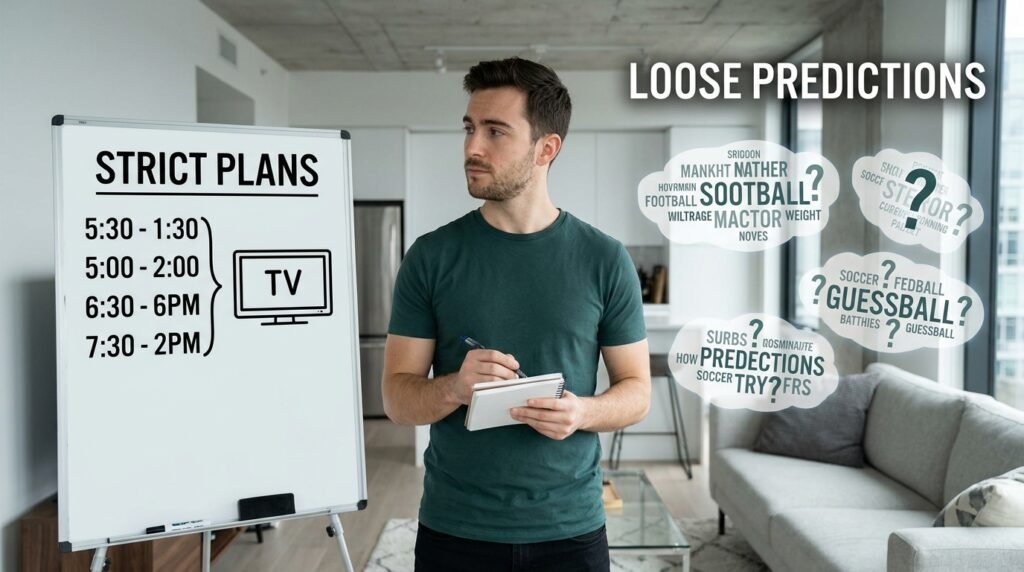
The future tense presents another massive trap. Learners often mix up strict plans with loose predictions.
I used my passion for Brazilian professional soccer to separate these concepts. I follow the intense rivalry between Vasco da Gama and Flamengo. The fan forums are loud, aggressive, and highly emotional. I read these forums in my target language to pick up natural phrasing.
This is where I mastered the future tenses.
When fans argue on the forum, they use predictions. They say, “Flamengo will lose.” They say, “The referee will make a terrible call.” They use the simple future tense because they are guessing. They have no proof. It is an opinion thrown into the void.
I contrasted this with my actual weekend schedule. I say, “I am going to watch the Vasco game on Sunday.” This is not a guess. I have the television channel ready. I have the time blocked out. It is a concrete plan.
I stopped studying the verb endings for the future tense. I just asked myself one question. Am I guessing, or am I planning?
If I was guessing about a soccer match, I used the simple prediction tense. If I was planning my content calendar for work, I used the concrete intention tense. The grammar stopped being a rigid rule and became an expression of my own certainty.
The Power of the Time-Stamp Vocabulary
You can cheat your way through a lot of grammar by mastering time stamps.
A time stamp is a specific vocabulary word that forces a sentence into a certain time frame. Words like yesterday, currently, tomorrow, lately, recently, and previously.
I stopped relying on verb conjugations to do all the heavy lifting. I started leading every sentence with a strong time stamp.
If I want to tell a story about my childhood, I start the sentence with “Many years ago.” This immediately signals to the listener that we are operating in the past. It sets the stage.
Once you provide a clear time stamp, the listener automatically adjusts their expectations. If you mess up the verb conjugation later in the sentence, they will still understand you perfectly. Their brain uses the time stamp to override your grammar mistake.
I built a list of twenty highly useful time stamps. I practiced attaching them to basic verbs. “Right now, I write.” “Yesterday, I write.” “Next year, I write.” It sounded a bit rough, but it communicated my ideas flawlessly. It kept the conversation moving forward while I slowly refined my verb endings behind the scenes.
Building Professional Context Bubbles
I manage multiple digital projects. I run sites, optimize content, and write privacy policies. I spend eight hours a day doing highly technical work. I realized this environment was the perfect place to practice complex tenses.
I created context bubbles around my specific work tasks.
When I finish writing an article, I look at the screen and declare the action completed. I say, “I have published the post.” I use the perfect tense because the result of the action is sitting right there on the screen.
When I am in the middle of a tedious site audit, I narrate my ongoing struggle. I say, “I have been fixing broken links for three hours.” I use the continuous perfect tense because the action started in the past, it is still happening, and I am highly annoyed by it.
I tied the most complicated grammar structures to the most mundane work tasks. The repetition of my daily job provided the perfect practice environment. Incorporating these rules into my work life was The Way I Made Grammar Feel Less Boring and it completely eliminated the need for dedicated study sessions.
Dropping the Academic Ego
The final step in mastering tenses was entirely psychological. I had to drop my ego.
As adults, we hate sounding foolish. We are used to being articulate. When we learn a new language, we are stripped of our sophisticated vocabulary. We sound like toddlers.
To protect our pride, we refuse to speak until we can form a perfect, grammatically flawless sentence. We stay silent. We calculate. We wait.
This perfectionism destroys progress. You must embrace the ugly sentence.
I started forcing myself to speak before my brain finished calculating the tense. I would open my mouth and just let the words fall out. Sometimes I used the future tense to talk about what I had for breakfast. Sometimes I used the present tense to describe a movie I saw last year.
I looked foolish. I made mistakes. But I communicated.
Native speakers do not carry red pens. They do not grade your grammar. They just want to understand your story. If you use the wrong tense, they will often gently repeat the sentence back to you with the correct verb. They give you the answer for free.
You have to be willing to fail loudly. The fastest way to learn a rule is to break it in front of a native speaker and pay attention to how they fix it.

The Tipping Point
There is no magic shortcut to perfect grammar. You have to put in the hours. You have to expose your brain to massive amounts of input.
But you can control how you process that input. You can choose to stare at abstract tables, or you can choose to map the language onto your actual life.
I knew I had finally broken through the barrier during a casual conversation about coffee. I was explaining the difference between a natural process bean and a washed bean. I told a story about a specific cup of coffee I drank three years ago in a small cafe.
I spoke for two minutes straight. I used the past tense. I used the present tense. I used conditional phrases.
When I finished the story, I realized something incredible. I had not thought about the grammar once. I did not calculate any conjugations. I did not picture any verb tables in my head. I just remembered the taste of the coffee, and the words matched the memory perfectly.
The grammar had moved from my logical brain into my subconscious instinct.
Stop treating tenses like a math test. Stop trying to translate every single word. Look at your life. Look at the actions you are performing right now. Look at the plans you have for tomorrow. Anchor the language to those concrete realities. When you stop studying the rules and start living them, the confusion will vanish, and the right words will simply appear.

Gabriel Henrique is a language enthusiast and productivity writer. After testing countless study methods, he became obsessed with mastering new languages efficiently. He achieves this without burnout, without endless grammar drills, and without losing focus. At Blog The Curious, he shares everything he has learned along the way.