
I stood at the counter of a busy local bakery. I wanted to order a simple loaf of bread. I took a deep breath. I spoke the sentence out loud. I knew my vocabulary was completely accurate. I knew my grammar was totally flawless.
The baker stopped wiping the counter. He stared at me with a completely blank expression. He leaned across the glass case and asked me to repeat myself. I repeated the sentence slower. He still looked highly confused. He finally guessed what I wanted, handed me the bread, and turned away.
I walked out of the bakery feeling completely defeated. The reality was harsh. My perfect grammar was entirely useless because my accent was too thick. The native speaker could not decode the clumsy sounds coming out of my mouth.
People treat accents like a random genetic lottery. They think you either have a natural ear for languages or you do not. This is a massive myth. An accent is not a magical gift. It is a strict physical habit.
Your mouth is a complex machine made of small muscles. You have spent your entire life training those specific muscles to make English sounds. When you try to speak a new language, you force those muscles to move in brand new ways. They resist. They take lazy shortcuts. The final result is a heavy, muddy accent.
I stopped treating my accent as a mysterious problem. I started treating it as a purely mechanical failure. I broke down the physical movements of my mouth. I made tiny, deliberate adjustments to my daily speaking habits. These small physical changes completely transformed the way I sounded. Here is exactly what I changed to improve my accent.
Purifying the Lazy Vowels
Beginners always obsess over the hard consonants. They spend weeks trying to roll an R or make a harsh scraping sound in the back of their throat.
Consonants are just the skeleton of a word. The vowels are the actual meat. The vowels carry the entire weight of your accent. If your vowels are wrong, your entire sentence sounds completely foreign.
English vowels are incredibly lazy. They glide constantly. They slide around in your mouth. When you say the letter O in English, your lips physically move and close as you make the sound. It is not a single, solid sound. It is a shifting sound.
Foreign languages do not tolerate lazy vowels. They demand pure, rigid, sharp vowel sounds. If you use a sliding English vowel in a foreign word, you instantly reveal yourself as a beginner.
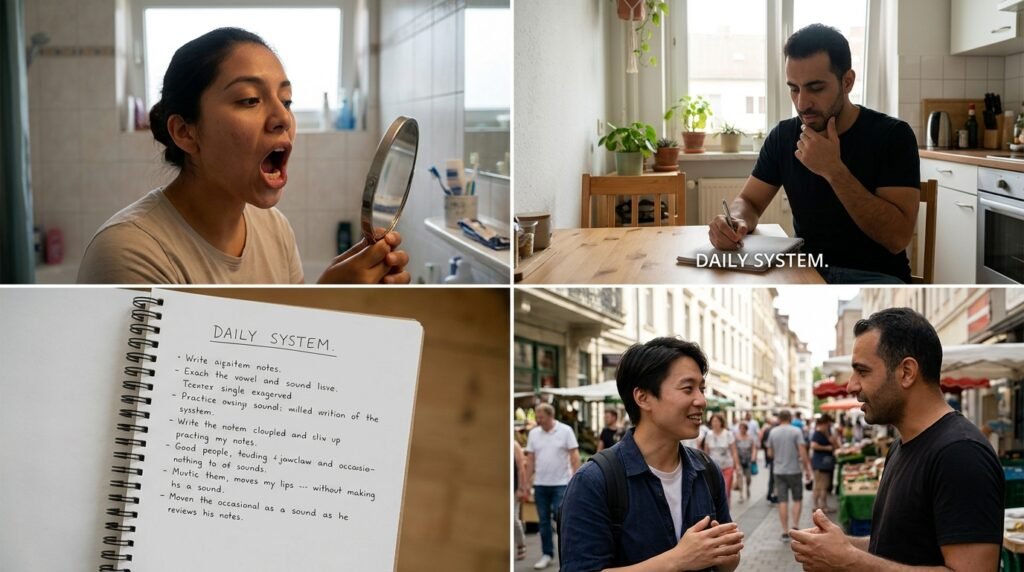
I completely stopped worrying about difficult consonants. I put all my focus strictly on my vowels. I stood in front of my bathroom mirror. I practiced opening my mouth significantly wider. I practiced locking my jaw firmly in place. I refused to let my lips slide around when I made a sound.
This single adjustment felt highly unnatural at first. My face physically ached from the new tension. But the results were undeniable. When you purify your vowels, your accent instantly sounds sharper and more authentic. You stop sounding like a tourist. You start sounding local.
To make these physical changes permanent, you have to build a highly rigid daily system. I created a strict schedule to ensure I was drilling these mechanical movements daily. I document exactly How I Practiced Pronunciation Every Day to build this specific muscle memory.
Changing the Resting Mouth Posture
Every single language has a specific resting mouth posture. This is the exact shape your mouth naturally takes when you are not speaking.
In English, the resting posture is very relaxed. The tongue sits flat and heavy in the bottom of the mouth. The lips are loose. The jaw drops slightly.
Other languages require a completely different physical posture. Some languages require the tongue to sit high against the roof of the mouth right behind the front teeth. Some languages require the lips to be constantly pushed forward in a tight circle.
If you try to speak a foreign language using a relaxed English resting posture, you are starting a race from the completely wrong starting line. Your tongue has to travel too far to make the correct sounds. This physical distance creates a heavy, dragging delay in your speech.
I actively researched the resting posture of my target language. I found out the native speakers hold a massive amount of tension in their upper lip. Their tongues sit much farther forward in their mouths.
I started practicing this new resting posture. I held my mouth in this new position while driving my car. I held it while reading emails at my desk. I trained my facial muscles to accept this new physical position as normal. When I finally opened my mouth to speak, the correct sounds came out much faster. My tongue was already exactly where it needed to be.
Flattening the Aggressive Melody
Language is completely musical. Every single language has a unique rhythm, a specific pitch, and a defined melody.
English is a highly aggressive, bouncing language. We stress random syllables heavily. We jump up and down in pitch to show emotion. We punch certain words and swallow others completely.
Many foreign languages are much flatter. They flow like a steady, continuous stream of water. Every single syllable gets the exact same amount of time and energy.
If you apply the bouncing, aggressive English melody to a flat foreign language, your accent will sound terrible. You will sound angry, confused, or entirely erratic.
I stopped listening to the vocabulary and started listening strictly to the music. I put on native podcasts and completely ignored the actual meaning of the words. I hummed along with the speakers. I paid close attention to how their voices rose slightly at the end of a sentence. I noticed how they maintained a perfectly steady rhythm.
I started mimicking that exact melody when I spoke. I flattened out my aggressive English rhythm entirely. I forced myself to give every single syllable the exact same amount of physical time. My speech immediately sounded much more natural and much less chaotic.
The Consonant Clipping Rule
English speakers are incredibly sloppy with the ends of their words. We rarely pronounce the final consonant clearly. We just let the word fade away into silence. We swallow the final T or K sounds.
In many other languages, the final consonant is absolutely critical. If you do not pronounce it sharply, the word changes meaning entirely.
I realized I was dropping the ends of all my foreign words. I was swallowing the final syllables out of pure native habit. This made my speech sound muddy and highly confusing. Native speakers had to constantly ask me to repeat myself.
I implemented a new rule for myself. I called it consonant clipping. I forced myself to aggressively punch the final letter of every single word. I made the sound incredibly sharp and obvious in the empty room.
This mechanical rule forces you to physically finish the word before you start the next one. It prevents the words from bleeding into a messy puddle of sound. It also slows down your overall speaking pace, which is a massive advantage. When you punch the final consonants clearly, your speech sounds highly educated.

Utilizing the Audio Mirror
Listening to your own voice is a brutal but completely necessary step. You hear things on a recording that your brain normally filters out in real time. It is the absolute only way to gather objective data on your accent.
I realized that forcing myself to analyze these painful recordings was essential. I wrote a complete guide on How I Got Comfortable Hearing My Own Voice to help you survive this exact process.
When you listen to the tape, you hear the exact moments where your native English accent bleeds through. You hear the lazy vowels. You hear the swallowed consonants. You hear the bouncing rhythm.
I took a red pen and wrote down my exact failures. I targeted those specific physical sounds the very next day during my mirror practice. The voice recorder strips away your ego and gives you a perfect roadmap for mechanical improvement.
The Intense Shadowing Workout
You cannot fix your accent in a vacuum. You need a perfect, native model to copy.
I started using a physical technique called shadowing. I found short, fast audio clips of native speakers telling casual stories. I put on heavy noise canceling headphones. I hit play.
I spoke out loud at the exact same time as the native speaker. I tried to completely overlap my voice with their voice. I copied their exact speed. I copied their exact breath pauses. I copied their precise tone.
This is an intense physical workout. Your tongue will physically ache. Your brain will struggle heavily to keep up the pace. But shadowing completely bypasses your internal logical filters. It forces your mouth to adopt the native rhythm without giving your brain time to interfere or calculate.
I did this for ten minutes every single day. The mechanical results compound rapidly. Your mouth physically learns the dance steps of the language. When you finally speak in a real conversation, your mouth automatically executes those native dance steps.
Removing the Vocal Cords
Sometimes your accent suffers because you are trying to do entirely too many things at once. You are trying to remember the vocabulary, calculate the grammar rules, project your voice, and shape your mouth all at the exact same time. It is a massive mental overload.
I used the whisper drill to isolate the physical movements.
I took a complex, difficult sentence. I completely removed my vocal cords from the equation. I whispered the sentence out loud to the room.
When you whisper, you do not have to worry about pitch, volume, or tone. Your brain can put one hundred percent of its energy entirely into the mechanical shape of your lips and your tongue.
I whispered the difficult sentences over and over again. I focused intensely on the physical friction of the hard consonants and the strict shapes of the pure vowels. I built the physical muscle memory in total silence.
When I finally turned my vocal cords back on and spoke the sentence at a normal volume, the pronunciation was flawless. The complex mechanics were already perfectly mapped in my facial muscles.
Removing the mental overload is crucial for a clean accent. If you are constantly calculating grammar, your mouth will stumble. You need your brain to trust your mouth. I outline exactly how to build this physical trust in The Method That Helped Me Speak Without Overthinking so you can achieve true fluency.
Deep Diaphragmatic Projection
Your accent is heavily influenced by how you use your physical air.
When you are nervous, you take very shallow breaths into the top of your chest. You speak quietly. You hold back your air. This makes your voice sound thin, weak, and highly foreign. Your throat tightens up, changing the exact shape of your sounds.
I had to relearn how to breathe. I learned to breathe deeply into my stomach. I took massive columns of air from my diaphragm and used them to push the words out of my mouth aggressively.
When you support your voice with deep air, you sound incredibly confident. The physical resonance of your voice changes completely. The words sound heavier and much more deliberate.
This deep projection hides many minor pronunciation flaws. The native speaker hears the strong, steady confidence vibrating in your chest. They automatically perceive your accent as being much better than it actually is because you are speaking with total authority.

The Goal is Absolute Clarity
Improving your accent does not require a special genetic talent. It requires strict physical discipline.
You have to treat your mouth exactly like a mechanical instrument. You have to actively break decades of lazy native speaking habits. You have to purify your vowels, permanently change your resting posture, and adopt a completely new musical rhythm.
Stop trying to sound absolutely perfect on day one. Start making tiny, deliberate mechanical changes. Record your voice today. Face the ugly truth on the playback. Drill the weak points relentlessly in front of your bathroom mirror until your jaw muscles actually feel tired.
The ultimate goal is not to trick people into thinking you were born in their specific country. The goal is absolute clarity.
When you speak clearly, you completely remove the heavy friction from the conversation. You allow the other person to relax. You allow them to focus entirely on your message instead of struggling to decode your strange sounds. Put in the physical, embarrassing work today. Your voice will carry your ideas beautifully tomorrow.

Gabriel Henrique is a language enthusiast and productivity writer. After testing countless study methods, he became obsessed with mastering new languages efficiently. He achieves this without burnout, without endless grammar drills, and without losing focus. At Blog The Curious, he shares everything he has learned along the way.