
I sat in the back row of a crowded language classroom. The room was hot. The teacher stood at the front with a black marker. He drew a massive, complex diagram on the whiteboard. He connected circles with intersecting arrows. He wrote long, confusing academic terms underneath each circle. He called it the definitive guide to advanced verb conjugation. It looked exactly like a highly technical engineering schematic.
My brain completely shut down. I could not process a single thing he said. I stared at the arrows and felt entirely defeated. I walked out of that room believing my brain was simply defective. I thought I lacked the special genetic talent required to learn foreign languages.
Later that afternoon, I met a friend at a quiet park. He spoke four languages fluently. I complained to him about the engineering schematic. I told him the rules were too heavy. I told him I could not memorize the formulas.
He laughed out loud. He told me I was looking at the problem entirely backwards. He gave me a radically simple explanation. It completely shattered my confusion. It made everything clear in ten seconds. Here is the exact explanation that changed my entire trajectory.
The Stage Play Metaphor
My friend told me to stop treating the language like a math equation. He told me to stop looking for formulas. He gave me a new mental model.
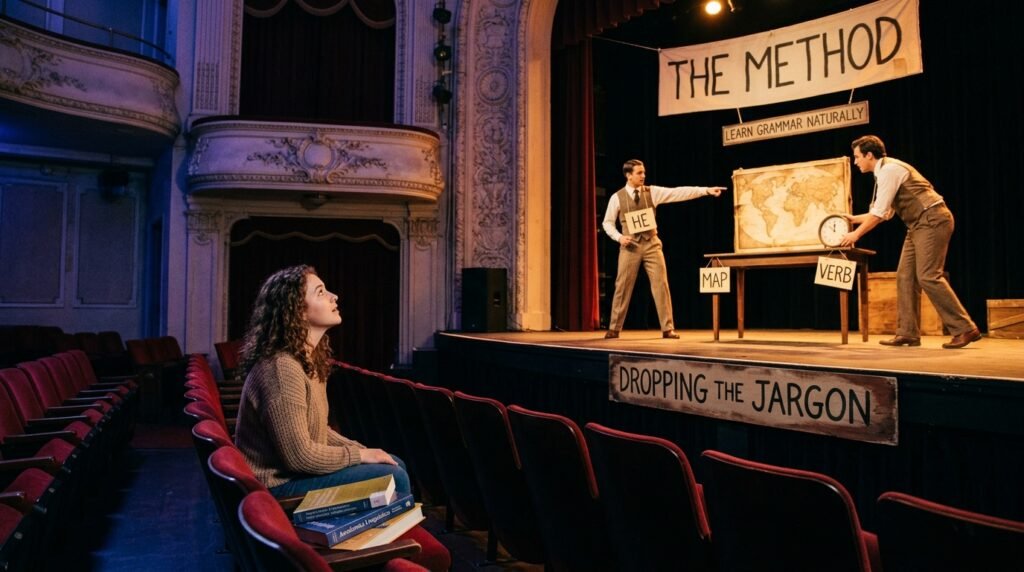
He said that human language is exactly like a live stage play.
When you sit in a theater, you do not think about the mathematical physics of the stage lighting. You do not analyze the chemical composition of the wooden props. You just watch the actors move. You watch the story unfold.
Every single grammar rule in existence is just a simple piece of theatrical stage direction. Grammar simply tells you who is standing on the stage, what they are holding, and what time of day it is. That is the entire secret.
I completely stopped reading the academic textbooks. I explain this exact mental shift in The Method I Used to Learn Grammar Naturally so you can fully understand the process of dropping the jargon. I started viewing every single sentence as a tiny, highly visual theatrical production.
Setting the Lighting
The most intimidating part of grammar is always the verb tenses. Textbooks use terrifying words like pluperfect, preterite, and future continuous. These words cause massive anxiety.
My friend told me to forget those words entirely. Verb tenses are just lighting cues on the stage. They instantly set the mood and the timeline.
When you use a past tense, you are simply dimming the stage lights. You are telling the listener that the action is a memory. The scene is slightly blurry. It already happened.
When you use the present tense, you are turning on a massive, bright spotlight. The action is happening right now in front of your eyes. It is urgent and clear.
When you use the future tense, you are pointing a laser pointer at the closed curtain. You are indicating something that has not appeared on the stage yet.
You do not need to memorize a complex conjugation chart to understand time. You just need to decide which lighting cue fits your story. You pick the light, and you shine it on the actors.
Identifying the Lead Actor
Every stage play needs a lead actor. In grammar, the textbook calls this the nominative case or the subject.
This terminology is completely useless for a beginner. You just need to find the person doing the action. The lead actor is the person pushing the story forward.
If the sentence is about a dog chasing a car, the dog is the lead actor. The dog owns the spotlight. The dog is doing the physical work.
I stopped trying to label the subject of my sentences. I just visualized the stage. I asked myself who was standing center stage under the brightest light. Once I identified the lead actor, the rest of the sentence naturally built itself around them.
Handing Out the Props
The next massive hurdle for language learners is understanding direct and indirect objects. Textbooks use cases like the accusative and the dative. They force you to memorize strict ending changes for your nouns. It feels like solving a puzzle blindfolded.
The stage play explanation makes this incredibly simple.
The direct object is simply the prop being held. The indirect object is the person catching the prop.
Let us go back to the stage. The lead actor picks up a heavy red ball. He throws the ball across the stage to a second actor.
The lead actor is doing the throwing. The red ball is the prop. The second actor is the catcher.
When you want to build a sentence, you just hand out the props. You do not need to think about the accusative case. You just need to know what object is flying through the air. You do not need to think about the dative case. You just need to know whose hands are catching the object.
Visualizing the physical movement of a prop makes the grammar rules completely obvious. You literally see the action moving from one person to another.
The Wardrobe Department
Sentences look extremely complicated when they are filled with adjectives and adverbs. A basic sentence can turn into a massive paragraph. This overwhelves your processing speed.
My friend told me to treat adjectives and adverbs strictly as the wardrobe department. They do not change the core story. They just change how the actors look.
An adjective is a heavy winter coat placed on a noun. An adverb is a pair of fast running shoes placed on a verb.
If you get confused by a long sentence, just mentally strip the actors naked. Remove all the descriptive words. Look at the bare bones of the action. Find the lead actor. Find the prop. Find the catcher.
Once you understand the basic plot of the play, you can slowly put the costumes back on. You realize the heavy winter coat does not change the fact that the actor is still throwing the red ball. This mental trick instantly makes long paragraphs readable and completely unthreatening.

Stage Directions
Prepositions are tiny, frustrating words. Words like in, on, at, through, and under cause endless headaches. Every language uses them completely differently. You cannot translate them directly.
I tried to memorize lists of prepositions for months. It never worked. I would always use the wrong one in conversation.
The stage play metaphor fixes this immediately. Prepositions are just literal stage directions written on the floor in tape. They tell the actors exactly where to stand in relation to the props.
Do not try to translate the word “on” into your native language. Translation destroys your natural flow. I talk about fixing this specific problem in How I Learned to Stop Translating in My Head to help you stay present in the moment.
Instead of translating, just visualize the spatial relationship. Is the actor standing on top of the box? Is the actor hiding underneath the box? Is the actor walking directly through the door?
Prepositions map physical space. If you mentally picture the actors moving around the stage props, you will intuitively choose the correct preposition. Your brain understands spatial relationships much faster than it understands dictionary definitions.
The Dream Sequence
The most terrifying concept in any language is the subjunctive mood. Textbooks devote entire books to this single topic. They frame it as a highly advanced, nearly impossible rule to master.
The simple explanation destroys this fear completely.
The subjunctive mood is not a rule. It is a dream sequence.
Sometimes a stage play stops the main action. The lights turn purple. Smoke fills the floor. The actors start acting out a fantasy, a deep wish, or a terrible fear. The scene is not actually happening in the real world of the play. It is happening inside a character’s imagination.
That is exactly what the subjunctive mood is. You use it when you are talking about something that is not concrete reality. You use it to express doubt, desire, or intense emotion.
You are stepping off the solid ground of facts and stepping into the smoke of the imagination. When you want to express a deep wish, you just trigger the dream sequence. You change the verb slightly to let the audience know you are no longer talking about hard facts. It is a change in atmosphere, not a mathematical calculation.
Firing the Internal Director
When you learn traditional grammar, you become a terrible, micromanaging stage director.
You stand in the front row and scream at the actors. You tell them their posture is wrong. You tell them they are holding the prop in the wrong hand. You constantly interrupt the play to check the script.
This internal director lives inside your head. It is the voice that makes you stutter. It is the voice that makes you freeze before you speak.
You have to completely fire that internal director. You have to let the play run.
When you are in a real conversation, you cannot stop to fix a minor costume mistake. If you use the wrong adjective ending, the play still continues. The audience still understands the plot. The lead actor still threw the ball. The catcher still caught it.
The goal of language is to deliver the core message. It is not to put on a technically flawless performance. The audience wants to feel your emotion. They do not care if one of the stage lights flickers for a second.
Watching the Rehearsals
If grammar is a stage play, you cannot learn it by reading the script in a quiet room. Reading a script does not teach you timing. It does not teach you delivery. It does not teach you the rhythm of the dialogue.
You have to go sit in the theater and watch the rehearsals.
You must consume massive amounts of native media. You must watch native speakers act out their daily lives. You must observe how they hand props to each other. You must listen to the exact moment they dim the stage lights to tell a story about the past.
Observation is the greatest teacher. When you watch the play performed correctly a thousand times, you naturally memorize the movements. You build a new physical reflex. I outline my daily observation routine in How I Learned Words Faster by Changing My Approach so you can build massive daily momentum without studying.
Your brain absorbs the patterns silently. You stop thinking about the rules entirely. You just know where to stand on the stage because you have seen other people stand there so many times.

Trusting the Visual Mind
The human brain is a highly visual machine. We evolved to track physical movement in three dimensional space. We did not evolve to read complex conjugation tables on a flat piece of paper.
When you force your brain to learn through academic terminology, you are fighting your own biology. You are working against millions of years of evolution.
The stage play explanation works because it aligns perfectly with your biology. It translates abstract, invisible rules into concrete, physical movements. It turns a boring sentence into an active, moving picture.
The next time you open a language book and feel overwhelmed, close the book immediately. Take a deep breath. Look at the confusing sentence.
Find the lead actor. Find the prop. Look at the lighting. Watch the action unfold in your imagination.
You will be entirely shocked at how quickly the confusion vanishes. The language is not trying to trick you. It is just trying to tell you a story. Drop the heavy academic labels. Step back from the whiteboard. Just focus on the actors and let the play begin.

Gabriel Henrique is a language enthusiast and productivity writer. After testing countless study methods, he became obsessed with mastering new languages efficiently. He achieves this without burnout, without endless grammar drills, and without losing focus. At Blog The Curious, he shares everything he has learned along the way.