
I sat at my desk completely exhausted. I was looking at a list of new vocabulary words. I knew every single definition perfectly. I understood the complex grammar rules behind the sentences. But the thought of actually calling my language partner to practice speaking made my stomach tie into tight knots.
I felt a massive, heavy mental block. Speaking felt like an impossible mountain to climb. Every time I opened my mouth in a real conversation, my brain froze. I stuttered. I forgot the simplest verbs. I felt like a complete beginner despite months of hard work.
The pressure of performing for another human being was crushing my ability to communicate. I realized that my study methods were completely broken. I was training my eyes to read. I was training my hands to write. I was absolutely not training my mouth to speak.
I needed a radical change. I needed to remove the heavy pressure. I developed one specific daily habit that completely transformed my spoken fluency. It took the act of speaking from a terrifying chore to an effortless, daily reflex. Here is exactly the habit that made speaking feel incredibly easy.
The Problem With an Audience
We naturally view conversation as a performance. When you speak to a native speaker, you feel like you are standing on a stage under a bright spotlight.
You desperately want to sound intelligent. You want to prove that you are making progress. You want them to respect you. This intense desire for approval triggers a massive stress response in your brain.
When you are stressed, your brain physically changes how it processes information. It shuts down the creative, fluid language centers. It shifts into survival mode. You cannot access your deep memory banks. You literally lose access to the vocabulary you studied the night before.
I realized I could not build speaking confidence while my brain was in survival mode. I had to completely remove the audience. I had to practice speaking in an environment with zero social pressure.

The Habit of Constant Narration
I started talking strictly to myself. I turned my empty home office into a private language laboratory.
I decided to stop letting my thoughts remain silent. I forced my internal monologue entirely out into the physical world. I began narrating my daily life out loud in my target language.
I spend hours every day managing my network of digital blogs. I write articles. I update legal documentation. I analyze search traffic. I started describing all of these actions out loud while I did them.
I spoke to my computer monitor. I said, “I am opening a new document. I am writing an article about productivity. The website traffic is increasing today.”
It felt incredibly foolish on the first day. It felt entirely unnatural. But the results were undeniable. By speaking to an empty room, I completely bypassed my social anxiety. I gave my brain permission to fail safely. I cover the exact psychology behind breaking this social fear in What I Did to Stop Freezing During Conversations because you absolutely must kill the performance anxiety first.
Lowering the Mental Stakes
When you talk to yourself, the stakes are completely nonexistent. There is no native speaker waiting for your response. There is no one to judge your broken grammar.
This lack of judgment allows your brain to relax. When your brain is relaxed, the language flows significantly faster.
I realized my biggest problem was perfectionism. I wanted every sentence to be a masterpiece. The narration habit violently destroyed my perfectionism. When I narrated my actions, I spoke quickly. If I used the wrong verb tense, I just ignored it and kept talking.
I focused entirely on the sheer volume of output. I prioritized continuous momentum over technical accuracy. I trained my mouth to keep moving no matter what happened. This built incredible physical endurance.
Mapping Language to Physical Reality
Most people learn language in a completely sterile environment. You sit at a desk and look at black text on a white page. The words have no physical context.
The narration habit maps the foreign language directly onto your physical reality.
I am deeply meticulous about my morning coffee routine. I use a specific V60 pour over method. I weigh the heirloom Ethiopian beans on a digital scale. I monitor the exact temperature of the water.
I used this highly focused routine as a dedicated speaking drill. While the water boiled, I narrated the entire process out loud. I described the smell of the roasted coffee. I described the heat of the water.
This attaches the foreign vocabulary to physical sensations. When you connect a word to a smell, a temperature, or a physical movement, your brain locks it into deep memory permanently. You completely stop translating from English because the foreign word is directly attached to the physical object in your hand.
Discovering Your Personal Vocabulary Gaps
Textbooks teach you generalized vocabulary. They teach you how to ask for directions to a museum. They teach you how to order a basic meal at a restaurant.
They do not teach you the specific vocabulary of your actual, personal life.
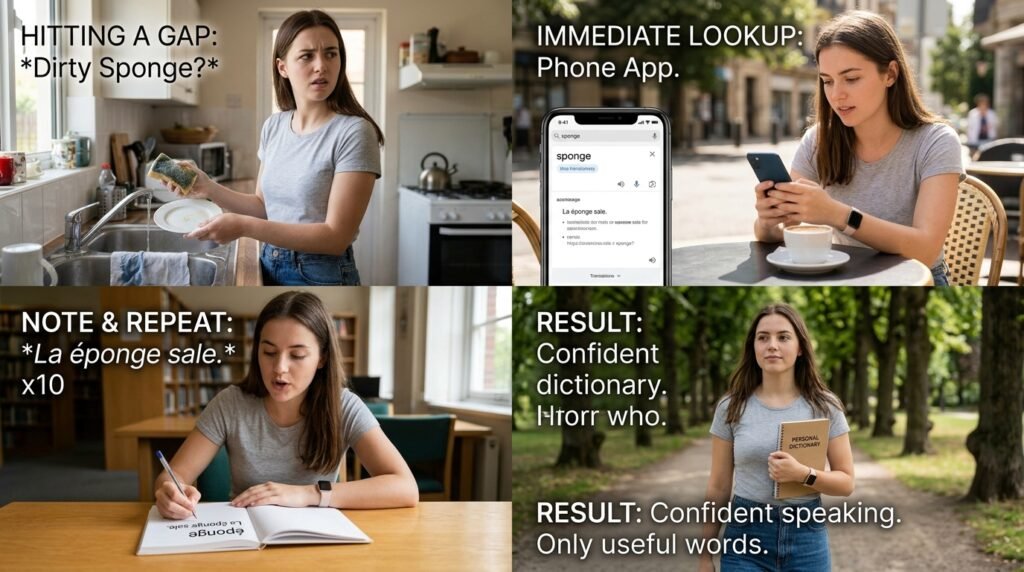
When you start narrating your daily actions, you immediately hit massive vocabulary gaps. You realize you can discuss international politics, but you do not know the correct foreign word for a dirty sponge or a paper clip.
This is incredibly valuable data.
When I hit a vocabulary gap during my daily narration, I stopped immediately. I pulled out my phone. I looked up the exact word I was missing. I wrote it down. Then I repeated the complete sentence out loud ten times.
This ensures you are only learning words you actually need to survive your daily life. You stop wasting time memorizing useless flashcards. You build a highly personalized, deeply relevant dictionary. You can read exactly how to structure this targeted learning approach in How I Built Confidence Speaking Step by Step to guarantee you never waste another study hour.
Analyzing Complex Data Out Loud
Narrating household chores is fantastic for building a foundation. But you also need to practice expressing complex logic.
I run statistical models for professional basketball games. I spend hours analyzing data to find the probability of a specific player grabbing a rebound or recording an assist.
I started using this intense analytical work for my speaking practice. I stood up from my desk. I paced around the room. I pretended I was a professional sports analyst on live television.
I argued my statistical predictions out loud in my target language. I explained why a certain point guard was highly likely to score the first basket in the playoff game. I explained the exact logic behind the numbers.
This drill forces you to use advanced transition words. You have to express doubt, probability, and strict certainty. You have to link multiple complex clauses together smoothly. It rapidly expands your conversational range.
Treating the Mouth as a Muscle
Speaking is not just a mental exercise. It is a highly demanding physical workout.
Your native language uses a very specific set of facial muscles. Your mouth is entirely accustomed to making English sounds. When you try to speak a foreign language, you demand completely new physical movements.
Your lazy native muscles will actively resist these new movements. They will take shortcuts. The result is a heavy, muddy accent and frequent stuttering.
Talking to myself for an hour a day was strict physical resistance training for my jaw and tongue.
I forced my mouth to form the strange new vowels. I forced my tongue into uncomfortable new positions. My facial muscles literally ached after the first week of this habit. That physical soreness proved I was actually building the necessary muscle memory.
When your mouth physically knows how to form the words, speaking feels infinitely easier. The mechanical friction completely disappears.
Embracing the Absurdity
Talking loudly to yourself in an empty room feels incredibly stupid.
When you first start doing this, your ego will fight you. You will feel highly self conscious. You will worry that your neighbors can hear you through the thin walls. You will feel crazy arguing passionately with a blank wall about basketball statistics.
You must completely surrender your dignity.
If you are too proud to sound ridiculous in the privacy of your own home, you will never sound confident in public. Fluency requires a total lack of shame.
I learned to laugh at myself. When my tongue tied itself into a knot over a simple verb conjugation, I did not get angry. I just smiled, took a deep breath, and started the sentence completely over. I built a private sanctuary where mistakes were entirely harmless.
Building Raw Vocal Speed
When you practice in a low pressure environment, you can experiment with speed.
Slow speaking often causes translation. When you speak slowly, your brain has too much time to think. It tries to drag the words back into English. It tries to analyze the grammar rules.
I used my solo practice to build raw vocal speed. I picked a random topic and set a timer for exactly sixty seconds. I forced myself to speak about the topic at absolute maximum speed until the timer stopped.
I completely ignored my terrible grammar. I completely ignored my sloppy pronunciation. The only goal was rapid, continuous vocal output.
This drill completely short circuits the analytical brain. You physically cannot translate when you are speaking at top speed. You rely entirely on pure reflex. If you want to see exactly how to implement this high speed conditioning, check out The Technique That Helped Me Speak Faster to help you permanently break your internal speed limits.
Preparing the Mental Grooves
The brain is like a dense forest. Every time you speak a sentence, you walk through the forest and step on the grass.
If you only speak once a week, the grass grows back instantly. The path disappears. The next time you try to speak, you have to fight your way through the thick brush all over again. It feels exhausting.
If you speak to yourself every single day, you beat down a clear dirt path. You walk the exact same route over and over. The path becomes wide, flat, and extremely fast.
My daily narration habit carved massive, deep grooves into my brain. I repeated the structures for asking questions, stating opinions, and describing actions thousands of times in the safety of my apartment.
The language stopped feeling foreign. It started feeling like a deeply ingrained physical habit. The words were always resting right at the front of my mind, completely ready to be deployed.
Transferring the Skill to the Real World
Solo practice is the ultimate training camp. But eventually, you have to test your skills in a real game.
After months of talking to my empty apartment, I finally met with a native speaker at a loud local cafe. My heart still beat fast before the meeting. The nervous energy was still there.
But the moment he asked me a question, everything changed.
I opened my mouth, and the words simply fell out. There was absolutely zero hesitation. I did not freeze. I did not search for an English translation. My mouth just executed the exact physical routines I had drilled thousands of times in my kitchen.
I was completely shocked by how easy it felt. The heavy mental block was entirely gone.
The native speaker smiled and replied naturally. We had a fluid, continuous conversation for over an hour. All those bizarre hours of narrating my coffee brewing and analyzing sports data completely paid off.
Consistency Over Intensity
You do not need to lock yourself in a room for four hours a day to achieve this. Massive intensity leads to massive burnout.
You only need relentless daily consistency.
I narrated my life for exactly fifteen minutes a day. I did it while I was showering. I did it while I was cooking. I did it while I was driving my car to the grocery store.
I scattered the practice across the empty margins of my existing life. Because the daily time commitment was so incredibly low, I never used fatigue as an excuse to skip a session.
The small daily actions compound heavily over time. Fifteen minutes a day equals roughly ninety hours of active spoken output over a single year. Ninety hours of raw vocal output will completely transform your fluency.

Stop Waiting for Permission
The biggest mistake you can make is waiting for the perfect conversation partner to arrive.
You do not need a tutor. You do not need to move to a foreign country. You do not need a native speaker sitting across from you to practice your speaking skills.
Your environment is exactly what you make it. You have everything you need right now. You have a voice, a brain, and an immediate physical reality surrounding you.
Stand up from your desk right now. Look at the objects in your room. Start naming them out loud. Describe the weather outside your window. Explain exactly what you are going to eat for dinner tonight.
Force the language out of your silent brain and pull it deeply into your physical body. Accept the awkwardness. Embrace the absolute absurdity of talking to yourself. The more words you push out into the empty air of your home, the easier the words will flow when you finally step out into the real world.
Gabriel Henrique is a language enthusiast and productivity writer. After testing countless study methods, he became obsessed with mastering new languages efficiently. He achieves this without burnout, without endless grammar drills, and without losing focus. At Blog The Curious, he shares everything he has learned along the way.