
I spent six months studying a foreign language in total silence. I memorized massive vocabulary lists. I understood complex grammar charts perfectly. I could read articles without looking at a dictionary. I felt incredibly smart sitting alone at my desk.
Then I tried to speak to a real person.
I walked into a local cafe. A native speaker stood behind the counter. He asked me what I wanted to drink. My brain completely froze. The massive vocabulary list vanished from my memory. I stared at him with wide eyes. I mumbled a completely broken sentence, pointed at a random pastry, paid, and quickly left the building.
My confidence was entirely destroyed. I realized that academic knowledge does not equal spoken confidence. Knowing the words is useless if your body completely panics under social pressure.
Confidence is not a magical personality trait. You are not born with it. Confidence is a physical habit. You have to build it brick by brick. You have to train your nervous system to stay calm. I completely stopped reading textbooks. I built a strict, step by step system to conquer my speaking fear. Here is exactly how I built my spoken confidence from the ground up.
The Illusion of Instant Courage
People think you just need to be brave. They tell you to just go out there and talk to strangers. This is terrible advice.
If you are terrified of speaking, throwing yourself into a crowded language exchange event will only traumatize you. It will reinforce your deep fear of failure. Your brain will associate the foreign language strictly with massive social anxiety.
You cannot jump straight to the top of the mountain. You have to build a staircase. You have to start with situations that carry absolutely zero social risk. You have to prove to your brain that speaking out loud is completely safe.

Starting in an Empty Room
I started my confidence building process completely alone. I locked the door to my home office. I made sure absolutely nobody could hear me.
If you want to speak confidently in public, you must first speak confidently in private. I started talking to the blank walls. I forced my internal monologue out into the physical world.
I did not practice complex debates. I practiced raw, basic sentences. I pointed at my computer monitor and named it. I pointed at my desk and named it. I spoke loudly and clearly.
This sounds incredibly silly. But it serves a vital mechanical purpose. It forces your jaw, your tongue, and your vocal cords to physically produce the foreign sounds. Your mouth needs strict physical exercise. When your mouth gets comfortable making the sounds in an empty room, the friction slowly disappears.
Narrating the Daily Routine
Naming objects gets boring very quickly. I needed to practice real verbs and fluid sentences. I started narrating my daily physical routines.
I take my morning coffee extremely seriously. I use a V60 pour over method. I buy highly specific heirloom beans from the Guji region of Ethiopia. I weigh the beans perfectly on a digital scale. I use a gooseneck kettle to control the exact water temperature.
I turned this strict morning routine into my daily speaking laboratory. While the water boiled, I narrated every single physical step out loud in my target language.
I said, “I am grinding the coffee beans. The water is hot. I am pouring the water over the grounds.”
This attaches the foreign vocabulary directly to your physical reality. It bypasses your native English entirely. You stop translating because the words are tied to the physical objects in your hands. I heavily outline how to structure this solitary practice in How I Practiced Real Conversations by Myself to show you exactly how to build momentum without a partner.
Building an Unbreakable Script
The most terrifying part of any conversation is the very beginning. The first ten seconds hold all the panic. If you survive the first ten seconds, your heart rate naturally drops.
I decided to completely script my first ten seconds.
I wrote down a perfect, highly accurate introduction. I wrote down my name, my profession, and my exact reason for learning the language. I checked the grammar three times.
I memorized this short script perfectly. I practiced it hundreds of times in the shower. I practiced it while driving. I drilled it until it became a pure physical reflex.
When you have a perfect script ready, you completely eliminate the initial panic. You do not have to think. Your mouth just goes on autopilot. By the time you finish your introduction, you are calm enough to handle the unscripted rest of the conversation.
The Low Risk Transaction
After a month of talking to myself, I finally felt ready to face the real world. But I did not start with a complex conversation. I started with a highly controlled transaction.
I went to a small local bakery run by native speakers. A transaction is perfect because the dialogue is entirely predictable.
I knew exactly what the baker was going to say. He was going to ask for my order. I prepared my exact response before I even opened the front door. I walked up to the counter. I delivered my single sentence. I paid for the bread. I left.
The entire interaction lasted fifteen seconds. But the impact on my confidence was massive. A native speaker understood me. The communication was entirely successful. I proved to my brain that I could survive a real world interaction.
Shifting the Heavy Spotlight
Beginners feel a massive spotlight shining directly on their face during a conversation. They think they have to deliver long, perfect monologues to keep the other person entertained.
This pressure completely paralyzes you. You have to learn how to shift the spotlight.
I started memorizing simple follow up questions. When a native speaker finished a sentence, I immediately asked them a direct question. I asked for their opinion. I asked about their personal experience.
People absolutely love talking about themselves. When you ask a good question, the native speaker will gladly take over the conversation. They will talk for three solid minutes.
This gives your brain a massive break. You get to step out of the hot spotlight. You can take a deep breath. You can lower your heart rate. You control the pace of the interaction simply by asking the right questions.

Using Passion as a Shield
When you talk about a boring topic, you have to force the words out. When you talk about a topic you deeply love, the words flow naturally. Passion completely overrides anxiety.
I spend hours every week running complex statistical models for professional basketball games. I analyze player prop betting markets. I track the exact probability of an NBA player recording the first basket, a crucial assist, or a key rebound in a playoff series.
I decided to strictly talk about basketball during my language exchanges.
I learned the specific foreign vocabulary for statistics, probability, and sports analysis. When I talked about these topics, I completely forgot to be nervous. I was too busy defending my statistical models. My deep passion for the subject acted as a heavy shield against my social anxiety. Talk about what you know deeply. Your natural confidence in the subject will automatically transfer to your speaking voice.
Recognizing the Internal Panic
You must learn to recognize the exact physical signs of panic in your own body.
When I tried to speak and forgot a word, my body reacted instantly. My shoulders rose up to my ears. My jaw clenched tight. I stopped breathing from my stomach and started taking shallow breaths from my chest.
This physical tension chokes your vocal cords. It makes your voice sound weak and heavily strained.
I trained myself to perform a physical reset. When I felt the tension rising during a conversation, I forced myself to drop my shoulders immediately. I pushed my feet firmly into the floor. I took one deep, highly deliberate breath.
This physical grounding technique breaks the adrenaline loop. It tells your brain that you are not in physical danger. Once your body relaxes, your vocabulary naturally becomes accessible again. I explain exactly how to manage this fear reflex in What I Did When I Was Afraid to Speak so you can physically calm yourself down in real time.
Embracing the Awkward Silence
Fear feeds completely on silence and shame.
In the past, when I forgot a word, I stared at the floor in silent terror. I prayed the other person would not notice my failure. This silence made the situation infinitely worse. The awkwardness became totally unbearable.
I completely changed my reaction to failure. I decided to own the breakdown immediately.
When my brain froze in the middle of a sentence, I stopped staring at the floor. I looked the native speaker directly in the eye. I laughed out loud. I explicitly told them my brain just crashed.
By calling out the awkwardness directly, you destroy it instantly. The native speaker always laughs with you. They completely relax. They offer to help you find the missing word. Vulnerability builds instant human connection. When you show the other person that you are comfortable making mistakes, they become comfortable helping you fix them.
Killing the Internal Perfectionist
The deepest cause of conversational fear is strict self monitoring.
You treat every spoken sentence like a high school grammar test. You constantly monitor every single syllable. You check your verb conjugations. You check your noun genders.
This heavy self monitoring drains all your mental energy. It causes you to stumble. It causes the massive brain freeze.
You must fire the internal critic immediately. You must completely stop caring about your perfect grammar during a live conversation.
I shifted my focus entirely away from the mechanics of the language. I focused one hundred percent of my energy on the core message I wanted to deliver. I prioritized the human connection over strict technical accuracy. If I used the wrong past tense, I ignored it completely and kept moving forward.
Recording the Ugly Truth
You always think you sound worse than you actually do. Anxiety heavily distorts your perception of reality. You need objective data to prove to yourself that you are actually improving.
I started using the voice recorder app on my smartphone.
I recorded myself speaking for two minutes every single evening. I forced myself to listen to the playback.
The recordings were incredibly painful to hear at first. But they provided a highly accurate map of my actual skills. I realized my mistakes were not as terrible as my brain told me they were. I was perfectly understandable.
The digital voice recorder strips away your ego. It gives you raw facts. Listening to your own voice hardens your skin. It removes the shock factor. If you can listen to your own mistakes in private, you will not panic when you make them in public.
Increasing the Speed Slowly
Confidence allows you to build speed. But you cannot force speed before you have confidence.
When beginners try to speak fast, they stumble and completely destroy their own confidence. I focused entirely on deliberate, slow speech for my first three months. I spoke clearly and calmly.
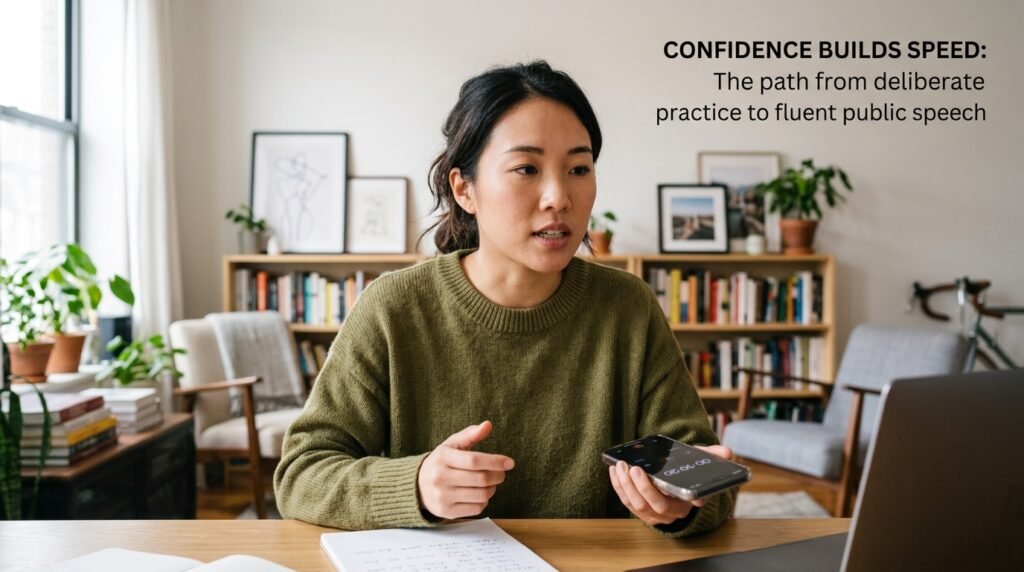
Once I felt deeply comfortable at a slow pace, I introduced high speed drills in my private practice. I set a timer for sixty seconds and forced myself to speak as fast as physically possible. I ignored all grammar rules. I just focused on rapid output.
This private speed training slowly bled into my public conversations. I found myself speaking faster naturally because the mechanical pathways in my brain were completely paved. I detail exactly how to execute these specific timing drills in The Technique That Helped Me Speak Faster to help you break through your own internal speed limits safely.
The Power of Unbreakable Routine
Confidence is not built through occasional bursts of extreme bravery. Confidence is built through boring, relentless, daily repetition.
You must put in the necessary reps. You must talk to your empty kitchen every single morning. You must record your terrible voice notes every single night. You must walk into the local bakery and stumble through a highly predictable transaction.
The first time you speak a foreign language, you will feel completely terrified. The tenth time, you will feel slightly nervous. The hundredth time, you will feel entirely bored.
Boredom is the ultimate goal. You want the act of speaking to become so incredibly routine that it no longer triggers any emotional response whatsoever.
Stop waiting for a magic feeling of readiness. You will never feel fully ready. The confidence only arrives after you actually take the action. Open your mouth today. Accept the awkwardness. Push directly through the immediate panic. The more words you force out into the world, the faster your fear will permanently disappear. Build your staircase one single word at a time.
Gabriel Henrique is a language enthusiast and productivity writer. After testing countless study methods, he became obsessed with mastering new languages efficiently. He achieves this without burnout, without endless grammar drills, and without losing focus. At Blog The Curious, he shares everything he has learned along the way.