
I sat in a noisy cafe across from a native speaker. The conversation was moving rapidly. I understood everything he was saying. I knew exactly what I wanted to say in response. The vocabulary was clear in my head. The grammar was perfectly aligned.
I opened my mouth to reply. The words came out at an incredibly painful, agonizingly slow pace.
I spoke one single word at a time. I paused heavily between each word. I sounded exactly like a broken machine running out of battery power. The native speaker tried to maintain eye contact. I watched his eyes slowly drift away. I watched him lose interest entirely. The conversation completely died because I could not keep up the necessary physical momentum.
That interaction humiliated me. It also taught me a vital lesson. Knowing a language mentally is completely different from producing it physically. You can be a genius on a written exam and a complete failure in a live conversation. Speed is the ultimate barrier to fluency.
I completely stopped studying grammar books. I realized my brain was not the problem. My mouth was the problem. I built a highly aggressive, physical training routine to force my mouth to move faster. Here is the exact technique that helped me completely break my internal speed limit.
The Illusion of Natural Speed
People think speed is a natural byproduct of studying for a long time. They believe if they just memorize enough flashcards, their mouth will magically speed up.
This is a massive lie. Your mouth is a collection of physical muscles. Those muscles are entirely accustomed to the lazy, familiar movements of your native language. When you try to speak a new language, you demand completely new physical movements.
Your native muscles resist these new movements. They take shortcuts. They stumble. They move slowly because they lack specific coordination. You cannot think your way to faster speech. You have to physically train your facial muscles exactly like an athlete trains for a sprint.

The Brain Traffic Jam
Before you can fix the physical speed, you must fix the internal traffic jam.
When beginners try to speak, their brain is doing too many things at once. You are trying to remember the vocabulary word. You are trying to calculate the correct verb conjugation. You are trying to remember the gender of the noun. You are trying to physically pronounce the strange new vowel.
This creates a massive traffic jam between your brain and your vocal cords. The words pile up. They crash into each other. The final output is an incredibly slow, stuttering mess.
You must clear the highway. You must remove the heavy processing load from your brain so your mouth can actually move.
Firing the Internal Editor
The biggest cause of this traffic jam is your internal editor.
As you speak, a harsh internal critic monitors every single syllable. If you use the wrong verb tense, the critic screams. You stop speaking immediately. You go back. You correct the mistake. Then you try to move forward again.
This constant stopping and starting completely destroys your speed. You sacrifice the entire flow of the conversation just to fix a tiny, irrelevant detail.
I had to actively fire my internal editor. I made a strict rule for myself. I completely banned self correction during my speed drills. If I made a mistake, I ignored it completely. I forced myself to push through the error and finish the sentence. Continuous forward momentum became my only acceptable metric for success.
The Sixty Second Sprint Drill
To build raw physical speed, you must push your brain into a state of panic. You must force it to operate faster than it wants to.
I developed a daily routine called the sixty second sprint.
I stood alone in my home office. I picked a random, familiar topic. I chose topics like my morning coffee routine, my weekend plans, or a movie I recently watched. I set a digital timer on my phone for exactly sixty seconds.
I hit the start button. I forced myself to speak about the topic at absolute maximum speed.
I did not care about making sense. I did not care about perfect grammar. I only cared about producing a continuous, rapid stream of vocal noise. If I forgot a specific vocabulary word, I was not allowed to stop. I had to rapidly talk around the missing word using simpler words.
This drill forces your brain to abandon its slow analytical processes. It relies entirely on pure, immediate reflex.
The Exhaustion Phase
The first time you do a sixty second sprint, you will feel completely exhausted. Your brain will panic. Your tongue will literally tie itself into a knot.
This exhaustion is highly productive. It means you are breaking your old speed limits.
I ran this drill five times in a row every single evening. The first two sprints were always a disaster. By the fourth sprint, my brain stopped fighting. My mouth stopped trying to perfectly articulate every single consonant. The words started blurring together into a fast, fluid stream.
When you push your mouth to its absolute maximum limit in private, your normal speaking speed naturally increases. After a session of sixty second sprints, speaking at a normal conversational pace feels incredibly slow and relaxing. You buy yourself massive amounts of mental breathing room.
Bypassing the Assembly Line
You cannot speak quickly if you assemble every single sentence from scratch.
Beginners take a noun, add a verb, calculate the tense, add a preposition, and finally deliver the sentence. This is a factory assembly line. It is highly inefficient.
Native speakers do not assemble sentences from scratch. They deploy prebuilt chunks of language. You must completely stop building sentences word by word. You need to use prebuilt blocks. This concept is the entire foundation of a How I Learned Phrases Instead of Isolated Words strategy that bypasses the slow assembly process entirely.
I memorized long, complex phrases as single units of sound. I learned exactly how to say “I do not know what to do about that.” I treated that entire phrase as one single word.
When I needed to express that thought, I did not assemble it. I just launched the entire block instantly. Deploying heavy blocks of language instantly skyrockets your speaking speed.
The Whisper Sprint Technique
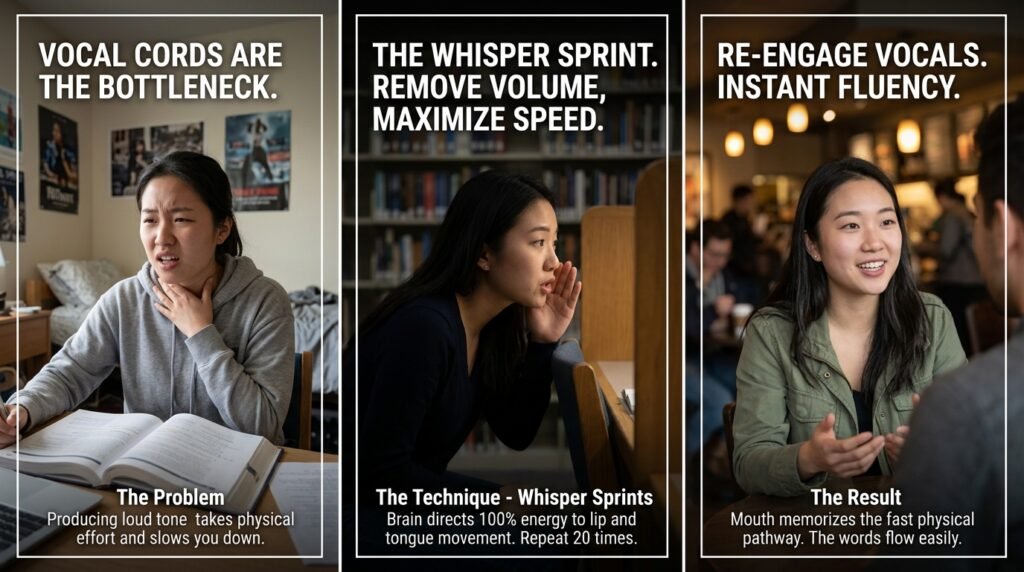
Sometimes your vocal cords are the actual bottleneck. Producing loud, resonant tone takes physical effort. It slows down your jaw.
I wanted to isolate my lip and tongue speed completely. I used the whisper sprint technique.
I took a complex paragraph written in my target language. I removed my vocal cords from the equation entirely. I whispered the paragraph out loud to the empty room.
When you whisper, you remove the heavy burden of producing volume and pitch. Your brain can direct one hundred percent of its energy entirely to the mechanical movement of the lips and the tongue.
I whispered the paragraph as fast as physically possible. I pushed my mouth to its absolute mechanical limit. I did this twenty times in a row. My facial muscles burned.
Then, I turned my vocal cords back on. I spoke the paragraph out loud at a normal volume. The speed carried over instantly. My mouth had already memorized the fast physical pathway. The words fired out of my mouth like a machine gun.
The Artificial Privacy Requirement
You cannot execute these drills if you feel embarrassed. High speed drills sound completely insane. You will spit. You will stutter loudly. You will make bizarre noises.
You need absolute privacy to execute these drills. You cannot push your speed limit if you are worried about your roommates hearing you. I detail my exact private laboratory setup in a The Way I Practice Speaking When I’m Alone framework to ensure you have a completely safe space to fail.
I locked my door. I closed the windows. I removed every single social consequence from the environment. When you know nobody is listening, you are finally free to completely lose control of your mouth. Losing control is the only way to find your true top speed.
High Speed Audio Shadowing
You cannot build native speed using your own internal metronome. Your internal metronome is too slow. You need an external pacemaker to drag you across the finish line.
I used high speed audio shadowing.
I downloaded podcasts recorded by fast speaking natives. I put on heavy noise canceling headphones. I hit play. I immediately started speaking out loud, completely overlapping my voice with the podcast host.
I tried to match their exact speed syllable by syllable.
This is incredibly frustrating. You will constantly fall behind. But the effort forces your brain to process the language at a native velocity. It forces your tongue to stop taking lazy pauses. You blindly trust your ears and force your mouth to keep up.
The Over-Speed Training Hack
I took the shadowing technique one step further. I used a classic athletic training hack called over-speed training.
Runners train on a downhill slope to force their legs to move faster than they naturally can on flat ground. I applied this exact concept to my audio.
I used an app to speed up the native podcast to 1.2x speed. The audio sounded frantic. It sounded almost impossible to follow.
I forced myself to shadow the audio at this accelerated speed for five solid minutes. My mouth completely failed multiple times. My brain felt entirely scrambled.
Then, I dropped the audio speed back down to the normal 1.0x speed. I shadowed the audio again.
The normal speed suddenly felt like slow motion. Because I had just forced my brain to process the language at an impossible velocity, the normal velocity felt completely manageable. I easily kept pace with the speaker. My words were clear, sharp, and incredibly fast.
Reading Out Loud for Raw Endurance
Speed requires massive physical endurance. If your facial muscles get tired after two minutes of talking, your speed will completely collapse in a real conversation.
I built physical endurance by reading native novels completely out loud.
I stood up in the center of my bedroom. I held a thick thriller novel. I read the text at maximum volume. I read for thirty uninterrupted minutes every single evening.
Reading a professional novel removes the mental burden of creating the grammar yourself. The author did the hard work. You only have to supply the raw physical vocal energy.
Thirty minutes of continuous speaking is a heavy workout. My jaw was completely sore afterward. This soreness proved I was building brand new muscle. A strong mouth is a fast mouth.
Adapting to the Native Rhythm
Speed is closely tied to the specific melody of the target language.
English has a bouncy, aggressive rhythm. We punch specific syllables heavily and swallow others. Other languages operate on a completely flat, even rhythm. Every single syllable receives the exact same timing.
If you apply a bouncy English rhythm to a flat language, you will constantly trip over your own tongue. You cannot gain speed if your fundamental rhythm is wrong. I completely fixed my vocal melody using a What Helped Me Sound More Natural When Speaking routine to sound much more authentic.
I flattened out my pitch completely. I stopped stressing random vowels. I forced my mouth to operate like a steady, continuous metronome. When you align your physical rhythm with the native rhythm, the friction disappears entirely. The words slide out smoothly without any structural resistance.
Deep Breath Momentum
Slow speaking is often caused by terrible breath control.
When beginners speak a foreign language, they take short, shallow breaths into their chest. They run out of air completely halfway through a complex sentence. When you run out of air, your body panics. You drop the volume. You stumble. You stop to take another nervous breath.
I completely retrained my breathing habits. I learned to breathe deeply from my diaphragm.
Before I started a sixty second sprint, I took a massive column of air into my stomach. I used that heavy air pressure to push the words out aggressively.
A strong, steady stream of air supports continuous speech. You do not have to stop mid sentence. You can link five different thoughts together rapidly because you have the physical fuel to sustain the output.
The Real World Transition
Private speed training is useless if you freeze in public. You must slowly transfer this new velocity to real conversations.
I did not unleash my top speed immediately. I started testing it in highly predictable situations.
I went to a busy local bakery. I knew the exact dialogue required to buy a loaf of bread. I prepared my sentence. I walked up to the counter and delivered the sentence at a much faster speed than I normally would.
The baker understood me perfectly. He handed me the bread.
That tiny transaction proved the speed was functional. I slowly started accelerating my speech during longer language exchanges. I noticed a massive shift in how native speakers treated me.
When you speak slowly, native speakers look at you with pity. They speak to you like a child. They use simple words.
When you speak with speed, you immediately command respect. You project massive confidence. Native speakers assume your comprehension level is much higher than it actually is. They stop treating you like a fragile beginner. They relax their posture. They start talking to you like a normal human being.

Consistency Over Talent
Speaking faster is not a magical talent. It is not tied to your IQ. It is entirely tied to your physical discipline.
You must push your mouth beyond its comfortable limits. You must sound completely ridiculous in the privacy of your own home. You must ban your internal critic. You must heavily shadow native speakers until your jaw physically aches.
Stop treating the language like a delicate mental puzzle. Start treating it like a physical sport.
Set your digital timer for sixty seconds tonight. Pick a random topic. Open your mouth and absolutely refuse to stop talking until the alarm sounds. Make terrible mistakes. Let the grammar fall apart completely. Just force the physical noise out of your throat. Break the speed limit today, and true fluency will naturally follow.

Gabriel Henrique is a language enthusiast and productivity writer. After testing countless study methods, he became obsessed with mastering new languages efficiently. He achieves this without burnout, without endless grammar drills, and without losing focus. At Blog The Curious, he shares everything he has learned along the way.