
I sat at my desk in complete silence. The room was entirely empty. I manage a network of digital blogs for a living. I spend my entire day looking at analytics dashboards and drafting legal policies. My daily life offers absolutely zero opportunities to speak my target language with another human being.
I used to view this isolation as a massive disadvantage. I believed the common language learning advice. Everyone said I needed to find a native conversation partner. Everyone told me to join a local language group. I spent weeks searching for people online. The time zones never matched. The scheduled calls were always awkward. I spent more time coordinating the meetings than actually speaking the language.
My progress completely stalled. I realized I was waiting for someone else to solve my problem. I had to take total control of my own spoken output. I needed to learn how to simulate the intense pressure of a real conversation without leaving my home office.
I transformed my quiet room into a dedicated conversational laboratory. I stopped waiting for partners. I became my own partner. Here is the exact system I used to practice real conversations completely by myself.
The Myth of the Necessary Partner
You do not need a native speaker to build conversational fluency. Native speakers are actually terrible partners for beginners. They speak too fast. They use heavy local slang. They interrupt you. The social pressure of talking to them completely paralyzes your brain.
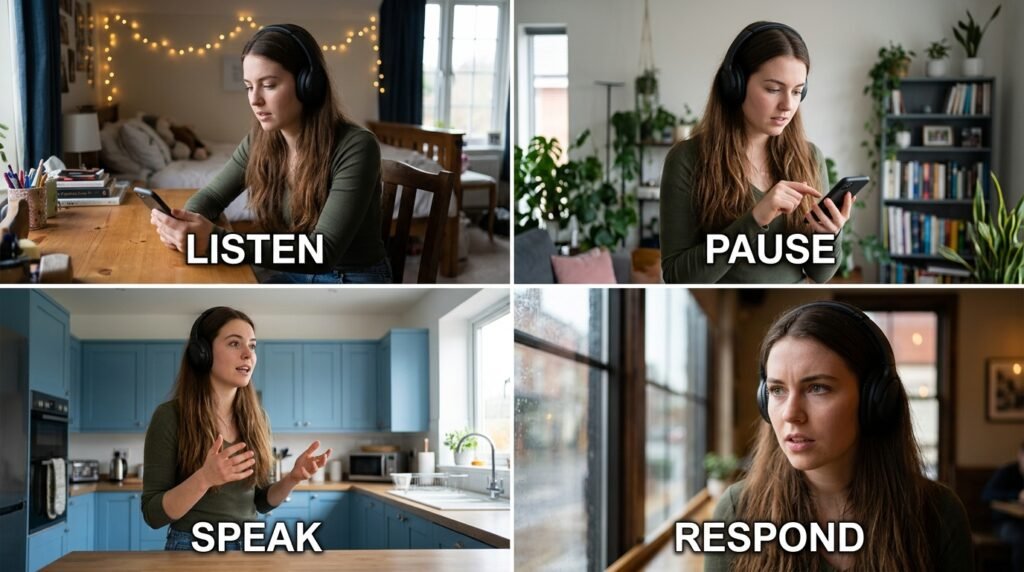
A conversation is simply a rapid exchange of information. It is a process of listening, processing, and responding. You can easily replicate this exact mechanical process in total isolation.
When you remove the native speaker, you completely remove the fear of judgment. You give yourself a totally safe environment to fail. You can stutter safely. You can forget words safely. This isolation is not a curse. It is a massive strategic advantage. You just need to structure your solo practice correctly.

The Host and Guest Protocol
A real conversation requires two different perspectives. You cannot just deliver a single, long monologue. You have to answer direct questions.
I invented a solo game to simulate this dynamic. I called it the host and guest protocol.
I pretended I was a highly respected guest on a popular podcast. I physically divided my room into two distinct zones. I placed a chair on the left side of the room. This was the host chair. I placed a chair on the right side of the room. This was the guest chair.
I sat in the host chair first. I adopted a professional posture. I asked a complex, open ended question out loud in my target language. I asked about my career. I asked about my personal hobbies.
Then I stood up. I physically walked over and sat in the guest chair. I took a deep breath. I answered the exact question I had just asked. I forced myself to give a detailed, two minute response.
This physical movement is crucial. It tricks your brain into switching perspectives. You practice the grammar of asking questions. Then you immediately practice the grammar of providing answers. The entire exchange flows exactly like a real human interaction.
Arguing Both Sides of the Coin
Polite interviews are good for building basic flow. But real conversations often involve conflict and persuasion. You need to know how to defend your opinions.
I started staging aggressive debates in my living room. I picked a highly controversial topic. I assigned myself the role of the first debater.
I delivered a passionate, loud speech defending one side of the argument. I used strong hand gestures. I used persuasive vocabulary. I spoke for exactly two minutes.
Then I physically turned around to face the spot I had just occupied. I adopted a completely different posture. I delivered a brutal counter argument. I violently attacked the exact points I had just made. I found flaws in the logic. I used vocabulary expressing deep doubt and intense frustration.
This drill builds massive mental agility. You force your brain to quickly access completely different sets of vocabulary. You practice the emotional highs and lows of a real argument. You do all of this without the risk of actually offending a real person.
Leveraging Deep Personal Passions
You cannot practice conversations about boring topics. If you try to debate international trade laws and you do not care about them, you will quit in five minutes. You have to talk about things you genuinely love.
I rely heavily on my own personal interests for solo practice. I track professional basketball very closely. I analyze first-action statistics for specific NBA players during the playoffs. I calculate the probability of points, rebounds, and assists to forecast game outcomes.
I used this intense analytical work as my primary conversation topic. I paced around my office and explained my statistical models out loud. I argued why a specific point guard would dominate the next game. I laid out the exact math behind my forecast.
When you talk about a deep passion, the words flow much easier. You forget to be nervous. The passion completely overrides the hesitation. You naturally push your vocabulary to its absolute limits because you desperately want to explain your point accurately.
The Pause and React Drill
Real conversations are not perfectly scripted. The other person often surprises you. You have to react spontaneously.
I needed to inject chaos into my solo practice. I achieved this by using random audio prompts.
I downloaded several interview podcasts recorded by native speakers. I put my headphones on. I listened to the host ask a guest a question. The second the host finished asking the question, I hit the pause button.
I did not let the actual guest answer. I answered the question myself. I spoke out loud to the empty room. I gave my own personal opinion on the topic.
This drill forces complete spontaneity. You have absolutely no idea what the host is going to ask. You have to process the audio instantly. You have to formulate a response instantly. It perfectly simulates the exact pressure of a real face to face interaction.
Exploring Physical Routines
You must connect your spoken language directly to your physical reality. Abstract concepts are hard to discuss. Physical objects are much easier to map in your brain.
I mapped out my exact process for this when I documented How I Turned Everyday Moments Into Vocabulary Practice to show how powerful your immediate environment actually is.
I took my morning routine and turned it into an interactive conversation. I am deeply meticulous about my coffee. I use Ethiopian heirloom varieties. I weigh the beans. I monitor the exact water temperature.
I imagined a curious friend was standing in my kitchen watching me. I explained every single physical action to this imaginary friend out loud. I described the specific origin of the coffee beans. I explained why the water temperature mattered. I asked the imaginary friend if they understood the process.
This forces you to use the practical vocabulary of your daily survival. It removes the heavy academic feeling from the language. You learn how to converse naturally about the simple things you actually do every single day.
Visual Detail Training
Conversations heavily rely on your ability to describe visual details to another person. If you cannot describe what you see, you cannot tell a good story.
I possess a strong interest in digital photography. I spend hours editing studio portraits. I focus intensely on preserving facial geometry. I study the retro aesthetics of old Canon lenses.
I used this visual obsession to build my descriptive vocabulary. I opened a highly complex photograph on my computer monitor. I imagined I was speaking to a blind person. I described the entire photograph out loud in extreme detail.
I described the exact angle of the lighting. I described the subtle expression on the subject’s face. I described the specific colors in the background.
This drill forces you to hunt for highly precise adjectives. You cannot use basic words. You have to dig deep into your mental dictionary to paint a clear picture with your voice. It massively upgrades the quality of your spoken output.
The Voice Note Ping Pong
Talking to the air eventually feels too abstract. You need to direct your voice at a specific target.
I turned my smartphone into a conversational partner. I opened my voice memo application. I recorded a short question. I asked, “What was the most difficult part of your work day?”
I stopped the recording. I waited exactly ten seconds. Then I hit record again and answered my own question in a completely new audio file. I created a long chain of audio messages back and forth with myself.
This method creates a physical record of the conversation. You are playing conversational ping pong. It forces you to speak in complete, contained thoughts. It prevents you from trailing off into silence.
Harvesting the Missing Vocabulary
When you practice conversations alone, you discover massive holes in your vocabulary.
When I tried to explain my blog monetization strategy to the empty room, I suddenly realized I did not know the foreign word for traffic. I did not know the word for advertising revenue.
In a normal conversation with a native speaker, this is the exact moment you freeze in panic. In a solo conversation, this is a moment of pure discovery.
When I hit a missing word, I stopped the solo drill immediately. I picked up my phone. I searched for the exact missing word. I wrote it down on a notepad. I immediately integrated that new word back into the solo conversation.
Solo practice is the absolute best diagnostic tool for your vocabulary. It reveals exactly what you do not know in a completely safe environment. You build a highly personalized dictionary based strictly on the things you actually want to talk about.
The Speed and Recovery Drill
A massive part of conversational fluency is the ability to recover from your own mistakes. When you speak to a native, you will inevitably stumble. You must learn how to keep moving forward.
I built a specific drill to practice this recovery. I set a timer for three continuous minutes. I picked a random topic. I forced myself to speak loudly without stopping until the timer rang.
My strict rule was absolutely no self correction. If I used the wrong verb tense, I had to ignore it completely. If my tongue tripped over a consonant, I had to push right through it.
I trained my brain to prioritize continuous forward momentum over perfect grammatical accuracy. This is the exact secret to looking confident. Confident speakers do not speak perfectly. Confident speakers just refuse to apologize for their messy mistakes. They keep the conversation alive no matter what happens.
Simulating the Distraction
Real conversations never happen in a perfectly quiet room. They happen in loud bars. They happen on busy streets. You get distracted constantly.
I needed to simulate this environmental chaos. I opened a window to let the street noise in. I turned on a television in the background with the volume down low.
I forced myself to maintain my solo conversation while surrounded by these heavy distractions. I practiced holding my train of thought while a siren wailed outside. I practiced projecting my voice over the noise of the television.
This builds massive mental endurance. It hardens your focus. When you finally step into a loud coffee shop to speak with a real person, your brain is already conditioned to ignore the chaos. The noise does not rattle you at all.
Building the Routine
You cannot do this once a month and expect to become fluent. Solo conversational practice requires strict, boring, daily repetition.
I carved out exactly twenty minutes every single evening. I locked my office door. I paced the floor. I argued with myself about basketball. I answered random podcast questions. I described complex photographs.
It felt completely insane for the first two weeks. My ego hated it. But I built a specific system to manage this discomfort, which is heavily detailed in The Way I Practice Speaking When I’m Alone to guarantee daily consistency.
The repetition completely normalized the process. I stopped feeling foolish. My jaw muscles grew stronger. My ability to recall words instantly became much faster. The heavy mental friction completely vanished.
The Final Real World Test
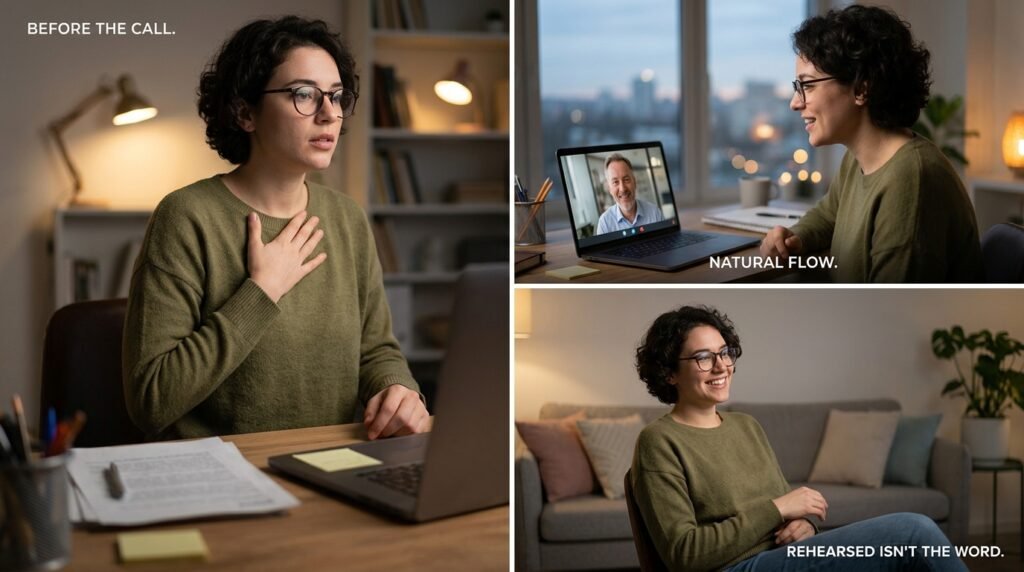
After four months of talking exclusively to my office walls, I finally scheduled a video call with a native speaker.
I sat down at my desk. My heart beat slightly faster. The native speaker joined the call. He asked me a direct question about my work with digital blogs.
I did not freeze. I did not search for an English translation in my head. I simply opened my mouth and let the words fall out.
The conversation flowed perfectly. I used the exact sentence structures I had practiced hundreds of times in the guest chair. I used the specific vocabulary I had harvested during my solo debates. When I made a mistake, I pushed through it instantly without breaking eye contact.
The native speaker was incredibly impressed by my fluidity. He had absolutely no idea that he was interacting with a script I had perfected in total isolation.
You Have Everything You Need
Stop using your environment as an excuse. Stop complaining that you do not live in the right country. Stop waiting for the perfect language exchange partner to magically appear on your screen.
You already possess everything you need to build spoken fluency today. You have a brain. You have a voice. You have an empty room.
Stand up from your chair right now. Pick a topic you care about deeply. Start speaking out loud. Argue with the blank wall. Answer questions nobody actually asked. Embrace the complete absurdity of the process. I conquered this exact fear by applying the methods found in How I Became More Confident Speaking Out Loud to completely destroy my own social anxiety.
The hardest conversations you will ever have are the ones you force yourself to have in an empty room. Once you master the solo conversation, talking to a real human being feels completely effortless. Open your mouth today and become your own absolute best partner.
Gabriel Henrique is a language enthusiast and productivity writer. After testing countless study methods, he became obsessed with mastering new languages efficiently. He achieves this without burnout, without endless grammar drills, and without losing focus. At Blog The Curious, he shares everything he has learned along the way.