
I sat at my desk looking at a recorded video of myself speaking my target language. I sounded completely terrible. My accent was thick, clumsy, and confusing. I had perfect grammar. I had a massive vocabulary. But my mouth simply refused to cooperate. I realized pronunciation is not a mental task. It is a strict physical workout. Your tongue, your lips, and your jaw are physical muscles. They require daily resistance training.
You cannot learn to pronounce a language by reading a textbook silently. You have to physically train your face. I completely stopped treating pronunciation as a mysterious talent. I started treating it like a mechanical sport. I built a rigid, unbreakable daily routine to force my mouth to make the correct sounds. Here is exactly how I practiced pronunciation every single day.
The Biological Reality of Your Face
You have used your facial muscles the exact same way for decades. Your native language carved deep physical grooves into your jaw. When you learn a new language, you ask those muscles to move in strange, completely unfamiliar ways.
Your muscles will aggressively resist these new movements. They will take lazy shortcuts. They will substitute native English sounds for the foreign sounds. This biological laziness creates a heavy, confusing accent.
You must physically break these old habits. You must build brand new muscle memory. This requires thousands of perfect repetitions. It requires dedicated daily focus. You cannot practice pronunciation once a week and expect any results. The muscles will simply revert back to their comfortable English default. You need daily mechanical consistency.

The Morning Coffee Vowel Workout
I built my very first pronunciation drill right into my morning routine. I am incredibly meticulous about my daily coffee. I use a specific V60 pour over method. I weigh heirloom Ethiopian coffee beans. I monitor the exact water temperature with a digital gooseneck kettle. The entire brewing process takes exactly four minutes.
I turned these four minutes into an intense vowel workout.
Beginners always obsess over difficult consonants. They completely ignore the vowels. Vowels carry the true weight and clarity of an accent. English vowels are incredibly lazy and tend to slide around. Foreign vowels are often rigid, pure, and sharp.
While my coffee bloomed, I stood in my kitchen and isolated the core vowels of my target language. I did not use any consonants. I just made the raw vowel sounds out loud. I watched my reflection in the dark glass of the microwave. I forced my lips into tight circles. I dropped my jaw aggressively. I held each sound for five solid seconds. Doing this daily built a rock solid physical foundation before I even started my workday.
The Commute Shadowing Drill
I needed to practice the exact rhythm of the language. Every language has a specific melody. If you use your bouncing native English melody, you will sound exactly like a tourist. You have to flatten or change your pitch.
I started using my daily drive to practice shadowing. I put on an unscripted podcast recorded by native speakers. I did not just listen passively. I spoke out loud at the exact same time.
I tried to completely overlap my voice with their voice. I copied their exact pauses. I copied their exact pitch. I matched their precise breathing patterns.
This drill forces your mouth to move at native speed. It completely bypasses your internal editor. You do not have time to think about grammar. You simply have to blindly trust your ears and force your mouth to keep up. If you want to seamlessly integrate this kind of constant practice into your daily life, you should read How I Turned Everyday Moments Into Vocabulary Practice because using dead time is the absolute secret to high volume output.
Recording Blog Drafts Out Loud
I manage a network of digital blogs. I write long, detailed articles about mobile productivity and digital automation. I realized I possessed a massive library of complex text right on my hard drive. I decided to use my own writing for advanced pronunciation practice.
I translated a paragraph of my own work into the target language. Then, I turned on the voice recorder app on my smartphone. I read the paragraph out loud to my empty office.
Listening to the playback was incredibly brutal. I heard every single swallowed consonant. I heard every lazy, sliding vowel. I heard the exact moments where my breath control completely failed.
But this pain provided objective data. I found exactly which sounds my mouth was failing to produce. The voice recorder is a ruthless, honest teacher. It strips away your ego entirely. It gives you an exact map of your physical weaknesses so you can target them directly the next day.
Minimal Pairs Boxing
Your brain naturally filters foreign sounds through your native language. If two foreign sounds are very similar, your brain treats them as completely identical. This auditory illusion destroys your pronunciation.
I started hunting down minimal pairs. These are two words that differ by only one single sound. In English, a minimal pair would be the words bat and pat.
I created specific audio flashcards for the most difficult minimal pairs in my target language. I listened to them back to back hundreds of times. I closed my eyes and focused intensely on the tiny physical differences in tongue placement and breath pressure.
Then I fought back. I spoke the words out loud. I forced my mouth to aggressively exaggerate the difference between the two sounds. I trained my ears to hear the boundary, and I trained my tongue to respect that strict boundary.
The Whisper Technique
Sometimes trying to speak loudly and clearly causes too much mental friction. You worry heavily about your pitch and your tone. You try to sound confident, and you lose the actual mechanics of the word.
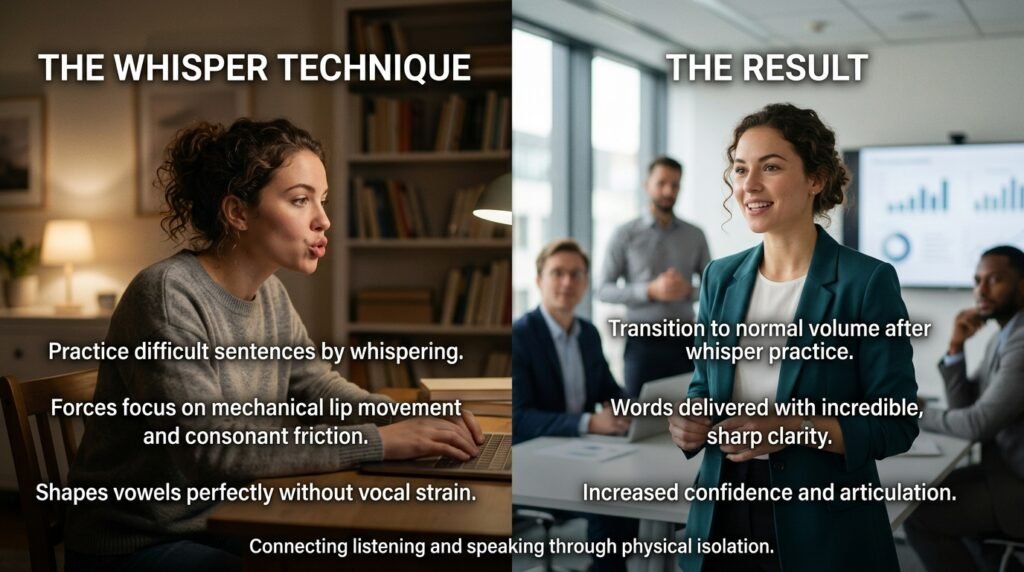
I wanted to isolate the physical movement of my lips completely. I used the whisper technique.
I took a difficult sentence and completely removed my vocal cords from the process. I whispered the sentence out loud to my empty room.
Whispering forces you to exaggerate the mechanical friction of the consonants. It forces you to shape the vowels perfectly because you have absolutely no volume to hide behind. Your mouth has to do one hundred percent of the heavy lifting. This specific isolation strategy heavily connects to The Way I Improved My Listening and Speaking Together to help you decode and replicate difficult sounds physically.
After whispering the sentence twenty times, I turned my vocal cords back on. I spoke at a normal volume. The words fired out of my mouth with incredible, sharp clarity.
The Exaggeration Protocol
When you practice alone, you must practice at absolute extremes.
I took my most difficult vocabulary words and completely distorted them. I opened my mouth incredibly wide. I stretched my lips until they physically hurt. I shouted the words loudly at the blank wall.
This is heavy resistance training for your face. When you exaggerate a sound in private, your mouth builds excess physical strength. You stretch the muscles far past their normal operating limits.
When you go out into the real world and speak normally, the sound feels incredibly easy. The normal, casual pronunciation requires only a tiny fraction of the physical effort you used during your private, exaggerated practice. You build a massive buffer of physical comfort.
Using the Pen Drill
To push my facial muscles even harder, I used an old actor technique called the pen drill.
I placed a clean plastic pen horizontally across my teeth. I bit down gently to hold it in place. I forced myself to read a paragraph out loud with the pen blocking my mouth.
Your tongue gets completely trapped. Your lips cannot close. You have to work ten times harder just to make a basic, recognizable sound. You have to aggressively push your tongue against the plastic. You have to stretch your lips into highly unnatural shapes.
I sounded completely ridiculous. I drooled slightly on my desk. But after five solid minutes, I removed the pen. I read the exact same paragraph again.
My mouth felt incredibly light. My tongue snapped into position perfectly. The heavy resistance had instantly activated every single lazy muscle in my face. The words came out sharper than they ever had before.
Flattening the Resting Posture
Every single language has a specific resting mouth posture. This is the exact shape your mouth naturally takes when you are not speaking at all.
In English, the resting posture is very relaxed. The tongue sits flat and heavy in the bottom of the mouth. The jaw drops open slightly.
If you try to speak a foreign language using a relaxed English resting posture, you are starting the race from the wrong starting line. Your tongue has to travel too far to make the correct sounds. This physical distance creates a heavy, dragging delay in your speech.
I actively practiced the new resting posture of my target language. I held my tongue high against the roof of my mouth right behind my front teeth. I held this tense posture while answering emails. I held it while analyzing basketball statistics on my monitor. I trained my face to accept this new physical position as the default state. When I finally opened my mouth to speak, the correct sounds came out much faster.
Tracking the Daily Streak
Pronunciation degrades incredibly quickly if you do not practice it every single day. Your muscles will quickly revert to their lazy English habits. I needed a strict system to keep myself fully accountable.
I used a mobile productivity app on my phone. I created a dedicated habit tracker strictly for my physical vocal drills.
I did not track my grammar study. I did not track my reading time. I only tracked my physical, mechanical output. I checked the box every single day after my morning coffee vowel routine and my afternoon shadowing session.
Seeing that visual streak build up over weeks kept my discipline ironclad. I refused to break the chain. I document exactly how to set this specific tracking system up in How I Built a Routine That Actually Worked for Me to ensure you never use fatigue as an excuse to miss a day of practice.
Embracing the Mundane Repetition
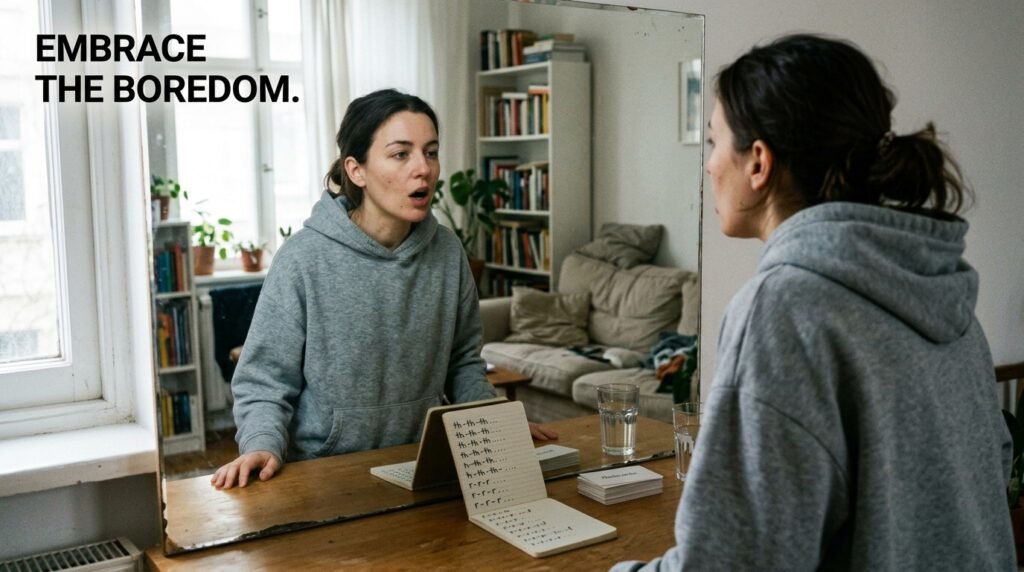
Building a perfect accent is incredibly boring. It is not glamorous. You do not learn exciting new cultural concepts. You just say the exact same sound three hundred times in a row until your jaw literally aches.
You have to learn to love the boring, mundane repetition.
The repetition is where the magic actually happens. It is where the conscious, highly frustrating effort drops deeply into your unconscious physical reflexes. You have to endure the boredom to achieve the effortless fluency on the other side.
I stopped looking for shortcuts. I stopped buying new pronunciation apps. I just stood in front of the mirror and put in the raw physical work. I accepted that my mouth was going to feel sore. I accepted that I was going to sound like a toddler for a few months.
The Ultimate Result of Daily Practice
After six months of this relentless daily physical routine, everything changed.
I stopped freezing during real conversations. I stopped planning my sentences in advance. My mouth simply knew exactly where to go. Native speakers completely stopped asking me to repeat myself. They understood my words instantly.
The heavy physical friction was entirely gone. I could speak for an hour without my jaw feeling tired. I could deploy complex, difficult vocabulary words at top speed without stumbling over the consonants.
Pronunciation is absolutely not a genetic gift. It is the direct result of brutal, consistent, daily mechanical practice. Stop blaming your bad ear for languages. Stop making excuses about your natural accent. Treat your mouth like a piece of heavy machinery. Stand in front of your mirror today. Open your mouth wide. Exaggerate the vowels. Shadow the fast audio. Do the boring physical work, and your clear, confident voice will finally emerge.

Gabriel Henrique is a language enthusiast and productivity writer. After testing countless study methods, he became obsessed with mastering new languages efficiently. He achieves this without burnout, without endless grammar drills, and without losing focus. At Blog The Curious, he shares everything he has learned along the way.