
I walked through the crowded city streets with heavy headphones over my ears. I was listening to a highly rated foreign language podcast. The hosts were laughing loudly. They were telling fast jokes. I understood absolutely nothing. It sounded like a continuous, rapid stream of blurred noise. I took off the headphones. I felt deeply frustrated. I spent hours every week practicing my speaking skills in private. I could produce decent sentences. I could easily order a coffee or ask for directions. But my listening skills were completely broken. I realized a brutal truth right there on the sidewalk. You cannot hold a real conversation if you are completely deaf to the other person. Speaking perfectly is useless if you cannot understand the response.
The Fatal Separation
Language schools make a massive mistake. They separate listening and speaking into completely different study blocks. You sit in a quiet room and take a listening test on Tuesday. You sit in a different room and take a speaking test on Thursday. This artificial separation completely destroys your progress.
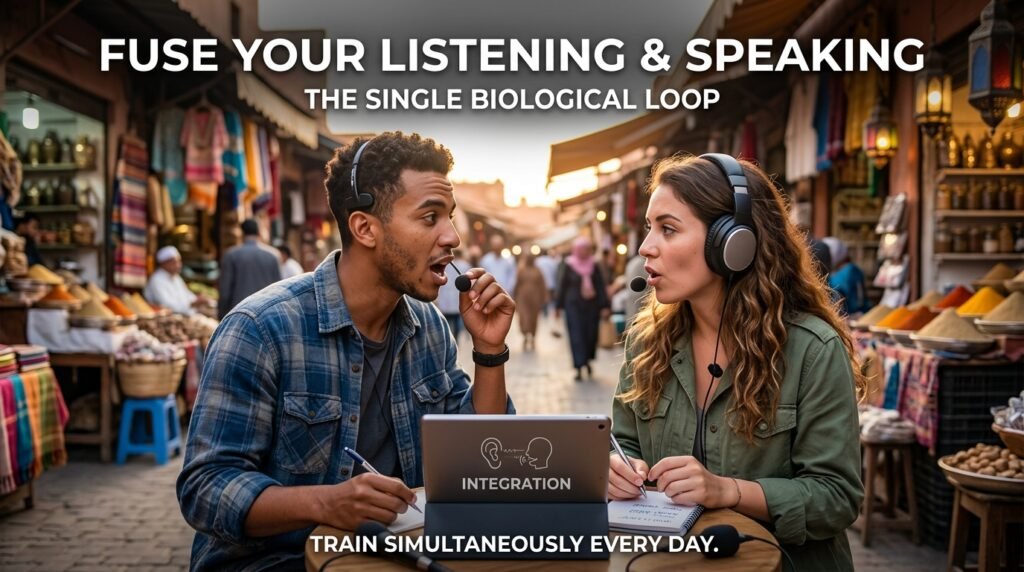
The human brain does not separate these skills. The ear and the mouth are part of the exact same biological loop. If your ear cannot isolate a specific foreign vowel, your mouth will never produce it correctly. If your mouth does not know how to shape a difficult consonant, your ear will never recognize it in fast native speech. You must fuse these two skills together permanently. You must train them simultaneously every single day.
The Active Echo Routine
Passive listening is a complete waste of valuable time. Playing a foreign radio station in the background while you cook dinner does absolutely nothing for your fluency. Your brain naturally filters it out as meaningless background noise. To properly link your ears and your mouth, you need aggressive, active engagement.
I developed the active echo routine. I put on a short audio clip from a native speaker. I listened to exactly one single sentence. I paused the audio immediately. I repeated the sentence out loud to the empty room. I forced my mouth to physically recreate the exact sounds I just heard. The gap between hearing the noise and speaking the noise was less than two seconds. This immediate physical execution forces your brain to pay strict attention to the audio track.
Forcing the Auditory Connection
When you echo the audio out loud, you instantly expose your hidden blind spots. You will hear a sentence, try to repeat it, and realize you completely missed a critical word. Your tongue will stumble heavily. That physical stumble is highly valuable data. It proves your ear entirely failed to process the sound correctly.
I would rewind the track. I listened to that specific broken sentence ten times in a row. I closed my eyes. I focused entirely on the missing sound. Then I forced my mouth to produce it perfectly. This tight feedback loop repairs the broken connection between your auditory processing and your vocal cords. This method requires massive daily consistency. I heavily advise reading The Simple System I Followed to Make Daily Progress so you can build the necessary rigid discipline to execute this echo routine every single morning.
The Transcription Breakdown
Sometimes the audio is simply too fast. The active echo routine fails completely because the native speaker slurs their words heavily. I needed a surgical tool to dissect the chaotic noise. I started doing heavy transcription drills.
I took a one minute video of a native speaker talking directly to the camera. I opened a blank text document on my laptop. I hit play. I tried to literally type out every single word I heard. I paused and rewound the video constantly. It took me twenty solid minutes to transcribe a single minute of audio. This process is incredibly tedious. It is also the most effective listening exercise in existence.
From Text to Vocal Output
Transcription forces your ear to actively identify every single syllable. You absolutely cannot skip over the messy, fast parts. Once the manual transcript was finally complete, I verified it against the official video subtitles. I found my spelling mistakes. I found the exact words my ear completely misunderstood.
Then I turned the transcription exercise directly into a physical speaking drill. I read my corrected transcript out loud. I matched the speed and the tone of the original native video. By manually decoding the audio and then physically speaking it, I built a permanent neurological bridge between the raw sound and the physical muscle movement.
Pitch Matching and Melody
Listening is not just about identifying strict vocabulary words. It is heavily about identifying the underlying melody. Every language has a unique musical pitch. If you speak with your native English bouncing melody, you sound completely terrible. You must train your ear to hear the foreign melody first.
I listened to native speakers telling highly emotional stories. I completely ignored the actual vocabulary words. I only listened to the rising and falling pitch of their voices. Then I hummed the melody out loud. I matched their specific pitch with my own vocal cords. This exercise trains your ear to pick up the subtle musical cues. It automatically improves your spoken rhythm. You can learn exactly how to implement this in What Helped Me Sound More Natural When Speaking to completely eliminate your stiff, robotic beginner rhythm.
The Blindfold Strategy
We rely entirely too heavily on visual context. When you watch a foreign movie, you constantly read the subtitles. You watch the actor move their physical lips. You look closely at the environment. Your brain uses these visual clues to quickly guess the meaning. Your ears get incredibly lazy.
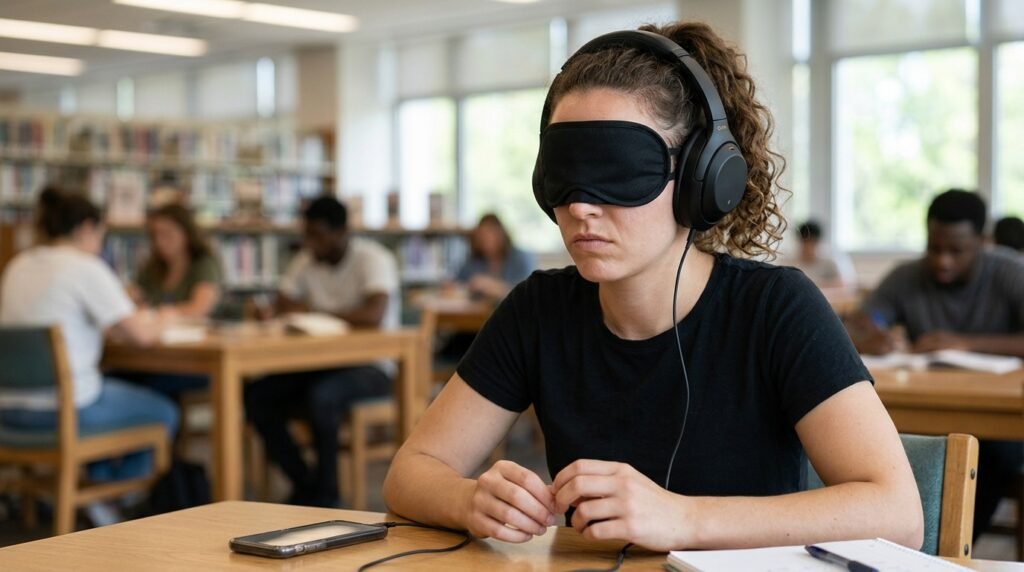
I needed to force my ears to do all the heavy lifting. I started practicing blindfolded. I put on my heavy noise canceling headphones, closed my eyes entirely, and listened to fast audio dialogues. Removing the visual input was completely terrifying. The language suddenly felt twice as fast. My brain panicked because it lost its visual crutch.
Surviving the Audio Void
I forced myself to stay completely in the dark. I listened to the audio clip three times blindly. I forced my ears to manually isolate the verbs and the nouns without any visual help. Then, keeping my eyes firmly closed, I summarized what I just heard out loud. I spoke directly into the dark, empty room.
This intense isolation forces your auditory cortex into massive overdrive. When you finally open your eyes and engage in a real face to face conversation, your listening comprehension feels incredibly sharp. Real conversations become incredibly easy because you already trained your ears to survive in total darkness.
Pronunciation Unlocks Comprehension
I discovered a massive biological secret during these specific drills. There were certain foreign words I could never hear correctly. They always sounded like a blurry, muffled mess.
Then one day, I spent thirty minutes practicing the exact physical pronunciation of those specific words. I trained my tongue to hit the correct sharp consonants. I trained my lips to form the pure, rigid vowels. The very next day, I listened to a podcast. The speaker used those exact words. I heard them with crystal clear perfection.
Learning to physically pronounce a word completely unlocks your ability to hear it. Your motor cortex talks directly to your auditory cortex. Your brain finally builds the correct mental file for the sound. If you struggle heavily with this physical barrier, review How I Improved My Pronunciation Without Feeling Embarrassed to safely build your physical vocal strength in absolute private.
The Interactive Podcast Drill
Podcasts are traditionally a very passive listening experience. I turned them into an active, highly stressful speaking simulation. I found interview style podcasts in my target language. I listened closely to the host. The host would ask the guest a complex, difficult question about their career.
I immediately hit the pause button. I did not let the guest answer. I answered the question myself. I spoke out loud for two full minutes. I gave my own personal, detailed opinion on the topic using the vocabulary I already possessed.
Comparing the Output
After I finished my spoken answer, I hit the play button again. I listened closely to how the native guest actually answered the exact same question. I compared their advanced vocabulary to my basic vocabulary. I compared their fluid grammar to my clunky grammar. I noticed the natural, casual filler words they used to buy time. I noticed exactly how they structured their logical argument.
This is the ultimate combined workout. You practice intense listening comprehension to understand the host. You practice spontaneous speaking to deliver your answer. Then you practice analytical listening to study the native guest. It turns a simple audio file into a highly demanding, interactive conversational sparring partner.
Speed Manipulation
Native speakers talk entirely too fast for absolute beginners. If you only listen to full speed audio, you will get deeply discouraged and quit the language completely. Your brain simply cannot process the incoming data.
I used basic software technology to manipulate the speed. I downloaded audio clips and slowed them down to exactly seventy five percent of their original speed. I listened to the slowed audio carefully. I easily identified every single word. I shadowed the audio out loud at this slower, highly comfortable pace. My mouth could easily keep up. I built total confidence at the slower speed.
Scaling Up the Velocity
Once I mastered the slower speed perfectly, I bumped the audio back up to normal speed. I listened again. Because my brain already mapped the sentence structure perfectly at the slow speed, the normal speed suddenly felt completely manageable.
I shadowed the audio out loud at full velocity. My tongue remembered the mechanical movements from the slow practice. It seamlessly accelerated to match the native pace. This scaling technique prevents massive frustration. It allows your ear and your mouth to graduate together step by step without overwhelming your nervous system.
Ditching the Translation Crutch
The absolute biggest barrier to combined fluency is internal translation. When you hear a word, you try to translate it into English. When you speak, you try to translate an English thought into the foreign language.
This heavy translation completely breaks the vital loop between your ear and your mouth. It makes your responses incredibly slow. You must actively stop translating. When I listened to audio, I visualized the raw concepts directly. I pictured physical objects instead of English letters floating in my head.
Direct Concept Linking
When I spoke, I tried to pull the foreign words directly from those physical images. I completely bypassed the slow English middleman. If you tie the foreign sound directly to a physical object, your listening speed skyrockets immediately. Your speaking speed skyrockets simultaneously.
The loop becomes completely self sustaining. You hear the word, you picture the concept, and you immediately speak the relevant response. This direct linking is the ultimate goal of combining your listening and speaking practice. It removes the mental friction entirely.

Closing the Loop
Stop treating your ears and your mouth as completely separate enemies. They are a single, highly efficient biological team. If you only read grammar books silently, you are starving both of them.
You must feed your ears raw, physical audio. You must demand raw, physical vocal output from your mouth. Throw away the written transcripts for a while. Put your heavy headphones on. Close your eyes. Listen deeply to the native rhythm. Pause the track. Open your mouth and aggressively throw those exact same sounds back into the room. Force your body to close the feedback loop. The faster you merge your listening and your speaking habits, the faster you will unlock true, effortless fluency.
Gabriel Henrique is a language enthusiast and productivity writer. After testing countless study methods, he became obsessed with mastering new languages efficiently. He achieves this without burnout, without endless grammar drills, and without losing focus. At Blog The Curious, he shares everything he has learned along the way.