
I committed to a strict personal experiment. I wanted to test the absolute limits of digital language learning. I set a firm goal to use a popular language application every single day for exactly one month. I refused to skip a single session. I refused to break my digital streak.
I manage a complex network of digital publishing websites. I spend my days writing strict privacy policies and building intricate internal link architectures for domains like blogthecurious.com. My daily schedule is completely packed with heavy analytical work. I wanted to see if a simple mobile application could actually build real fluency if I gave it flawless, unbroken consistency.
I executed the thirty day plan perfectly. I hit every daily target. I collected every digital reward. The final results completely destroyed my expectations. I realized that flawless consistency on a flawed platform produces absolutely nothing of value. Here is exactly what I learned after using apps every single day for a month.
The Day One Dopamine Rush
The first three days of the experiment were incredibly fun. Software developers are masters of psychological engineering. They design the onboarding process to make you feel like an absolute genius.
The application fed me incredibly simple vocabulary. It asked me to match a picture of a cat to the word for cat. When I tapped the correct image, the screen flashed bright green. A satisfying musical chime played through my speakers. A digital progress bar filled up instantly.
My brain flooded with dopamine. I felt a massive surge of productivity. I spent forty five minutes on the application during the very first day. I believed I had found the ultimate shortcut to fluency. I believed the algorithm would carry me effortlessly across the finish line. This initial honeymoon phase is a brilliant trap. It convinces you that learning a complex foreign language is going to be easy.

The Day Seven Vocabulary Crisis
By the end of the first week, the honeymoon phase completely vanished. The application started forcing me down a highly generic, predetermined path.
The software wanted to teach me how to order a generic apple at a supermarket. It wanted to teach me how to ask for directions to a public library. I do not care about public libraries. My brain completely rejected this boring data.
I analyze professional basketball statistics for a living. I track first action NBA playoff metrics. I calculate point spreads, rebounding probabilities, and assist ratios. I also study digital photography. I analyze the retro visual aesthetics of 35mm film lenses and vintage Canon IXUS flashes.
I needed to learn how to express these specific, highly technical passions. The application completely failed me. It locked me inside a child’s vocabulary list. I realized very quickly that What I Did in My First 30 Days of Learning a New Language required me to abandon the default curriculum entirely and source my own wild data. If you do not control the vocabulary, the software controls you.
The Illusion of Multiple Choice
During the second week, I noticed a very dangerous mental habit forming. I was completing my daily lessons incredibly fast. I felt proud of my speed.
Then I looked closely at the actual mechanics of the test. Every single question was multiple choice.
When you see four possible answers on a glowing screen, your brain takes the path of absolute least resistance. I was not actually recalling the foreign words from my deep memory. I was simply recognizing the correct shape of the letters. I was using the process of elimination.
Multiple choice creates a massive illusion of competence. Passive recognition is entirely different from active recall. In a real human conversation, nobody provides a drop down menu of four possible verbs. You have to pull the correct word out of absolute nothingness. I realized my high scores in the application were completely fake. I was becoming an expert at playing a mobile game. I was not becoming a speaker.
Day Fifteen and the Visual Anchor Pivot
I decided to manipulate the application to serve my own needs. I stopped using the default flashcards entirely. I built a custom deck.
More importantly, I completely banned the use of the English language on my screen. Translating foreign words into English adds a heavy, unnecessary step to the mental processing chain. You must link the foreign sound directly to physical reality.
I used my deep interest in digital photography to build these links. If I wanted to learn the foreign word for a camera lens, I did not type the English word. I took a high resolution macro photograph of my physical camera equipment. I uploaded that specific image directly to the flashcard.
When the software tested me, I looked directly at the glass geometry and the metal casing in the photograph. My brain instantly connected the foreign sound to that exact physical object. Bypassing English completely eliminates internal translation. The word becomes a permanent reflex.
The Toxic Nature of the Digital Streak
By day twenty, I hit a massive psychological wall. The experiment turned into a heavy burden.
I was working late on a complex server migration for one of my websites. It was eleven forty at night. I was completely exhausted. I realized I had not opened my language application yet. My digital streak was about to reset to zero.
I felt a massive spike of genuine panic. I grabbed my smartphone. I opened the application. I blindly tapped through a basic lesson as fast as humanly possible just to satisfy the algorithm before midnight.
I closed the phone and felt deeply ashamed. I did not learn a single thing during that session. I was serving the software. The digital streak had completely hijacked my original goal. I realized that gamification is inherently toxic to long term discipline. It forces you to prioritize the software over the actual language.
Automating the Daily Trigger
I needed to remove the emotional panic from my study routine. I relied heavily on my background in mobile software and task automation. I use iOS Shortcuts to manage my busy daily schedule. I decided to build a rigid mechanical trigger for my language application.
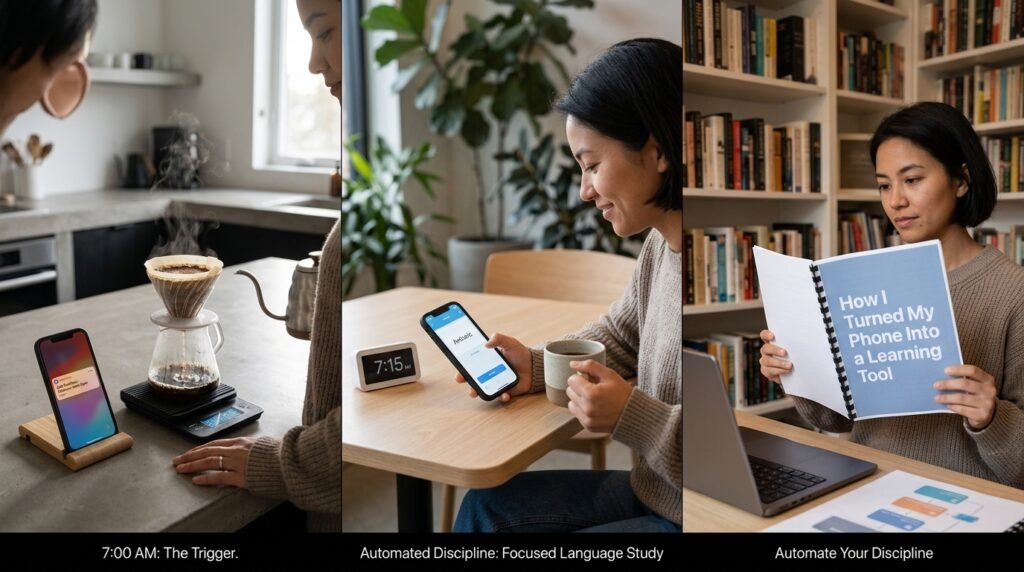
I anchored the software directly to my morning coffee routine. I brew Ethiopian Guji beans every single morning. I use a strict V60 pour over method. I weigh the beans perfectly on a digital scale. The bloom phase takes exactly forty five seconds.
I built a custom mobile script. At exactly seven o’clock every morning, my phone silences all notifications. It blocks my email inbox. It automatically opens my custom flashcard deck.
I review my vocabulary while the hot water drains through the paper filter. The physical smell of the coffee became the exact trigger for the study session. I completely removed willpower from the equation. I detail this exact technological setup in How I Turned My Phone Into a Learning Tool because you must automate your discipline if you want to survive a busy professional schedule.
The Audio Disconnect
As I approached the final week of the experiment, I felt confident in my new custom vocabulary. I knew the statistical terms for basketball. I knew the technical terms for photography.
I decided to test my listening comprehension. I opened a native sports podcast. I hit the play button.
My confidence shattered instantly.
The native speaker talked incredibly fast. The words blurred together into a muddy stream of noise. My brain could not separate the syllables. I recognized absolutely nothing.
I realized the audio in my language application was completely sterile. The app used a voice actor speaking perfectly in a silent room. Real humans mumble. Real humans use local hesitation sounds. Real humans overlap their sentences. The app had trained my eyes to read perfectly, but it had completely failed to train my ears to listen. A pristine digital environment leaves you totally unprepared for the chaos of reality.
Day Twenty Eight and the Blank Page Test
I wanted to see if I could actually produce spontaneous thoughts. Applications train you to be a passive consumer. You consume puzzles and multiple choice questions. You never actually create anything original.
I closed the application. I opened a blank text document on my computer. I forced myself to write a short paragraph about my plans for the weekend using only my target language.
It was agonizing. Without the colorful hints and digital buttons, my mind went completely blank. I forgot the most basic verb conjugations. I stared at the blinking cursor for ten minutes.
This test proved that you must actively force yourself into a creator mindset. You must pull the language out of your own brain from absolute scratch. If you only practice inside the app, your fluency remains trapped inside the app.
Day Thirty: The Real World Collision
On the final day of the experiment, I walked into a local cafe. I wanted to order a simple black coffee from a native speaker. I had practiced this exact scenario on my phone hundreds of times.
I walked up to the counter. The native speaker looked at me and asked a slightly different question than the application had taught me.
My heart rate spiked. I froze completely. The massive vocabulary I had built over thirty days vanished. I pointed at the menu, muttered a broken word, and paid my bill in silence.
The physical stress of a live human interaction completely overrides your digital training. You cannot simulate a racing heart on a smartphone screen. You cannot simulate the fear of judgment. The application completely failed to prepare my nervous system for the heavy pressure of the real world.
The Final Audit and Purge
The thirty day experiment concluded. I sat down and audited the entire process exactly like I audit website traffic data.
The application was highly effective at one single task. It was fantastic at forcing me to memorize raw vocabulary words through spaced repetition. It was a great digital storage container.
The application failed at absolutely everything else. It failed to teach me grammar. It failed to train my ear for native speed. It failed to prepare me for the emotional stress of speaking.
I immediately executed a massive digital purge. I deleted every single gamified feature. I turned off the leaderboards. I turned off the daily streak notifications. I stripped the application down to its bare, utilitarian core. I explain this ruthless filtering process in How I Avoid Wasting Time With Ineffective Apps to guarantee I never fall for a bright user interface again.

Redefining the Tool
I still use a language application today. But my relationship with the software is completely different.
I no longer view the app as my teacher. I view it strictly as a starter motor. The app provides the initial spark. It helps me memorize a new word.
But the actual learning happens the exact moment I close the app. The real learning happens when I read a native article about NBA forecasting. The real learning happens when I listen to a messy, unscripted podcast. The real learning happens when I embarrass myself in front of a native speaker.
The application is a bridge. It is not a destination.
If you are staring at a massive streak on your smartphone right now, you need a reality check. You are playing a very fun digital game. You are not building real fluency. Stop chasing digital gems. Stop worrying about the leaderboard. Take your custom vocabulary, turn off your phone, and walk out your front door. The real world is loud, fast, and terrifying. It is also the only place where true fluency actually exists.

Gabriel Henrique is a language enthusiast and productivity writer. After testing countless study methods, he became obsessed with mastering new languages efficiently. He achieves this without burnout, without endless grammar drills, and without losing focus. At Blog The Curious, he shares everything he has learned along the way.