
I have a specific folder on my smartphone that I call the digital graveyard. It contains dozens of colorful application icons. These applications promised to make me fluent in weeks. I spent thousands of hours tapping on glass. I collected digital gems. I maintained streaks that lasted over a year. I finally stood in a crowded cafe in a foreign city and realized I was functionally illiterate. I could not order a simple coffee without sweating.
I manage a network of specialized digital publishing websites. I write technical privacy policies. I build internal link structures. I analyze NBA playoff statistics for first action forecasting. I am a person who values data and efficiency above everything else. I realized my approach to language learning was the exact opposite of efficient. I was treating it like a mobile game.
I decided to run a ruthless audit of every tool on the market. I treated these apps like I treat failing web servers. If they did not produce a measurable return on my time, they were deleted. After testing dozens of platforms, I have a very short list of recommendations. These are the tools that actually survived my audit. Here is exactly what I recommend after testing multiple language tools.
The Problem with Gamified Entertainment
Most popular language apps are not education tools. They are entertainment products designed to keep you subscribed. They hire psychological engineers to build dopamine loops. They want you to care about your leaderboard rank. They want you to feel bad if your digital mascot looks sad.
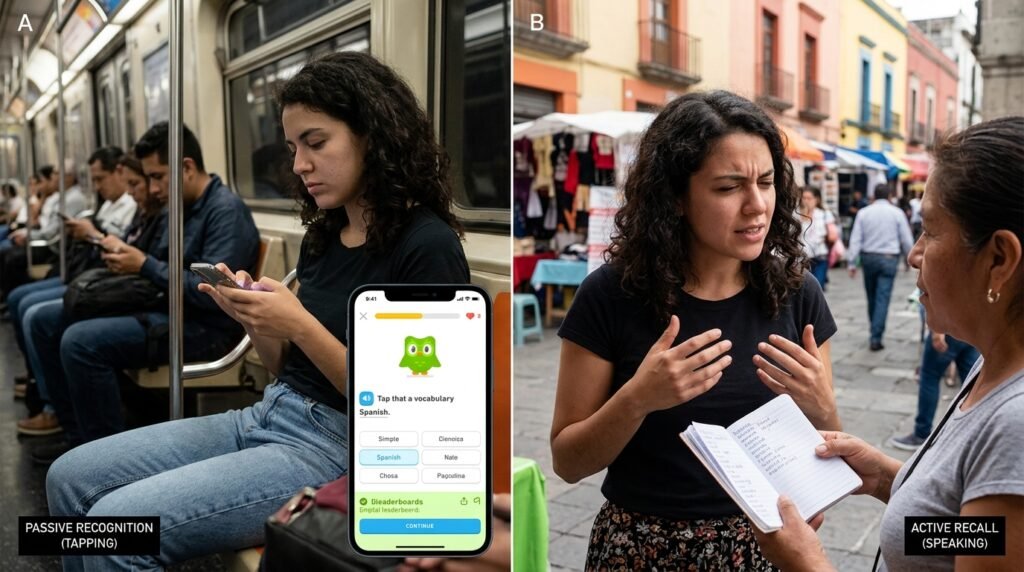
I realized that What Worked (and What Didn’t) in My First Months Learning depended entirely on whether the app forced me to think or just forced me to click. Most apps choose clicking. They give you multiple choice questions. They give you word banks. Your brain does not have to recall anything. It only has to recognize the correct answer from a list.
Recognition is not the same as recall. In a real conversation, nobody gives you four options to choose from. You have to pull the word out of thin air. I strictly avoid any tool that relies on multiple choice as its primary teaching method. If the app does not make your brain hurt, it is not working.
Spaced Repetition as a Professional Database
The only digital tool I still use daily is a raw Spaced Repetition System. This is not a fun app. It has no bright colors. It looks like a database from the early nineties. It is a tool for professionals who need to memorize massive amounts of data.
The beauty of this system is that it respects the forgetting curve. It tracks exactly how well you know a word. It shows you the word again at the precise moment you are about to forget it. It uses mathematical intervals to maximize memory retention.
I stopped using pre made vocabulary lists. I source my own wild data. I am deeply interested in specialty coffee. I brew Ethiopian Guji beans every morning using a V60 pour over. I track the temperature of the water. I weigh exactly 18 grams of coffee. I took the specific vocabulary from my coffee ritual and put it into my database.
I did the same with my NBA playoff analytics. I added terms for point spreads, rebounding probabilities, and assist ratios. When the data is personal, the memory becomes permanent. My brain does not want to remember the word for apple. It wants to remember the word for a first action turnover.
The Superiority of Monolingual Tools
Once I reached an intermediate level, I deleted every translation app on my phone. Translating is a massive mental bottleneck. It adds a heavy step to your thinking process. You hear a word. You translate it to English. You process the meaning. You translate your response back. This is far too slow for real life.
I switched to a monolingual dictionary. If I do not know a word, I read the definition in the target language. I have to use words I already know to understand new concepts. This creates a closed loop in the brain. It forces you to stay inside the language.
This was incredibly frustrating for the first month. It felt like I was walking through deep mud. The middleman eventually disappeared. I started thinking in the language. I realized that (How I Built a Learning System That Didn’t Feel Like Studying was a direct result of this strict immersion. I was no longer a student. I was a user of the language.
Audio Fidelity and the Shadowing Technique
Most apps use synthetic text to speech. These are robotic voices that lack the natural melody of human speech. They pronounce every syllable with equal weight. Humans do not speak like that. We mumble. We slur. We skip sounds.
I recommend using unscripted native audio. I find podcasts or YouTube videos of native speakers discussing things I actually like. I find photographers discussing the retro aesthetics of 35mm film lenses. I watch videos about the glass geometry of vintage Canon IXUS flashes.
I use the shadowing technique. I put on noise canceling headphones. I play the audio at slow speed. I repeat exactly what the speaker says as they are saying it. I try to match their exact pitch and rhythm. I mimic the way they slur their vowels. This is the only way to train your jaw muscles to produce the correct sounds. It is physically exhausting. It is also the most effective pronunciation tool in existence.
The Role of Mobile Automation
I use task automation for productivity. I use mobile scripts to manage my daily publishing workflows. I decided to apply this same logic to my study routine. I knew that What Helped Me Stay Consistent Using Language Apps was not about willpower. It was about controlling the digital environment.
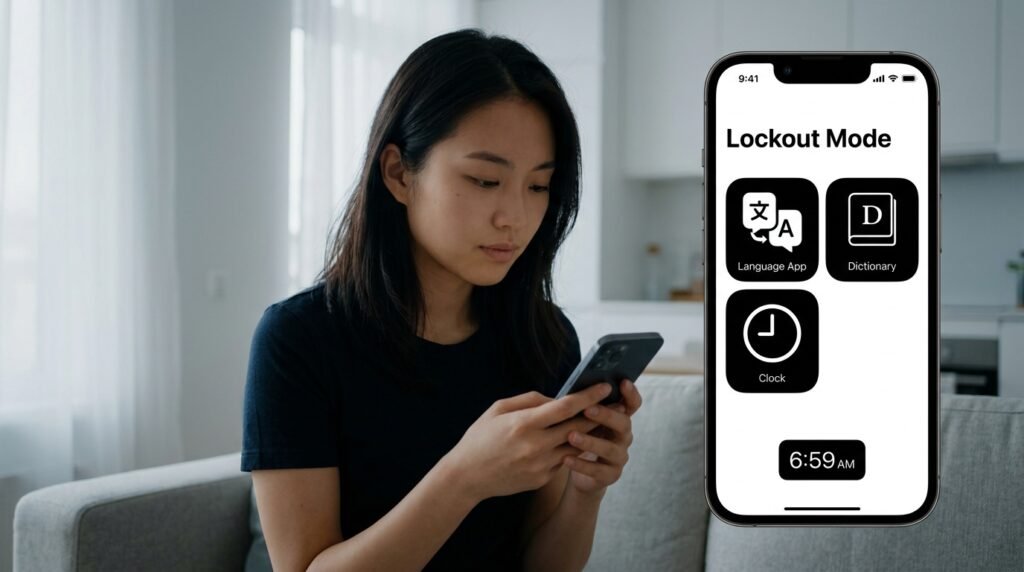
I built a specific focus mode on my phone. Every morning at seven o’clock, my phone automatically enters a strict lockout. It hides my social media apps. It silences my work emails. It changes the home screen to only show my language tools.
I anchored this to my coffee ritual. While the water is heating in my gooseneck kettle, I do my first set of reviews. While the coffee is blooming, I do my second set. I do not have to make a choice to study. The phone and the coffee make the choice for me. I removed every ounce of friction from the process.
The Blank Page Test
I recommend moving away from consumption as fast as possible. Apps train you to be a passive consumer. You are always reacting to something on a screen. Fluency is the ability to produce original thoughts.
I use a simple digital notepad to conduct the blank page test. Every evening, I force myself to write five original sentences. I do not write about the weather. I write about the server migration I managed that afternoon. I write about the statistical trend I noticed in the NBA Western Conference.
I force my brain to pull the grammar and vocabulary out of absolute silence. If I cannot write it, I do not know it. This test is a brutal reality check. It exposes exactly where your gaps are. It tells you which verbs you actually need to learn.
Sourcing Content from Personal Passions
If you are bored, you will quit. Language learning is a long term project. It takes thousands of hours. You cannot survive those hours if you are reading textbooks about fictional characters.
I source all my reading material from my actual interests. I read foreign language blogs about digital photography. I analyze technical reviews of vintage camera gear. I follow native speakers on social media who discuss web development and site icons.
I am not studying. I am just doing my normal daily activities in a different language. This is the only way to stay consistent for years. You must integrate the language into your identity. It must be a tool that helps you do the things you already love.
The Danger of Broad Platforms
I recommend avoiding the massive platforms that claim to teach you every aspect of a language. They usually do everything poorly. They give you a little bit of grammar, a little bit of vocabulary, and a little bit of listening. It is a shallow experience.
I prefer specialized micro tools. I use one tool for memory. I use one tool for listening. I use one tool for reading. I use one tool for output.
By using specialized tools, I can control the intensity of each skill. I can focus on listening for a month if my ears are falling behind. I can focus on writing if my grammar is messy. Massive platforms take away your agency. They treat you like a child in a classroom. You are a professional. You should manage your own curriculum.
The Social Component of Learning
I am a solitary person. I prefer to work alone in my office with my dual monitors and my coffee. Language is a social tool. You cannot master it in total isolation.
I do not recommend the random chat apps where you talk to strangers. They are a massive waste of time. You spend twenty minutes exchanging basic greetings with fifty different people. It is the most inefficient way to learn.
I recommend finding communities built around your hobbies. I joined a foreign language forum for NBA fans. I joined a server for specialty coffee roasters. I am not there as a language learner. I am there as a basketball fan and a coffee nerd.
The pressure of wanting to contribute to a real discussion is a massive motivator. It forces you to look up words you actually need. It forces you to learn the slang that real people use. It provides immediate feedback.
Auditing Your Progress with Raw Data
I do not trust my feelings. Some days I feel fluent. Some days I feel like I have forgotten everything. Feelings are unreliable. I trust the data.
I keep a simple spreadsheet of my metrics. I track how many minutes I spend in my database. I track how many pages of native text I read. I track how many minutes of native audio I shadow.
I treat my language progress like I treat my website traffic. I look for trends. I look for plateaus. If my vocabulary growth slows down, I change the source material. If my listening comprehension is stagnant, I increase the audio speed. This objective approach removes the emotional frustration of learning. It turns the process into an engineering problem.
The Nightly Reset Protocol
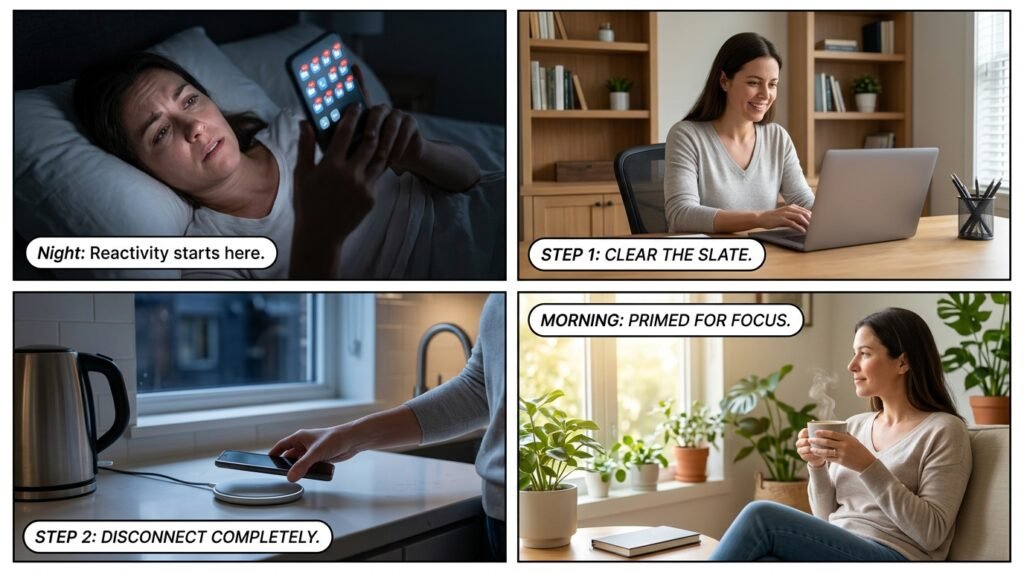
My final recommendation is a strict nightly reset. Your morning routine is determined by your actions the night before. If I leave my phone on my nightstand with fifty unread notifications, I will wake up in a reactive state. I will check my messages instead of doing my reviews.
I clear my digital environment every night. I close every open tab. I clear my cache. I put my phone in a charger in a different room.
When I wake up, I have a clean slate. I have a fresh pot of coffee. I have twenty minutes of silence. My digital environment is primed for focus. I have removed the possibility of failure.
Summary of Recommendations
Testing multiple tools taught me that simpler is almost always better. You do not need the newest software features. You do not need the most expensive subscription. You need a system that forces you to do the hard work.
Use a raw database for vocabulary. Source data from your actual life. Use unscripted native audio for listening. Shadow the speakers to train your jaw. Use monolingual dictionaries to stop translating. Automate your phone to protect your focus. Conduct the blank page test daily.
Stop looking for the perfect app. It does not exist. The best tool is the one that forces you out of the screen and into the real world. Choose the path of most resistance. That is where the fluency lives. Build your system, protect your time, and start using the language to live your life. The gems and the leaderboards are fake. The human connection is the only thing that is real.

Gabriel Henrique is a language enthusiast and productivity writer. After testing countless study methods, he became obsessed with mastering new languages efficiently. He achieves this without burnout, without endless grammar drills, and without losing focus. At Blog The Curious, he shares everything he has learned along the way.