
Day one of learning any new language feels exactly like staring at a massive brick wall. You hear sounds but process zero meaning. The letters might look familiar, but they make absolutely no sense together.
Most people quit right at this wall. They look at the sheer volume of unknown vocabulary and assume they simply lack the natural talent for languages.
Talent is a complete myth.
The first thirty days are not a test of your intelligence. They are a test of your daily systems. I manage several digital content platforms for a living. I decided to run an experiment. I treated my new language exactly like launching a new website. I built the backend architecture first. I ignored the shiny applications. I focused entirely on raw, daily execution.
This is the exact blueprint of my first month. I will show you how I built the habit, what specific words I studied, and how I survived the initial phase of total confusion without burning out.
Mini-Summary: The Goal of Month One Your only goal in the first thirty days is survival. You are not trying to become fluent. You are trying to build an unbreakable daily habit and familiarize your brain with completely foreign sounds.
Days 1 to 7: Building the Daily Architecture
I did not start by buying a massive grammar textbook. Buying textbooks gives you a false sense of progress. I started by auditing my daily calendar.
You cannot add a new, difficult cognitive task to your life without clearing space for it. I tracked my time for two days and realized my evenings were useless. After a full day of writing and managing projects, my brain was completely dead. I could not absorb new information at 8:00 PM.
I moved my study session to the absolute beginning of the day.
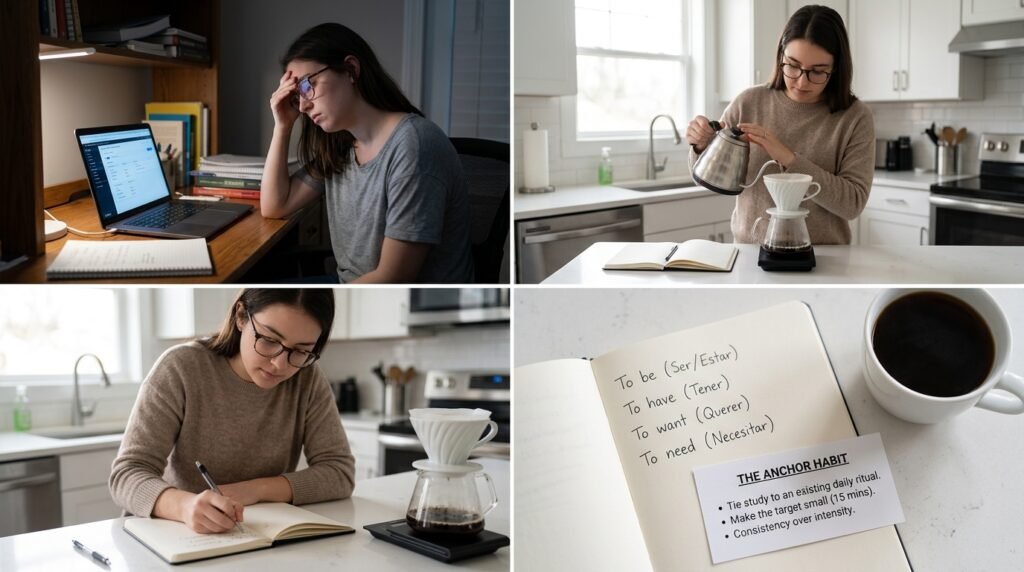
I needed a physical trigger to start the habit. Every single morning, I prepare a manual V60 pour over coffee. It is a quiet, deliberate process. I weigh the Ethiopian Guji beans. I heat the water to a precise temperature. I pour the water slowly over the paper filter.
I tied my language learning directly to this physical ritual.
I placed my blank notebook and a pen right next to my coffee scale. When I walked into the kitchen, the notebook was waiting for me. While the coffee bloomed, I sat at the counter and began my session.
I dedicated exactly fifteen minutes a day for the first week. I focused purely on core survival verbs.
I learned how to say to be, to have, to want, to need, and to go. I ignored complex grammar rules completely. I just wanted to recognize these fundamental anchors when I saw them on a page. Building this specific foundation helped me realize The Mistake I Was Making With Vocabulary (And How I Fixed It) which was trying to learn too much too quickly.
Mini-Summary: The Anchor Habit Do not rely on motivation. Tie your new study sessions to an unbreakable existing daily habit. Make the target incredibly small during week one. Fifteen minutes of focused work is superior to an hour of distracted reading.
Days 8 to 14: The Niche Vocabulary Sprint
By the second week, my coffee routine was solid. The notebook felt natural in my hands. It was time to upgrade the actual input.
Standard language courses make a massive error here. They teach you the names of obscure zoo animals, the colors of the rainbow, and articles of winter clothing. I looked at these lists and felt completely bored. Your brain aggressively deletes information it finds boring.
I needed vocabulary that solved immediate problems or connected to my deep personal interests.
Outside of my digital work, I have a massive interest in traditional Japanese tattoo art. I love studying Irezumi folklore. I specifically focus on the historical meaning behind motifs like the kitsune, the hebi, and the katana.
I stopped reading the beginner textbook dialogues. I started searching for short, simple texts about these specific artistic traditions.
I sat with my coffee and translated these texts line by line. I learned the foreign words for ink, skin, serpent, myth, and protection. This changed the entire dynamic of my morning session. It no longer felt like a tedious academic chore. It felt like I was using the language as a tool to explore a topic I genuinely loved.
I also learned the specific vocabulary for my morning coffee ritual. I learned the words for boiling, water, filter, cup, and dark. I narrated my physical actions in my head while I prepared my drink.
This hyper-specific focus locked the words into my long term memory instantly. I actually cared about the definitions.
Mini-Summary: Curate Your Input Throw away the generic vocabulary lists. Find reading material that maps directly to your actual hobbies. The desire to understand a topic you love will completely override the friction of learning new words.
Days 15 to 21: The Audio Shock Therapy
Reading and writing are safe. The words sit quietly on the paper. You can control the speed.
Real language does not work like that. Native speakers talk incredibly fast. The words blend together. By week three, I realized my reading comprehension was growing, but my listening comprehension was absolutely zero.
I needed to shock my ears. I needed an audio flood.
I started replacing my daily English podcasts with podcasts in my target language. I did not look for beginner audio. I looked for natural, native speed conversations.
The first few days were incredibly frustrating. I understood absolutely nothing. It sounded like one continuous, chaotic noise.
I forced myself not to panic. I did not pause the audio to look up words. I simply let the sounds wash over me while I drove my car or folded laundry. I was training my brain to recognize the natural cadence and rhythm of the speech.
After three days of passive listening, I introduced active listening blocks.
I took a two minute clip of audio. I sat at my desk with no distractions. I played the first sentence, paused it, and tried to write down exactly what I heard. I played that single sentence five times until I captured every syllable.
This process was exhausting. It drained my mental energy rapidly. But it forced my brain to separate the continuous noise into individual, recognizable words. I tracked this specific process closely and wrote down What Worked (and What Didn’t) in My First Months Learning so I could duplicate the exact listening methods that yielded the highest results.
Mini-Summary: Active Audio Processing Passive listening builds familiarity. Active listening builds comprehension. Force yourself to dictate short audio clips line by line. It is brutal work, but it is the fastest way to tune your ear to native speeds.

Days 22 to 30: The Uncomfortable Output Engine
By the final week of my thirty day experiment, I had a decent baseline. I knew a handful of high value verbs. I had a niche vocabulary. My ears were slowly adjusting to the speed of the language.
But I had not actually spoken a single sentence out loud.
Input is comfortable. Output is terrifying. Speaking exposes your mistakes. It forces you to construct sentences in real time under pressure. I knew that if I did not start speaking immediately, I would develop a massive mental block.
I did not hire a tutor yet. I was not ready for a real conversation. I decided to build a safe, private environment for my initial output.
I started using the shadowing technique.
I put my headphones on and played a podcast episode I had already analyzed. As the host spoke, I spoke directly over them. I tried to perfectly mimic their pronunciation, their pitch, and their emotional tone. I walked around my house talking to myself in a foreign language.
Then, I moved to unscripted output.
When I cooked dinner, I narrated the entire process out loud to my empty kitchen.
I am cutting the vegetables. The pan is hot. I need more salt.
This exercise immediately highlighted the gaps in my vocabulary. If I did not know the word for onion, my sentence stopped dead. I would grab my phone, look up the word, and immediately use it. This constant loop of finding gaps and filling them built The Routine That Helped Me Go From Zero to Basic Conversations in record time.
I sounded like a toddler. My grammar was heavily flawed. But I was finally transferring the language from my brain to my facial muscles.
Mini-Summary: Force Output Early Do not wait until you feel ready to speak. You will never feel ready. Talk to your empty room. Narrate your daily chores out loud. Shadow native audio tracks. Muscle memory is a massive component of fluency.
Tracking the Data, Not the Emotion
Throughout these thirty days, I heavily relied on my professional background in productivity tracking.
When you learn a complex skill, your emotions will lie to you. On day fourteen, I felt like a complete failure. I felt like I was making zero progress. If I relied on my feelings, I would have quit the experiment right there.
I relied on hard data instead.
I used a minimal habit tracking application on my phone. My only goal was to execute my daily fifteen minute block and check the box.
I did not track my fluency. Fluency is an invisible, lagging metric. You cannot control it on a daily basis. I tracked my raw input hours. I watched the total number of study minutes grow on a spreadsheet.
By day thirty, I had accumulated over ten hours of highly focused, uninterrupted study time. I had listened to dozens of hours of native audio. The data proved I was moving forward, even when my brain felt stuck.
If you want to survive the first month, you must build a visual representation of your effort. Buy a paper wall calendar. Draw a red cross on every day you complete your minimum study block. Build a chain. Your desire to protect that visual chain will push you through the days when your motivation completely disappears.
Managing the Digital Environment
During this thirty day period, I also weaponized my digital environment.
I spend hours every day managing content platforms. My laptop and my smartphone are my primary workspaces. I realized I could use these devices to force passive immersion.
On day fifteen, I changed the default operating language on my smartphone to my target language.
This was incredibly frustrating. I use my phone for task management, banking, and client communication. Suddenly, I could not find my alarm clock settings. I could not quickly navigate my calendar.
I was forced to learn the vocabulary simply to survive my workday. I learned words for settings, messages, tomorrow, and delete purely through muscle memory and context clues.
I also cleaned up my social media feeds. I unfollowed useless entertainment accounts. I followed pages dedicated to my interests in the target language. When I mindlessly opened an application while standing in line at the grocery store, I was immediately hit with foreign text.
I removed the choice to study. The language was simply waiting for me everywhere I looked.
The Result After Thirty Days
So, what exactly did thirty days of strict daily execution buy me?
Did I become fluent? Absolutely not. That is a marketing lie sold by applications and expensive courses.
But I achieved something much more valuable. I built a bulletproof foundation.
I successfully completely removed the fear of the unknown. The language no longer looked like an impossible puzzle. It looked like a standard daily task. The strange sounds were no longer intimidating. My mouth knew how to form the basic vowels.
I possessed a core vocabulary of roughly three hundred high value words. I could navigate simple texts about topics I actually cared about. I could listen to native audio without experiencing a spike in my heart rate.
Most importantly, I proved to myself that I could maintain the habit.
The hardest part of language learning is not the grammar. The hardest part is showing up to the desk on a Tuesday morning when you are tired and busy. By anchoring my study session to my coffee routine, keeping the time limit small, and tying the vocabulary to my genuine interests, I removed the friction.

How You Can Duplicate This Month
If you are standing at day one, feeling completely paralyzed by the journey ahead, you need to shrink your focus immediately.
Do not plan for the next year. Plan for the next thirty days.
Here is your exact checklist for month one:
-
Find Your Anchor: Audit your morning. Find a habit you already do every single day without fail. Put your study materials directly next to that physical location.
-
Set a Tiny Floor: Commit to fifteen minutes. Do not aim for an hour. Aim for a target so small you cannot possibly make an excuse to skip it.
-
Pick Your Niche: Write down three topics you love. Find short articles or videos in the target language about those specific topics. Ignore the generic beginner lists.
-
Embrace the Noise: Flood your ears with native audio. Do not pause it. Let the rhythm train your brain.
-
Talk to the Wall: Start narrating your life out loud immediately. Sound stupid in private so you can sound competent in public later.
-
Track the Execution: Use a calendar or a digital tracker. Focus entirely on checking the daily box. Ignore your feelings of inadequacy.
The wall is high, but it is entirely climbable. Stop hoarding resources. Stop researching the perfect method. Clear your desk, set your timer for fifteen minutes, and take the very first step.

Gabriel Henrique is a language enthusiast and productivity writer. After testing countless study methods, he became obsessed with mastering new languages efficiently. He achieves this without burnout, without endless grammar drills, and without losing focus. At Blog The Curious, he shares everything he has learned along the way.