
I used to be a professional procrastinator. I would spend hours planning to study. I would buy expensive notebooks. I would download the best software. I would create massive, color coded spreadsheets to track my future progress. I would organize my desk perfectly. I would arrange my pens. I would do absolutely everything except actual language learning.
At the end of the day, I would look at my blank notebook and feel a massive wave of guilt. I would tell myself a familiar lie. I would promise to study for two hours the next day to make up for my failure.
The next day, the exact same cycle would repeat. I manage a complex digital publishing business. I spend my days fixing broken site maps, analyzing user retention metrics, and managing remote writers. I deal with constant digital fires. By the time I finished my professional work, the thought of opening a foreign language textbook felt like lifting a boulder.
Procrastination is not laziness. Laziness is a lack of desire to do the work. I had a massive desire to learn the language. Procrastination is a structural failure. It is a complete inability to cross the bridge between intention and action. I realized I could not simply try harder. I had to completely dismantle my behavior. Here is exactly how I stopped procrastinating my language learning.
The Trap of Productive Procrastination
The most dangerous form of delay looks exactly like hard work.
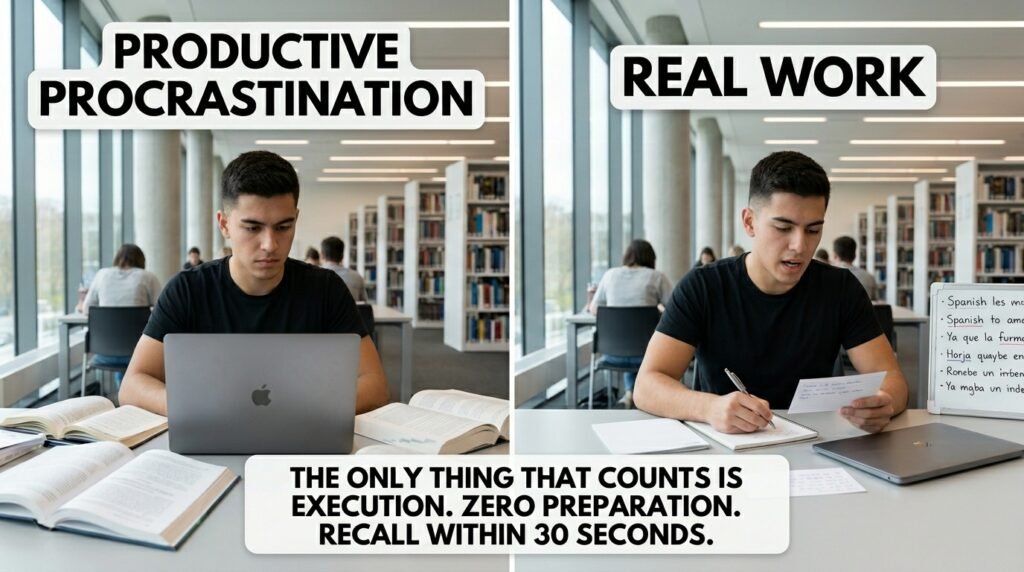
I call this productive procrastination. I would spend forty five minutes searching the internet for the absolute best grammar resources. I would read reviews of different textbooks. I would watch videos of other people speaking the language fluently.
My brain felt like it was doing real work. I felt productive. But I was not producing anything. I was just consuming information about the work instead of doing the work itself.
You must recognize this trap immediately. Researching how to study is not studying. Organizing your flashcards is not studying. Watching a video about language learning is not studying. The only thing that counts as studying is forcing your brain to recall foreign vocabulary or produce foreign sentences. Everything else is just a comfortable distraction. I had to set a strict rule. Zero preparation allowed. When the study block begins, I must execute raw output within thirty seconds.
The Myth of Motivation
Amateurs wait for motivation. Professionals simply go to work.
I spent months waiting for the right mood to strike. I thought I needed to feel inspired to tackle a difficult grammar concept. This is a massive mental error. Motivation is a completely unreliable emotion. It fluctuates based on your sleep, your diet, and your stress levels.
You cannot build a permanent skill on a temporary emotion.
I completely stopped caring about how I felt. Action must always precede motivation. You do not feel motivated to study, so you sit down and study anyway. After five minutes of forced action, the brain engages. The friction disappears. The motivation arrives as a direct result of doing the work. You must divorce your actions from your feelings.
The Barrier to Entry
We procrastinate because the task feels too big.
When you tell yourself you need to study for a full hour, your brain perceives a massive threat. An hour is a long time. It requires heavy cognitive load. Your brain immediately looks for an escape route. It suggests checking your email. It suggests making a snack.
I had to completely destroy the barrier to entry. I lowered my daily goal to an absurdly small metric.
I told myself my only requirement was to review exactly three vocabulary cards. That was the entire daily goal. It takes less than thirty seconds to review three cards. The brain does not perceive a thirty second task as a threat. There is zero resistance.
I would open the application, review the three cards, and hit my goal. Ninety nine percent of the time, I would just keep going. Since the application was already open, doing twenty more cards felt incredibly easy. The entire secret is initiating the task. Once you are moving, physics takes over. An object in motion stays in motion.
Engineering the Environment
Willpower fails. Environment never fails.
I used to keep my study materials buried in a drawer. I kept my language applications hidden on the third page of my smartphone. If I wanted to study, I had to actively seek out the tools. This creates unnecessary friction.
I reversed the entire setup. I engineered my physical and digital space to make studying unavoidable.
I put my physical notebook directly on top of my computer keyboard. When I sat down at my desk, I physically had to move the notebook to start my workday. I moved my flashcard application to the primary dock of my smartphone. I deleted the social media applications that lived next to it.
I realized that The Strategy That Helped Me Stay Focused While Studying required a completely hostile environment for distractions. You must design a workspace where doing the wrong thing is difficult and doing the right thing is the default option.
Killing the Perfectionism
Perfectionism is just procrastination wearing a suit.
I used to avoid practicing my writing because I was afraid of making grammar mistakes. I wanted my sentences to be flawless. Because I could not write perfectly, I chose to write absolutely nothing at all.
You must embrace the ugly reality of learning. You are going to sound stupid. You are going to make brutal mistakes. You are going to use the wrong verb tense and confuse native speakers.
This is exactly How I Stopped Overthinking Grammar Rules because I accepted that mistakes are mandatory data points. I stopped trying to write a perfect paragraph. I started writing terrible, broken paragraphs as fast as possible. You cannot refine a blank page. You can only refine messy output. Produce the garbage first, then fix it later.
The Decision Fatigue Problem
I audit content management systems for a living. I make hundreds of micro decisions every single day. Do we publish this article? Do we change this headline? Do we migrate this server?
By the late afternoon, I suffer from massive decision fatigue. My brain literally lacks the energy to make one more choice.
If your study plan requires you to make a decision, you will fail. If you sit down at your desk and ask yourself what you should study today, you have already lost. The decision fatigue will crush you. You will open a video site instead.
I removed all choices from my routine. I plan exactly what I am going to study the night before. I write a single sticky note. I write exactly which vocabulary deck I will review. I write exactly which podcast episode I will listen to. When the study block begins, I do not think. I just follow the script.

Forgiving the Missed Days
The most critical moment in your language journey is the day after you fail.
You will miss a day. A crisis will happen at work. You will get sick. You will simply forget. This is inevitable.
Most people let a single missed day ruin their entire month. They feel guilty. They feel like their perfect streak is broken, so they might as well quit entirely. This is a toxic spiral.
A missed day is just a missed day. It means absolutely nothing. Do not try to compensate. Do not try to study for double the time the next day. Just get back on the normal schedule immediately. Forgive yourself instantly. Consistency is not about never breaking the chain. It is about how fast you repair the chain after it snaps.
The Power of Immediate Action
Procrastination feeds on the gap between thought and action.
You have a thought. You think you should review some vocabulary. Then you pause. You consider if you really have the energy. You wonder if you should make coffee first. That five second pause is where the delay takes root.
You must close the gap. I use a strict five second rule. The exact moment I realize I need to study, I physically move my body within five seconds. I do not allow my brain to generate excuses. I stand up. I grab the notebook. I open the application.
Action kills anxiety. The longer you wait to start, the bigger the task feels in your mind. Crush the hesitation with immediate, aggressive movement.
Redefining the Study Session
I used to believe that a study session had to be a formal event. I thought I needed a quiet room, a cup of tea, and an hour of uninterrupted silence.
This formal definition is a massive barrier. I rarely have an hour of uninterrupted silence.
I completely redefined what studying means. Studying is just making contact with the language. Reviewing flashcards for three minutes while waiting for a web page to load is a valid study session. Listening to a native podcast while driving to the grocery store is a valid study session.
You must understand How I Built a Learning System That Didn’t Feel Like Studying to realize that fragmented time is your greatest asset. Stop waiting for the perfect conditions. The perfect conditions do not exist. Use the messy, noisy gaps in your day.
The Cost of Delay
We procrastinate because the consequences of delay are invisible in the short term.
If you do not study today, nothing bad happens immediately. You do not lose your job. You do not go bankrupt. The pain of failure is pushed far into the future.
You have to make the cost of delay visible. I sat down and calculated exactly how many hours I was wasting on my smartphone every week. The number was horrifying. I realized I was actively choosing to remain ignorant. I was choosing to be unable to speak the language.
Every time you choose comfort over the work, you are casting a vote for the person you do not want to be. You have to get angry at your own excuses. You have to realize that time is running out. You do not have infinite days to achieve this goal.
Public Accountability
When you make a private promise to yourself, it is incredibly easy to break. Nobody knows you failed.
I forced myself into public accountability. I do not mean posting generic goals on social media. That is just another form of productive procrastination.
I found a native speaker in a digital community. We set up a strict schedule. Every Friday at four o’clock, we have a twenty minute conversation. I cannot hide. If I do not study my vocabulary during the week, I will look completely foolish on Friday afternoon.
The fear of public embarrassment is a highly effective tool. Use it to your advantage. Put your reputation on the line. When other people are relying on you to show up and perform, the urge to procrastinate completely disappears.
Embracing the Friction
Learning a language is hard. It is supposed to be hard.
Your brain is literally building new neural pathways. It is rewiring its entire communication system. This process burns massive amounts of glucose. It causes physical fatigue.
We procrastinate because we want to avoid this cognitive pain. We want things to be easy.
You must change your relationship with the friction. The friction is not a sign that you are doing something wrong. The friction is the exact mechanism of growth. When you feel a headache coming on after a difficult grammar drill, that is the exact moment the learning is happening.
Stop running from the hard work. Lean directly into it. Expect it to be difficult. Expect to be frustrated. When you accept the reality of the struggle, the urge to escape it completely vanishes.

The Final Audit
Look closely at your daily routine. Audit your behavior like a cold, calculating machine.
Where are the gaps? What are the specific triggers that make you pick up your phone instead of your notebook?
You must identify the exact moments where your discipline breaks down. Once you map the failure points, you can build systems to protect them.
Turn off the notifications. Lower the daily goal to two minutes. Prepare the materials the night before. Stop waiting for motivation. Force the action.
You have spent enough time planning. You have spent enough time organizing. The preparation phase is officially over. Close the browser. Put the phone away. Open the material and start the timer. The only thing standing between you and fluency is the work you are actively avoiding right now. Get to work.
Gabriel Henrique is a language enthusiast and productivity writer. After testing countless study methods, he became obsessed with mastering new languages efficiently. He achieves this without burnout, without endless grammar drills, and without losing focus. At Blog The Curious, he shares everything he has learned along the way.