
I used to believe that consistency was a character trait. I thought some people were simply born with iron discipline. I watched other people master new skills and assumed they possessed a secret reserve of willpower that I lacked. I tried to force myself to study. I set ambitious goals. I promised myself I would study for one hour every single night.
The strategy failed completely. I manage a network of specialized digital publishing websites. My daily schedule is packed with complex tasks. I write strict privacy policies. I map out internal link architectures for multiple domains. By the time seven o’clock in the evening arrived, my mental battery was entirely empty.
When you are exhausted, your brain will always choose the path of absolute least resistance. I would look at my language learning books. I would look at the television. The television won every single time. I realized that relying on willpower is a massive structural mistake. Willpower is a finite resource. It drains completely with every decision you make during the day.
I stopped trying to be a stronger person. I decided to build a stronger system. I engineered an environment where failing became harder than succeeding. I stripped away the need to make any conscious choices. Here is the exact study habit that helped me stay consistent every single day.
The Myth of the Perfect Schedule
My first mistake was trying to schedule massive blocks of study time. I blocked out two hours on Sunday afternoons. I thought long, unbroken sessions were required for real progress.
This approach is incredibly fragile. Life does not respect your perfect calendar. A web server goes down. A critical website update requires immediate attention. A family emergency happens. When you miss your two hour block, the psychological blow is devastating. You feel like a complete failure. You abandon the habit entirely until next week.
I realized I needed an anti fragile routine. I needed a habit that could survive a chaotic professional life. I completely abandoned the idea of long study blocks. I shifted my entire focus to frequency. I stopped caring about how long I studied. I only cared about how often I made contact with the material. Ten minutes of daily contact is infinitely more powerful than two hours of panicked studying on a Sunday.

The Concept of Physical Anchoring
You cannot attach a new habit to empty space. If you tell yourself you will study whenever you have free time, you will never study. Free time does not exist. Your schedule will always fill the empty gaps with digital distractions or extra work tasks.
You must attach the new habit to a permanent physical ritual. This is called anchoring.
You find a physical action that you already execute every single day without fail. You do not have to think about this action. You just do it automatically. You then bolt your new study habit directly to this existing ritual. The existing ritual acts as a massive psychological trigger. It pulls the new habit forward.
I analyzed my daily routine. I found my perfect anchor.
My Permanent Morning Anchor
I am incredibly meticulous about my morning coffee. It is the one physical ritual I never skip.
Every single morning, I walk into the kitchen and execute a precise series of steps. I brew Ethiopian Guji beans. I place a glass decanter on my digital scale. I weigh exactly eighteen grams of coffee. I grind the beans to a medium coarse texture. I use a strict V60 pour over method. I monitor the exact water temperature with a gooseneck kettle. The bloom phase takes exactly forty five seconds.
This physical routine is deeply ingrained in my nervous system. I do it perfectly even when I am half asleep. I decided to bolt my language learning directly to this specific process.
I do not study in the evening anymore. I study while the hot water drains through the paper filter. The physical smell of the coffee and the heat of the kettle act as an immediate neurological trigger. My brain recognizes the sensory input. It immediately knows that coffee time is now study time. This was exactly How I Built a Routine That Actually Worked for Me because I stopped fighting my natural daily rhythm.
The Brutal Digital Automation
Anchoring the habit was not enough. I still had to pick up my smartphone to open my digital flashcards. The smartphone is a highly dangerous device. It is packed with bright red notification badges and addictive social media feeds.
I would pick up my phone to study. I would see a notification about a server error. I would see an email about a privacy policy draft. Twenty minutes would instantly disappear.
I had to remove the choice completely. I rely heavily on mobile task automation in my professional life. I write complex scripts to manage my web platforms. I applied this exact same logic to my daily study habit.
I used the native shortcuts application on my smartphone to build a strict digital trigger. I programmed the device to recognize exactly when my coffee routine occurs. At exactly seven o’clock every morning, my phone enters a customized focus mode.
The automation silences all incoming emails. It mutes all text messages. It hides my web browser. It automatically launches my primary spaced repetition flashcard application. It places the target language directly on my screen. I literally have to fight my own phone if I want to avoid studying. By removing the friction of choice, the habit becomes automatic.
The Two Minute Minimum Contract
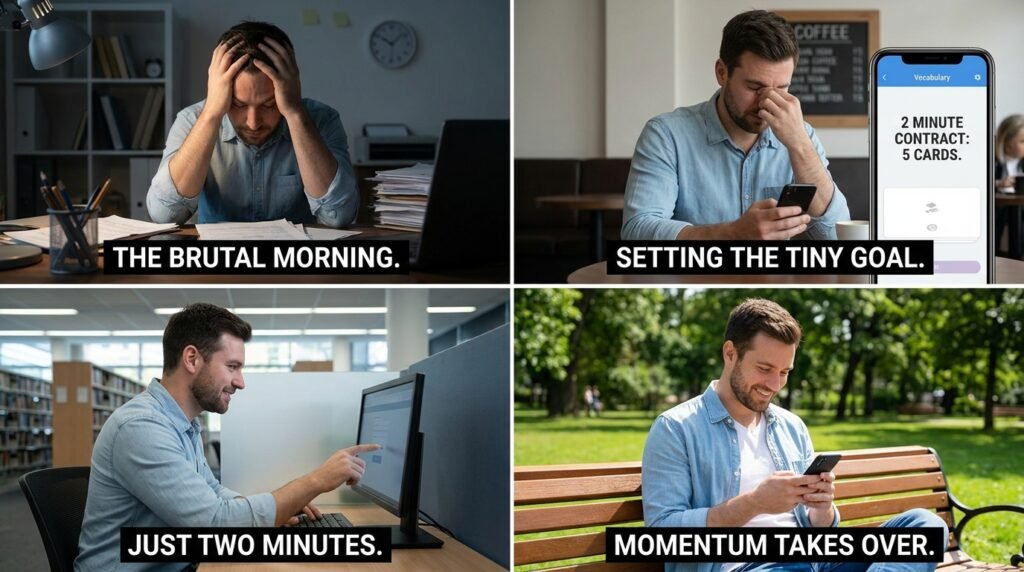
Some mornings are brutal. I might be exhausted from a late night server migration. I might be stressed about a massive drop in website traffic. On those mornings, even a ten minute study session feels like climbing a mountain.
To survive these low energy days, I created a strict contract with myself. The minimum daily requirement is exactly two minutes.
I can do absolutely anything for two minutes. I tell myself I only need to review five vocabulary cards. I tap the screen five times. The barrier to entry is so incredibly low that my brain stops resisting the task.
Here is the secret of the two minute contract. Once you actually start the task, the mental resistance completely evaporates. You realize the task is not actually painful. Ninety five percent of the time, I finish my five cards and decide to keep going for another ten minutes. The two minute rule is just a mental hack to trick your brain into initiating the action.
Sourcing High Leverage Data
You will never stay consistent if the material bores you to death.
Most people fail because they use default application curriculums. They learn how to order generic apples at a supermarket. They learn how to ask for directions to a public swimming pool. My brain actively deletes information it deems entirely useless to my survival.
I completely stopped using prepackaged vocabulary lists. I turned my study system into a highly personalized data vault. I only study things I am deeply passionate about.
I am obsessed with professional basketball. I analyze first action NBA playoff statistics. I calculate point spreads, rebounding probabilities, and assist ratios for specific point guards. I took these highly technical statistical terms and built my own digital flashcards.
I also study digital photography. I focus heavily on preserving precise facial geometry in my portrait edits. I study the retro visual aesthetics of 35mm film lenses and vintage Canon IXUS flashes. I translated these specific technical concepts into my target language and fed them directly into my database.
When your vocabulary describes your actual daily passions, your brain locks onto the data immediately. The study session stops feeling like a chore. It feels exactly like reading your favorite magazine. I realized that personalizing the data is precisely What Actually Helped Me Stay Consistent While Learning a Language because relevance always beats raw discipline.
Rejecting the Gamified Streak
Software developers are masters of psychological manipulation. They use gamification to hijack your attention. They give you digital gems. They put you on a competitive leaderboard. They track your daily learning streak with massive glowing numbers.
I used to care deeply about my digital streak. I reached over two hundred consecutive days on a popular application. Then, I missed one day because I was traveling. The application reset my counter to zero. It sent me a passive aggressive notification about losing my progress.
The psychological blow was massive. I felt completely defeated. I almost quit the language entirely.
I realized the gamified streak is incredibly toxic. It punishes you for living a normal human life. It forces you to prioritize the software algorithm over the actual language. I executed a ruthless digital purge. I deleted every single gamified app on my device. I switched to a raw, ugly database tool that simply shows me raw data without any digital manipulation.
The Analog Tracking Calendar
I still need to track my progress. Tracking provides necessary visual feedback. I just needed a method that did not judge me.
I bought a cheap, large physical paper calendar. I nailed it directly to the wall above my computer monitors. I keep a thick black marker right next to it.
Every single day that I complete my morning flashcard review, I take the black marker and draw a massive X over the date.
The physical calendar is incredibly powerful. The analog feedback is deeply satisfying. More importantly, the calendar is completely neutral. It does not judge me. If I miss a day because a web server crashes and ruins my morning, the calendar just shows a blank square. It does not send me a notification. It does not reset my past progress. The next morning, I simply pick up the marker and draw a new X. The visual chain on the wall provides raw motivation without the toxic guilt of a digital algorithm.
The Monolingual Dictionary Rule
Translating foreign words into English text is a massive mental crutch. It allows your brain to stay lazy. You look at a foreign word, translate it to English, and process the English meaning. You are not actually learning to think in the target language.
I implemented a strict rule to force deep engagement during my daily study sessions. I deleted every single translation tool from my smartphone and my computer. I replaced them all with a strict monolingual dictionary.
When I find a foreign word I do not understand, I am forced to read the definition in that exact same foreign language. I have to use simpler foreign words to decode the complex word.
This process was agonizing for the first month. A simple reading session took five times longer. But it forced my brain to stay completely submerged inside the target language environment. It built incredible linguistic resilience. I found this to be The Simple Habit That Doubled My Vocabulary Retention because the mental struggle forces the word deep into your long term memory.
Forcing Physical Output
My daily study habit is not just about passive consumption. You can review flashcards for three years and still remain completely unable to hold a conversation. Fluency requires rapid, spontaneous creation.
I integrated a strict writing protocol into the end of my day. I open a completely blank digital notepad. I force myself to write a five sentence journal entry entirely in my target language.
I do not allow myself to write generic sentences. I write about the exact NBA point guard statistics I analyzed that morning. I write about the privacy policies I drafted. I write about the specific color grading tweaks I made to a digital photograph.
I force my thumbs to type out the complex foreign characters. This builds massive physical muscle memory. It exposes my grammatical weaknesses immediately. You cannot fake your knowledge when you are staring at a completely blank screen. This daily output forces me to actually synthesize the raw data I memorized during my morning coffee ritual.
The Weekly Data Audit
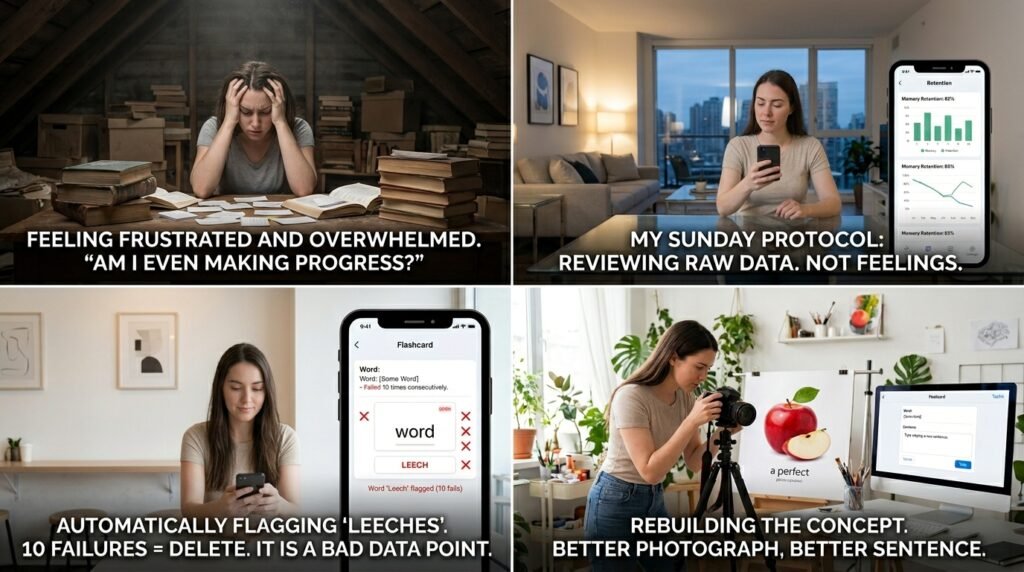
You cannot improve a system if you refuse to measure its output. Feelings are highly unreliable. You might feel like you are failing while actually making massive progress. You must trust raw data.
I treat my personal language progress exactly like I treat the traffic analytics for my digital publishing websites. Every Sunday evening, I sit down and execute a strict review protocol.
I open the native screen time features on my smartphone. I look at the exact number of minutes I spent actively swiping inside my flashcard application. I check my memory retention rates in the database.
If I fail a specific word ten times in a row, the software flags it as a leech. I immediately delete the leech. It is a bad data point. It is draining my energy. I rebuild the concept completely from scratch with a better photograph and a better sentence. The objective numbers remove all the emotional frustration. They turn the learning process into a cold, clinical engineering problem.
The Final Reality of Consistency
Consistency is not a magical superpower. It is not a genetic gift. It is simply the result of intelligent environmental design.
If you are struggling to practice every day, stop blaming your lack of willpower. Your willpower is fine. Your system is broken.
You must rip your current routine apart. Find a permanent physical anchor. Brew your coffee. Tie your study habit directly to that physical action. Automate your smartphone to remove the friction of choice. Strip away the gamified distractions. Feed your database the raw, wild data that you actually care about. Use an analog calendar to track your physical progress.
When you stop relying on motivation and start relying on rigid, automated mechanics, your progress becomes inevitable. The system takes over the heavy lifting. You just have to wake up, pour the water over the grounds, and let the habit execute itself. That is the only real secret to mastering any complex skill.

Gabriel Henrique is a language enthusiast and productivity writer. After testing countless study methods, he became obsessed with mastering new languages efficiently. He achieves this without burnout, without endless grammar drills, and without losing focus. At Blog The Curious, he shares everything he has learned along the way.