
My attention span was completely broken. I would sit at my desk with a foreign language textbook open in front of me. Within three minutes, my hand would automatically reach for my smartphone. I would open a new browser tab. I would check the server status for blogthecurious.com. I would review the internal link architecture for thebrightlance.com. I would spend twenty minutes auditing website traffic.
I would suddenly realize I had not learned a single foreign word. My brain was completely scattered. I manage a network of specialized digital publishing websites. My entire professional life requires rapid context switching. I jump from drafting strict privacy policies to analyzing deep statistical data. This constant pivoting makes me highly effective at my job. It makes me absolutely terrible at studying a new language.
Language acquisition requires singularity of focus. It requires you to stay in one place. You have to wrestle with a difficult grammar concept until it finally makes sense. You cannot build deep neural pathways if you constantly interrupt the construction process. I realized I could not rely on natural concentration. My brain was wired for distraction. I had to build an external system to force my attention into a narrow tunnel. Here is the exact strategy that helped me stay focused while studying.
The Myth of Natural Discipline
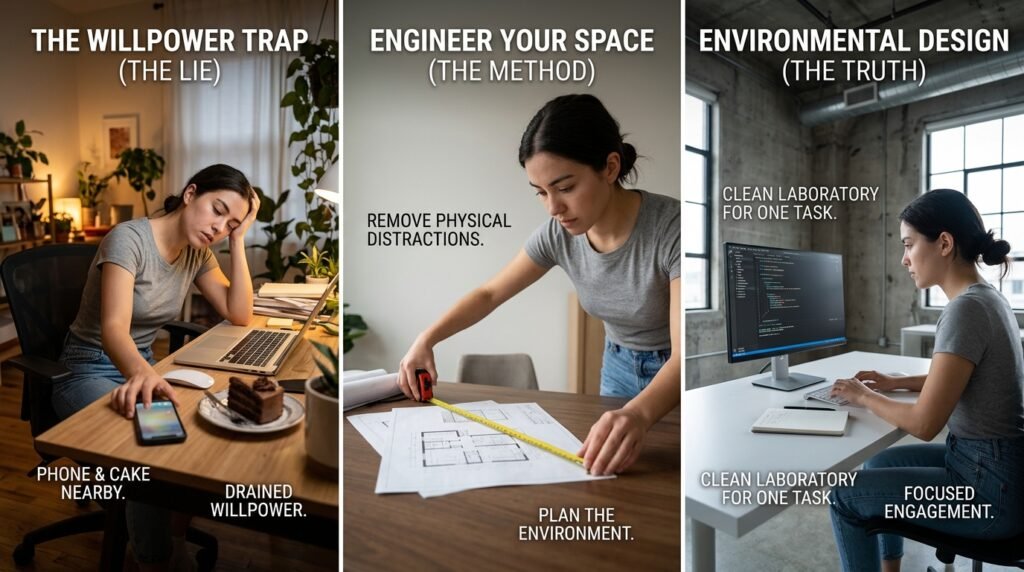
Most people believe that focus is a natural talent. You either have discipline or you do not. This is a complete lie. Focus is not a character trait. Focus is the direct result of environmental design.
If you put a piece of chocolate cake on your desk, you will eventually eat it. If you put your smartphone on your desk, you will eventually check it. You cannot fight proximity with willpower. Willpower is a limited resource that drains every time you make a decision.
I stopped trying to be a highly disciplined person. I accepted that my brain wants to be distracted. I decided to build an environment where distraction was physically impossible. I completely engineered my physical and digital space. I turned my desk into a sterile laboratory designed for one specific task.
Designing the Physical Laboratory
Your physical environment dictates your mental state. I used to study in my living room. The living room is full of visual noise. It has a television. It has magazines. It has comfortable couches designed for sleeping.
I moved my study session to a dedicated desk. I cleared every single object off the surface. I applied a strict science laboratory aesthetic to my workspace. I wanted the desk to look completely clinical. I removed the pens I was not using. I removed the loose papers. I removed the coffee cups from yesterday.
The only things allowed on the desk are the specific tools required for the language session. I have one physical notebook. I have one black pen. I have my digital database open on a single monitor. Visual clutter creates mental clutter. A completely empty desk signals to your brain that there is only one option available. You either stare at the blank wall or you do the work.
The Digital Lockdown Protocol
Cleaning the physical desk is only the first step. The digital desk is infinitely more dangerous.
My computer is a weapon of mass distraction. It contains all my business data. It contains my social media feeds. I had to build a wall between my professional work and my language learning.
I created a separate user profile on my computer. I named it strictly for language study. This profile has absolutely no business applications installed. It does not have my email accounts logged in. It does not have my website analytics dashboards bookmarked.
When I switch to this user profile, the digital noise completely vanishes. The environment is sterile. I combined this profile with a website blocker application. The application completely blocks all news sites and social media platforms for exactly forty five minutes. I cannot turn it off. I literally lock myself inside a digital room with the foreign language. Finding this isolation method was exactly The Simple Trick That Improved My Focus because it removed the burden of choice from my tired brain.
Harnessing Mobile Task Automation
My smartphone was the final enemy. I use it constantly for task automation and mobile organization. It is always in my pocket.
I used the native shortcuts application to build a specific focus script. When I sit down at my sterile desk, I tap a single button on my phone screen. The script executes instantly.
The phone silences all incoming calls. It mutes all text messages. It turns the screen completely grayscale to kill the addictive colors. Most importantly, it launches a forty five minute countdown timer.
I place the phone face down in another room. I do not keep it on the desk. Even a silent phone on the desk drains your cognitive capacity because part of your brain is actively ignoring it. Physical distance is the only real barrier.
Triggering the Deep Work State
You cannot just demand focus from your brain. You have to warm it up. You have to trigger the deep work state through a physical ritual.
I use specialty coffee as my neurological trigger. Every morning, I execute a highly precise brewing method. I use Ethiopian Sidamo beans. I weigh exactly eighteen grams of coffee on a digital scale. I use a strict V60 pour over method. I monitor the exact water flow with a gooseneck kettle. The entire process takes exactly four minutes.
This is not just about drinking coffee. The physical ritual sends a clear signal to my nervous system. My brain recognizes the smell of the Sidamo beans. It recognizes the heat of the cup. It knows that this specific sequence of events always leads to a period of intense focus. The ritual transitions my mind from the chaos of the morning into the silence of the study session.
Sourcing Highly Specific Data
You cannot focus on boring material. If you are reading a textbook about farm animals, your brain will shut down. The material must demand your attention.
I completely discarded generic vocabulary lists. I turned my study session into a personalized data analysis project.
I am deeply interested in professional basketball. I follow the NBA playoff season closely. I track first action statistics. I calculate point spreads, rebounding probabilities, and assist ratios for specific players.
I translated these complex statistical concepts into my target language. I found foreign language articles analyzing the exact same NBA playoff games. I read these articles with intense focus because I actually cared about the outcome of the data. My brain did not want to wander. It wanted to know the foreign word for a fast break assist.
The Visual Anchoring Technique
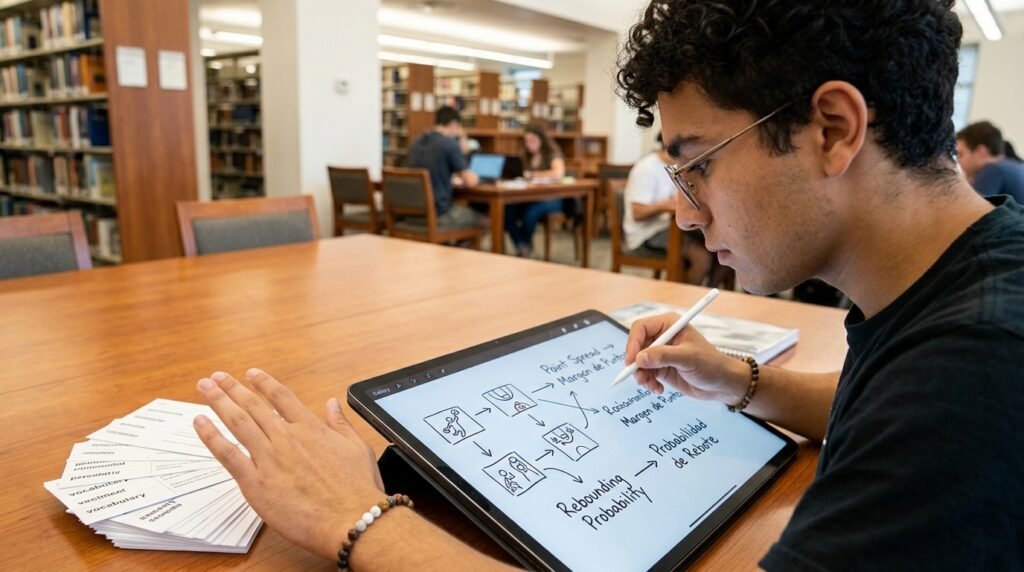
I am a highly visual person. I study digital photography. I focus on retro aesthetics using a Canon IXUS and 35mm film lenses. I spend hours editing studio style portraits.
When I create digital flashcards for my language study, I refuse to use English translations. English text makes my brain lazy. It breaks my focus.
Instead, I use my own high resolution photography. If I need to learn the word for a camera shutter, I use a macro photo of my actual lens. When I edit portraits to use as visual prompts for human anatomy vocabulary, I ensure the edits maintain human traits perfectly. Preserving the exact facial geometry in the image keeps my brain anchored to reality. The visual precision forces my brain to lock onto the foreign word without relying on English text.
The Time Boxing Method
Human beings cannot focus intensely for hours at a time. The brain simply runs out of glucose.
I used to force myself to sit at the desk for two straight hours. I would spend the first thirty minutes studying and the next ninety minutes staring blankly at the screen. This is a massive waste of time.
I implemented strict time boxing. I work in intense, unbroken intervals of exactly forty five minutes. During those forty five minutes, I work with absolute aggression. I type fast. I speak out loud. I push my brain to its absolute limit.
When the timer rings, I stop immediately. I do not finish the sentence. I simply stand up and walk away. I take a strict ten minute break. I walk outside. I drink water. I do not look at any screens. This method is the core structure behind How I Balanced Work and Language Learning Without Burning Out because it respects the biological limits of the human mind.
Tracking Focus as a Metric
I am an analyst. I do not trust my feelings. I only trust raw data.
I realized I needed to track my focus exactly like I track the server uptime for my digital publishing sites. I created a simple spreadsheet to measure my daily attention span.
Every time I complete a forty five minute time box without checking a single distraction, I log a successful session. If I break the rules and open a new browser tab, the session is marked as a failure.
Looking at this raw data is incredibly confronting. You cannot lie to a spreadsheet. The numbers force you to be honest with yourself. When I see a string of successful sessions on the screen, I build momentum. I do not want to break the visual chain of success. The tracking mechanism turns the act of focusing into a measurable game.
Handling the Inevitable Distractions
You will eventually get distracted. A thought will pop into your head. You will suddenly remember an email you forgot to send. You will want to check the rebounding statistics for last night’s basketball game.
Do not try to suppress these thoughts. Suppressing a thought takes massive amounts of mental energy. It destroys your focus.
Instead, I keep a blank physical notepad next to my keyboard. I call it the distraction pad. When a random thought enters my brain, I quickly write it down on the pad. I write down the email I need to send. I write down the statistic I need to check.
The moment I write it down, the thought leaves my working memory. My brain knows the information is safe on the paper. It stops worrying about forgetting it. I immediately return my full attention to the foreign language. I deal with the list on the notepad after the study session is completely over.
The Power of Active Production
Passive consumption destroys focus. If you are just reading a textbook or listening to a podcast, your brain will naturally drift away.
Focus requires active output. You must force the brain to generate information.
I structure my study sessions to be highly interactive. I do not just read foreign articles about photography. I read a paragraph and then immediately force myself to summarize that paragraph out loud. I speak to the empty room.
I write original sentences by hand. I force my thumbs to physically type out the complex grammar structures. When you are physically producing the language, your brain cannot wander. You cannot accidentally type a foreign sentence while thinking about your website architecture. Active production demands total mental presence.
Embracing the Friction
Focus is painful. It is supposed to be painful.
Your brain naturally wants to conserve energy. Learning a complex foreign language requires your brain to burn massive amounts of energy to build new neural pathways. The brain resists this process. The urge to check your phone is just your brain trying to escape the heavy cognitive lifting.
You must change your relationship with this friction. You have to stop viewing the mental fatigue as a sign to quit. The fatigue is the exact indicator that you are doing the right thing.
When my head starts to hurt during a complex grammar drill, I lean into the pain. I recognize that the friction is the actual mechanism of growth. I learned that accepting this struggle is What I Changed to Make Learning Feel Easier because fighting your own biology is a complete waste of time. Accept the difficulty and keep pushing forward.
The Re Entry Process
When the study session ends, you must transition back into your normal life correctly. Do not immediately grab your phone and start scrolling.
I take three minutes to document my progress. I write down exactly where I stopped. I write a quick note about the specific vocabulary words that gave me trouble. I write down the exact podcast episode I need to listen to tomorrow.
This sets up the environment for the next day. When I sit down at the desk twenty four hours later, I do not have to make any decisions. I look at the note and I start working immediately. I eliminate the decision fatigue before the session even begins.
The Final Audit
Look closely at where you currently study. Look at the objects on your desk. Look at the open tabs on your computer.
If your environment is full of distractions, your brain will be full of distractions. You cannot outsmart a chaotic environment.
You must become the ruthless architect of your own attention. Clear the physical desk. Create a sterile digital profile. Automate your smartphone to lock you out. Trigger your mind with a specific coffee ritual. Source highly specific data that you actually care about. Track your successful minutes on a cold spreadsheet.
Focus is a mechanical system. Build the machine correctly, and the consistency will follow automatically. Stop relying on your motivation. Start engineering your environment. Turn off the noise. Sit down at the empty desk. The language is waiting for your undivided attention.
Gabriel Henrique is a language enthusiast and productivity writer. After testing countless study methods, he became obsessed with mastering new languages efficiently. He achieves this without burnout, without endless grammar drills, and without losing focus. At Blog The Curious, he shares everything he has learned along the way.