
Learning a foreign language felt like dragging a heavy stone up a steep hill. I spent my days managing a network of digital publishing websites. I drafted complex privacy policies. I built intricate internal link architectures for multiple domains. I analyzed professional basketball statistics. By the time I sat down at my desk to study, my mental battery was completely empty.
I tried to force the issue. I bought thick textbooks. I downloaded massive grammar applications. I tried to memorize lists of isolated verbs. The friction was unbearable. Every single study session felt like a punishment. I realized I was fighting my own brain. You cannot build a long term habit on pure agony. You have to remove the friction. You have to make the process feel light.
I completely tore down my approach. I stopped doing the things that caused mental fatigue. I engineered a system that operated entirely in the background of my life. I aligned the language with my natural daily rhythms. The results were immediate. The heavy stone disappeared. Here is exactly what I changed to make learning feel infinitely easier.
Eliminating the English Middleman
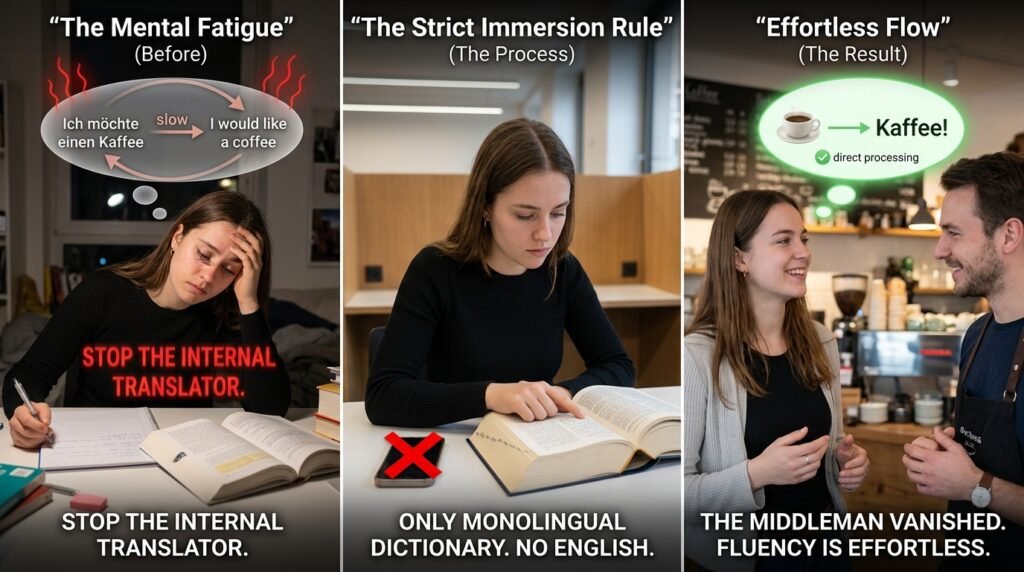
My biggest source of mental fatigue was internal translation. I would read a foreign sentence. I would pause. I would translate each word into English inside my head. I would process the English meaning. Then, I would translate my response back into the foreign language.
This process is incredibly slow. It burns massive amounts of glucose. It makes your brain feel hot and tired.
I made a radical rule. I banned the English language from my study environment. I deleted every translation application on my smartphone. I bought a strict monolingual dictionary. If I found a foreign word I did not understand, I forced myself to read the definition in that exact same foreign language.
The first week was brutal. It felt like walking through deep mud. But soon, the middleman vanished. My brain adapted. I discovered How I Learned to Stop Translating in My Head was simply a matter of starvation. When you starve the brain of English, it has no choice but to accept the target language as reality. The cognitive load dropped massively. Processing the language suddenly felt effortless.
Visual Anchoring with Raw Photography
Reading text on a digital screen is boring. It does not engage your visual memory. I possess a deep interest in digital photography. I focus heavily on retro aesthetics. I use a vintage Canon IXUS. I love the look of 35mm film lenses.
I used this visual obsession to anchor my vocabulary. I stopped writing the English definition on the back of my digital flashcards. I replaced the text with high resolution macro photography.
I took photos of my actual camera gear. I took photos of my coffee equipment. I also spend hours editing studio style portraits. When I edit these images, I am completely obsessive. I always ensure specific human anatomical traits are accurately maintained. I must preserve the exact human facial geometry. I took these highly realistic, anatomically correct portrait edits and used them to learn the foreign vocabulary for the human body.
When the flashcard appears, I look at the physical geometry of the face or the glass lens. My brain maps the foreign sound directly to the raw image. I bypass the English text completely. Linking the sound to a physical reality makes memorization happen instantly.
The Automated Coffee Trigger
Willpower is a terrible tool for consistency. You have to make a conscious decision to study. Making a decision requires energy. I wanted to eliminate the decision completely.
I bolted my study habit directly to an existing physical ritual. I am meticulous about my morning coffee. I brew Ethiopian Guji beans every single morning. I place a glass decanter on my digital scale. I weigh exactly eighteen grams of coffee. I grind the beans to a medium coarse texture. I use a strict V60 pour over method. I monitor the exact water temperature with a gooseneck kettle.
I programmed my smartphone to recognize this exact physical window. At seven o’clock every morning, my phone automatically enters a strict focus mode. It silences all notifications. It launches my primary spaced repetition flashcard application.
The phone presents the vocabulary cards while the hot water drains through the paper filter. I never decide to study. The automation makes the choice for me. I realized How I Built a Learning System That Didn’t Feel Like Studying required me to link the digital software directly to the smell of the coffee. The habit executes itself.
Sourcing Wild Statistical Data
Boredom creates massive mental friction. Standard language applications teach you how to ask for directions to a public library. They teach you the names of common farm animals. I do not care about libraries or farm animals. My brain actively deletes this useless information.
I completely discarded the default curriculums. I turned my study session into a personalized data analysis project.
I follow the professional basketball season closely. I track first action NBA playoff statistics. I calculate point spreads, rebounding probabilities, and assist ratios for specific point guards. I translated these highly technical statistical concepts into my target language.
I found foreign language sports blogs. I read articles analyzing the exact same NBA playoff games. I read these articles with intense focus because I actually cared about the outcome of the data. My brain did not want to wander. It wanted to know the foreign term for a fast break turnover. When you study things you already love, the effort feels invisible.
Shrinking the Daily Requirement
We make learning hard by setting massive expectations. You tell yourself you need to study for two straight hours. Your brain perceives a two hour block as a massive threat. It looks for an escape route. You end up scrolling social media instead.
I had to completely destroy the psychological barrier to entry. I lowered my daily goal to an absurdly small metric.
I created a strict contract with myself. The minimum daily requirement is exactly two minutes. I can do absolutely anything for two minutes. I tell myself I only need to review five vocabulary cards. The barrier to entry is so incredibly low that my brain stops resisting the task.
I established The Simple System I Followed to Make Daily Progress to trick my own nervous system. Once you actually start the task, the mental resistance completely evaporates. Ninety five percent of the time, I finish my five cards and decide to keep going for another twenty minutes. An object in motion stays in motion.
Destroying Digital Distractions
Your smartphone is a weapon of mass distraction. It is packed with bright red notification badges and addictive social media feeds. You cannot outsmart a casino. The engineers who build these apps know exactly how to hijack your attention.
I stopped trying to ignore the distractions. I removed them entirely.
I went into the accessibility settings on my smartphone. I turned on the grayscale color filter. The entire screen instantly turned into a boring, flat grey box. This completely destroys the addictive visual power of the device.
I moved every single social media application off my phone. I kept my digital dictionary and my flashcard database on the primary home screen. I turned my phone into a sterile industrial tool. When you pick up a grey phone with no games on it, you either do the work or you put the phone back in your pocket. Focus becomes the default option.

Embracing Messy Output
Perfectionism makes everything feel impossible. I used to avoid practicing my writing because I was terrified of making grammar mistakes. I wanted every sentence to be flawless. Because I could not write perfectly, I chose to write absolutely nothing at all.
I had to change my relationship with failure. You are going to sound stupid. You are going to make brutal mistakes. You are going to use the wrong verb tense and confuse native speakers.
I stopped trying to write the perfect paragraph. I opened a blank digital notepad every evening. I forced myself to write five sentences about my daily publishing tasks as fast as possible. I produced terrible, broken paragraphs.
You cannot refine a blank page. You can only refine messy output. I produced the garbage first. I fixed the grammar later. Accepting the mess removes the anxiety. When you stop worrying about being perfect, the words flow much faster.
The Audio Shadowing Drill
Listening comprehension used to give me terrible headaches. Native speakers talk incredibly fast. The words crash together into a muddy stream of noise.
I tried listening to slow, robotic audio from language apps. This made the problem worse. It trained my ears to expect perfect pronunciation. Real humans never pronounce things perfectly.
I switched to unscripted native podcasts. I downloaded an audio player with a speed control slider. I found a two minute clip of a native speaker discussing website analytics. I pulled the speed slider down to exactly seventy five percent.
I played the audio and shadowed the host. I spoke aloud at the exact same time. I overlapped my voice perfectly with their voice. I mimicked their exact pitch and rhythm. I repeated this ten times in a row. It shocked my nervous system. Once my jaw mapped the sentence at the slow speed, I pushed the slider back to one hundred percent. The fast speed suddenly felt manageable. I broke the sound barrier without breaking my brain.
Utilizing Dead Time
I used to believe that studying required a quiet room, a clean desk, and an hour of uninterrupted silence. This formal definition is a massive barrier. I rarely have an hour of uninterrupted silence.
I completely redefined what studying means. Studying is just making contact with the language. I started hunting for hidden pockets of wasted time in my daily schedule. I call this dead time.
You wait in line at the grocery store for five minutes. You wait for a website server to compile for three minutes. You sit in traffic.
I stopped wasting these moments. Because my home screen is perfectly organized, my flashcard database is always exactly one tap away. When I have two free minutes, I complete ten rapid vocabulary reviews. I string dozens of these tiny micro sessions together throughout the entire day. By the time I go to sleep, I have completed a full hour of intense study without ever sitting down at a desk.
The Monolingual Dictionary Shift
Using a bilingual dictionary makes learning feel harder in the long run. You look up a word, read the English definition, and instantly forget it. The information is too cheap. Your brain does not value it.
I deleted the English dictionary entirely. I downloaded a strict monolingual dictionary.
When I find a foreign word I do not understand, I read the definition in that exact same foreign language. I have to use simpler foreign words to decode the complex word. This requires intense cognitive effort.
The struggle is the point. When you have to fight to understand a definition, your brain flags the information as highly important. It burns the word directly into your long term memory. The process feels slower in the moment, but it accelerates your total fluency massively. You retain the vocabulary permanently because you earned it.
Tracking the Raw Analytics
I do not trust my feelings. Some days I feel incredibly fluent. Some days I feel like I have forgotten every single word. Feelings fluctuate based on sleep and stress. I only trust raw data.
I treat my personal language progress exactly like I treat the traffic analytics for my digital publishing websites. I use a simple spreadsheet. Every Sunday evening, I look at the exact number of minutes I spent actively swiping inside my flashcard application. I check my memory retention rates.
If I fail a specific word ten times in a row, the software flags it as a leech. I immediately delete the leech. It is a bad data point. I rebuild the concept completely from scratch with a better photograph and a better sentence. The objective numbers remove the emotional frustration. They turn the learning process into a cold, clinical engineering problem.
The Nightly Reset Protocol
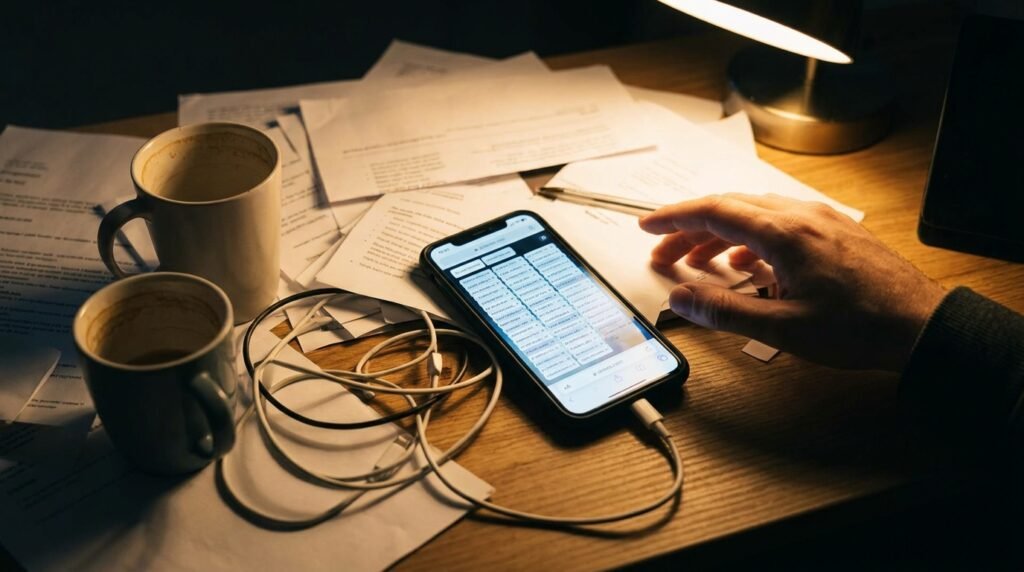
Your morning success is completely determined by your physical actions the night before. If you leave your desk covered in papers and your phone cluttered with open browser tabs, you will wake up to immediate stress. The routine will fail before you even start the coffee maker.
I built a strict nightly reset protocol. Before I go to sleep, I manually close every single open application on my device. I clear the entire digital cache.
I plug the phone into a charger located completely outside of my bedroom. I never sleep with the phone next to my head. I wipe my physical desk completely clean. I leave only my blank notepad and my black pen on the surface.
When I wake up, the environment is sterile. It is primed for focus. I have removed the possibility of friction before the day even begins.
The Final Reality
Learning a language is a mechanical process. It requires thousands of hours of exposure. You cannot survive those thousands of hours if you are constantly fighting your own environment.
You must drop the heavy boulder. Stop trying to force your brain to memorize boring lists. Stop relying on sheer willpower.
Turn off the English translation. Use your own photography to anchor the words. Bolt the habit to your morning coffee. Source wild data about the sports and hobbies you actually care about. Shrink your daily goals. Make your smartphone completely boring.
When you remove the friction, the language simply flows into the empty space. You stop fighting the current. You let the system do the heavy lifting. Engineer your environment today and watch the struggle disappear entirely.

Gabriel Henrique is a language enthusiast and productivity writer. After testing countless study methods, he became obsessed with mastering new languages efficiently. He achieves this without burnout, without endless grammar drills, and without losing focus. At Blog The Curious, he shares everything he has learned along the way.