
I hit a massive wall six months into my language learning routine. I studied every single day. I reviewed my digital flashcards. I listened to native audio. I wrote my daily journal entries. Suddenly, everything completely stopped working.
I felt functionally illiterate again. I could not recall basic vocabulary. My listening comprehension dropped. Every study session felt like dragging a heavy boulder up a steep hill. I was completely stuck.
I manage a complex network of digital publishing websites. I track daily server metrics and user retention data. Website traffic naturally hits a plateau. When traffic stops growing, I do not panic. I do not quit the business. I execute a strict technical audit. I analyze the internal link architecture. I review the privacy policies. I look for the broken pieces in the system.
I applied this exact same clinical audit to my language learning routine. I stopped relying on my feelings. I started analyzing my raw data. I tore my system apart to find the friction. Here is exactly what I do when I feel completely stuck.
Redefining the Plateau
Your brain is a biological machine. It cannot acquire complex data in a straight, linear upward curve.
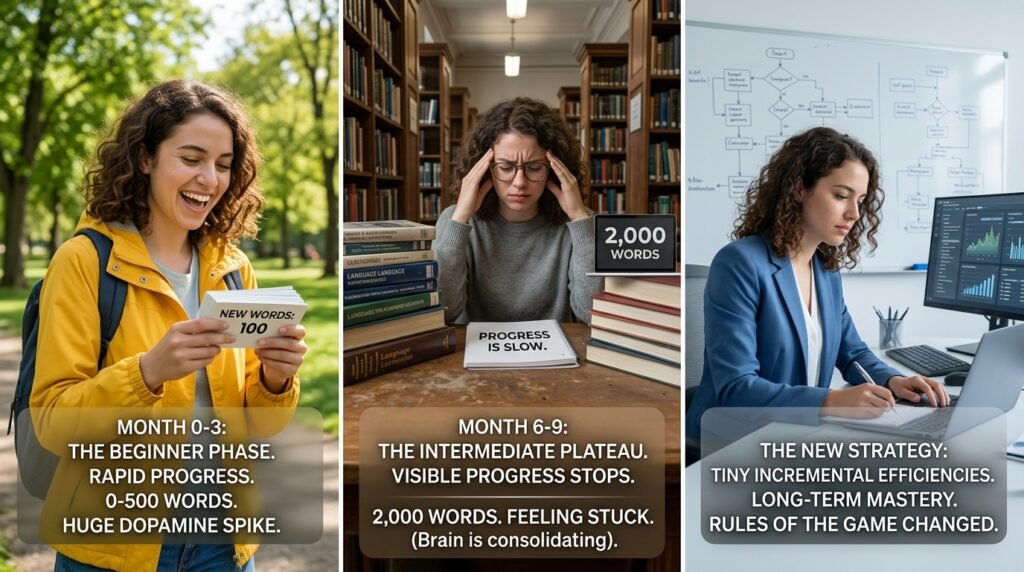
When you first start learning, progress is massive and obvious. You go from knowing zero words to knowing five hundred words. This creates a massive dopamine spike. You feel incredible.
Around month six, you hit the intermediate phase. You now know two thousand words. Adding fifty new words does not feel like a massive victory anymore. The progress becomes invisible. You feel stuck. You are not actually stuck. Your brain is simply taking time to consolidate the massive amount of raw data you just fed it.
You must change your expectations. I realized that The Strategy I Used to Avoid Getting Stuck as a Beginner was no longer going to work for the intermediate phase. The rules of the game completely changed. I had to stop looking for massive daily breakthroughs. I had to start hunting for tiny, incremental efficiencies.
Auditing the Flashcard Database
My first step is always a brutal data audit. I use a spaced repetition system to memorize vocabulary. It tracks my exact memory retention curve.
When I feel stuck, I open the database analytics. I look for the leeches. A leech is a specific digital card that I fail constantly. I will review the card fifteen times and still forget the meaning.
Leeches clog the system. They drain your cognitive energy. They make the study session feel impossible. I execute a ruthless purge. If I fail a card ten times, I delete it completely. It is a bad data point.
I do not blame my memory. I blame the flashcard. I rebuild the concept entirely from scratch. I find a better context sentence. I source a better photograph. I fix the system instead of punishing myself.
Updating the Visual Anchors
Boring visual prompts create mental friction. I am deeply interested in digital photography. I focus on retro aesthetics using a Canon IXUS and 35mm film lenses. I spend hours editing studio style portraits on my computer.
I use my own high resolution photography for my flashcards. When I feel stuck, it usually means my brain has grown blind to the images. The visual anchors are stale.
I replace the old photos with new, highly precise edits. When I use portrait edits to memorize human anatomy vocabulary, I am absolutely meticulous. I must ensure specific human anatomical traits are accurately maintained. I preserve the exact facial geometry in the edit. If the face looks artificial or distorted, the brain rejects the visual anchor. I update the images to keep the data fresh and visually demanding.
Sourcing Wild Statistical Data
You cannot break a plateau using boring material. Default language apps teach you how to ask for directions to a public library. They teach you the names of common farm animals. My brain actively deletes this useless information.
When my progress stalls, I completely change the source material. I inject my actual daily passions into the language routine.
I follow the professional basketball season obsessively. I track first action NBA playoff statistics. I calculate point spreads, rebounding probabilities, and assist ratios for specific point guards.
I take these highly technical statistical terms and translate them into my target language. I find foreign language sports blogs. I read articles analyzing the exact same NBA playoff games. My brain actively wants to know the foreign term for a fast break turnover. The intense curiosity immediately breaks the feeling of being stuck.
The Audio Shock Protocol
Listening comprehension plateaus are brutal. You listen to a podcast and suddenly realize the words sound like a muddy stream of noise. You stop understanding the context.
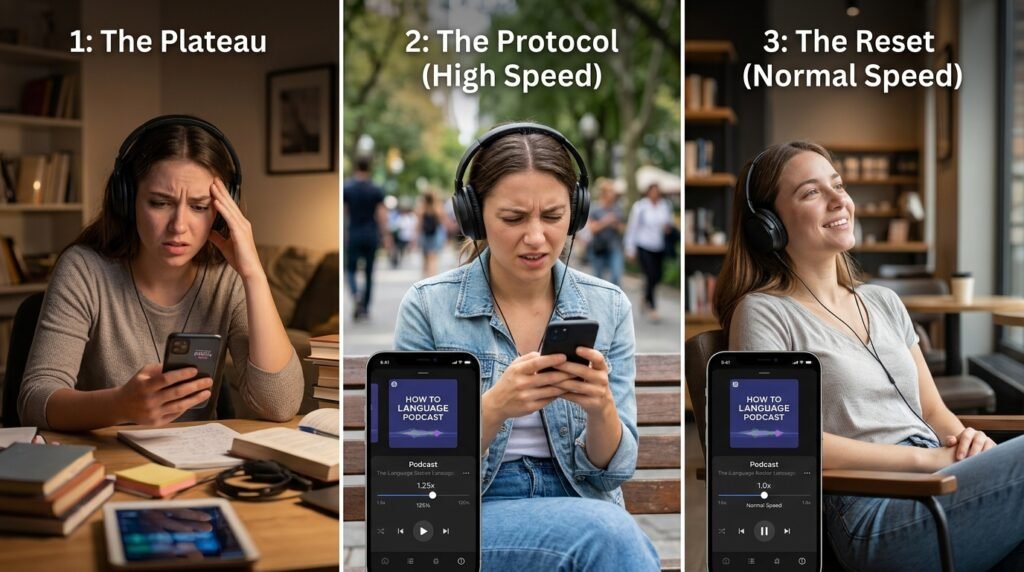
I use a specific technique called the audio shock protocol. I open my dedicated podcast application. I find a two minute clip of a native speaker discussing website analytics.
I use the speed control slider. I push the speed up to one hundred and twenty five percent. I play the clip five times in a row. It sounds completely insane. It is far too fast to understand.
Then, I pull the speed slider back down to one hundred percent. The normal speed suddenly feels incredibly slow. My brain has adjusted to the artificial velocity. The individual words separate from the muddy noise. The comprehension returns instantly. You have to shock your nervous system to reset your baseline.
Forcing the Blank Page
Passive consumption is the enemy of progress. If you only read textbooks and listen to podcasts, you will eventually stall. You are just absorbing data without synthesizing it.
When I feel stuck, I completely stop all passive consumption for three days. I switch entirely to active output.
I open a blank digital document. I force myself to write a five sentence journal entry entirely in my target language. I write about the server migrations I handled that afternoon. I write about the privacy policies I drafted.
I force my thumbs to physically type out the complex foreign characters. This builds massive physical muscle memory. Staring at a blank page forces you to generate original thoughts. It is uncomfortable. It exposes your exact grammatical weaknesses. I discovered exactly What I Did When Grammar Started to Feel Too Complicated by failing repeatedly on the blank page until the rules finally clicked.
The Monolingual Dictionary Shift
Using an English translation dictionary is a massive mental crutch. It makes learning feel easier in the short term, but it causes severe plateaus later.
You look up a word, read the English definition, and instantly forget it. The information is too cheap. Your brain does not value it.
If I feel stuck, I make my routine harder. I delete the bilingual dictionary entirely. I use a strict monolingual dictionary. When I find a foreign word I do not understand, I read the definition in that exact same foreign language.
I have to use simpler foreign words to decode the complex word. This requires intense cognitive effort. The struggle is the entire point. When you fight to understand a definition, your brain flags the information as highly important. It burns the word directly into your long term memory.
Lowering the Daily Goal
Sometimes being stuck is simply a symptom of physical exhaustion. I manage remote teams. I build internal link maps. I deal with constant digital fires. My cognitive battery drains quickly.
If I set my daily study goal too high, my exhausted brain will refuse to start. I will procrastinate.
I counter this by lowering the barrier to entry completely. I create a strict contract with myself. The minimum daily requirement is exactly two minutes. I tell myself I only need to review five vocabulary cards.
The barrier is so incredibly low that my brain stops resisting the task. Once I actually start the task, the mental resistance evaporates. Ninety five percent of the time, I finish my five cards and decide to keep going for another twenty minutes. An object in motion stays in motion. You break the plateau simply by initiating the movement.
Rebuilding the Physical Anchor
Habits decay over time. The trigger loses its power.
I bolt my language study directly to my morning coffee routine. I brew Ethiopian Guji beans every single morning. I weigh exactly eighteen grams of coffee. I grind the beans to a medium coarse texture. I use a strict V60 pour over method. I monitor the exact water temperature with a gooseneck kettle. The bloom phase takes exactly forty five seconds.
If I feel my language habit slipping, I focus intensely on the physical coffee ritual. I make sure every single step is perfect. I study my flashcards while the hot water drains through the paper filter. Rebuilding the physical precision of the coffee brewing automatically tightens the discipline of the study session. The physical anchor pulls the mental habit forward.
Executing a Digital Purge
A cluttered digital environment destroys focus. Your smartphone is a weapon of mass distraction.
I routinely audit my phone. I look for addictive social media feeds. I look for gamified language apps. I completely delete any app that uses a cartoon mascot or a leaderboard. These tools provide a false sense of progress. They keep you stuck in the beginner phase forever.
I realized How I Avoid Wasting Time With Ineffective Apps required me to be absolutely ruthless with my digital storage. I keep one app for memory. I keep one app for listening. I keep one app for writing. I turn my screen grayscale to kill the addictive colors. I transform my phone into a sterile industrial tool.
The Power of Shadowing
When my speaking ability plateaus, I stop trying to have free flowing conversations. I return to strict mechanical drills.
I use the shadowing technique. I open my podcast application. I find a native speaker discussing basketball analytics. I pull the speed slider down to seventy five percent.
I play the audio and I speak aloud at the exact same time. I try to perfectly overlap my voice with their voice. I match their exact pitch. I mimic their exact rhythm. I repeat this brutal process ten times in a row. It is physically exhausting. My jaw literally aches.
This specific drill shocks the nervous system. It forces your tongue to move in unfamiliar patterns. It breaks the bad pronunciation habits you developed. Shadowing is the fastest way to unstick a stagnant accent.
Embracing the Friction
The ultimate key to surviving a plateau is changing your relationship with the struggle.
Learning a complex language is hard. It is supposed to be hard. Your brain is building new neural pathways. It is rewiring its entire communication system. This process burns massive amounts of glucose. It causes intense mental fatigue.
We feel stuck because we want the process to remain easy. We want the dopamine spikes of the beginner phase to last forever. They will not.
You must lean directly into the friction. The friction is not a sign that you are failing. The friction is the exact mechanism of growth. When you feel a headache coming on after a difficult grammar drill, that is the exact moment the learning is actually happening.

The Final Step
When you feel stuck, do not quit. Do not buy a new textbook. Do not download a new premium application.
Stop looking for external motivation. Start engineering your environment. Audit your raw data. Delete your leech cards. Update your visual anchors. Source high leverage material about the topics you actually love. Lower your daily minimum requirement. Force your brain to output original sentences on a blank page.
A plateau is just a biological pause. It is your brain asking for time to organize the data. Respect the pause. Tighten your systems. Execute your daily routine without emotion. The breakthrough will happen quietly, on a random Tuesday, when you suddenly realize you just understood a native speaker without thinking. Keep the system running. The results are inevitable.

Gabriel Henrique is a language enthusiast and productivity writer. After testing countless study methods, he became obsessed with mastering new languages efficiently. He achieves this without burnout, without endless grammar drills, and without losing focus. At Blog The Curious, he shares everything he has learned along the way.