
I spent the first few months of my language journey completely frustrated. I bought standard textbooks. I downloaded popular mobile applications. I tried to follow the standard path. The standard path failed me completely. I manage a complex network of digital publishing websites. I run platforms like blogthecurious.com and apps.fly2kart.com. My daily professional life requires intense cognitive labor. I write strict privacy policies. I draft terms of service agreements. I build intricate internal link architectures. By the time I finished my workday, my brain refused to absorb generic foreign vocabulary. I realized I was approaching the entire process incorrectly. I was treating language learning like a school subject. It is not a subject. It is a tool.
The Problem with Standard Curriculums
Traditional learning methods rely on generic data. They teach you how to ask for directions to a public library. They teach you the names of common farm animals. They provide fictional dialogues about tourists ordering food. My brain actively deletes information it deems entirely useless to my daily survival. I do not visit public libraries. I do not care about farm animals. Studying boring material requires massive amounts of raw willpower. Willpower is a finite biological resource. It drains completely with every decision you make during the workday. I realized I could not force my tired brain to care about generic content. I had to hijack my own attention span. I had to make the language highly relevant to my actual life.
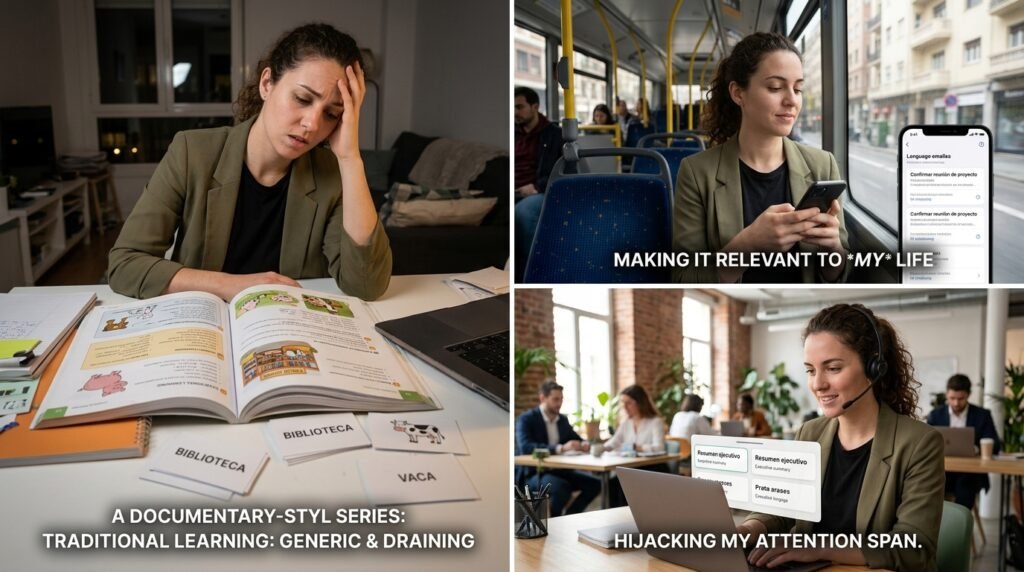
The Paradigm Shift: Contextual Immersion Anchoring
The learning technique that changed everything for me is Contextual Immersion Anchoring. I stopped learning isolated words. I started learning entire concepts related to my daily professional tasks and personal passions. I completely discarded the default curriculums provided by the software applications. I turned my study system into a highly personalized data vault. I only study things I am deeply passionate about. Instead of learning generic vocabulary, I learned highly specific, technical vocabulary. I forced the target language to describe my actual reality. This fundamental shift removed the friction of boredom. The study session stopped feeling like a chore. It felt exactly like reading my favorite magazine. This was precisely How I Learned Faster Once I Stopped Overcomplicating Everything because I simply eliminated the uninteresting data.
Sourcing Data from Digital Publishing
I applied this anchoring technique immediately to my professional work. I spend hours every day managing my digital publishing business. I design logos and site icons. I analyze server traffic and user retention metrics. I took these highly specific technical concepts and translated them into my target language. I found foreign language blogs dedicated to web development and search engine optimization. I read articles analyzing website architecture. Because I already possessed deep knowledge of the subject matter, I could easily decode the foreign vocabulary from the context. I did not need an English translation. I understood the concepts natively. This deep professional relevance glued the new words directly into my long term memory.
Weaponizing NBA Playoff Analytics
I extended this anchoring technique to my personal hobbies. I follow the professional basketball season with obsessive detail. I do not just watch the games. I analyze first action NBA playoff statistics. I track exact points, rebounds, and assists. I calculate complex point spreads and rebounding probabilities for specific players. I used these statistical forecasting models as my primary study material. I took these highly technical sports terms and built my own digital flashcards. I read foreign language sports publications analyzing the exact same NBA playoff games I watched the night before. I read these articles with intense focus because I actually cared about the outcome of the data. My brain actively wanted to know the foreign term for a fast break turnover or a defensive assist. The intense curiosity drove the retention completely.
Visual Anchoring with Retro Photography
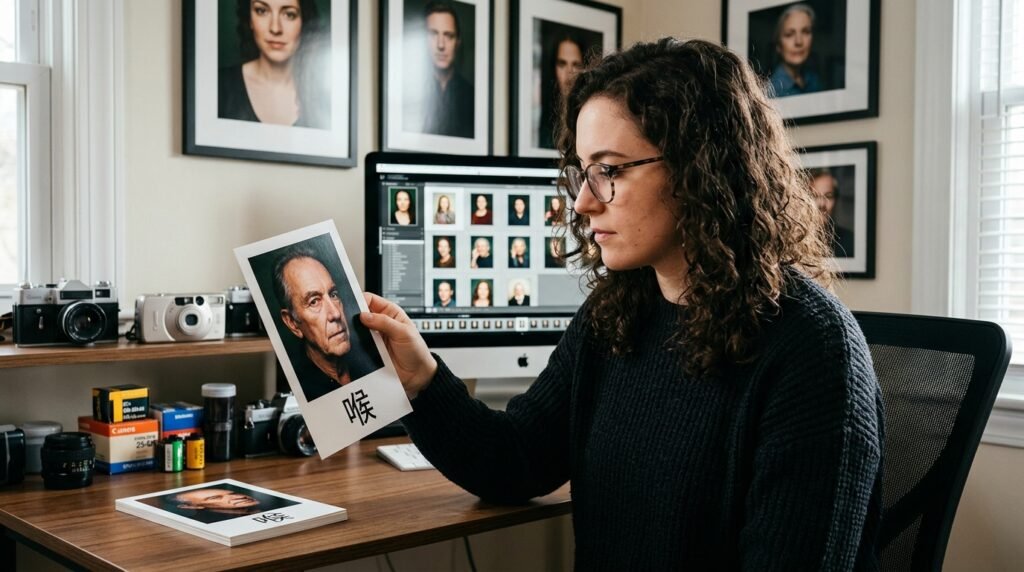
Reading text on a digital screen is inherently boring. It does not engage your deep visual memory. I possess a sophisticated interest in digital image manipulation. I study the retro aesthetics of 35mm film lenses. I love the specific flash look of the vintage Canon IXUS camera. I spend hours editing studio style portraits on my computer. I applied this exact visual precision to my language learning routine. I absolutely refuse to use English translations on my digital flashcards. English text makes the brain incredibly lazy. It forces you to rely on internal translation. Instead, I use my own high resolution photography as the prompt.
When I edit portraits to use as visual anchors for human anatomy vocabulary, I am absolutely meticulous. I must ensure specific human anatomical traits are accurately maintained. I command the software to maintain human traits perfectly. I preserve the exact facial geometry in my image edits. If an edit looks distorted or artificial, the brain rejects the visual anchor. When the flashcard appears, I look at the accurate physical geometry of the face. My brain connects the foreign sound directly to the physical reality in the image. By doing this, I discovered exactly The Trick I Used to Remember Vocabulary Without Effort was simply a matter of bypassing English completely and relying on precise visual data.
The Physical Coffee Trigger
Mental techniques require physical execution. You cannot build a new cognitive habit in a vacuum. You must attach the new behavior to a permanent physical ritual. I bolted my contextual learning directly to my morning routine. I am incredibly meticulous about my morning coffee. It is the one physical ritual I never skip. Every single morning, I walk into the kitchen and execute a precise series of steps. I brew Ethiopian heirloom varieties. I prefer Guji or Sidamo beans. I place a glass decanter on my digital scale. I weigh exactly eighteen grams of coffee. I grind the beans to a medium coarse texture. I use a strict V60 pour over method. I monitor the exact water temperature with a gooseneck kettle. The bloom phase takes exactly forty five seconds.
I learned the entire sensory vocabulary of the Third Wave cafe culture in my target language. I study my customized flashcards while the hot water drains through the paper filter. The physical smell of the coffee acts as an immediate neurological trigger. My brain recognizes the sensory input and initiates the focus state automatically.
Mobile Task Automation
Anchoring the habit physically is only half of the battle. Your digital environment must enforce your discipline. The smartphone is a highly dangerous device. It is packed with bright red notification badges and addictive social media feeds. I rely heavily on mobile software and task automation in my professional life to manage repetitive tasks. I applied this exact same automation logic to my daily study habit.
I used the native shortcuts application on my smartphone to build a strict digital trigger. I programmed the device to recognize exactly when my morning coffee routine occurs. At exactly seven o’clock every morning, my phone enters a customized focus mode. The automation silences all incoming emails. It mutes all text messages. It completely hides my web browser. It automatically launches my primary spaced repetition flashcard application. It places the target language directly on my screen. By completely removing the friction of choice, the habit becomes absolutely automatic. I documented this process when I realized What I Focused On Instead of Memorizing Rules was actually just building a rigid system that executed itself.
The Monolingual Dictionary Shift
The Contextual Immersion Anchoring technique requires total commitment to the target language. Translating foreign words into English text is a massive mental crutch. It increases cognitive fatigue over time. You look up a word, read the English definition, and instantly forget it. The information is simply too cheap. Your brain does not value data that requires zero effort to acquire.
I deleted my bilingual dictionary entirely. I downloaded a strict monolingual dictionary. When I find a foreign technical term related to website hosting or basketball statistics, I read the definition in that exact same foreign language. I have to use simpler foreign words to decode the complex new word. This requires intense cognitive effort upfront. The initial struggle is the entire point. When you have to fight to understand a definition, your brain flags the information as highly important for survival. It burns the word directly into your long term memory.
Forcing Active Output
Passive consumption destroys your mental energy. If you only read foreign blogs or listen to podcasts, your tired brain will naturally drift away. You will read an entire page and realize you absorbed absolutely nothing. The anchoring technique demands active output. You must force the brain to generate original information using the specific vocabulary you acquired.
I structure my study sessions to be highly interactive. I open a completely blank digital document every evening. I force myself to write a five sentence journal entry entirely in my target language. I write about the exact NBA point guard statistics I analyzed that morning. I write about the specific color grading tweaks I made to a retro photograph. I force my thumbs to physically type out the complex grammar structures. When you are physically producing the language, your brain cannot wander. You cannot accidentally type a foreign sentence while thinking about your website architecture. The blank page forces absolute mental presence.
The Audio Shadowing Drill
Listening comprehension requires its own specific anchoring technique. Native speakers talk incredibly fast. The words crash together into a muddy stream of noise. I stop listening to slow, robotic audio from language learning applications. I switch entirely to unscripted native podcasts covering my personal interests.
I find a podcast analyzing Western Conference basketball statistics. I download an audio player with a granular speed control slider. I find a two minute clip of a native speaker discussing player efficiency. I pull the speed slider down to exactly seventy five percent. I play the audio and I shadow the host. I speak aloud at the exact same time. I overlap my voice perfectly with their voice. I mimic their exact pitch and rhythm. I repeat this brutal process ten times in a row. It shocks the nervous system. It forces the jaw muscles to map the physical movements required for native pronunciation. Once my jaw maps the sentence at the slow speed, I push the slider back to one hundred percent. The normal speed suddenly feels entirely manageable.
The Weekly Data Audit
You cannot improve a technique if you refuse to measure its output. Feelings are highly unreliable metrics. You might feel like you are failing while actually making massive progress. I trust raw data. I treat my personal language progress exactly like I treat the traffic analytics for my publishing domains.
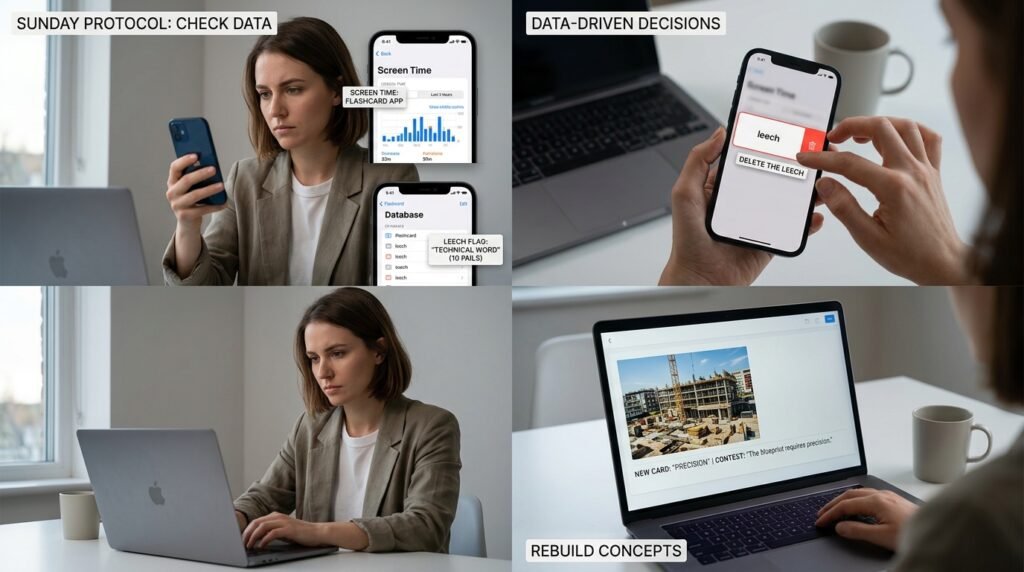
Every Sunday evening, I sit down and execute a strict review protocol. I open the native screen time features on my smartphone. I look at the exact number of minutes I spent actively swiping inside my flashcard application. I check my memory retention rates in the database. If I fail a specific technical word ten times in a row, the software flags it as a leech. I immediately delete the leech. It is a bad data point. It is draining my cognitive energy. I rebuild the concept completely from scratch with a better, more precise photograph and a more relevant context sentence. The objective numbers remove all emotional frustration from the learning process.
The Final Reality
Learning a new language is a mechanical process. It requires thousands of hours of exposure. You cannot survive those thousands of hours if you are constantly fighting your own biology and forcing yourself to consume boring, generic material.
You must drop the heavy boulder. Stop trying to memorize basic vocabulary lists for two hours every night. Stop relying on sheer willpower. Deploy Contextual Immersion Anchoring. Turn off the English translation entirely. Use your own precise photography to anchor the words. Bolt the habit to your morning coffee ritual. Source wild data about the sports, hobbies, and professional tasks you actually care about. When you make the material deeply personal, the friction simply vanishes. The language flows into the empty space. You stop fighting the current. Engineer your environment today and watch your fluency accelerate automatically.

Gabriel Henrique is a language enthusiast and productivity writer. After testing countless study methods, he became obsessed with mastering new languages efficiently. He achieves this without burnout, without endless grammar drills, and without losing focus. At Blog The Curious, he shares everything he has learned along the way.