
I used to be the person who bought a brand new planner every time I started a new project. I would sit down with my colored pens and map out a perfect, military style schedule. Wake up at 5:00 AM. Study vocabulary for sixty minutes. Listen to a podcast during breakfast. Review grammar for an hour after work. It looked beautiful on paper. It looked like the schedule of a person who was destined for fluency in record time.
The problem was that I am not a robot. I am a person with a job, a home to clean, friends who call me unexpectedly, and days where I just feel exhausted. My “perfect” study plan usually lasted about four days. By Thursday, I would miss a session because of a late meeting. By Friday, I would feel guilty and try to “catch up” by studying for four hours. By Sunday, I was so burnt out that I didn’t want to look at a foreign word ever again.
I had to stop and ask myself why I kept failing. I realized that I wasn’t designing a plan for my life. I was trying to force my life into a plan that belonged in a university dorm room. If I wanted to actually learn a language while working full time, I needed a strategy that was flexible, resilient, and realistic. I needed to move past the ideas that failed me before, many of which I detailed when I wrote about The Beginner Mistakes I Made and How I Fixed Them to find something that actually worked in the real world.
The Myth of the “Hour-Long Block”
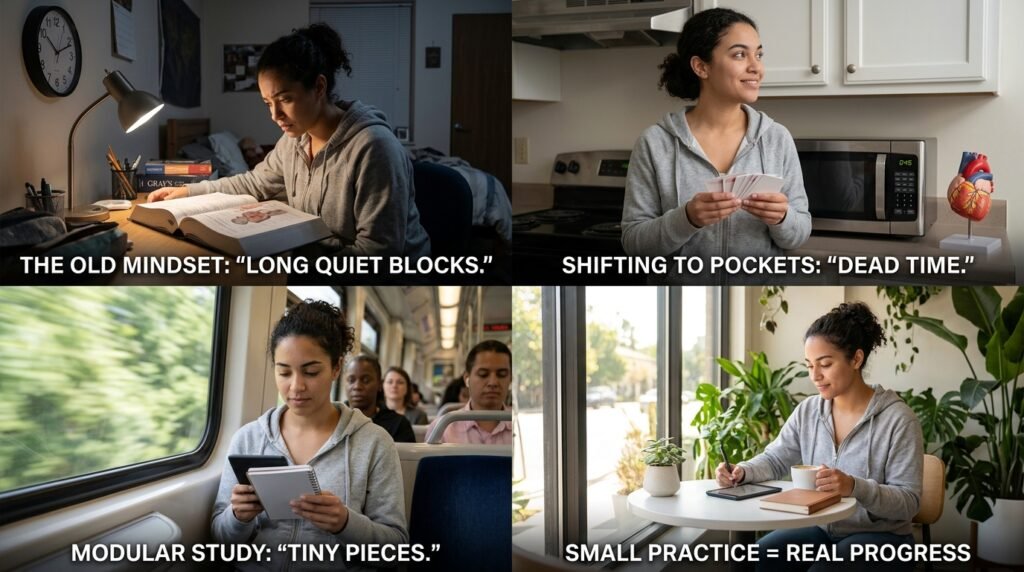
The biggest lie I told myself was that “real” studying only happens in long, quiet blocks of time. I thought that if I didn’t have a clear hour at my desk, it wasn’t worth opening a book. This mindset is a progress killer. In a busy life, those golden hours are rare. If you wait for the perfect hour, you might wait all week.
I shifted my mindset from “blocks” to “pockets.” I started looking for the dead time in my day. The five minutes waiting for the microwave. The ten minutes on the train. The fifteen minutes while drinking my morning coffee. When I added these up, I realized I had nearly an hour of potential study time hidden in my day without ever sitting at a desk.
This was the birth of my “modular” study plan. Instead of one big task, I broke my learning into tiny pieces that could fit anywhere. I stopped viewing these small moments as “extra” and started viewing them as the foundation of my progress. This shift is exactly How I Turned Small Daily Practice Into Real Progress and it took the pressure off my schedule immediately.
Auditing My Energy, Not Just My Time
Most people plan their study sessions based on when they are free. I learned to plan mine based on when I am mentally sharp. I used to try to study complex grammar rules at 9:00 PM after a long day of work. My brain was fried. I would read the same sentence five times and understand nothing. I felt stupid, but I wasn’t stupid. I was just tired.
I started auditing my energy levels throughout the day. I realized that my peak focus is between 7:00 AM and 9:00 AM. Even though I have a job to do, I could squeeze in ten minutes of high intensity vocabulary work before my first email.
On the other hand, my energy crashes at 3:00 PM. That is a terrible time for grammar, but a great time for “low-stakes” listening. I started playing music or simple podcasts in my target language during that afternoon slump. I wasn’t trying to master deep concepts; I was just keeping the language in my ears. By matching the difficulty of the task to my energy level, I stopped feeling like I was constantly fighting my own brain.
Creating the “Minimum Viable Day”
Life happens. You get sick. Your car breaks down. You have a deadline that requires an all-nighter. On these days, a standard study plan feels like a burden. Most people miss one day, feel like they broke their streak, and then quit entirely.
I solved this by creating a “Minimum Viable Day” (MVD). My MVD is the absolute smallest amount of work I can do to keep the engine running. For me, it is five minutes. If I can listen to one song or review five flashcards, I win.
The goal of the MVD isn’t massive progress. The goal is to protect the habit. On my best days, I might study for an hour. On my worst days, I do my five minutes and go to bed. Because I never “quit,” I never have to deal with the mental struggle of “starting over.” This consistency is the secret sauce. It is the core of The Routine That Helped Me Go From Zero to Basic Conversations because it ensures that I am always moving forward, even if it is just an inch at a time.
The Environment is the Plan
I realized that if I had to go find my textbook, find a pen, and clear off my table every time I wanted to study, I wouldn’t do it. Friction is the enemy of a busy person. I needed to make studying the “path of least resistance.”
I started “seeding” my environment. I put a book on my nightstand. I left a notebook on the kitchen counter. I made my target language the default on my phone and my car’s Bluetooth. I stopped thinking of “study time” as a destination I had to go to. Instead, I made my life a place where the language was already happening.
When the language is everywhere, you don’t need a rigid plan to find it. You just need to show up. I replaced my social media apps with language learning shortcuts. Now, when I reflexively grab my phone to scroll, I end up looking at a news article in my target language instead. This didn’t require more willpower; it just required better design.

Why Flexibility is a Superpower
We often think of flexibility as a weakness, like we are “giving in” to our laziness. But in language learning, flexibility is a survival skill. If your plan is a glass rod, it will snap the moment life puts pressure on it. If your plan is a rubber band, it will stretch and return to its shape.
I stopped beating myself up for not following a calendar. Now, I use a “task menu” instead of a schedule. I have a list of things I want to accomplish each week:
-
Listen to three podcasts.
-
Write two short paragraphs.
-
Learn thirty new words.
-
Have one conversation.
I don’t care when these happen. If I have a burst of energy on Tuesday, I might do half the list. If Wednesday is a nightmare, I do nothing. This “menu” approach gives me the freedom to adapt to my real life while still ensuring that by Sunday night, the work is done.
Handling the Guilt of “Doing Nothing”
There will be days when even the five-minute minimum feels like too much. Maybe you are grieving, maybe you are burnt out, or maybe you are just on vacation. In the past, I would feel a deep sense of guilt during these gaps. I felt like I was losing everything I had worked for.
I had to learn that rest is part of the process. Your brain needs time to “set” the information you’ve given it, much like concrete needs time to dry. I started scheduling “off weeks” on purpose. Every six weeks, I take a few days off from active study. I still live my life, but I don’t “try” to learn.
When I come back from these breaks, I usually find that my brain has organized the information better than I could have while pushing hard. The guilt is gone because the rest is planned.
How to Start Your Own Realistic Plan
If you are struggling to stay consistent, I want you to try a three step approach this week.
-
Find your “Dead Zones”: Identify three times in your day where you are currently doing nothing (commuting, waiting, cleaning). Assign a small language task to each.
-
Set your MVD: Decide what your “emergency” five-minute study session looks like. Write it down.
-
Create a Task Menu: List five things you want to achieve by the end of the week. Forget about the calendar and just focus on checking those boxes whenever you can.
You don’t need more hours in the day. You just need a better relationship with the hours you already have. Language learning shouldn’t feel like a second job. It should feel like a new way to experience the life you are already living.
When I stopped trying to be the perfect student, I finally became a successful one. I stopped looking at my watch and started looking at my progress. My plan isn’t beautiful, and it wouldn’t look good on a social media post, but it fits my life. And because it fits, I actually do it. That is the only thing that matters in the end.
The Importance of Forgiveness
The final piece of my study plan isn’t a technique or a tool. It is forgiveness. I had to learn to forgive myself for being human. If I go a week without studying, I don’t tell myself that I’ve failed. I just say, “That was a busy week,” and I start again the next morning.
The people who reach fluency aren’t the ones who never miss a day. They are the ones who never stop coming back. They are the ones who realize that the plan is just a tool, and if the tool isn’t working, you change the tool, not the person.
I spent years feeling like I was “bad at languages” because I couldn’t stick to a rigid schedule. Once I realized the schedule was the problem, everything opened up. I realized that my brain was perfectly capable of learning; it just needed a little bit of breathing room.
Don’t build a plan for the person you wish you were. Build a plan for the person you are on a rainy Tuesday when you’re tired and the internet is slow. If you can make progress on that day, you can make progress on any day.

Building Your Vocabulary the Easy Way
As part of my new approach, I stopped forcing myself to memorize huge lists of academic words. I started focusing on the words that actually appeared in my daily life. If I was cooking, I learned the names of the ingredients I was touching. If I was at work, I learned the words for the tools I was using.
By grounding the language in physical reality, the study plan became almost invisible. I wasn’t “studying” anymore; I was just naming my world. This reduced the mental load significantly. Instead of having to “get ready” to study, I was always studying.
This leads to a much more natural way of speaking. You don’t sound like a textbook; you sound like a person. And that, after all, is the whole point of learning a language in the first place. You want to connect, you want to share, and you want to understand. You can’t do that if you’re stuck behind a rigid, unrealistic schedule that makes you hate the process.
So, take your planner and rip out the pages that make you feel guilty. Start over with a plan that has space for your mistakes, your busy days, and your need for rest. You’ll be surprised at how much faster you learn when you’re actually enjoying the ride.

Gabriel Henrique is a language enthusiast and productivity writer. After testing countless study methods, he became obsessed with mastering new languages efficiently. He achieves this without burnout, without endless grammar drills, and without losing focus. At Blog The Curious, he shares everything he has learned along the way.