
I used to believe that fluency was a prize reserved for people with endless free time. I imagined that if I couldn’t move to a small village in Italy or spend four hours a day locked in a library with heavy grammar books, I would never truly learn. This mindset kept me stuck in a loop for years. I would start a language with a burst of energy, buy all the supplies, and try to study for hours on a Saturday. By Monday, I was exhausted. By Tuesday, I had forgotten half of what I learned. By Wednesday, I had quit again.
The shift happened when I stopped looking at language as a mountain to climb and started seeing it as a garden to water. You can’t dump a hundred gallons of water on a plant once a month and expect it to live. It needs a little bit of water every single day. Once I embraced the power of small, daily practice, my progress exploded. I wasn’t doing “more” work in terms of total hours. I was just doing it differently.
This change required me to look back at my past failures. I had to acknowledge The Beginner Mistakes I Made and How I Fixed Them which mostly involved overestimating my willpower and underestimating the power of habit.
The Myth of the Marathon Study Session
We are conditioned to think that “real work” must be painful and long. In school, we crammed for exams for eight hours straight. We stayed up all night to finish projects. We brought this same “grind” mentality to language learning. But the brain doesn’t work that way when it comes to acquiring a new tongue.
Language is a physical skill as much as an intellectual one. It involves training your ears to hear new sounds and your mouth to make them. It involves building new neural pathways. When you try to do this in a six-hour marathon session once a week, your brain reaches a point of diminishing returns very quickly. After the first hour, your retention drops. After the third hour, you are just staring at pages without absorbing anything.
By switching to small daily blocks, I kept my brain in a state of constant “readiness.” Instead of letting the language go cold for six days, I kept the fire burning. Even fifteen minutes a day was enough to keep the vocabulary fresh. It meant that on Tuesday, I didn’t have to spend the first twenty minutes trying to remember what I did on Monday. I already knew.

Finding the Hidden Pockets of Time
The biggest excuse I used was that I was too busy. We all feel busy. But when I actually looked at my day, I realized I had “hidden pockets” of time everywhere. These are the five to ten minute windows where we usually pull out our phones and scroll through social media without thinking.
I started reclaiming these moments.
-
The Morning Coffee: Instead of checking the news, I reviewed ten flashcards.
-
The Commute: I stopped listening to the radio and started listening to a simple language podcast.
-
The Grocery Line: I practiced counting the items in my cart in my target language.
-
The Evening Wind-down: I wrote three simple sentences about my day in a journal.
None of these felt like “studying.” They felt like life. By the end of the day, I had often accumulated forty-five minutes of practice without ever sitting down at a desk. This was a revelation. I didn’t need to find a new hour in my day. I just needed to use the hours I already had differently. This was the foundation of How I Created a Study Plan That Actually Fit My Life because it proved that consistency is about integration, not isolation.
The Power of Habit Stacking
One of the most effective ways I made daily practice stick was through a concept called “habit stacking.” You take a habit you already have and “stack” your language practice on top of it.
For example, I always drink a cup of tea at 4:00 PM. I made a rule: I cannot take the first sip of tea until I have said five sentences out loud in my target language. Because the tea was already a solid habit, the language practice became a solid habit by association.
I did the same with my gym routine. I only allowed myself to listen to my favorite upbeat music in the target language while I was on the treadmill. If I wanted the music, I had to do the exercise. This created a positive feedback loop. I started looking forward to my practice because it was linked to things I already enjoyed.
Consistency Over Intensity
If you have to choose between studying for five hours on a Sunday or studying for ten minutes every day of the week, choose the ten minutes. Every single time.
Consistency creates a sense of identity. When you study every day, you begin to see yourself as a “language learner.” It becomes part of who you are. When you only do it occasionally, it feels like an external chore.
I noticed that on the days I only did five minutes, I felt a sense of pride. I had kept my promise to myself. That pride fueled me to do more the next day. On the other hand, when I missed a day, it was much easier to miss the second day. And the third. Small wins build the momentum needed to stay the course for the long haul. This is The Exact Process I Used to Stay Motivated Every Week because it focuses on protecting the streak rather than achieving perfection.

Managing the Mental Load
Daily practice works because it reduces the “mental friction” of starting. When you have a massive two-hour study session scheduled, your brain tries to talk you out of it. It feels like a big commitment. It feels heavy.
But when the goal is just “five minutes of audio,” your brain doesn’t fight back. It’s easy to say yes to five minutes. The secret is that once you start, you often want to keep going. Five minutes turns into fifteen. Fifteen turns into twenty. But even if it stays at five, you’ve won. You’ve kept the habit alive.
I also stopped worrying about “mastering” a concept in one day. I gave myself permission to be confused. I realized that if I saw a grammar rule today and didn’t quite get it, it was okay. I would see it again tomorrow. And the day after. By spreading the learning out, I allowed my subconscious mind to work on the problems while I was sleeping. I often found that a concept that was impossible on Tuesday suddenly made sense on Thursday morning.
The Role of Low-Stakes Immersion
Part of my daily practice involved what I call “passive immersion.” This is when you have the language playing in the background while you do other things. I would put on a foreign language radio station while I was cleaning the house. I wasn’t actively trying to translate every word. I was just letting my ears get used to the rhythm, the intonation, and the speed of the language.
This removed the pressure. I wasn’t “failing” if I didn’t understand. I was just “soaking” in the sounds. Over weeks and months, I started to pick out individual words. Then phrases. Then entire sentences. This passive exposure, combined with my active daily minutes, created a powerful synergy.
Dealing with “Zero Days”
We all have days where everything goes wrong. You’re sick, the kids are crying, or work is overwhelming. On these days, the idea of a study plan feels like a joke.
I developed a “No Zero Days” policy. A “Zero Day” is a day where you do absolutely nothing for your goal. My goal was to avoid them at all costs. On my absolute worst days, my practice might just be looking at one single word on a sticky note on my mirror. It takes three seconds. But it means that the day was not a zero.
This is a psychological game. It’s about keeping the chain linked. Once that chain is broken, it takes a lot of emotional energy to start a new one. By doing the bare minimum on your hardest days, you save yourself from the “starting over” cycle that kills so many dreams.
Why “Boring” is Good
People often look for the “fun” or “exciting” way to learn. They want the newest app or the most gamified software. But real progress usually happens in the boring moments. It happens in the quiet repetition. It happens when you review the same verb conjugations for the tenth morning in a row.
Small daily practice embraces the boring. It turns the mundane into a ritual. When you stop looking for entertainment and start looking for results, you find that the progress itself becomes the entertainment. There is no feeling quite like the moment you realize you understood a sentence on the radio without trying. That “click” is worth a thousand hours of boring repetition.
The Results After Six Months
When I looked back after six months of this “small and steady” approach, I was shocked at how far I had come. I hadn’t felt like I was working hard. I hadn’t felt stressed. But because I never stopped, I had accumulated hundreds of hours of exposure.
I could follow basic conversations. I could read simple news articles. Most importantly, I didn’t feel like I was fighting the language anymore. We were friends. We spent time together every day.
If you are feeling overwhelmed by your language goals, I want you to give yourself permission to do less. Stop trying to be a hero on the weekends. Just be a student for ten minutes every morning. The results won’t show up tomorrow. They might not even show up next week. But they will show up.
Success is just a collection of small days added together. You don’t need a miracle. You don’t need a higher IQ. You just need to show up today, and then show up again tomorrow. The language isn’t going anywhere. It’s waiting for you in those five minute gaps in your day. Go find them.
Designing Your Environment for Success
I also learned that my environment played a huge role in my daily consistency. If I had to go look for my notebook or search for a specific website every time I wanted to practice, I would often give up before I started. I needed to remove the barriers.
I started leaving “cues” everywhere.
-
I kept a book in the bathroom.
-
I changed my phone’s wallpaper to a list of the top 20 verbs.
-
I put a post-it note on the TV remote that said “Watch 5 minutes of news first.”
By making the language the default choice, I didn’t have to use my limited supply of willpower. The environment made the decision for me. If the book is already in your hand, you’re going to read a page. If the podcast is already queued up in your car, you’re going to listen to it.
The Importance of Tracking Progress
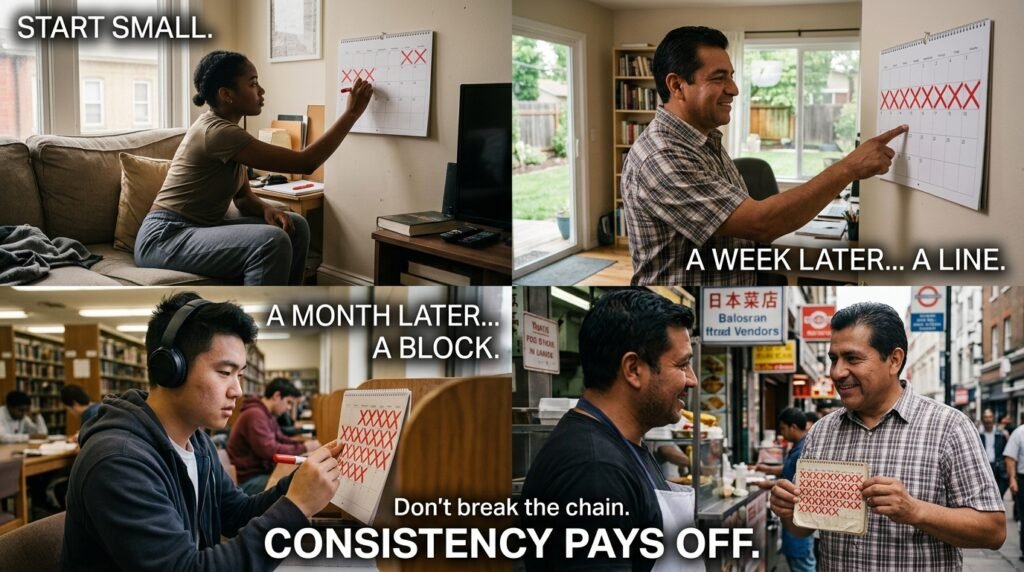
When you only do a little bit each day, it can feel like you aren’t moving. To combat this, I kept a very simple calendar on my wall. Every day that I did my practice, I put a big red “X” through the day.
After a week, I had a line. After a month, I had a block. Looking at that block of red Xs gave me a huge sense of accomplishment. It was visual proof of my dedication. On the days I didn’t feel like practicing, I would look at the calendar and think, “I can’t break that line.”
This simple visual tool was more effective than any expensive app. It turned my progress into a game of “don’t break the chain.” It reminded me that even if I didn’t feel “smarter” today, I was still being consistent. And in the world of language learning, consistency is the only thing that actually pays off.
Final Thoughts for the Busy Learner
If you’re reading this and thinking, “I still don’t have time,” I want you to try an experiment. Just for one day, track how much time you spend on your phone looking at things that don’t matter. Be honest. Most of us spend at least thirty minutes a day on mindless scrolling.
Imagine if you took just half of that time and gave it to your language. In a year, that is nearly 100 hours of focused practice. That is enough to go from a total beginner to someone who can navigate a foreign country with confidence.
You have the time. You just have to decide that your goals are more important than the algorithm. Start small. Start today. Don’t wait for Monday. Don’t wait for the new year. Just find five minutes right now, and give them to the language you want to speak. Your future self will thank you.

Gabriel Henrique is a language enthusiast and productivity writer. After testing countless study methods, he became obsessed with mastering new languages efficiently. He achieves this without burnout, without endless grammar drills, and without losing focus. At Blog The Curious, he shares everything he has learned along the way.