
My neighbor used to say that learning grammar from a textbook was like trying to learn how to swim by reading about water. She had lived in four countries by the time she was thirty, picked up three languages along the way, and never once enrolled in a formal grammar course. I thought she was exaggerating — maybe even showing off a little. But two years into my own language journey, completely tangled up in Spanish subjunctive rules I could recite perfectly but never actually use, I started to think she might have been onto something.
That conversation stuck with me. So one afternoon, instead of opening my textbook, I opened a Spanish novel I’d bought months earlier and never touched — too afraid I wasn’t “ready” for it. I read three pages. Understood maybe sixty percent. And something small but important shifted.
This article is about what I built from that afternoon — the method that eventually replaced my grammar textbook entirely, not because textbooks are useless, but because I needed something different. Something that felt less like studying and more like actually being inside the language.
Why “Studying Grammar” Wasn’t Working for Me
Before I explain the method, I want to be honest about the specific problem I was trying to solve — because “grammar isn’t working” can mean very different things for different people.
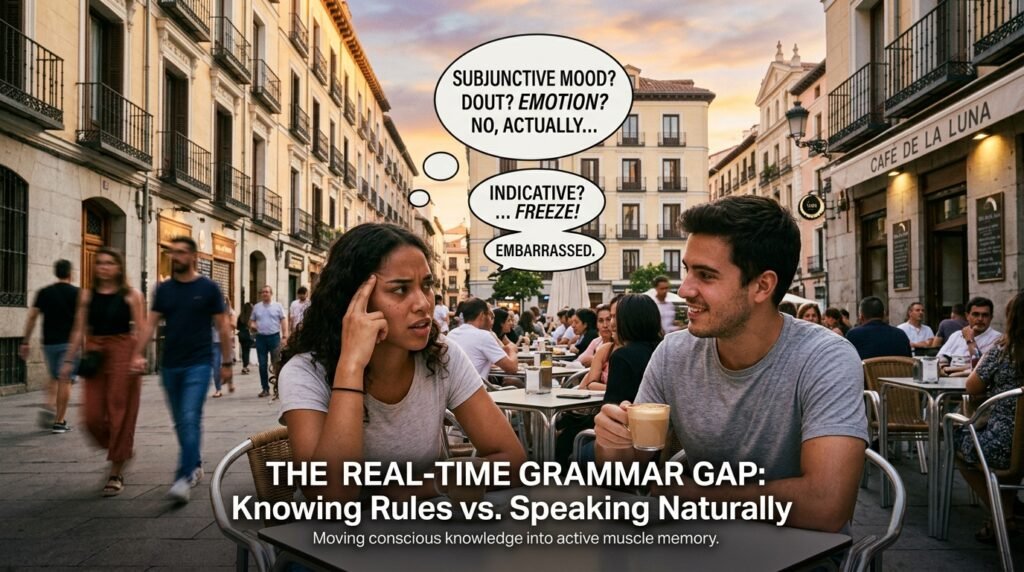
My problem wasn’t understanding the rules. I could explain the difference between the indicative and subjunctive mood in Spanish with reasonable accuracy. I could tell you that the subjunctive is used for doubt, emotion, hypotheticals, and certain subordinate clauses. I could write it correctly in an exercise. But the moment I was in a real conversation — or even just writing an email in Spanish to a language partner — that understanding evaporated. I would freeze, second-guess myself, choose wrong, and then feel deeply embarrassed by something I theoretically “knew.”
There’s a gap between knowing a rule and having it available to you in real time. Crossing that gap is what natural grammar acquisition is actually about.
The method I developed was specifically designed to close that gap — to move grammar from my “conscious knowledge” shelf into something more like muscle memory. And the surprising thing was how little formal grammar study it required.
The Core Idea: Input Before Analysis
The entire method is built on one principle that runs counter to how most language courses are structured: you need to encounter grammar in context before it makes sense to study it formally.
Think about how you learned complex grammar in your native language. Nobody sat you down at age four and explained relative clauses. You heard sentences with relative clauses thousands of times — “the dog that bit me,” “the book you recommended” — until those patterns became part of your internal model of how sentences work. The grammar existed in your brain as a felt sense of correctness long before anyone gave it a name.
For adults learning a second language, we can compress that process — but we can’t skip it. We still need the input. We still need the exposure. The difference is that we can also use our analytical minds to consciously notice patterns and speed up what would otherwise take decades of immersion.
The method I used tried to have it both ways: massive input first, targeted analysis second. Never the other way around.
What the Method Actually Looked Like
Here’s the practical breakdown — what I did, in what order, and why each piece mattered.
Phase 1 — Flooding
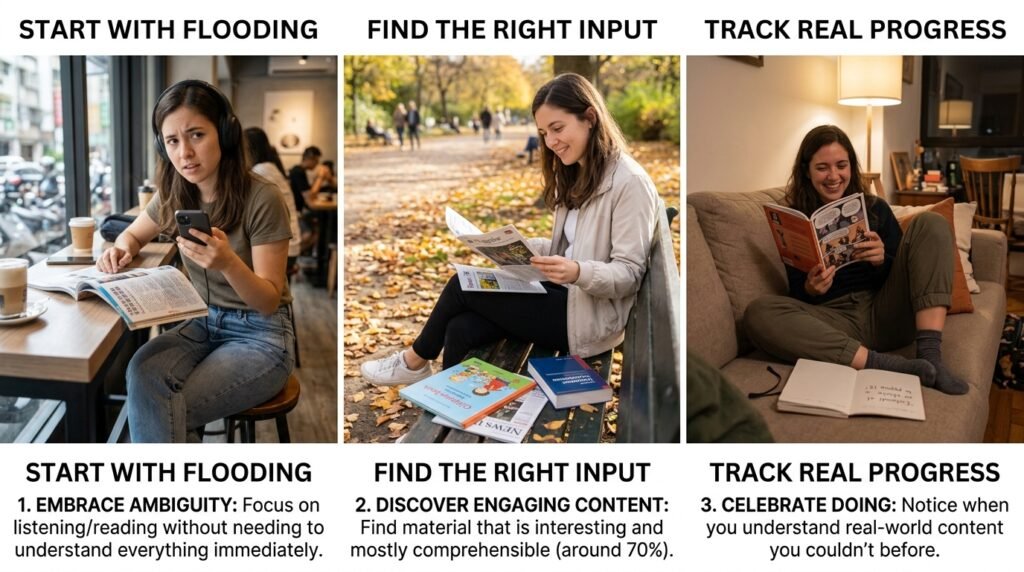
Every week, I chose one source of “comprehensible input” — something in Spanish that I could understand about 70–80% of without stopping to look things up. A graded reader, a slow podcast, a YouTube channel from a Spanish creator I found engaging. The 70% threshold is important: too easy and you don’t encounter enough new grammar; too hard and you lose the meaning that gives grammar its context.
I consumed that source for about 30 minutes a day, five days a week. No studying. No pausing to analyze. Just absorbing.
Phase 2 — Noticing
After two or three days of flooding, I went back to the same material with a different lens. I picked one grammatical structure that had appeared repeatedly — sometimes something I already knew vaguely, sometimes something completely unfamiliar — and I read or listened specifically to notice how it was being used.
Not analyzing yet. Just noticing. How often does it appear? In what kinds of sentences? What seems to trigger it — what comes before it, what comes after? I wrote down three or four examples that felt clear and natural.
What I Noticed
The structure in context — the sentences around it, the emotion or logic it seemed to carry.
What I Didn’t Do
I didn’t immediately look up the rule or try to apply it. Noticing first. Everything else second.
Time Spent
About 15 minutes, twice a week. Focused and intentional, never passive.
The Goal
Build a mental “feel” for the structure before giving it a name or a rule to follow.
Phase 3 — Targeted Reading
Only after noticing did I read about the structure formally — and by that point, the rule almost always felt like confirmation rather than new information. My brain had already started forming its own hypothesis about how the thing worked, and the formal explanation either confirmed it or refined it.
This is a fundamentally different relationship with grammar rules than I’d had before. Instead of rules feeling like instructions I had to memorize and apply, they felt like vocabulary for something I already partially understood. That shift made them stick.

Phase 4 — Deliberate Output
Once I’d noticed and confirmed a structure, I spent one session deliberately using it in output — writing four or five sentences, or in conversation with a language partner. Not perfectly. Not carefully. Just deploying it and seeing what happened.
This was the stage where I made the most errors, and also where the most learning happened. Errors in output, I came to understand, are not evidence that you haven’t learned something — they are part of the learning itself. If you’re only ever right, you’re not being challenged enough.
The Grammar Structures That Responded Best to This Method
Not all grammar behaves the same way, and I noticed that some structures responded much better to the input-first method than others.
- Mood and aspect (subjunctive, imperfect, conditional) — these are deeply tied to meaning and emotion, which makes them ideal for the noticing phase. You feel them before you can name them.
- Preposition use — entirely idiomatic and almost impossible to learn through rules alone. Input flooding is the only thing that actually works here.
- Word order — you develop instincts for natural word order through exposure far faster than through explicit study.
- Collocations and fixed expressions — these have to be absorbed whole, not built from grammar rules. Flooding is essential.
- Verb + preposition combinations — “pensar en,” “soñar con,” “depender de” — these have to be learned in context, and input provides that context naturally.
The structures that benefited less from this approach — and where I did actually spend time on explicit study — were things like pronoun placement rules, where the logic is specific enough that a clear explanation saves a lot of guesswork. Even then, I did the explanation after input, not before.
How This Connected to the Rest of My Learning
One thing I want to emphasize is that this method didn’t exist in isolation. It was the grammar component of a larger approach that tried to make every part of language learning feel less like memorization and more like genuine engagement with the language.
The vocabulary side of things followed a similar logic — learning words in context rather than from lists, building phrases rather than isolated items. Once I understood the method I used to learn words in context, the grammar piece fit naturally alongside it. They reinforced each other: richer vocabulary gave me more to notice grammatically, and stronger grammar intuition helped me understand vocabulary in more nuanced ways.
The speaking side also shifted once my grammar became more intuitive. When you’re not consciously running grammatical checks while speaking, you have more mental bandwidth for what you actually want to say. That’s when conversation starts feeling like communication instead of performance. If you’ve ever felt yourself freezing mid-sentence while running a mental grammar check, you know exactly what I mean — and what I did to stop freezing during conversations was deeply connected to letting grammar operate below the conscious level.
When grammar stops being something you think about and becomes something you feel, speaking stops feeling like a test and starts feeling like talking.
What Made This Method Hard — And How I Stayed With It
I won’t pretend this approach was effortless. There were specific challenges that took time to navigate.
- Patience with ambiguity. Early in the flooding phase, you encounter things you don’t understand and can’t explain. That discomfort is real. Your brain wants a rule. Learning to sit with the not-knowing is genuinely hard.
- Finding the right input level. The 70% comprehension threshold sounds straightforward, but finding material at exactly that level takes trial and error. Too easy is boring. Too hard is demoralizing.
- Trusting the process when you can’t measure it. Unlike drilling exercises where you can count correct answers, this method produces progress that only becomes visible over weeks. Trusting it through the invisible period requires real commitment.
- Resisting the urge to study more. Counterintuitively, one of my biggest challenges was not over-studying. When progress felt slow, my instinct was to add more explicit grammar work. Usually that made things worse, not better.
The thing that kept me going through those stretches was tracking not what I knew, but what I could do. Rather than counting grammar rules mastered, I started noting when I understood something in real input that I wouldn’t have understood a month ago — a joke, an idiom, a complex sentence in a podcast. Those moments of genuine comprehension were far more motivating than any quiz score.
Where I Am Now — and What I’d Tell Someone Starting Out
Two and a half years after that afternoon with the untouched Spanish novel, my relationship with grammar is completely different. I still make mistakes — plenty of them — but they feel like approximations now, not failures. My brain produces a sentence that’s close, I notice something feels slightly off, I adjust. That feedback loop is fast and mostly subconscious.
The structures I used to fear most — subjunctive, ser versus estar, the difference between preterite and imperfect — now feel intuitive in the way that English grammar feels intuitive to me. I don’t think about why I use “had gone” instead of “went” in a particular sentence. I just know. Spanish grammar is approaching that same place, gradually and imperfectly.
If you’re just starting out with this kind of approach, the most important thing I can tell you is to resist the pressure to prove your progress too early. The strategy that helped me build strong foundations was almost entirely invisible for the first few months — which made it hard to trust. But foundations are invisible by definition. They’re what everything else eventually stands on.
Be patient with your brain. It is doing something genuinely complex, and it is doing it well — just not always on your timeline.

Gabriel Henrique is a language enthusiast and productivity writer. After testing countless study methods, he became obsessed with mastering new languages efficiently. He achieves this without burnout, without endless grammar drills, and without losing focus. At Blog The Curious, he shares everything he has learned along the way.