
I spent my first year of language learning completely terrified of looking stupid. I treated every study session like an academic exam. I wanted to be perfect before I ever opened my mouth. I collected textbooks. I color coded my notes. I built complex spreadsheets to track my progress. I was a professional student.
I was also completely unable to hold a basic conversation.
I could read a grammar book and ace a multiple choice test. I could not order a coffee without sweating. My approach was entirely broken. I realized my failure was not a lack of effort. I was working incredibly hard. My failure was a fundamental flaw in my psychology. I was looking at the language through the wrong lens.
I had to completely tear down my internal beliefs about learning. I had to stop acting like a student trying to pass a test. I had to start acting like a mechanic trying to build a machine. I executed a radical shift in my mental framework. The moment I changed my mindset, the friction disappeared. The progress accelerated. Here is the exact mindset shift that improved my learning.
The Trap of the Professional Student
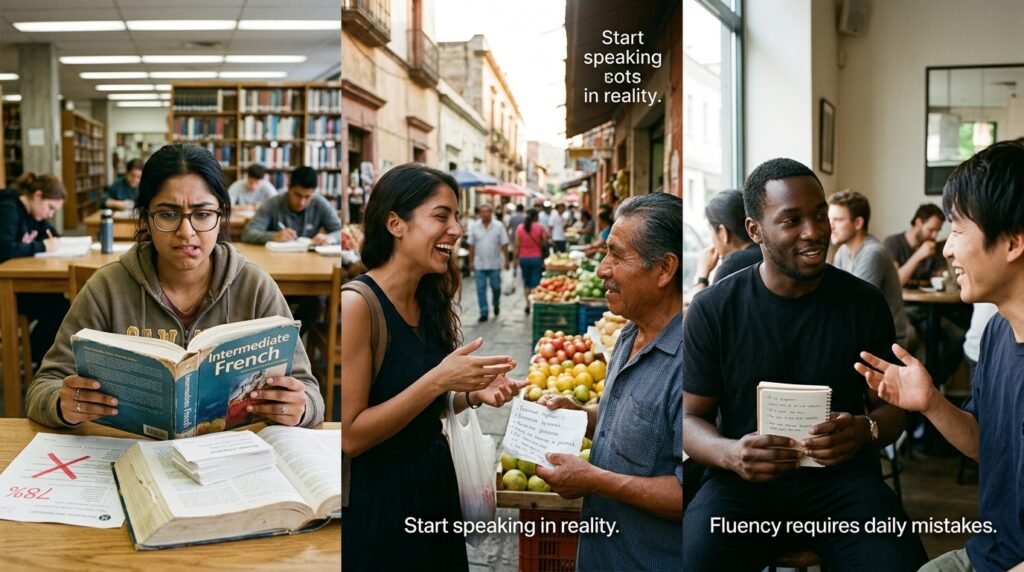
The traditional school system ruins our ability to learn as adults. School teaches you that mistakes are bad. School teaches you that a red mark on your paper is a failure. School trains you to optimize for the test, not for reality.
When I started learning a foreign language, I brought this toxic academic baggage with me. I wanted to score one hundred percent on my flashcard reviews. If I forgot a word, I felt a deep sense of personal shame. I felt like I was failing the class.
This student mindset is paralyzing. It forces you to stay in the shallow end of the pool. You only practice the things you already know because you are terrified of getting the new things wrong. You protect your ego at the cost of your actual fluency. I had to completely destroy my identity as a student. I realized that How I Learned Faster Once I Stopped Overcomplicating Everything required me to embrace massive, daily failure.
The Burden of Adult Competence
Learning a language is uniquely painful for adults. As an adult, you are highly competent in your daily life. You know how to do your job. You know how to navigate complex social situations. You know how to articulate your thoughts perfectly in your native tongue.
When you start learning a new language, you instantly lose all of that competence. You are reduced to the communication level of a toddler. You cannot express nuance. You sound foolish. Your adult ego violently rejects this demotion.
Your brain will do anything to protect your ego. It will convince you that you are too tired to study. It will convince you that you just need to read one more grammar book before you try speaking. I had to recognize this defense mechanism. I had to accept that looking foolish is the mandatory price of admission. You cannot skip the awkward phase. You must walk directly through it.
Shift One: Data Over Emotion
My first major mindset shift was removing emotion from the learning process.
I used to get angry when I forgot a vocabulary word. I would curse at my computer screen. I would tell myself I had a terrible memory. This emotional reaction burns massive amounts of cognitive energy. It associates the language with pain and frustration.
I decided to treat my brain like a cold piece of software. In software development, a bug is not a moral failure. It is just an error in the code. You find it. You patch it. You move forward.
I started treating my forgotten words as mechanical bugs. If I used the wrong verb tense, I did not get angry. I simply logged the data point. I flagged the flashcard. I adjusted the visual anchor. I fixed the code. Stripping the emotion away turned a frustrating ordeal into a calm, clinical engineering problem.
Shift Two: The Illusion of Readiness
The biggest lie you tell yourself is that you will start using the language when you are finally ready. You think there is a magical threshold of vocabulary where speaking will suddenly feel safe.
That threshold does not exist. You will never feel ready. Readiness is a complete illusion.
If you wait until you feel confident, you will wait for the rest of your life. You have to execute before you are ready. You have to write terrible, broken sentences. You have to speak and watch native speakers look at you with total confusion. I stopped waiting for permission. I started forcing messy output on day one.
Shift Three: Tools Over Trophies
Many people want to learn a language so they can show off. They want to impress their friends. They treat fluency like a shiny trophy to put on a shelf.
Language is not a trophy. It is a hammer. You do not put a hammer on a shelf to admire it. You use it to hit nails. You use it to build things.
I stopped trying to build a beautiful, perfect vocabulary. I started building a strictly useful vocabulary. I did not care if my grammar sounded elegant. I only cared if the native speaker understood my point. I shifted my focus entirely from aesthetics to pure utility. If the tool works, the sentence is successful.
Shift Four: Embracing Ambiguity
Beginners want every single foreign word to translate perfectly into English. They want strict mathematical logic. They want a one to one ratio for every concept.
This ratio does not exist. Languages do not map perfectly onto each other. A foreign verb might have three different meanings depending on the context. A preposition might not exist at all.
You have to accept the grey areas. You have to be comfortable with ambiguity. You have to accept that sometimes a phrase just is the way it is, and there is no logical English equivalent. I discovered that What I Focused On Instead of Memorizing Rules meant surrendering my need for perfect control. I stopped fighting the language. I let the foreign structures exist without demanding an English explanation.

Shift Five: Systems Over Goals
Setting massive goals is actually dangerous. If your goal is to be fluent in six months, you will wake up every single day feeling like a failure. You are constantly measuring the massive gap between where you are and where you want to be. The gap causes despair.
I completely threw away my long term goals. I stopped caring about fluency. Fluency is an invisible finish line.
I focused entirely on my daily system. My only goal is to execute my daily repetitions. I wake up. I brew my coffee. I review my flashcards for fifteen minutes. If I complete those fifteen minutes, I win the day. The long term outcome is irrelevant. The daily process is the only thing that matters.
Shift Six: Intensity Over Duration
I used to measure my dedication by the clock. I thought sitting at my desk for two hours meant I was working hard.
Duration is a terrible metric. Sitting in a comfortable chair and passively highlighting a textbook is incredibly easy. Your brain is barely engaged.
I shifted my mindset from duration to intensity. I realized that a brutal, hyper focused fifteen minute sprint is infinitely more valuable than two hours of passive reading. I stopped counting hours. I started measuring the amount of cognitive strain I felt. If my brain did not feel physically tired after the session, the session was too easy.
Shift Seven: Production Over Consumption
Reading and listening feel productive. They are safe. You consume the data without risking anything.
True fluency requires rapid, spontaneous creation. You have to pull the language out of absolute silence. I changed my ratio of consumption to production. I stopped reading endlessly. I started forcing output.
I forced myself to stare at a blank digital page and write original thoughts. I forced myself to speak aloud to an empty room. This shift is exactly How I Stopped Overthinking Grammar Rules because active production forces you to use the rules immediately. You cannot hide behind a multiple choice menu when you are holding a pen.
Shift Eight: The Danger of Gamification
Software developers use gamification to hijack your dopamine receptors. They give you digital gems. They track your daily streak. They put you on a competitive leaderboard.
This trains your brain to care about the software, not the language. You start logging into the app just to keep your streak alive. You rush through the exercises without thinking. You are optimizing for the game, not for real life.
I executed a ruthless purge. I deleted every single gamified app on my device. I switched to a sterile, raw database. I rejected the digital trophies. I forced my motivation to come from the actual acquisition of the language, not from a flashing cartoon on my screen.
Shift Nine: Extreme Personal Relevance
Your brain actively deletes information it finds boring. You cannot force yourself to memorize generic content.
I changed my mindset regarding what I actually studied. I stopped learning the words for generic farm animals and tourist directions. I made the language aggressively personal.
I only consume content related to my deep professional and personal interests. I study complex basketball statistics. I study the retro aesthetics of vintage photography. I read highly technical articles about website architecture. I force the language to describe my actual daily reality. When the material is deeply relevant, the brain absorbs it instantly. The boredom vanishes.
Shift Ten: Trusting the Compound Effect
Language learning is an exercise in delayed gratification. You put in massive amounts of work up front and see absolutely zero return. You study every day for a month and you still cannot understand a fast native podcast.
This delay causes most people to quit. They assume the system is broken.
You have to trust the math. You have to understand the compound effect. Neural pathways build microscopically. The progress is completely invisible until the exact moment it suddenly compounds. You will struggle for ninety days. On day ninety one, you will suddenly understand a full paragraph without thinking.
I stopped looking for daily breakthroughs. I accepted the invisible compounding. I put my head down and executed the reps.

The Final Reality
Your brain is capable of acquiring any language on earth. Your biology is perfectly equipped for the task. The only thing stopping you is your own psychology.
You must drop the heavy burden of the student mindset. Stop trying to be perfect. Stop demanding perfect English translations. Stop relying on gamified software to trick you into working.
Embrace the friction. Accept the mechanical reality of the process. Treat your mistakes like cold data points. Execute your daily system without emotion. When you finally stop trying to perform and start focusing entirely on the process, the language will stop being an obstacle. It will become a part of who you are.

Gabriel Henrique is a language enthusiast and productivity writer. After testing countless study methods, he became obsessed with mastering new languages efficiently. He achieves this without burnout, without endless grammar drills, and without losing focus. At Blog The Curious, he shares everything he has learned along the way.