
I stared at the digital screen. My daily learning streak hit one hundred and fifty days. I felt a massive rush of accomplishment. I closed the vocabulary application. I felt totally prepared to speak the language. Later that afternoon, I walked into a local cafe. I tried to order a simple drink from a native speaker. My brain completely crashed. The native speaker spoke rapidly. The words blurred together. I panicked, pointed at the menu, and stood in awkward silence. I realized my digital streak was a complete illusion.
Language applications exist in a completely sterile vacuum. They give you multiple choice questions. They give you unlimited time to think. They strip away all the chaos, speed, and messy emotion of actual human communication. I realized I could not live in the digital sandbox forever. I had to build a permanent, functional bridge between the glowing screen and the chaotic reality of native speech. I completely redesigned my daily routine. I stopped serving the software algorithm. I started making the software serve my real life. Here is exactly how I combine digital applications with brutal real world practice.
The Sandbox and The Playground
You must properly categorize your learning environments. A language app is a sandbox. It is a safe, highly controlled space where you learn the absolute basics. You learn how the shovel works. You learn how to build a tiny, fragile castle.
The real world is a massive, chaotic playground.
If you spend three years in the sandbox, you will be terrified of the playground. You must force yourself to step out of the box as early as possible. I instituted a strict eighty twenty split for my daily study schedule.
I allowed myself to spend exactly twenty percent of my allocated study time inside the application. The remaining eighty percent of my time was aggressively dedicated to real world practice. If I had an hour to study, I spent twelve minutes on digital flashcards. I spent the remaining forty eight minutes wrestling with native audio, real articles, and actual spoken conversations.

Sourcing Data from the Real World
The biggest mistake you can make is letting the application dictate your vocabulary list. Default app curriculums teach you how to buy a train ticket or order a basic apple.
I do not care about generic train tickets. I manage a complex network of digital publishing websites. I write extensive privacy policies. I build intricate internal link structures for multiple domains like blogthecurious.com and coffeenerdlab.com. I also spend hours analyzing first action statistics for NBA playoff games. I track point spreads and rebounding probabilities with heavy mathematical precision.
I needed to talk about these specific passions. I reversed the entire learning process.
I stopped learning words from the app and hoping they would appear in the real world. I started pulling words from the real world and forcing them into the app. I would read a native article about basketball analytics. When I found a complex statistical term I did not know, I harvested it. I created a custom flashcard for it in my spaced repetition software.
This completely changes the value of the application. The software becomes a highly personalized storage vault for the exact terminology you need to survive your daily life. I learned How I Turned Everyday Moments Into Vocabulary Practice is the only way to build a personalized, functional dictionary.
The Immediate Physical Anchor
When you learn a new word in a digital application, it is incredibly fragile. It lives strictly in your short term memory. If you do not use it immediately, your brain will efficiently delete it within twenty four hours.
I created the immediate application rule.
Every morning, I review my digital flashcards while I brew my coffee. I use a precise V60 pour over method. I weigh Ethiopian Sidamo beans perfectly on a digital scale. The bloom phase takes exactly forty five seconds. While the hot water extracts the coffee, I swipe through my daily vocabulary.
If the app teaches me the foreign word for temperature, I do not just tap the screen and move on. I immediately look at the digital thermometer on my gooseneck kettle. I touch the hot metal. I say the foreign word out loud. I physically anchor the digital data to a real object in my kitchen.
If the app teaches me a new verb tense, I immediately pull out a physical notebook. I write three original sentences using that exact verb tense to describe my upcoming workday. You must immediately force the digital information to do real, physical work.
The Audio Shadowing Bridge
Language applications often feature pristine, crystal clear audio recordings. A voice actor speaks a sentence perfectly in a completely silent studio.
Real human beings do not speak like voice actors. They mumble. They slur their words together. They speak incredibly fast.
To bridge this massive gap, I used a technique called audio shadowing. I found unscripted, highly conversational podcasts recorded by native speakers. I put on heavy noise canceling headphones. I hit the play button.
I tried to speak out loud at the exact same time as the podcast host. I tried to perfectly overlap my voice with their voice.
I failed miserably at first. My mouth could not keep up with the native velocity. But I forced my jaw and tongue to try. This drill completely shocks your nervous system. It forces your brain to process auditory data at native speed. You realize The Strategy That Helped Me Speak More Naturally requires you to abandon perfect pronunciation and embrace messy, fluid speed. Once you shadow a real podcast for ten minutes, the audio in your language application will suddenly sound like it is moving in slow motion.
Automating the Forced Switch
I possess a deep background in mobile software and task automation. I write detailed scripts to eliminate repetitive digital work. I realized I needed to automate the transition between the safe application and the terrifying real world.
If you rely on willpower to close your fun language app and open a difficult native podcast, you will fail. The app is too comfortable.
I used the native automation features on my smartphone. I wrote a strict script. When I open my flashcard application, a silent timer begins in the background. After exactly fifteen minutes, the script forcefully closes the flashcard application. It immediately launches my podcast player and automatically hits play on a native language sports broadcast.
I completely removed my own choice from the equation. The software literally kicks me out of the digital sandbox and throws me directly into the ocean.
The Transcription Interrogation
You cannot just listen to real world audio passively. Passive listening is a comfortable illusion. You can listen to a foreign radio station for ten hours and learn absolutely nothing.
You must interrogate the audio.
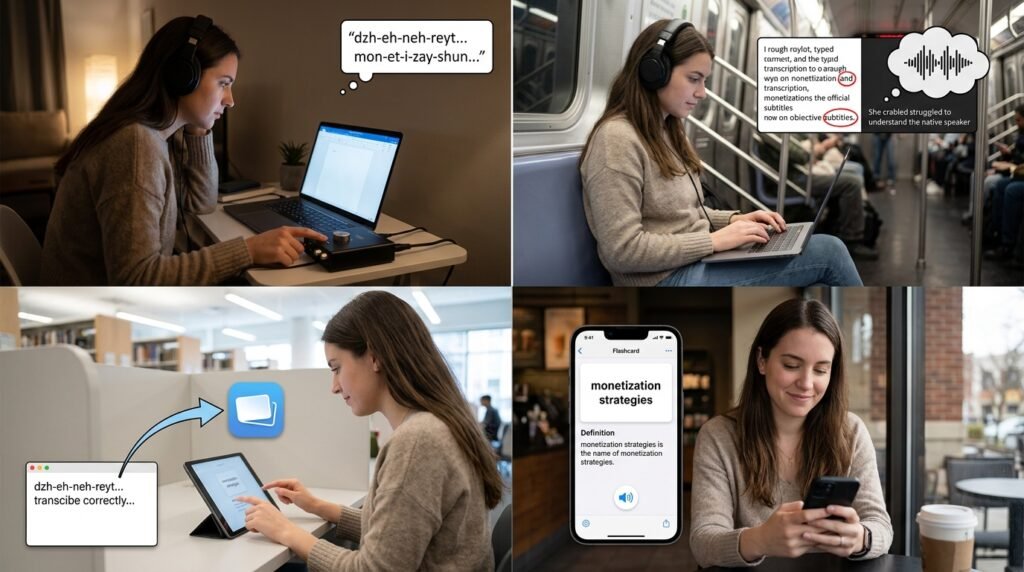
I took a two minute clip of a native speaker discussing digital monetization strategies. I opened a blank text document. I listened to the first three seconds of the audio. I paused the track. I tried to manually type out every single syllable I heard.
I repeated this brutal process for the entire two minute clip. It took me forty five minutes of intense, agonizing focus.
Once I finished the manual transcription, I checked my work against the official subtitles. I found the exact spots where my ears completely failed me. I found the words that I knew perfectly in my digital app, but completely failed to recognize in real spoken audio.
This is where the magic happens. I took those failed words and put them back into my flashcard application. I created a closed loop. The real world tested me, I failed, and I used the app to repair the specific failure.
Utilizing the Blank Page
Applications train you to be a consumer. You consume multiple choice questions. You consume fill in the blank puzzles.
Fluency requires you to be a rapid creator. You have to generate spontaneous thoughts.
I completely stopped using translation applications to check my daily writing. If I wanted to write an email or draft a short blog post in my target language, I stared at a completely blank piece of paper.
I forced my brain to build the sentences from absolute scratch. If I forgot a word, I did not reach for my phone to look it up. I forced myself to walk completely around the missing word. I used simpler vocabulary to describe the complex concept.
This simulates the exact pressure of a real conversation. You cannot pause a live human being to check your digital dictionary. You have to pivot. You have to survive with the tools you currently possess.
Treating Mistakes as Navigation Data
When you use a gamified application, a mistake is treated as a punishment. The screen flashes red. You lose a digital heart. You lose your perfect score.
This creates a massive psychological fear of failure. It trains you to play it safe.
In the real world, a mistake is not a punishment. A mistake is highly valuable navigation data.
When I finally started having real conversations with native speakers, I completely embarrassed myself. I used the wrong verb tenses. I accidentally used highly formal language in casual settings. I mispronounced words and confused the native speakers entirely.
I did not let these failures crush my ego. I treated them exactly like a broken line of website code. I isolated the bug. As soon as the conversation ended, I opened my digital flashcard app. I built a specific card to correct that exact conversational mistake.
The app became a repair shop for my real world failures. I was no longer afraid of making mistakes because I had a systematic, digital method for fixing them permanently. I learned The App Features That Actually Made a Difference are the ones that let you repair your specific, personal conversational failures.
The Visual Anchor Technique
Real practice heavily involves your physical environment. You do not speak in a digital void. You speak in grocery stores, coffee shops, and busy streets.
I wanted to train my brain to link foreign vocabulary directly to visual reality, completely bypassing English.
I used my deep interest in photography to build this link. I stopped using English words on the front of my digital flashcards. Instead, I used a high resolution photograph. I study the retro aesthetics of 35mm lenses and Canon IXUS flashes. I focus heavily on preserving precise facial geometry in my edits.
If I wanted to learn the word for lens, I did not write the English word. I used a macro photograph of a retro camera lens. When the flashcard appeared on my screen, I looked at the glass geometry. I looked at the metal casing. My brain immediately associated the foreign sound directly with the physical object.
This completely eliminates internal translation. When you step into the real world and see the object, the foreign word fires instantly because the visual trigger is already permanently wired into your brain.
The Weekly Digital Fast
To maintain a healthy relationship with your software, you must occasionally cut the digital cord entirely.
I instituted a mandatory digital fast every single Sunday. On Sundays, I refused to open my language learning application. I did not use digital dictionaries. I stayed completely away from the glowing screen.
I forced myself to interact strictly with analog materials. I read physical books. I wrote sentences by hand. I spoke out loud to myself in the kitchen.
This weekly fast resets your brain. It prevents digital burnout. When Monday morning arrives, you actually look forward to opening the application again. Absence creates desire. Furthermore, the fast exposes exactly what you do not know. When you cannot look up a word instantly on your phone, you have to survive using context clues. This builds massive mental resilience.
Filtering the Junk Input
Apps constantly try to feed you notifications. They send you emails about leaderboards. They send you push alerts about your friends’ progress. This is junk input. It does not help you speak faster. It just clutters your brain.
I turned off every single notification for my language apps. I removed the badges from the icons. I made the application completely silent. The app only speaks when I open it on my own terms. Controlling the flow of information is critical for maintaining your focus. When you combine real world practice with an app, the app must remain a quiet, obedient servant. It cannot constantly scream for your attention.
Designing the Exit Strategy
The ultimate goal of using a language app is to completely outgrow it.
You should never plan to use flashcards or daily mobile quizzes for the rest of your life. That is a terrible destiny.
I set clear, aggressive milestones for my digital tools. I decided that once my custom flashcard deck hit two thousand mature words, I would permanently delete the application.
Having a hard exit deadline changes your entire relationship with the software. You stop treating it like a fun daily game. You start treating it like an intense, temporary boot camp. You extract the necessary data as fast as physically possible because you are desperate to graduate to the real world.
Embracing the Inevitable Fatigue
Combining apps with real practice is physically exhausting.
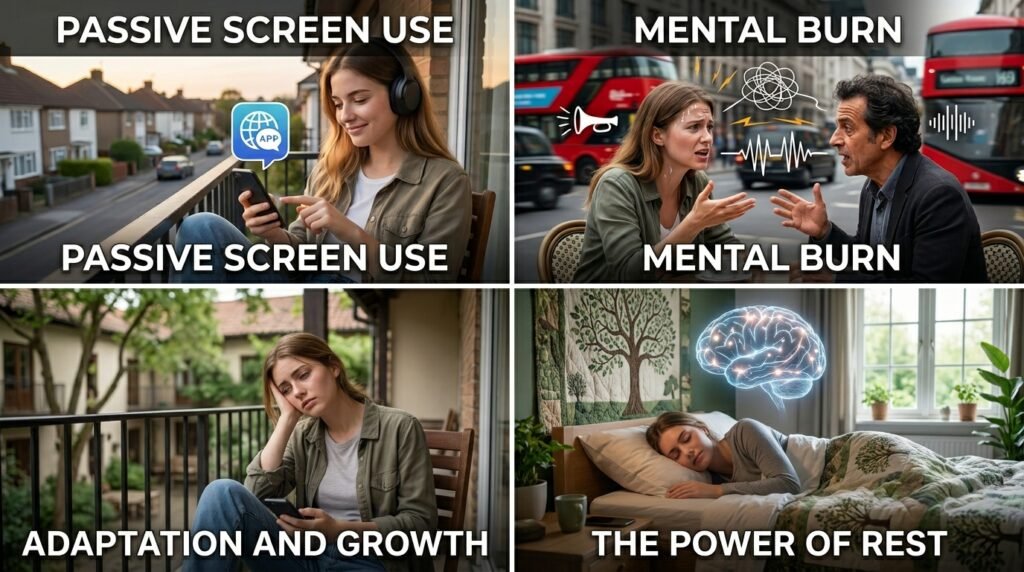
Tapping a screen for ten minutes is easy. Having a ten minute conversation with a native speaker while loud traffic blares in the background will completely drain your mental battery. Your brain burns massive amounts of glucose to process real time audio, cultural context, and complex grammar simultaneously.
You must respect this fatigue. When your brain feels completely fried after a real world immersion session, do not open your language app to do more flashcards.
Close everything. Step away from the language entirely. Rest your mind. The actual neurological growth happens during periods of deep rest. The friction you feel during the real practice is the exact mechanism that forces your brain to adapt and build permanent fluency.
The Final Reality
Digital applications are a miracle of modern technology. They can organize your study schedule. They can optimize your memory retention. They can provide instant access to thousands of vocabulary words.
But they cannot make you brave.
They cannot teach you how to read a native speaker’s body language. They cannot teach you how to recover gracefully when you completely forget a sentence halfway through. They cannot replicate the deep, human joy of connecting with someone from a completely different culture.
Use the applications aggressively. Squeeze every drop of efficiency out of their algorithms. Build your custom decks. Automate your daily routines.
But never forget the ultimate objective. The glowing screen is just the warm up routine. The real game is played entirely outside. Put the phone in your pocket, walk into the loud, messy world, and force yourself to speak. The apps built the bridge, but you have to physically cross it yourself.

Gabriel Henrique is a language enthusiast and productivity writer. After testing countless study methods, he became obsessed with mastering new languages efficiently. He achieves this without burnout, without endless grammar drills, and without losing focus. At Blog The Curious, he shares everything he has learned along the way.