
I remember the first time I sat down in a specialty coffee shop in a foreign country, determined to use the language I had been studying for six months. I had spent hours every night with my head in a textbook. I knew the words for “water,” “beans,” and “hot.” I even knew the word for “process.” But when the barista looked at me and asked a simple question about how I wanted my brew, my mind felt like a dusty attic. I could see the words in my head, but they were stuck. I could “read” them in my mental dictionary, but I couldn’t reach them with my tongue.
It was a humiliating moment. I walked out of that shop with a basic black coffee that I didn’t even want, simply because I couldn’t find the words to ask for a V60 of their Ethiopian Yirgacheffe. I was a digital content manager who spent all day working with words on sites like coffeenerdlab.com, yet I was functionally mute in real life. That failure was the turning point for me. I realized that “knowing” a word and “using” a word are two completely different brain functions.
If you are stuck in that gap between being a good student and being a good speaker, you are not alone. It is the most common plateau in language learning. I had to stop collecting words like they were stamps and start using them like they were tools. Here is the exact process that helped me move from a passive vocabulary to an active one.
The Mental Dictionary vs. The Utility Belt
The biggest mistake I made was treating my vocabulary like a collection. I wanted to have the biggest dictionary in the room. I thought that if I knew 5,000 words, I would magically be able to speak. The truth is that you only need about 500 words to have 80% of daily conversations, provided you actually know how to deploy them under pressure.
Think of your passive vocabulary as a massive library. It is full of books you have read once. They are sitting on shelves, gathering dust. When someone asks you a question, you have to run into the library, find the right aisle, find the right book, and look up the page. By the time you find it, the conversation has moved on.
Your active vocabulary is a utility belt. These are the tools you have strapped to your waist. You can reach for them without looking. You don’t “think” about them; you just use them. I realized that the biggest hurdle wasn’t my memory, but The Method I Used to Learn Words in Context which finally bridged the gap between recognition and production. I had to stop learning words in isolation and start learning them as part of a lived experience.

Scripting My Own Life
I stopped waiting for conversations to happen and started preparing for the ones I knew I would have. As a blogger, I talk about SEO, app productivity, and coffee processes every single day. Why was I learning the names of zoo animals and kitchen utensils I never use?
I started “scripting” my life. I wrote down the stories I tell most often in my native language. I wrote down how I explain my work. I wrote down my opinions on Brazilian soccer, specifically my frustration with Vasco’s recent performance compared to Flamengo’s dominance.
By preparing these scripts, I was creating “islands of fluency.” When someone asked me “What do you do?”, I didn’t have to build a sentence from scratch. I had a pre-built tool ready to go. This doesn’t mean I was memorizing a speech; it means I was familiarizing my mouth with the specific clusters of words I actually use. I noticed that when I stopped trying to build sentences from scratch and focused on How I Learned Phrases Instead of Isolated Words my speech suddenly became much more fluid.
The Power of Emotional Anchoring
We remember things that make us feel something. This is why I can remember every detail of a Kitsune tattoo design I saw three years ago but I can’t remember a random grammar rule from a textbook. The tattoo has a visual and emotional impact. The grammar rule is just ink on a page.
I started anchoring my new vocabulary to things I am passionate about. When I wanted to learn words related to “analysis” or “probability,” I didn’t look at business texts. I looked at NBA performance statistics. I love analyzing early game milestones like first baskets or rebounds for my betting analysis. Because I had “skin in the game,” the words stuck.
If I lost a bet because I misunderstood a stat in my target language, I never forgot that word again. Pain and excitement are powerful teachers. If you want to use the words you learn, stop learning them in a vacuum. Connect them to your hobbies, your fears, or your bank account. The brain prioritizes information that it thinks is necessary for survival or happiness.
The “Speaking to the Wall” Technique
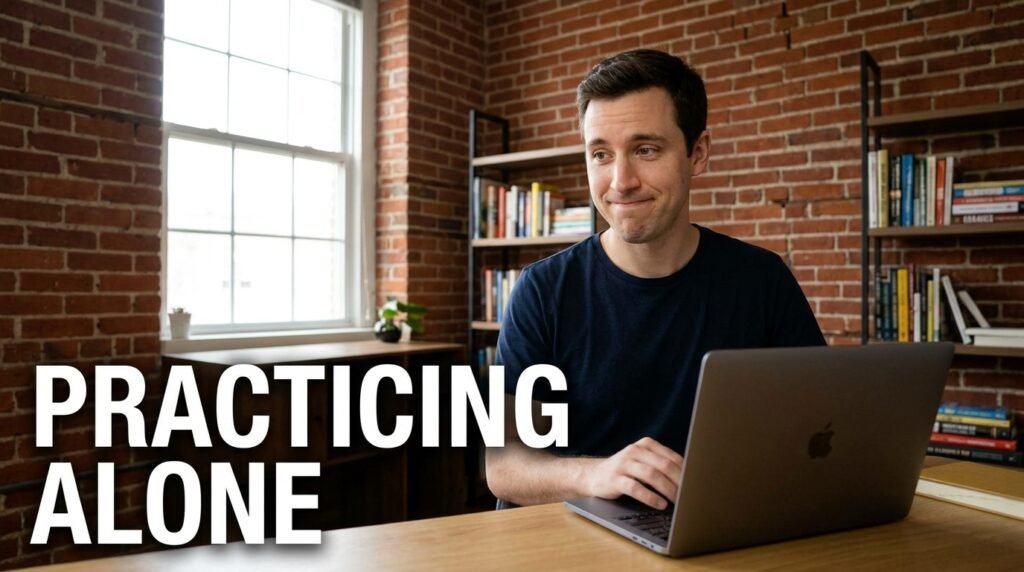
One of the biggest obstacles to using words is the fear of another person watching you fail. My solution was to eliminate the other person for a while. I started narrating my day out loud in my office.
“I am opening the laptop. I am checking the SEO for the new article. I need a second cup of coffee.”
It sounds crazy, but it works. It trains the physical muscles in your mouth to make the sounds without the stress of a social interaction. When you are alone, you can stumble, you can mispronounce, and you can take ten minutes to find the right verb. This low stakes practice builds the neural pathways between your brain and your vocal cords.
I found that by the time I actually spoke to a native speaker, I had already said the words hundreds of times to my office walls. The words felt familiar in my mouth. They weren’t “new” anymore; they were just part of my daily noise.
Abandoning the Pursuit of Perfection
For a long time, I wouldn’t say a sentence if I wasn’t 100% sure the grammar was correct. I would pause for five seconds to make sure I had the right verb tense. This is the death of conversation.
I had to learn that “Me want water” is better than silence. In the real world, people don’t care if you use the wrong gender for a noun or if you mess up a conjugation. They care if they understand you. Once I gave myself permission to be “the village idiot,” my progress skyrocketed.
The transition from being a silent observer to a participant happened because of How I Built Confidence Speaking Step by Step and it changed my entire outlook on fluency. I realized that confidence doesn’t come from being perfect; it comes from being understood despite the mistakes.
Using High Frequency Connectors
If you want to actually use your vocabulary, you need to learn the “glue.” Glue words are the small connectors like “however,” “actually,” “besides,” or “it depends.”
These words are powerful because they give your brain time to think. If someone asks me a complex question, I can start with “Well, actually, that’s an interesting point…” While I am saying that filler phrase, my brain is frantically searching the library for the actual answer.
If you don’t have these connectors, you just stare at the person in silence while you think. That silence creates pressure, and pressure makes you forget even the words you know. Learn the filler words. Learn how to stall for time in your target language. It makes you sound more natural and it buys your brain the seconds it needs to retrieve your passive vocabulary.
The Environment is Everything
I realized that if I only engaged with the language during “study time,” it would never become active. I had to force the language into my physical world.
I changed the language of my smartphone. I changed the navigation voice in my car. I started following Brazilian soccer forums where fans argue about Vasco and Flamengo in real time. I wanted the language to be the thing I used to get information I wanted, not the thing I was “trying” to learn.
When you use a language to solve a problem—like trying to figure out why your app isn’t syncing or checking the latest NBA injury report—your brain stops seeing it as an academic exercise. It becomes a tool for survival in your digital world. This “forced usage” is what eventually makes the words stick.
The Role of Curiosity
Finally, I learned that I only use the words that I am genuinely curious about. I stopped forcing myself to read news articles about politics if I found them boring in my own language. Instead, I read technical descriptions of coffee genetic diversity in Ethiopia. I read about the “Natural Process” and how it affects the floral notes in a Yirgacheffe bean.
Because I wanted to know the information, I worked harder to use the words. I would find myself explaining coffee processing to my tutor not because it was an “exercise,” but because I actually wanted to talk about it.
Find your “Why.” If you don’t have a reason to say the words, you never will. Language is a vehicle for your thoughts. If you don’t have anything you want to say, the vehicle will just sit in the garage.

Moving Forward
If you are struggling to use the words you’ve learned, stop studying. Start doing. Talk to yourself in the shower. Write a short blog post about your favorite soccer team. Try to explain your job to an imaginary person while you brew your morning coffee.
The bridge from passive to active vocabulary is paved with mistakes, embarrassment, and a lot of talking to inanimate objects. It isn’t a comfortable process, but it is the only one that works.
Stop being a student of the language and start being a user of it. The library in your head is great, but the tools on your belt are what will actually get you through the day. Pick one tool today—one phrase, one story, one opinion—and use it until it feels like a part of you. The rest will follow.

Gabriel Henrique is a language enthusiast and productivity writer. After testing countless study methods, he became obsessed with mastering new languages efficiently. He achieves this without burnout, without endless grammar drills, and without losing focus. At Blog The Curious, he shares everything he has learned along the way.