
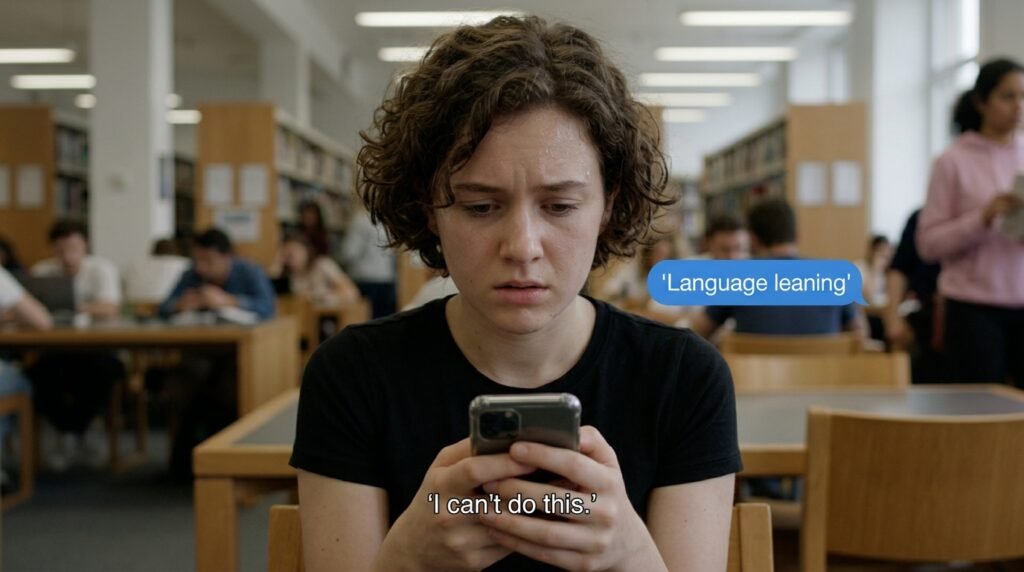
I have spent a lot of time staring at walls. Not literal walls, although I have done that too. I’m talking about the “Beginner’s Wall.” It is that invisible barrier you hit about three weeks into learning a new language. The initial excitement has worn off. The app notifications are starting to feel like nagging. The grammar rules are starting to look like a pile of tangled wires. This is the exact moment where most people quit. They tell themselves they aren’t “language people” and put the books back on the shelf.
I know this because I’ve quit more languages than I’ve learned. I used to be a serial quitter. I would start with a burst of energy, buy the best notebooks, and then get stuck the moment things got complicated. It wasn’t until I changed my entire strategy that I finally broke through. I realized that getting stuck isn’t a sign of low intelligence. It is a sign of a bad system.
If you are feeling stuck right now, I want you to take a breath. You don’t need a better brain. You need a better map. Here is the strategy I developed to navigate the beginner phase without losing my mind or my motivation.
Stop Trying to Learn the Whole Language
The biggest mistake beginners make is trying to learn everything at once. We want to be able to talk about politics, philosophy, and the weather by next Tuesday. When we realize how much we don’t know, we panic. The sheer volume of the task feels impossible.
My strategy changed when I decided to ignore 90% of the language. I realized that I didn’t need to know the word for “skyscraper” or “bankruptcy” yet. I needed a small, high-impact set of tools. I focused on what mattered most. I looked at my daily life and identified the words I actually use. As a blogger and someone who spends half my day thinking about specialty coffee or digital marketing, those were the words I needed.
By narrowing my focus, I stopped feeling overwhelmed. I wasn’t looking at a mountain anymore. I was looking at a small, manageable hill. This is a core part of What I Focused On First When Learning a New Language and it is the only reason I didn’t quit in those first critical weeks. I chose relevance over completeness.

The 15 Minute Momentum Rule
Beginners often get stuck because they set unrealistic goals. They tell themselves they will study for an hour every night. But then life happens. Work gets busy. You’re tired. You miss one night, then two, and suddenly a week has passed. Now you feel guilty. That guilt makes you want to avoid the language even more.
I killed the guilt by lowering the bar. I made a rule: I only had to do 15 minutes a day. That’s it. Anyone can find 15 minutes. You can find it while your coffee is brewing or while you’re waiting for a meeting to start.
The magic of this rule is that once you start for 15 minutes, you usually want to keep going. But even if you don’t, you’ve won. You kept the habit alive. You didn’t break the chain. This small, daily effort is what builds the neural pathways. I learned that How I Turned Small Daily Practice Into Real Progress was the secret to avoiding the burnout that usually kills a beginner’s momentum. It is about the streak, not the intensity.
Ignore Grammar Until You Have Vocabulary
This is a controversial one, but it saved me. Most beginners get stuck because they try to master complex grammar rules before they even know 500 words. Trying to learn how to conjugate verbs in the past subjunctive when you don’t know the word for “bread” is a waste of time. It’s like trying to learn how to build a roof when you haven’t even laid the foundation.
I decided to treat the language like music. I wanted to learn the “tunes” first. I learned common phrases and sentences as whole units. I didn’t worry about why the verb changed its ending. I just learned that “I want a coffee” sounds a certain way.
Once I had a bank of about 500 words and phrases, the grammar started to make sense on its own. My brain began to notice patterns. I stopped overthinking and started communicating. I found that How I Learned Faster Once I Stopped Overcomplicating Everything was the most liberating shift I ever made. I stopped trying to be a linguist and started trying to be a speaker.
Build a “Survival Kit” of Phrases
When you are a beginner, the biggest source of fear is the “Blank Mind Syndrome.” You find yourself in a conversation, and you suddenly forget everything. This makes you feel stuck and embarrassed.
To fight this, I built a “Survival Kit.” These are 10 to 15 phrases that I memorized until they were absolute muscle memory. They include things like:
-
“Could you say that more slowly?”
-
“How do you say [word] in this language?”
-
“I am a beginner, I am still learning.”
-
“What does that mean?”
These phrases are your safety net. If you get stuck, you use one of them. It keeps the conversation going and takes the pressure off your brain. It allows you to stay in the game rather than retreating into silence. Most beginners get stuck because they don’t have a way to ask for help in the target language. Once you have these phrases, you are never truly stuck.
Focus on Your Interests Immediately
If you are bored, you will get stuck. Many textbooks are painfully boring. They teach you how to ask for directions to the library or how to describe a family dinner with people you don’t know. If you don’t care about the content, your brain won’t store the information.
I bypassed this by bringing my interests into the language from day one. I am fascinated by Japanese Irezumi. I started looking for photos of traditional tattoos and learning the names of the motifs in Japanese. I looked up “hebi” for snake and “kitsune” for fox. Because I was genuinely interested in the art, I wanted to know the words.
I did the same with coffee. I learned the words for “roast,” “acidity,” and “pour over.” Suddenly, the language felt alive. It wasn’t a school subject anymore. It was a way for me to explore the things I already loved. If you are a beginner, find the things you love and learn how to talk about them first.

The Power of the “Micro-Win”
We often get stuck because we only focus on the big goal: fluency. But fluency is years away. If that is your only metric for success, you will feel like a failure every day.
I started celebrating “Micro-Wins.”
-
I understood a single word in a song.
-
I ordered my drink without looking at a translation app.
-
I remembered a verb conjugation correctly.
-
I finished my 15 minutes of practice even though I was tired.
By celebrating these tiny victories, I kept my dopamine levels high. I felt like I was winning every day. This positive reinforcement is what keeps you going when the grammar gets tough. Don’t wait until you can give a speech to feel proud of yourself. Be proud that you showed up today.
Avoid the “App Trap”
Apps are great tools, but they can also be a trap. Many beginners spend hours clicking buttons and matching pictures on an app and feel like they are “studying.” But then they try to speak and realize they can’t form a single sentence.
I realized that apps often teach you how to play a game, not how to use a language. My strategy was to use apps for no more than 20% of my time. The other 80% was spent on real usage: listening to podcasts, speaking out loud to myself, or writing simple sentences.
Don’t let a digital streak fool you into thinking you are making progress if you aren’t actually using the language. Use apps as a supplement, not the main course. Real progress happens when you step away from the screen and try to produce the language yourself.
Narrate Your Life
One of the best ways to avoid getting stuck is to practice “active thinking.” I started narrating my day in my head. As I was making my morning V60, I would say to myself: “I am grinding the coffee. I am pouring the water. The coffee smells good.”
It doesn’t matter if your sentences are simple or grammatically incorrect. The goal is to bridge the gap between your thoughts and the new language. By narrating your life, you realize exactly which words you are missing. You realize you don’t know the word for “kettle” or “spoon.” You look them up, use them immediately, and they stick.
This constant, low pressure practice keeps the language at the front of your mind. It makes it a part of your reality rather than a chore you do at a desk.
Embrace the “Ugly” Phase
There is a period in the beginning where everything you say sounds ugly. You have a thick accent. You make basic mistakes. You sound like a toddler. Most people get stuck here because their ego can’t handle looking foolish.
I decided to embrace the “Ugly Phase.” I told myself that I was allowed to be bad at this. In fact, being bad at it was the only way to get good at it. I stopped apologizing for my mistakes. I stopped feeling embarrassed when I mispronounced a word.
Once I let go of the need to look “cool” or “smart,” my progress skyrocketed. I was willing to try more things, which meant I learned more things. The people who get stuck are usually the ones who are too afraid to make a mistake. The people who succeed are the ones who are willing to be messy.
Change Your Digital Environment
We check our phones hundreds of times a day. If your phone is in your native language, you are missing out on a huge opportunity for “passive learning.”
I didn’t change my whole phone to the target language immediately—that’s a great way to get locked out of your own bank account. Instead, I changed specific things. I changed my weather app. I changed the language of my Instagram feed. I followed creators who spoke the language I was learning.
Now, even when I am just scrolling or checking the temperature, I am seeing the language. It becomes a natural part of my digital environment. This constant, subtle exposure adds up over time. It keeps the language “warm” in your brain without you having to exert any extra effort.
Finding a “Low Stakes” Speaking Partner
Eventually, you have to talk to someone. This is where most beginners hit the biggest wall of all: fear. The thought of talking to a native speaker can be terrifying.
I avoided this by finding “low stakes” partners. I used online platforms to find other learners or tutors who were specifically trained to work with beginners. These are people who expect you to make mistakes. They aren’t going to judge you. They are there to help you.
Having a safe space to practice speaking is essential. It turns the “scary” task of communication into a “practical” task of practice. Once you realize that the world won’t end if you use the wrong verb tense, your fear disappears. And once the fear is gone, you stop being stuck.
Conclusion
Getting stuck as a beginner is not inevitable. It is usually a result of trying to do too much, too fast, with too much pressure. By simplifying your goals, focusing on your interests, and showing up for just 15 minutes a day, you can sail through the beginner phase.
The goal isn’t to be perfect. The goal is to be consistent. Don’t let the “Beginner’s Wall” stop you. Walk around it. Step over it. Or just wait it out by doing your 15 minutes of practice.
Language learning is one of the most rewarding things you can do. It opens up new cultures, new friendships, and new ways of seeing the world. It’s worth the effort of getting past those initial hurdles.
Take your time. Be kind to yourself. Celebrate the micro-wins. And most importantly, don’t stop. The view from the other side of the wall is incredible. You just have to keep moving forward, one small step at a time. Your “fluency” isn’t a destination you reach; it’s a journey you live. And that journey starts with the decision to keep going today.

Gabriel Henrique is a language enthusiast and productivity writer. After testing countless study methods, he became obsessed with mastering new languages efficiently. He achieves this without burnout, without endless grammar drills, and without losing focus. At Blog The Curious, he shares everything he has learned along the way.