
Time is the biggest excuse we use to avoid learning. You probably tell yourself that you need a quiet room, a heavy textbook, and a solid hour of free time to make any real progress. I used to believe that lie. I would wait for the perfect moment to sit down and study. The problem is that the perfect moment never arrives. Life is loud, busy, and unpredictable. By the time I finally found a quiet hour, I was too exhausted to look at a flashcard.
I decided to stop fighting my schedule. I stopped looking for extra hours in the day and started looking closely at the hours I already had. I realized that my day was full of hidden gaps. These were small, seemingly useless moments. Waiting for a pot of water to boil. Standing in line at the checkout counter. Sitting in traffic.
I transformed these mundane gaps into my primary learning environment. I took the language out of the textbook and pasted it directly onto my physical reality. This shift changed everything. I stopped acting like a student sitting in a classroom. I started acting like a participant in my own life. Here is exactly how I built a massive vocabulary without ever sitting down at a desk.
The Myth of the Perfect Study Environment
We are conditioned to think that learning requires suffering. We think it requires sterile environments and intense concentration. This approach actually hurts your memory. When you sit in a silent room staring at a black and white list, your brain gets bored. It sees no physical context. It feels no emotion. It assumes the information is useless and discards it by morning.
Your brain prefers reality. It thrives on sensory input. It wants to smell, touch, and see the things you are trying to describe. If you learn the word for “cold” while holding a block of ice, you will never forget it. The physical shock anchors the sound to your nervous system.
I needed to break down the wall between my study sessions and my actual life. Discovering How I Made Learning a Language Part of My Daily Life became the foundation of my entire strategy. I began to view my house, my car, and my neighborhood as an interactive playground for new words.

Waking Up the Language Brain
The first ten minutes of the day set the tone for your brain. Most people wake up, grab their phones, and immediately flood their minds with news or social media in their native language. I replaced that habit.
Before I even get out of bed, I start naming the objects around me. I look at the ceiling, the window, the curtains, and the blanket. I say the words out loud. It sounds very simple, but it forces my brain to “boot up” in the target language.
The Bathroom Routine The bathroom is a fantastic laboratory for basic vocabulary. You perform the exact same actions every single morning.
-
Identify objects: Mirror, sink, toothbrush, towel, soap.
-
Narrate actions: I am turning on the water. The water is cold. I am brushing my teeth. I am looking in the mirror.
-
Describe sensations: The soap smells fresh. The towel is soft.
By speaking these sentences out loud every morning, I built a rock solid foundation of daily verbs and nouns. I did not have to memorize them from a book. I simply associated the foreign sounds with the physical actions I was already performing.
The Kitchen: Action Verbs in Motion
The kitchen is the best place in the world to learn action verbs. Cooking is a highly physical, sensory rich activity. You are chopping, boiling, frying, and stirring. You are smelling spices and tasting ingredients.
I stopped cooking in silence. I turned my meal preparation into a live cooking show. I became the host, and I narrated every single step to an imaginary audience.
Building the Culinary Vocabulary
-
The Verbs: To cut, to slice, to pour, to mix, to heat, to serve.
-
The Nouns: Knife, cutting board, pan, stove, plate, bowl.
-
The Adjectives: Sharp, hot, boiling, spicy, sweet, salty.
When I pick up a knife, I feel the weight of the handle. I say the word for knife. I say the word for sharp. I visualize the action of cutting. This creates a strong neural link between the physical sensation and the foreign sound. This is the exact core of The Method I Used to Learn Words in Context because the context is literally happening in your hands. You cannot get more contextual than holding the object you are naming.
The Commute: A Rolling Classroom
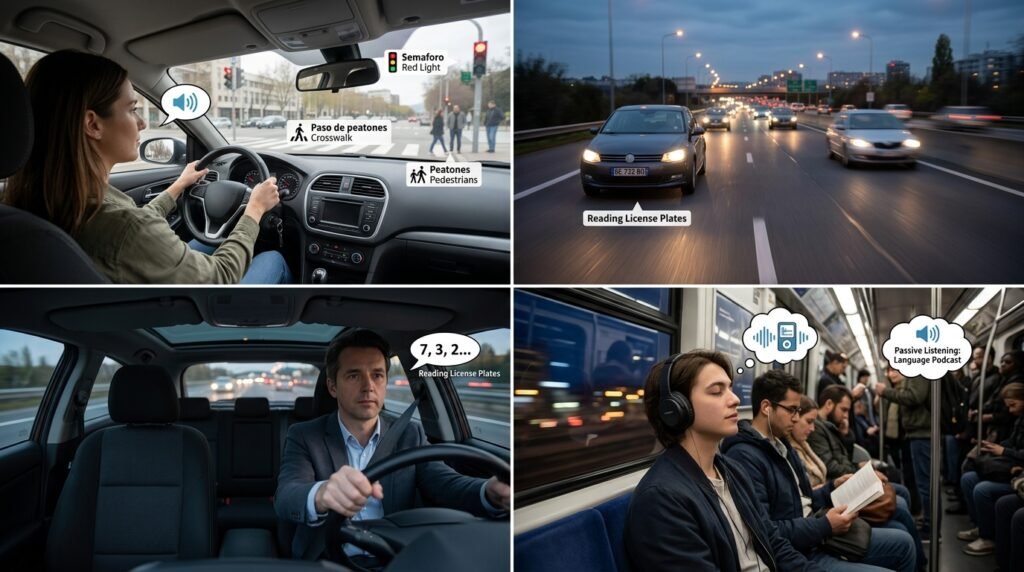
Most people hate their commute. Whether you are driving in heavy traffic or standing on a crowded train, it feels like wasted time. I decided to reclaim that time. I turned my car into a private language booth.
If you are driving alone, you have the ultimate freedom to make mistakes. No one can hear you mispronounce a word. No one can judge your accent.
The Windshield Strategy I started naming everything I saw through the windshield.
-
Traffic elements: Red light, stop sign, intersection, pedestrian, crosswalk.
-
Vehicles: Truck, motorcycle, bus, bicycle.
-
Weather: Cloudy, sunny, raining, windy.
When I run out of nouns, I switch to numbers. I look at the license plates of the cars in front of me and read the numbers out loud in the target language. Numbers are notoriously difficult to master because they require instant recall. Reading license plates at highway speeds forces your brain to process the numbers instantly.
If I am on a train, I switch to passive listening. I put on a podcast designed for native speakers. I do not try to understand every single word. I simply let the rhythm and intonation wash over me. I listen for the natural pauses. I pay attention to the filler words. This trains my ear to handle the actual speed of real human conversation.
The Grocery Store: The Real World Flashcards
The supermarket is a massive, perfectly organized dictionary. Every aisle is categorized by theme. You have the produce section, the dairy aisle, the bakery, and the meat counter.
I completely stopped using digital flashcards for food vocabulary. Instead, I go to the grocery store. I walk down the aisle and try to name every single item I put in my cart.
The Grocery Store Challenge
-
Pick it up: Pick up an apple. Feel the weight of it.
-
Say it out loud: Whisper the word for apple.
-
Describe it: Say the word for red, green, round, or sweet.
-
Read the labels: Look at the packaging. Try to decipher the ingredients or the nutritional information.
If I need to buy garlic and I do not know the word, I look it up on my phone while standing in front of the garlic. I read the word, I pick up the garlic bulb, I smell it, and I put it in my basket. This multi sensory approach is exactly How I Stopped Forgetting Words After Just One Day and built a memory that lasts. The brain simply cannot delete a word that is tied to a strong physical smell and a physical action.
Digital Immersion: Changing the Algorithms
We spend hours every day staring at screens. You check your phone, scroll through social media, and read the news. This is prime real estate for vocabulary practice.
You do not need to download a new language app. You just need to change the environment of the apps you already use.
The Interface Swap I changed the operating system language on my phone and my computer. This is terrifying for the first three days. You will struggle to find your settings. You will accidentally click the wrong buttons.
But within a week, your brain adapts. You learn a massive amount of functional, modern vocabulary. You learn words like download, delete, share, settings, upload, and update. You learn them because you have to use them to survive in your digital world.
Curation of the Feed I changed my social media algorithms. If I like cooking, I follow chefs who speak the target language. If I like fitness, I follow trainers from that country.
When I scroll through my feed, I am no longer wasting time. I am reading captions. I am listening to short video clips. I am looking at the comment sections to see how people actually type and use slang. The comments are the absolute best place to learn how native speakers communicate in the modern world. They use abbreviations, jokes, and casual phrasing that you will never find in a printed textbook.
Exercise and Physical Movement
There is a strong link between physical movement and memory. When your heart rate is elevated, your brain is highly receptive to new information. I combine my physical workouts with my language workouts.
If I am at the gym, I count my repetitions in the target language. I name the body parts I am training. Chest, back, legs, shoulders, arms. I name the movements. Push, pull, lift, run, stretch.
If I am going for a walk, I do a “sensory walk.” I leave my headphones at home. I walk through my neighborhood and describe everything my senses are processing.
-
I hear a dog barking.
-
I see a blue car.
-
I smell cut grass.
-
I feel the cold wind.
This forces me to find the adjectives and verbs that describe the natural world. It pulls the language out of the abstract realm and forces it into the present moment.
The Power of Frustration
During all of these everyday moments, you will get frustrated. You will be standing in the kitchen, holding a spatula, and you will realize you have no idea how to say “spatula.” Your mind will go blank.
Embrace this frustration. This is the exact moment where true learning happens.
When you read a word on a list, your brain does not care. But when you are trying to describe a physical action and you hit a wall, your brain gets annoyed. It recognizes a gap in your ability to communicate.
When you finally pull out your phone, look up the word for “spatula,” and say it out loud, your brain locks onto it. It registers the word as a solution to a problem. It files the word away in a highly accessible folder.
You must welcome these moments of not knowing. Every blank stare is an opportunity to build a permanent mental bridge. Stop hiding from the words you do not know. Expose your ignorance constantly by trying to narrate your life.
The Evening Wind Down
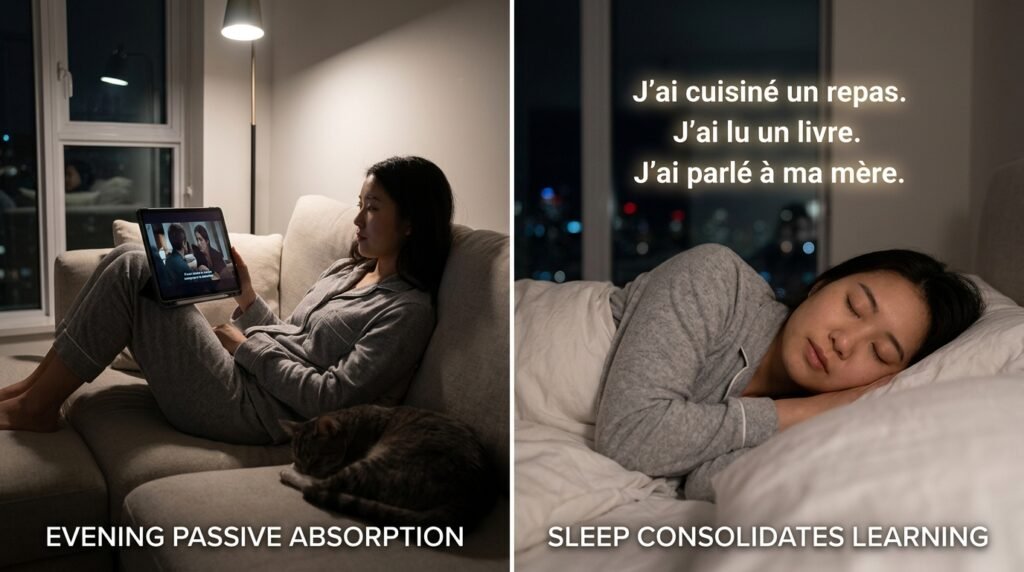
The way you end your day is just as important as how you begin it. When you sleep, your brain consolidates memories. It takes the events of the day and transfers them into long term storage.
I do not do heavy grammar study before bed. I do light, passive absorption. I will watch a television show or a movie in the target language. I keep the subtitles on, but they are in the target language, not my native language.
I am not trying to understand every plot point. I am simply letting my brain relax while the sounds of the language fill the room. It is a low pressure environment.
Before I close my eyes, I do a mental review of the day. I try to recount three things I did, using the target language.
-
I went to the store.
-
I cooked a good meal.
-
I worked on my computer.
This simple three sentence recall exercise signals to my brain that this language is important. It is the final thought before sleep, ensuring that my mind continues to process the vocabulary throughout the night.
Stop Waiting, Start Looking
You have enough time. You have the commute, the chores, the grocery runs, and the waiting rooms. The hours are already there. You simply need to change the lens through which you view them.
Vocabulary practice is not an event that happens at a desk. It is a continuous engagement with your environment. It is the act of looking at a tree and refusing to accept the English word for it. It is the decision to live your life through a new filter.
Stop waiting for the perfect hour. Stand up, walk into your kitchen, touch your refrigerator, and say the word. You have just started practicing. Keep doing that for every object you touch today. Your vocabulary will explode, and you will never need a flashcard again.
Gabriel Henrique is a language enthusiast and productivity writer. After testing countless study methods, he became obsessed with mastering new languages efficiently. He achieves this without burnout, without endless grammar drills, and without losing focus. At Blog The Curious, he shares everything he has learned along the way.