
How I Made Learning a Language Part of My Daily Life
I used to be a weekend warrior. Every Saturday morning, I would clear my desk, brew a large pot of coffee, and tell myself that I was going to study for four straight hours. I had the textbooks, the highlighters, and the best intentions. By Sunday evening, I usually felt like a genius. By Tuesday afternoon, I had forgotten 70% of what I learned. By Thursday, I was so busy with work that I didn’t even open my notebook.
This cycle was exhausting. It turned language learning into an “event”—something I had to prepare for and find a special block of time to execute. It felt like a chore, and eventually, I started dreading my Saturdays. I realized that if I wanted to actually speak this language while managing my career and my life, I had to stop “studying” and start “living” the language.
The shift was mental first. I had to accept that 15 minutes every single day is infinitely better than four hours once a week. I had to find ways to weave the language into the fabric of my existing routine so that it required zero willpower to start. Here is exactly how I transformed my life into a 24/7 immersion environment.
The Morning Anchor: Coffee and Conjugation
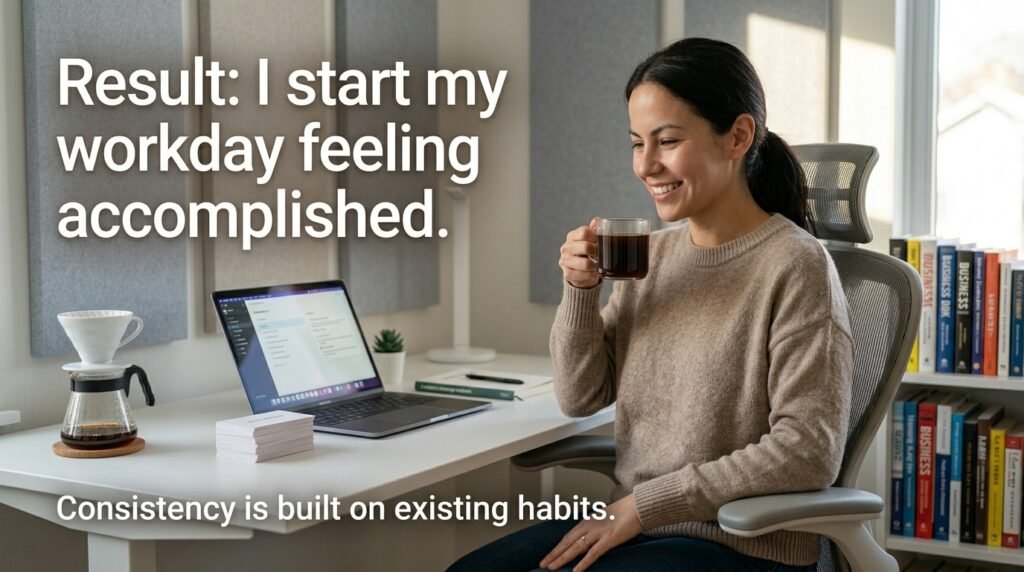
My day always starts with coffee. Specifically, a carefully brewed V60 of Ethiopian Guji beans. I realized that this ritual was the perfect “anchor” for my first language touchpoint of the day. Instead of scrolling through news or social media while the water heated, I made a rule: no coffee until I’ve engaged with the language for five minutes.
Early on, I documented how I Tried Learning a New Language Every Morning — Here’s What Happened and that was the spark that ignited my daily integration strategy. I found that my brain is most receptive when it’s fresh.
-
The Rule: The “No Coffee Without Language” policy.
-
The Action: Reviewing 10 flashcards or reading one short news article in the target language.
-
The Result: I start my workday feeling like I’ve already accomplished a personal goal.
This morning anchor is vital because it ensures that even if the rest of the day falls apart, I’ve already done something. It removes the “all or nothing” pressure. Consistency is built on the back of existing habits.
The “Dead Time” Revolution
We all have “dead time.” These are the minutes spent commuting, standing in line, waiting for the microwave, or walking the dog. I used to fill these gaps with mindless scrolling. Now, I see them as micro-classrooms.
I stopped listening to the radio in my car. Instead, I listen to podcasts specifically designed for intermediate learners. I don’t just listen passively; I practice “shadowing.” This means I repeat what the speaker says, matching their intonation and speed as closely as possible.
Key areas where I reclaimed my time:
-
Commuting: Podcasts and audiobooks are non-negotiable.
-
Cleaning/Cooking: I play YouTube vlogs in the background. I don’t need to understand every word; I just need to hear the music of the language.
-
Waiting Rooms: I keep a digital book on my phone. If I have two minutes, I read two sentences.
Finding the right rhythm took time, but eventually I identified What Actually Helped Me Stay Consistent While Learning a Language and it wasn’t willpower; it was design. I made it easier to practice than to do nothing.
Digital Infiltration: My Phone as a Teacher
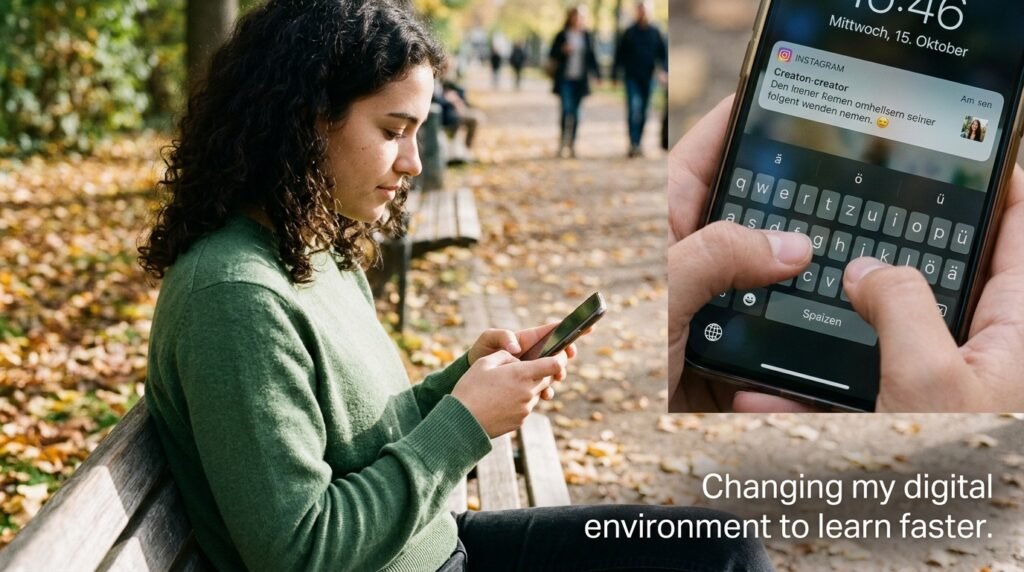
Your phone is either your greatest distraction or your best teacher. I chose to make mine a teacher. I didn’t just download a few apps; I changed my entire digital environment.
First, I changed the language of my phone’s operating system. This is a terrifying move for the first 48 hours. You will get lost in your own settings. You might accidentally set an alarm for 3:00 AM. But after three days, you stop “translating” the word for “Settings” or “Messages” and you just know it.
-
Social Media: I followed twenty creators in my target language. Now, my Instagram and TikTok feeds are half-filled with natural, colloquial speech.
-
Netflix: I created a separate profile specifically for my target language. This keeps the algorithm from suggesting English content and ensures I’m only seeing movies and shows that help me progress.
-
Keyboard: I added the language keyboard to my phone. Autocorrect actually helps me learn the spelling of common words.
If you see the language every time you check the time, your brain starts to treat it as a primary tool rather than a secondary hobby.
The Narrative Technique: Talking to the Walls
One of the weirdest but most effective things I did was start narrating my life out loud. When I’m alone in the kitchen, I talk to myself like I’m a contestant on a cooking show.
“Now, I am cutting the onion. I need a sharper knife. Where is the salt? Ah, here it is.”
It sounds ridiculous, but it forces you to find the gaps in your “utility” vocabulary. You might know the word for “government,” but do you know the word for “spatula” or “cutting board”? Probably not.
This total immersion wouldn’t be possible without the specific structure of How I Built a Routine That Actually Worked for Me which acted as the skeleton for my daily activities. It turned my home into a laboratory where I could fail privately and learn quickly.
Cultural Osmosis through Hobbies
I stopped treating language as a subject and started treating it as a gateway to my hobbies. I’m a fan of Japanese-style tattoos (Irezumi). Instead of reading about them in English, I started searching for Japanese tattoo artists on social media and reading their descriptions.
I did the same with my interest in digital productivity. I searched for “task management” or “SEO tips” in my target language.
-
The Benefit: I’m not bored because I’m learning about things I already love.
-
The Vocabulary: I’m learning “high-value” words that I’m likely to use in my professional or personal life.
-
The Connection: It makes the language feel “real” rather than “academic.”
When you use the language to learn something else, the language itself becomes secondary. That’s exactly when the magic happens. Your brain stops fighting the grammar and starts focusing on the message.
The “Minimum Viable Day” Strategy
Life happens. There are days when I’m traveling, days when I’m sick, and days when my workload is simply too heavy for a 30-minute session. In the past, missing a day would lead to missing a week. I’d feel guilty and give up.
Now, I have a “Minimum Viable Day.” My MVD is one minute.
My MVD Options:
-
Reviewing 5 flashcards on my phone.
-
Listening to one 2-minute news clip.
-
Writing one sentence in my journal.
The goal isn’t progress on these days; the goal is protection. I am protecting the habit. If I do my one minute, I can check the box and maintain my streak. This psychological win is more important than the actual learning that happens in that minute.
Social Integration: Finding My Tribe
Finally, I had to stop being a “closet learner.” I started telling people I was learning. I looked for local meetups, but as an introvert, I preferred one-on-one interactions.
I found a language partner online. We don’t have “lessons.” We have “chats.” We talk about our weeks, our frustrations with work, and our favorite movies. Because we have a real relationship, I am motivated to learn the words I need to tell him my stories.
-
Accountability: Knowing I have a call at 6:00 PM on Thursday makes me more likely to study on Tuesday.
-
Real Feedback: A textbook won’t tell you if you sound like a robot, but a friend will.
-
Cultural Context: You learn the slang and the jokes that you’ll never find in a classroom.
Why “Studying” Is the Enemy of “Learning”
The biggest takeaway from my journey is that the more you try to make it feel like school, the harder it will be to keep going. School is something we finish. A language is something we live.
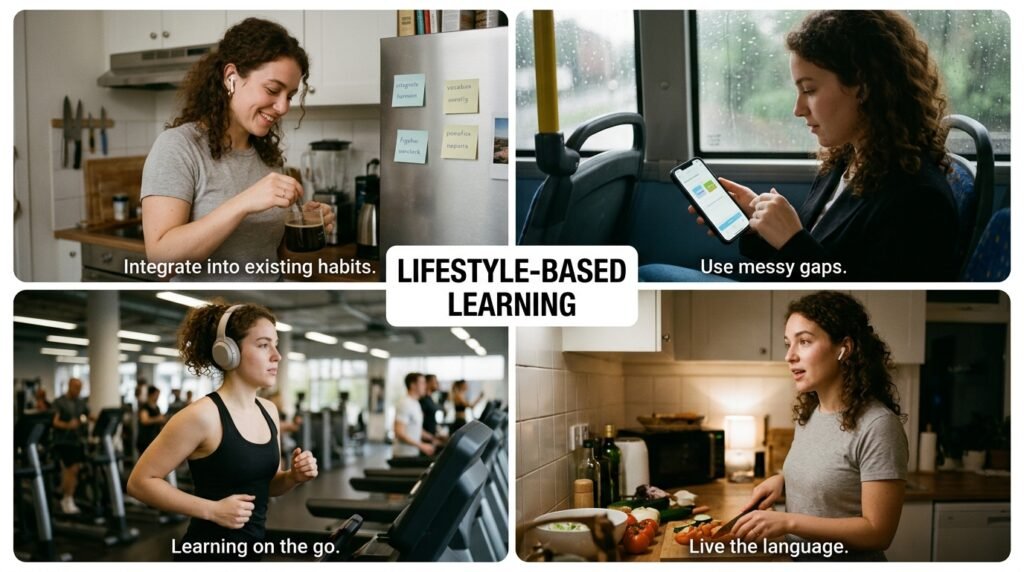
By integrating the language into my coffee routine, my commute, my phone, and my hobbies, I removed the friction. I no longer “find time” to study. The language is just there. It’s in my ears while I’m at the gym. It’s on my screen while I’m waiting for the bus. It’s in my mouth while I’m making dinner.
The shift from “event-based learning” to “lifestyle-based learning” is the only reason I am fluent today.
If you are struggling to stay consistent, stop looking at your schedule. Look at your life. Where are the gaps? Where are the habits you already have? Put your language there. Don’t wait for a “perfect” hour that will never come. Use the messy, imperfect five-minute gaps that are already in front of you.
Practical Steps to Start Today
If you want to make this shift, don’t try to do everything at once. Pick three things and implement them this week:
-
Change your phone’s wallpaper: Put a list of the 10 most common verbs on your lock screen. You’ll see them 50 times a day.
-
The Microwave Rule: Every time you heat something up, do a quick vocabulary review until the timer beeps.
-
Podcast Replacement: Swap your morning music for a 5-minute language podcast.
Language learning is a marathon, not a sprint. But it’s a marathon that you run while doing your grocery shopping, while walking your dog, and while drinking your coffee. Once you realize that, the “hard work” disappears and the progress begins to feel like a natural consequence of your daily life.
I still have days where I struggle. I still forget the word for “fork” sometimes. I still mess up my verb endings. But because the language is a part of my day, these mistakes don’t stop me. They are just small bumps on a very long, very rewarding road.
Stop waiting for the “right time.” Start using the time you have. Your future, bilingual self is waiting for you to make that first small change. Live the language, and the fluency will take care of itself.

Gabriel Henrique is a language enthusiast and productivity writer. After testing countless study methods, he became obsessed with mastering new languages efficiently. He achieves this without burnout, without endless grammar drills, and without losing focus. At Blog The Curious, he shares everything he has learned along the way.