
I remember staring at my notebook, feeling completely defeated. I had spent two hours trying to memorize a list of fifty basic verbs. I covered the English side, guessed the translation, and checked my answers. I got them all right. I closed the book and went to sleep feeling productive. The next morning, I tried to recall the word for “to find” while looking for my keys. My mind was a completely blank slate.
I thought I had a terrible memory. I assumed my brain was simply too stubborn to absorb a new language. I was putting in the hours. I was showing up every day. The effort was there, but the results were entirely missing. I was learning words at a painfully slow pace, and I was forgetting them almost as fast as I learned them.
The problem was not my intelligence. The problem was my approach. I was treating my brain like a digital hard drive. I thought I could just drag and drop a folder of vocabulary into my mind. The human brain does not work that way. It is a biological survival machine. It aggressively deletes any information it considers useless to conserve energy.
I had to stop fighting my own biology. I needed to trick my brain into believing these new words were a matter of life and death. I made a few distinct changes to my methodology. Almost overnight, my learning speed tripled. Here is exactly how I changed my approach to learn words faster than I ever thought possible.
Shift 1: The “Me First” Filter
Traditional language courses start you off with generic categories. You learn colors, zoo animals, and items of clothing. This is a massive waste of time. You do not need to know the word for “giraffe” in your first month of study. You need the words that describe your actual, everyday life.
I stopped using pre-made vocabulary lists. I started filtering my vocabulary ruthlessly. If a word did not apply to my exact daily routine, I refused to learn it. I became incredibly selfish with my study time.
I kept a small notepad in my pocket for three days. Every time I had a thought in my native language that I wanted to express in my target language, I wrote it down. I wrote down everyday thoughts like “I need to charge my phone” or “My back hurts from this chair.”
These highly specific sentences became my new vocabulary lists. I was learning the exact words I needed to narrate my own life. Because these words were immediately relevant, my brain absorbed them instantly. I cared about the meaning, so the memory stuck. This high level of personal relevance is a core part of What Actually Helped Me Stay Consistent While Learning a Language because you never get bored talking about your own reality.

Shift 2: The Physical Anchor
The slowest way to learn a word is to stare at it on a digital screen. Your brain has zero physical context for a pixel. You have to give the word weight, texture, and movement. Your nervous system needs to get involved.
I started using a physical anchoring technique. When I learned a new action verb, I forced myself to perform the action while saying the word out loud.
If I learned the word for “to push,” I walked up to a wall and pushed it. I felt the physical resistance in my shoulders. I said the word loudly. If I learned the word for “cold,” I grabbed an ice cube from the freezer. I held it until my fingers went numb, repeating the target word the entire time.
This method bypasses the logical center of your brain. It hardwires the vocabulary directly into your body. You are no longer memorizing a sound. You are memorizing a physical sensation. When you need the word later, your body remembers the physical feeling, and the word simply appears in your mind.
Shift 3: The 24-Hour Expiration Date
Words die if they are not used. A flashcard review session does not count as usage. You have to pull the word out of your head and release it into the real world to prove its value to your brain.
I created a strict deadline for my study routine. Every time I learned a new word, I had exactly twenty four hours to use it in a real conversation.
It did not matter if the conversation was clunky or awkward. I would force the word into a text message to a language partner. I would awkwardly insert it into a chat with a tutor. If I absolutely could not find a native speaker, I would write a comment on a foreign video using my new word.
This created a massive sense of urgency. I was not learning a word for a test next month. I was learning a tool I had to deploy today. This immediate application is essential for speed. It proves to your brain that the word has real world utility right now.
Shift 4: Embracing the “Ugly” Sentence
Perfectionism is the biggest speed bump in language acquisition. People learn a new word but refuse to use it until they understand all the grammar rules surrounding it. They want to construct a flawless, elegant sentence. This fear of making mistakes slows your progress to a crawl.
I decided to be messy. I embraced the ugly sentence.
If I knew the word for “dog” and the word for “eat,” but I did not know how to conjugate the verb for the past tense, I just threw the words together. I would point at the empty bowl and say “Dog eat.”
It sounded foolish, but it communicated the point. More importantly, it forced the active recall of the vocabulary. The faster you are willing to make mistakes, the faster you will learn the words. Native speakers will usually correct you gently, providing the grammar fix in real time. You learn the word first, and you learn the correct grammar later.
Shift 5: Banning the Native Language Translation
Translation is a highly complex cognitive task. If you see an apple, think the word “apple,” and then translate it to “manzana,” you are wasting valuable mental energy. This three step process slows down your learning speed and guarantees a stutter when you try to speak.
I had to sever the connection to my native tongue. I stopped using bilingual dictionaries entirely.
When I needed to look up a noun, I used an image search engine. If I searched for the foreign word and saw fifty pictures of a bridge, my brain understood the concept without ever seeing the English translation. I linked the foreign sound directly to the architectural structure.
This visual linking is The Trick I Used to Remember Vocabulary Without Effort because it removes all the mental friction. You stop translating and start thinking directly in the new language. Your brain absorbs the concepts much faster when it does not have to juggle two separate languages at once.

Shift 6: The “Echo” Technique for Pronunciation
You cannot learn a word fast if you are afraid to say it out loud. Many language learners mumble. They are unsure of the correct pronunciation, so they say the word quietly to avoid embarrassment. This guarantees you will forget the word by tomorrow.
I adopted the echo technique. I found native audio clips of my target vocabulary words. I listened to the word, and then I echoed it back immediately. I did not just say it quietly. I projected it.
I spoke the word loudly and confidently, even if my accent was terrible. I forced my mouth to adopt the strange new shapes required by the foreign vowels. The physical effort required to speak loudly cements the word in your memory. You are demanding attention from your own brain. A whispered word is easily ignored by your nervous system. A shouted word demands to be remembered.
Shift 7: Contextualizing the Review Process
Reviewing a list of isolated words is incredibly inefficient. You might remember the word on the paper, but you will not recognize it in a spoken sentence. Words change shape and meaning depending on their surroundings.
I stopped reviewing isolated words. I only reviewed complete sentences.
Instead of making a flashcard for the word “key,” I made a flashcard for the sentence “I lost my key again.” This provided grammar, context, and a realistic usage scenario. When I reviewed the sentence, I practiced my intonation. I practiced the rhythm of the entire phrase.
By learning the word inside a context, I was building a mental net. If I forgot the exact spelling of the noun, the surrounding verbs and adjectives would act as triggers to help me catch the meaning. Context provides backup memory pathways.
Shift 8: The Power of Single Tasking
Multitasking destroys memory retention. I used to try to learn vocabulary while listening to music, checking emails, or watching television. My attention was split, and my learning speed crawled to an absolute halt.
I instituted a strict rule of absolute focus. When I sat down to learn new words, I removed every single distraction. I put my phone in another room. I turned off the music. I gave the vocabulary my undivided attention for fifteen solid minutes.
Those fifteen minutes of deep focus were infinitely more productive than two hours of distracted studying. Your brain needs complete concentration to form strong, lasting neural pathways. When you eliminate distractions, you signal to your brain that the task at hand is extremely important.
Shift 9: Gamifying the Daily Routine
Learning words fast requires high frequency exposure. You need to see the words constantly throughout your day. Studying for an hour on Sunday is useless if you ignore the language for the rest of the week. You need to touch the language every single day.
I integrated the words deeply into my physical environment. I placed action prompts around my house. I put a note on my bathroom mirror that said “Look at your reflection” in my target language. Every time I looked in the mirror, I had to read the sentence out loud before I could brush my teeth.
This constant, low level exposure added up to massive repetition without any dedicated study time. Developing this specific system was exactly How I Built a Routine That Actually Worked for Me and it transformed my house into an interactive learning environment. I was accumulating hours of functional practice just by walking around my own home.
Shift 10: Emotional Storytelling
The human brain loves a good story. We remember narratives much better than we remember dry facts. I started wrapping my most difficult vocabulary words in absurd, highly emotional stories.
If I could not remember the word for “library,” I would invent a ridiculous mental image. I would picture a massive, brightly colored monster destroying a library while eating books and crying. I would make the image as vivid, strange, and emotionally charged as possible.
When I needed the word later, I did not try to remember the letters. I simply recalled the image of the crying, book eating monster. The image triggered the emotion, and the emotion triggered the word. This technique feels silly at first, but it is incredibly powerful. The weirder the story, the faster you will learn and retrieve the word.
Shift 11: Teaching to Learn
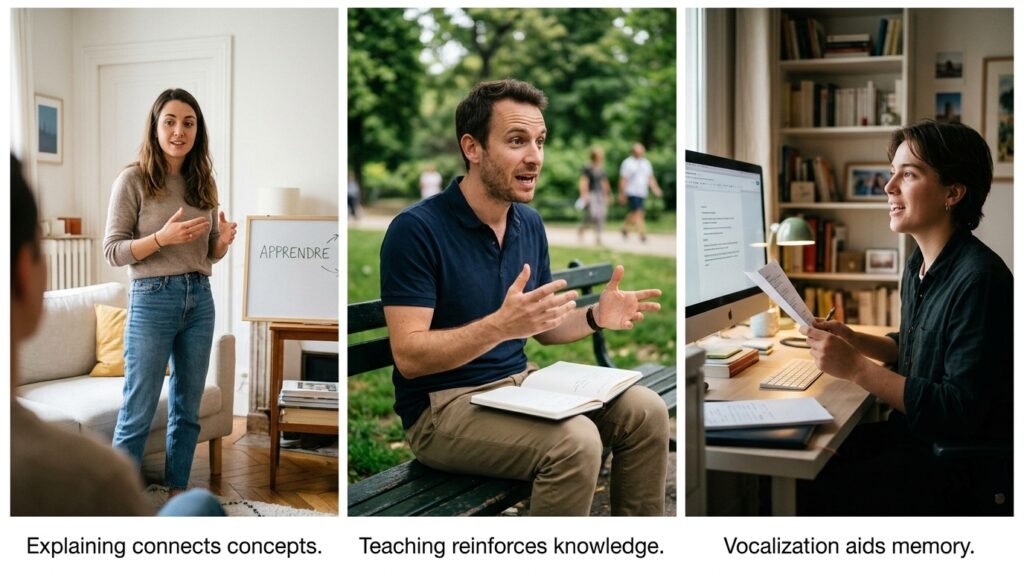
The fastest way to expose the gaps in your knowledge is to try teaching the material to someone else. When you are forced to explain a concept, your brain organizes the information much more efficiently.
I started teaching my target language to an imaginary student. I would stand in my living room and explain the meaning of a new word out loud. I would give my imaginary student three examples of how to use the word in a sentence. I would warn them about common pronunciation mistakes.
This active vocalization forces you to process the word from multiple angles. You are not just consuming information passively. You are manipulating the data, breaking it down, and restructuring it. This deep level of cognitive processing drastically accelerates the speed at which the word enters your long term memory.
The Compound Result
Learning vocabulary does not have to be a slow, agonizing process. You do not have to settle for forgetting fifty percent of what you study every single week.
The speed of your learning is directly tied to the quality of your approach. If you treat words like abstract data on a screen, your brain will reject them. If you treat words like vital tools for physical survival, your brain will lock them away forever.
Stop learning words you do not need. Stop translating everything into your native language. Start tying sounds to physical movements. Start projecting the words out loud with confidence. Start building ugly sentences and demanding real world practice immediately.
When you align your study methods with the way your brain actually wants to learn, the friction disappears completely. You stop fighting your own memory. The words begin to stick naturally and effortlessly. You will find yourself recalling vocabulary with ease, and the frustrating plateau of the beginner phase will finally be behind you. The words are waiting to be used. You just have to change the way you invite them in.

Gabriel Henrique is a language enthusiast and productivity writer. After testing countless study methods, he became obsessed with mastering new languages efficiently. He achieves this without burnout, without endless grammar drills, and without losing focus. At Blog The Curious, he shares everything he has learned along the way.