
I used to buy a new textbook, study for three intense hours on a Sunday afternoon, and completely quit by Wednesday. I repeated this frustrating cycle for years. I assumed I simply lacked discipline. I thought I was not smart enough to learn a second language.
The truth was much simpler. I was relying entirely on motivation.
Motivation is an emotion. Emotions are incredibly unreliable. You feel motivated after watching an inspiring video or buying a fresh notebook. But that excitement disappears the moment you have a terrible day at work, or you get a flat tire, or you sleep poorly.
When your motivation vanishes, your new language habit vanishes with it.
I realized I had to stop relying on how I felt. I needed to build a mechanical system that pushed me forward even when I was completely exhausted. I needed to engineer consistency.
This guide outlines the exact changes I made to stop quitting. I stopped looking for magical shortcuts and started focusing entirely on my daily habits. This is how I built a language routine that finally stuck.
The Problem With Relying on Willpower
Willpower is a finite resource. You wake up with a full battery. Every decision you make drains that battery. You decide what to wear. You navigate traffic. You solve problems at your job. You decide what to cook for dinner.
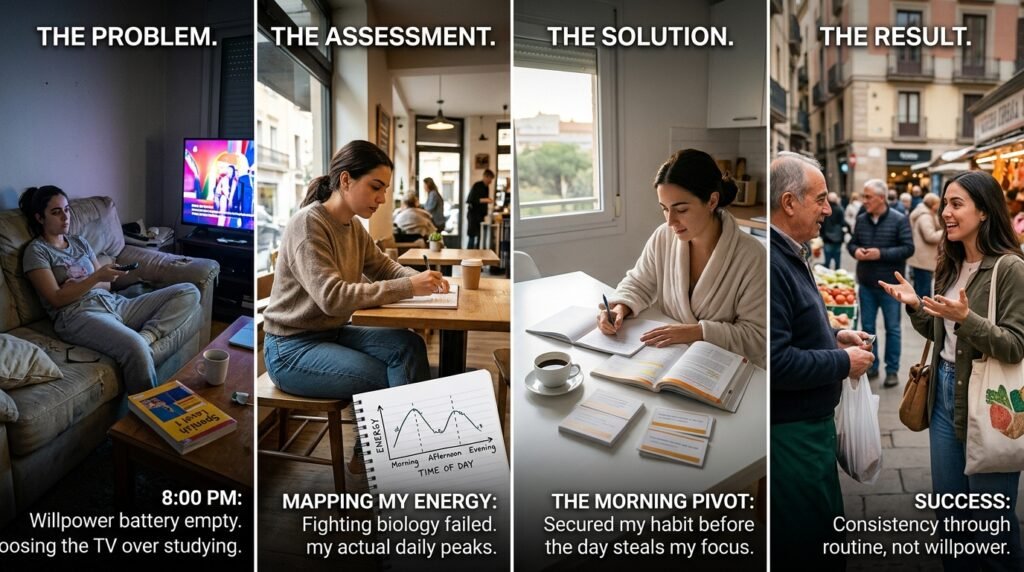
By eight o’clock in the evening, your willpower battery is entirely empty.
If your language study plan requires you to use willpower at the end of the day, you will fail. You will look at your textbook, look at your television, and choose the television every single time. Your brain wants to conserve energy.
I had to stop fighting my own biology. I stopped trying to force myself to study when I was exhausted. I sat down and looked closely at How I Created a Study Plan That Actually Fit My Life by mapping out my actual energy levels, not my ideal energy levels.
I moved my study time to the morning. I secured my habit before the day could steal my energy.
Eliminating Every Ounce of Friction
Friction is the enemy of new habits. Friction is any obstacle standing between you and your study session.
If your textbook is packed away in your backpack, that is friction. If your language application requires you to log in every time, that is friction. If you have to spend ten minutes deciding what chapter to read, that is massive friction.
Your brain will use any excuse to avoid hard work. You must remove the excuses.
I designed my environment to make studying the path of least resistance. I cleared my desk completely. I left my textbook open to the exact page I needed to read next. I left my favorite pen resting on top of the notebook.
When I sat down, I made zero decisions. The work was already waiting for me. I did not have to search for materials. I did not have to plan my session. I simply sat down and started executing.
Make doing the right thing easier than doing the wrong thing. If you want to study consistently, you must prepare your environment the night before.
Setting the Ridiculously Small Minimum
My biggest mistake as a beginner was setting massive daily goals. I told myself I needed to study for an hour every day.
An hour sounds great on paper. But in reality, an hour is a massive commitment. When life gets busy, finding a spare hour feels impossible. If I only had twenty minutes available, I would skip the session entirely. I had an all-or-nothing mindset.
I changed my strategy entirely. I lowered the bar to the floor.
I set a minimum daily requirement of exactly five minutes.
Everyone has five minutes. You have five minutes while you wait for your coffee to brew. You have five minutes while sitting on a train. You cannot make an excuse to avoid a five-minute task.
On my absolute worst days, I opened my book, reviewed vocabulary for five minutes, and closed the book. I checked the box. I kept the habit alive.
Most days, something incredible happened. Once I started the five-minute session, the friction was gone. I usually ended up studying for thirty minutes. Starting is always the hardest part. By lowering the entry requirement, I tricked my brain into starting. I realized exactly How I Turned Small Daily Practice Into Real Progress simply by refusing to score a zero on any given day.
The Power of Habit Stacking
You already have dozens of unbreakable habits. You brush your teeth. You lock your front door. You make your morning coffee. You do these things automatically, without any mental effort.
The easiest way to build a new habit is to attach it to an existing habit. This concept is called habit stacking.
I am a fanatic about specialty coffee. Every morning, I go to my kitchen and prepare a V60 pour over. It takes exactly four minutes for the water to boil and the coffee to bloom. I used to spend those four minutes staring blankly at the wall or scrolling on my phone.
I stacked my language learning onto my coffee routine.
I placed a stack of physical vocabulary flashcards directly next to my coffee grinder. While the water heated, I reviewed the cards. The coffee routine became the trigger for the study routine. I never had to remind myself to study. The smell of the coffee beans naturally prompted my brain to look at the flashcards.
Look at your daily schedule. Find a habit you already perform daily. Attach a five-minute language task directly to it.
Building Visual Proof of Your Streak
Consistency requires momentum. You need to see that your effort is accumulating.
When you learn a language, the daily progress is completely invisible. You do not feel smarter on Tuesday than you did on Monday. This lack of visual feedback kills your motivation. You feel like you are walking on a treadmill.
I needed a way to visualize my momentum.
I bought a massive paper wall calendar. I hung it directly above my desk. Every day that I completed my minimum five-minute study session, I drew a large red cross on that day.
After two weeks, I had a continuous red chain.
This simple visual trick is incredibly powerful. When you look at a two-week streak, you build a psychological desire to protect it. You do not want to be the person who breaks the chain. There were nights when I was exhausted and ready to sleep, but I saw the calendar. I spent five minutes reviewing a single grammar rule just so I could draw the red cross.
I documented The Exact Process I Used to Stay Motivated Every Week by relying on simple visual feedback instead of internal willpower. The calendar does not lie. It holds you accountable.
Embracing the Two-Day Forgiveness Rule
Perfectionism is toxic to consistency.
If your goal is to study perfectly for 365 days straight, you are setting yourself up for a massive mental crash. Life happens. You will get sick. You will have an emergency at work. You will miss a day.
When perfectionists miss one day, they feel like they ruined the entire system. They feel guilty. They abandon the goal entirely because the streak is broken.
I adopted a mandatory rule. I am allowed to miss one day, but I am never allowed to miss two days in a row.
Missing one day is a scheduling conflict. Missing two days is the beginning of a new, bad habit.
This rule completely removed the guilt from my process. If I had a terrible Tuesday and skipped my session, I did not beat myself up. I just knew that Wednesday was non-negotiable. I gave myself grace, but I maintained strict boundaries. Resilience is much more important than perfection.

Curating a Language Bubble
Consistency is much easier when the language surrounds you naturally. You should not have to force yourself to interact with the target language. It should just be there.
I built a passive immersion environment inside my own home. I changed the default language on my smartphone. Every time I unlocked my screen, I was forced to interact with the target language just to check my messages or set an alarm.
I replaced my regular morning news podcasts with a podcast in my target language. I did not sit at my desk to listen to it. I listened while driving to work or folding laundry.
I filled my dead time with passive input.
You do not need to sit at a desk with a textbook to be consistent. Passive listening counts as consistency. Engaging with a foreign interface on your phone counts as consistency. By building a language bubble, I ensured that I made contact with the language every single day, even when I did not formally study.
Tracking Input Instead of Fluency
Another consistency killer is measuring the wrong metric.
Beginners often measure their success by how fluent they feel. They try to have a conversation, they stumble over their words, and they feel like a failure. They assume their daily study sessions are useless.
You cannot control fluency. Fluency is a delayed result. It happens slowly over hundreds of hours.
You can only control your input.
I stopped tracking my ability to speak perfectly. I started tracking my raw hours. I used a simple spreadsheet to log how many minutes I spent reading, listening, or reviewing flashcards.
My only goal was to make the number go up. If I put in the hours, I knew the fluency would eventually follow. By focusing purely on the input, I removed the anxiety of performance. I just focused on doing the daily work.
Connecting the Language to Real Passions
It is incredibly difficult to stay consistent when you are bored.
Most beginner textbooks are incredibly boring. They force you to read dialogues about going to the bank, booking a hotel, or describing the color of a cat. I do not care about these topics in my native language. I definitely do not care about them in a foreign language.
I realized I needed to link the language to my actual hobbies.
I am highly interested in traditional Japanese tattoo art, specifically Irezumi folklore. I stopped reading generic beginner stories. I started looking up the vocabulary for mythological creatures, serpent motifs, and specific historical periods.
I spent hours translating short articles about these designs. It did not feel like studying. It felt like researching a topic I genuinely loved.
Find the intersection between your current passions and your target language. If you love cooking, read recipes in the target language. If you love fitness, watch workout videos from foreign trainers. When the content is inherently interesting to you, consistency happens automatically.
Upgrading Your Information Diet
Your brain absorbs what you feed it. If you spend your evenings scrolling through negative news or mindless social media, you drain your cognitive energy. You leave nothing in the tank for complex tasks like language acquisition.
I had to audit my information diet.
I realized I was spending two hours a night consuming absolute garbage online. I was not relaxing. I was just numbing my brain.
I aggressively unfollowed useless accounts. I deleted applications that offered endless scrolling feeds. I replaced that digital junk food with high quality language content.
I subscribed to YouTube channels hosted by native speakers talking about topics I cared about. I bought a physical magazine in my target language and kept it on my coffee table. I replaced low quality consumption with high quality consumption.
Creating Manufactured Accountability
When you study alone in your bedroom, nobody knows if you quit. There are zero consequences for giving up.
I needed stakes. I needed to manufacture accountability.
I started booking a thirty-minute online session with a native tutor every single Friday. I paid for these sessions in advance.
This completely changed my week. I knew that on Friday afternoon, a real human being was going to look at me through a screen and expect me to speak. I did not want to look foolish. I did not want to waste my money.
This manufactured pressure forced me to stay consistent Monday through Thursday. I knew I had a deadline.
You do not need to hire a tutor to create accountability. You can join a language challenge online. You can find a dedicated study partner and promise to text them a voice note every morning. You just need to create a scenario where someone else expects you to show up.
The Identity Shift
The final piece of the consistency puzzle is psychological.
As long as you tell yourself, “I am trying to learn a language,” you are giving yourself an out. Trying implies a high probability of failure. It sounds temporary.
I had to change my internal narrative. I stopped saying I was trying. I started telling myself, “I am a language learner.”
It became part of my identity. A runner does not ask themselves if they should run today. They just put on their shoes and run, because that is who they are. A language learner does not debate whether to study. They just open the book.
This identity shift removes the daily negotiation. You stop deciding whether or not to study. You just execute the behavior that matches your identity.

The Final Reality Check
Staying consistent with a language is not glamorous. It does not look like a montage in a movie.
It looks like sitting at a desk on a Tuesday morning, drinking coffee, and repeating a strange word out loud five times. It looks like crossing off a day on a wall calendar. It looks like choosing to read one paragraph instead of opening a social media app.
Consistency is quiet. It is repetitive. It is often boring.
But it is the only true path to fluency. Motivation will start the engine, but systems will drive the car.
Take a hard look at your current routine. Find the friction. Set a five-minute minimum. Buy a wall calendar. Tie your practice to your morning coffee. Build the system today, and let the habit do the heavy lifting for you.

Gabriel Henrique is a language enthusiast and productivity writer. After testing countless study methods, he became obsessed with mastering new languages efficiently. He achieves this without burnout, without endless grammar drills, and without losing focus. At Blog The Curious, he shares everything he has learned along the way.