
For the longest time, I felt like my brain was a leaky bucket. I would sit down with a fresh cup of coffee, open my language app, and spend thirty minutes diligently swiping through digital flashcards. I’d see a word, recognize it, and feel a surge of pride. “I’m learning,” I’d tell myself. But then, the next morning would arrive. I’d try to recall that same word to describe my breakfast or a task at work, and it was simply gone. It hadn’t just faded; it had vanished into a mental void.
I was working hard, but I wasn’t getting results. As a digital publisher who manages multiple niche blogs, I’m used to processing massive amounts of data. I can track SEO trends and manage content calendars across several domains without breaking a sweat. So, why was a handful of foreign words defeating me? I realized that I was treating language learning like a data entry job, and my brain—rightfully so—was rejecting the input. It didn’t care about abstract data; it cared about meaning, emotion, and survival.
I had to overhaul my entire approach. I stopped focusing on “studying” and started focusing on “anchoring.” Here are the specific shifts I made that finally allowed me to build a vocabulary that sticks.
Moving Away from the “List Mentality”
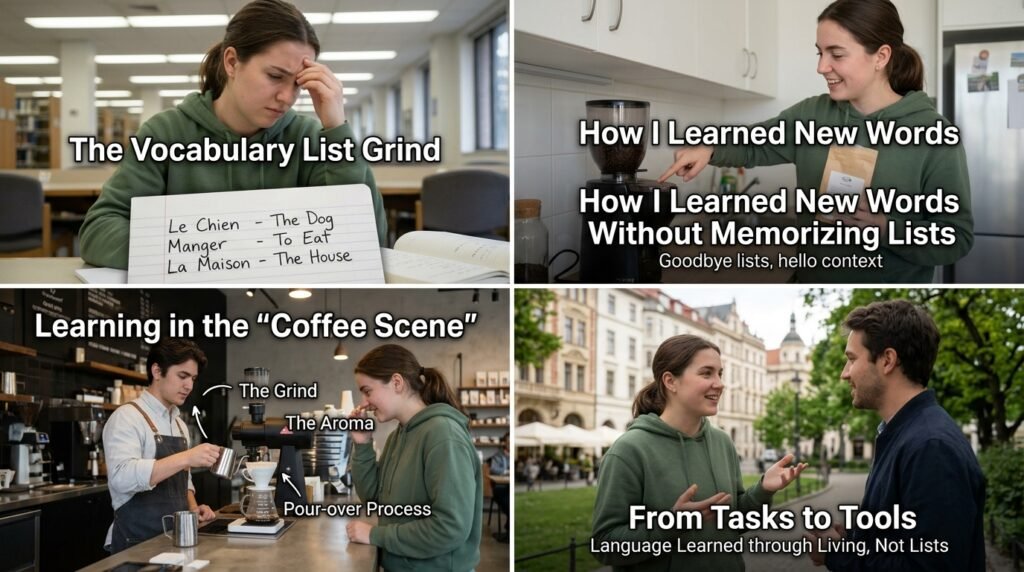
The biggest change I made was a total rejection of the traditional vocabulary list. I used to keep long columns of words in a notebook: the foreign word on the left and the English translation on the right. I would cover one side and try to guess the other. It felt like school, and it was just as boring. My brain saw these lists as a chore, and it has a very efficient way of deleting chores to save energy.
I realized that words don’t live in lists; they live in environments. When you learn a word in a list, it has no “home.” It’s an orphan in your mind. I decided that I would never again learn a word without a surrounding sentence or a physical trigger. I completely changed my trajectory when I committed to How I Learned New Words Without Memorizing Lists and suddenly, the words started to feel like tools rather than tasks.
I began grouping words by “scenes.” Instead of a list of random nouns, I would focus on the “Coffee Scene.” I’d learn the words for the grind, the aroma, the acidity, and the pour-over process. Because these words all shared the same mental “room,” they supported each other. If I forgot one, the others would often act as a bridge to help me find it.
The Sensory Connection: Tying Sounds to Reality
As a massive specialty coffee enthusiast, my morning ritual is sacred. I usually start with an Ethiopian Guji or Yirgacheffe bean, looking for those specific floral and tea-like notes. I realized that this ritual was the perfect laboratory for memory.
In the past, I would learn the word for “hot” or “bitter” by looking at a screen. Now, I do it through my senses. When I feel the steam from the kettle hitting my face, I say the word for “hot” out loud. When I take that first sip of a slightly over-extracted brew, I focus on the “bitterness” and name it.
Why this works:
-
Physical Memory: Your brain remembers physical sensations (heat, taste, smell) much more vividly than digital pixels.
-
Multi-Channel Encoding: You aren’t just hearing a sound; you are feeling a temperature and tasting a chemical reaction.
-
Contextual Triggers: Every time I make coffee now, my brain automatically “presents” me with the correct vocabulary.
I started applying this to everything in my office. I don’t just learn the word for “laptop”; I feel the texture of the keys while I say it. I don’t just learn the word for “light”; I look directly at the window while I speak. By anchoring the sounds to physical reality, I stopped being a student and started being a resident of the language.
High Stakes and Emotional Anchors
We never forget the words that make us feel something. You probably remember exactly what was said to you during a major life event, even if it happened years ago. Emotion is the “save button” for the human brain. I decided to harness this by bringing my actual passions into my study.
I’m deep into NBA performance statistics. I don’t just watch the games; I analyze the probability of first-quarter milestones like rebounds and assists for betting analysis. When I started reading injury reports and player stats in my target language, my retention skyrocketed.
If I missed a detail about a player’s “hamstring” or “recovery timeline” and it affected my analysis, I never forgot those words again. The “pain” of a missed opportunity or the “excitement” of a correct prediction acted as a powerful glue. I found that How I Turned Everyday Moments Into Vocabulary Practice became much more effective when those moments had real-world stakes attached to them.
I did the same with soccer. I follow the rivalry between Flamengo and Vasco in Brazil. The passion on the fan forums is incredible. When I read a heated argument about a controversial referee decision, I learn words for “unfair,” “mistake,” and “glory” that have genuine emotional weight. My brain doesn’t see them as “vocabulary”; it sees them as the language of my tribe.
The “Internal Narrator” Habit
One of the most transformative changes was becoming my own commentator. As a digital content manager, I spend a lot of time alone in my office. I used to work in silence. Now, I provide a play-by-play of my day.
I narrate my work tasks as I do them:
-
“I am opening the browser.”
-
“I am checking the SEO for the new blog post.”
-
“I am adjusting the internal link structure.”
It feels a bit ridiculous at first to talk to an empty room, but it bridges the gap between “knowing” a word and “using” a word. When you are alone, the stakes are low. You can stumble, you can mispronounce, and you can take thirty seconds to find the right verb without any social anxiety.
This habit forced me to realize exactly where my gaps were. If I didn’t know the word for “attachment” or “refresh,” I’d look it up, use it in my narration, and because it was tied to a physical action I was performing, it stuck. This is essentially What Helped Me Actually Use the Words I Learned because it turned my passive knowledge into an active skill through sheer repetition of life.

Designing a “Language First” Digital Environment
Since my life revolves around digital publishing and mobile productivity, I realized that my smartphone was my biggest missed opportunity. I was checking it a hundred times a day in English. I decided to stop fighting my screen addiction and start using it.
I made three key changes to my digital environment:
1. The Interface Swap
I changed the language of my smartphone and my content management systems. This was frustrating for the first 48 hours. I had to guess where the “Settings” and “Update” buttons were. But within a week, I didn’t need to guess anymore. I had learned a whole set of functional, professional vocabulary without ever “studying” it. It became part of my muscle memory.
2. Social Media Curation
I stopped following English-speaking accounts on one of my social media profiles and replaced them with creators who talk about the things I love: coffee, AI-assisted image generation, and sports analytics. Now, when I’m mindlessly scrolling to take a break, my brain is still “soaking” in the language. I’m learning the slang, the abbreviations, and the way people actually talk in 2026.
3. The Visual Dictionary
I stopped using bilingual dictionaries. When I see a new word, I use Google Images instead. If I see a hundred different pictures of a “bridge,” my brain builds a concept of what a bridge is in the new language, rather than just linking it to the English word “bridge.” This removes the “translation layer” in my head and helps me think directly in the language.
Quality Over Quantity: The Power of “Depth”
In the beginning, I was obsessed with the number of words I “knew.” I wanted to hit 2,000 words as fast as possible. Now, I’d rather know 500 words deeply than 5,000 words superficially.
Knowing a word “deeply” means knowing more than just the definition. It means knowing:
-
Which prepositions usually follow it?
-
Is it formal or casual?
-
Does it have a secondary meaning in a different context?
-
How do native speakers actually use it in a sentence?
I started spending more time with fewer words. I would take one “power verb” (like “to get” or “to make”) and learn twenty different ways it can be used. This made me feel much more fluent than having a huge list of obscure nouns. I focused on the “connectors”—words like “however,” “actually,” and “besides.” These are the glue that holds a language together. Once I mastered the glue, the rest of the vocabulary started to fall into place.
Forgiveness and the Forgetting Curve
I had to change my attitude toward forgetting. I used to see a forgotten word as a failure. I’d get frustrated and tell myself I was losing ground. Now, I understand that forgetting is a vital part of the learning process.
The “Forgetting Curve” is a real thing. Every time you forget a word and then “re-discover” it, the neural pathway to that word gets stronger. It’s like a muscle. You have to “tear” it through forgetting so it can grow back stronger through recall.
I stopped aiming for 100% retention. I started aiming for “persistence.” If I forget a word today, I’ll find it again tomorrow. I stay curious. I don’t let the frustration stop the momentum. By removing the stress of “perfect memory,” I actually ended up remembering more because my brain was in a relaxed, receptive state.
The Identity Shift
The biggest change wasn’t a technique; it was a shift in identity. I stopped saying, “I am studying a language,” and started saying, “I am a speaker of this language.”
I started looking for ways to express my personality. I looked for the specific slang that fits my sense of humor. I looked for the idioms that match how I talk about soccer or my work. When the words felt like “me,” I didn’t forget them. They weren’t foreign sounds anymore; they were a part of my voice.
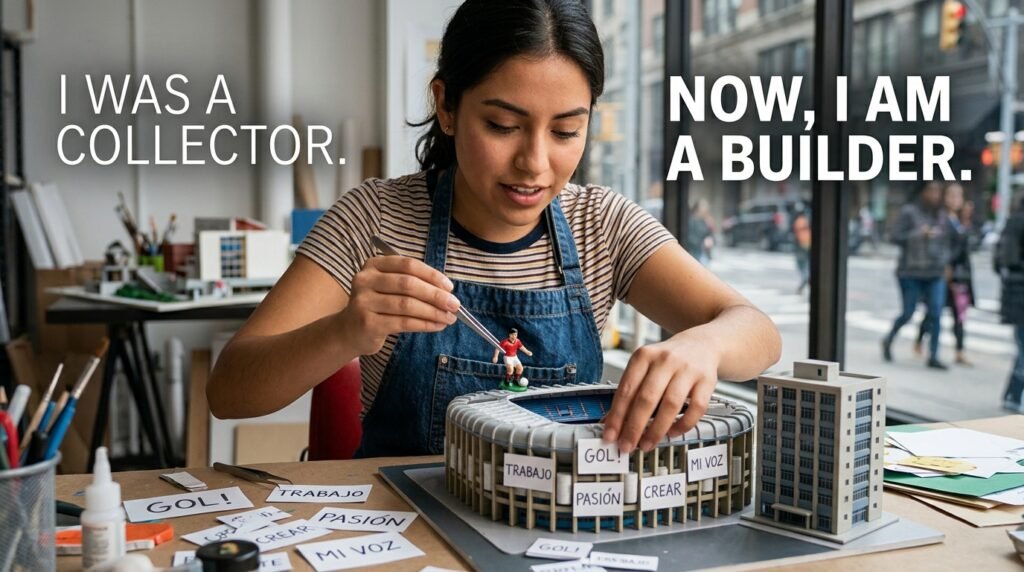
I used to be a word collector. I was like a person who buys a lot of tools but never builds anything. Now, I am a builder. I use every word I have to describe my world, my passions, and my work. I might only have a few tools right now, but I know how to use them to create something meaningful.
How to Apply These Changes Today
If you feel like your vocabulary isn’t sticking, don’t buy a new textbook. Instead, look at your daily routine. Where can you anchor the words?
-
Identify your “Anchor Zones”: Pick one place (like the kitchen) where you will only name things in your target language.
-
Narrate the Mundane: Spend five minutes a day talking to yourself about what you are doing.
-
Follow Your Passions: Stop reading generic news. Read about your hobbies. Whether it’s specialty coffee, tattoo art, or NBA stats—make the content matter.
-
Use Images: Stop translating. Start visualizing.
Language is not a collection of definitions. It is a way of experiencing the world. When you stop treating words like data and start treating them like experiences, they stop disappearing. Grab your coffee, find a topic that excites you, and start naming your world. The words will stay because they finally have a reason to be there.

Gabriel Henrique is a language enthusiast and productivity writer. After testing countless study methods, he became obsessed with mastering new languages efficiently. He achieves this without burnout, without endless grammar drills, and without losing focus. At Blog The Curious, he shares everything he has learned along the way.