
I stared at the page of my textbook and sighed. The characters in the dialogue were named John and Mary. John was going to the bank. Mary was asking him to buy an apple. The sentences were perfectly structured. They were grammatically flawless. They were also incredibly boring. I read the dialogue out loud ten times. Ten minutes later, I could not remember a single phrase.
I walked out of my apartment later that afternoon and went to a local coffee shop. I listened to the native speakers ordering their drinks. Nobody sounded like John or Mary. Nobody used the rigid, sterile sentence structures from my textbook. People spoke quickly. They dropped words. They used slang. They mashed verbs and prepositions together in ways my workbook never mentioned.
The gap between the textbook and reality was massive. I realized right then that memorizing artificial dialogues was a complete waste of my time. The textbook examples lacked context. They lacked emotion. Most importantly, they lacked reality.
I decided to throw away the artificial dialogues. I completely changed my strategy. I decided to learn the rules exclusively through real, messy, authentic examples. This shift completely transformed my ability to speak and understand the language. Here is exactly how I learned grammar through real examples.
The Problem With Artificial Sentences
Textbook sentences are created in a laboratory. Linguists write them specifically to highlight a single grammar rule. They strip away all the natural chaos of human communication. They give you a perfect, clean sentence in a vacuum.
This sounds helpful in theory. In practice, it is terrible for your memory.
The human brain does not remember clean, sterile information. Your brain deletes information it deems unimportant. A sentence about John buying an apple carries absolutely no weight. It does not trigger any emotional response. Your brain looks at it, processes the vocabulary, and immediately throws it in the trash.
Furthermore, artificial sentences teach you to expect perfection. When you study clean dialogues, you train your ear to listen for perfect syntax. But native speakers are not perfect. They hesitate. They change their minds mid sentence. If you only train with laboratory examples, you will completely freeze when you hear a real person speak.
I needed examples that had actual dirt on them. I needed sentences spoken by real people living real lives. I remember exactly when my mindset shifted on this topic. I wrote about that breakthrough in The Moment Grammar Finally Clicked for because it changed my entire trajectory.

Hunting for Authenticity
Once I abandoned the textbook, I had to find a new source of examples. I turned entirely to native media. I wanted media created by native speakers, for native speakers.
I stopped watching language learning channels on YouTube. I started watching native vloggers. I watched cooking tutorials, travel guides, and technology reviews. I watched people talk naturally to a camera about things they actually cared about.
I turned on the native subtitles. This was crucial. I needed to see the words written down as they were being spoken.
My goal was not to understand every single word. My goal was to hunt for specific grammar structures in the wild. If I was struggling to understand how a certain past tense worked, I would simply listen for it in the videos.
When I heard a native speaker use that specific tense, I paused the video. I wrote their exact sentence down in a notebook. I did not write down the translation. I just wrote the authentic sentence exactly as it was spoken.
Reverse Engineering the Rules
Traditional study asks you to look at a rule and then build a sentence. I completely reversed this process. I took a completed, perfect native sentence and worked backwards to understand the rule.
Let us say I found a complex sentence in a documentary. The speaker was talking about something they wished they had done differently in their past. They used a combination of verbs that looked incredibly confusing at first glance.
Instead of opening a grammar manual, I just looked closely at the sentence. I identified the main subject. I identified the action. I noticed the specific small words that connected the ideas.
I accepted the sentence as an absolute truth. I did not ask why the speaker chose that structure. I just observed that this was how a native speaker expressed regret. The sentence itself became the rule.
This is a much more natural way to learn. You are acting like a detective instead of a student. You are finding clues in the wild and piecing them together. You are observing the language as it actually exists, not as a professor wishes it existed.
The Power of Emotional Context
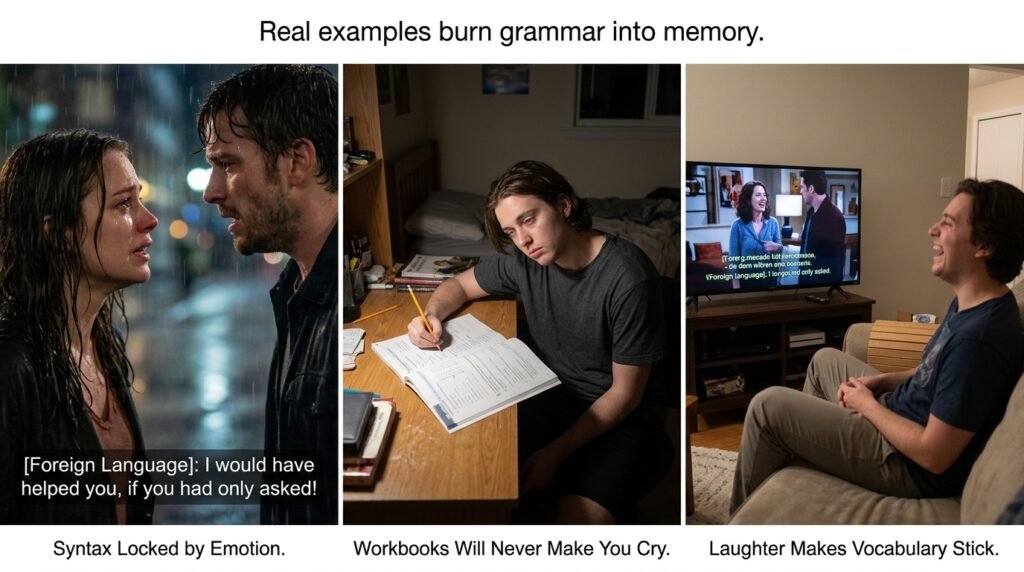
Real examples stick in your memory because they carry emotional weight.
I once watched a highly dramatic movie in my target language. Two characters were having a massive argument in the rain. One character screamed a sentence using a very specific conditional grammar structure. The actor was crying. The music was intense.
I wrote that sentence down immediately. I never forgot it. I did not have to study it with flashcards. The raw emotion of that scene burned the grammar structure directly into my brain.
Whenever I needed to use that specific conditional tense in my own life, I instantly remembered the angry actor in the rain. The grammar rule was permanently attached to that feeling of intense anger and betrayal.
You cannot get that from a workbook. A fill in the blank exercise will never make you cry. It will never make you laugh out loud. You must find real examples that make you feel something. The emotion acts as a powerful glue that locks the syntax into your long term memory.
Moving Beyond Single Words
You cannot learn grammar if you only focus on single words. Words change meaning depending on their neighbors.
I used to learn a list of verbs and a list of nouns. Then I would try to smash them together using a grammar formula. The results were always terrible. Native speakers would look at me with complete confusion. My sentences were technically correct according to the book, but they were completely unnatural.
I stopped learning isolated words entirely. I started learning full phrases. You have to look at the whole picture. I explain this process heavily in How I Learned Phrases Instead of Isolated Words to show why context matters more than vocabulary lists.
When you learn a real phrase from a native speaker, the grammar is already built in. You do not have to assemble the pieces. You just take the whole block of sound and use it.
If I needed to know how to ask for directions, I did not learn the words for “where,” “is,” and “the.” I went to a travel vlog and found exactly how a native speaker asked the question on the street. I copied their entire phrase. I inherited their perfect grammar for free.
Building a Personal Database
I started collecting these real examples aggressively. I bought a fresh notebook. I called it my sentence database.
Every time I watched a video, read an article, or listened to a podcast, I kept my ears open. When I heard a sentence that expressed an idea I knew I would need, I wrote it down.
I looked for sentences about daily life. I looked for sentences expressing opinions. I looked for sentences describing past events or future plans. I completely ignored sentences about highly specific, useless topics.
My notebook quickly filled up with hundreds of high quality, authentic examples. This notebook became my personal grammar textbook. It was vastly superior to any book I could buy in a store because it was tailored exactly to my interests and needs.
If I was confused about how a preposition worked, I did not look up the definition. I flipped through my notebook and found five real examples of that preposition being used in real life. I read the examples out loud until the pattern clicked in my head.
The Daily Habit of Immersion
Collecting examples requires massive daily exposure to the language. You cannot hunt for real sentences if you only engage with the language once a week.
I had to build a system of daily immersion. I changed the language on my phone. I listened to podcasts while cooking dinner. I watched the news in my target language every morning. Consistency is the absolute secret to pattern recognition. I detail my exact schedule in How I Made Learning a Language Part of My Daily Life so you can see how to fit this into a busy week.
Your brain needs constant, relentless data to find the patterns. If you feed it enough real examples, the grammar rules will eventually become obvious. You will start to anticipate how sentences will end before the speaker even finishes talking.
This intuition only develops through heavy repetition. You have to surround yourself with the authentic language until it starts to feel completely normal.
Using Real Sentences as Templates
Once I had my database of real examples, I started using them as templates. This is where the real magic happens.
Let us say I copied down a native sentence that translates to: “I have never seen such a beautiful house in my entire life.”
This is a fantastic template. It contains a complex verb tense. It contains an emotional intensifier. It flows perfectly.
I would take this exact template and make one small surgical change. I would swap out the noun. Instead of a house, I would use the word for a car. “I have never seen such a beautiful car in my entire life.”
Then I would swap the adjective. “I have never seen such a terrible car in my entire life.”
I practiced replacing the vocabulary while keeping the grammatical structure completely untouched. This allowed me to create dozens of my own highly accurate sentences without ever thinking about conjugation rules. I was simply recycling perfect native grammar to fit my own personal needs.
This template method completely bypasses the internal filter that causes stuttering. You know the structure is correct because a native speaker built it. You just have to drop your own vocabulary into the empty slot.
Embracing the Chaos of Spoken Language
One of the biggest shocks of using real examples is discovering how native speakers actually treat their own grammar.
Textbooks teach you the formal, strict rules. They tell you exactly where the commas go. They tell you which pronoun is technically correct.
Native speakers break these rules constantly. They use double negatives. They end sentences with prepositions. They invent completely new ways to conjugate verbs just for fun.
If you only study formal grammar, this chaos will terrify you. But if you learn through real examples, you embrace the chaos immediately. You learn the difference between academic accuracy and practical fluency.
I realized I did not want to sound like a printed legal document. I wanted to sound like a normal person sitting at a bar. Real examples taught me the casual filler words. They taught me the informal slang that glues sentences together. They taught me how the language actually breathes.
The Shift in Confidence
When you rely on textbook rules, you are always guessing. You build a sentence in your head and hope it is right. You wait for the other person to correct you.
When you rely on real examples, that hesitation vanishes. You are no longer guessing. You are simply repeating a structure you already know is correct because you heard a native speaker use it yesterday.
This gives you a massive surge in speaking confidence. You stop asking for permission to speak. You stop constantly apologizing for your mistakes. You start delivering your sentences with authority.
Even if you make a mistake with a vocabulary word, your underlying structure is solid. The listener will easily understand your intention. Confidence makes you speak faster. Speaking faster prevents your conscious brain from interfering with the grammar. It becomes a beautiful, positive cycle.

Stop Analyzing and Start Observing
Grammar is not a math test. It is not a puzzle you have to solve with formulas and charts. Grammar is simply a collection of habits. It is a record of how a group of people have agreed to share their thoughts with each other.
You cannot learn these habits by isolating them in a laboratory. You have to go out into the real world and observe them in action.
Put down your heavy workbooks today. Stop filling out blank spaces with a pencil. Stop trying to memorize the names of sixteen different verb tenses.
Open up a video made by a native speaker. Find a sentence that sounds interesting. Write it down on a piece of paper. Look at how the words fit together. Repeat the sentence out loud until it feels comfortable in your mouth. Then change one word and make the sentence your own.
This simple process of observing, copying, and modifying real examples will teach you more grammar in one month than a textbook will teach you in a year. Trust the native speakers. They already did the hard work of building the sentences. All you have to do is borrow them.

Gabriel Henrique is a language enthusiast and productivity writer. After testing countless study methods, he became obsessed with mastering new languages efficiently. He achieves this without burnout, without endless grammar drills, and without losing focus. At Blog The Curious, he shares everything he has learned along the way.