
I sat on a hard wooden bench at a busy train station. I held a thick language workbook in my lap. I was intensely focused on a chapter about the past perfect tense. I read the rules over and over. I memorized the exact formula. You take the auxiliary verb. You conjugate it. You attach the past participle. You check for irregular exceptions. I felt highly confident. I closed the book and walked up to the ticket window. I wanted to tell the agent that I had already purchased a ticket online but my phone battery died.
I opened my mouth to speak. My mind went completely blank. I stood there in complete silence. The agent stared at me impatiently. A long line of angry commuters formed behind me. I desperately tried to assemble the sentence in my head. I looked for the auxiliary verb. I searched for the correct participle. By the time I formulated the first half of the sentence, the agent waved me away. I stepped aside in total defeat.
I walked out of the station. I felt completely stupid. I had just spent two hours studying that exact grammar rule. I scored a perfect grade on the workbook quiz. Yet, in a real situation, the rule completely abandoned me. I realized that treating grammar like a math equation was a massive mistake. I could not calculate sentences in real time. The language had to become an automatic reflex. I had to change my entire approach.
Here is the exact story of how I stopped treating the language like an academic subject and finally made the grammar click.
The Problem With the Whiteboard
Language classes teach you a very specific lie. They teach you that fluency is the final result of memorizing enough rules. The teacher stands in front of a whiteboard. They write a clean, perfectly structured sentence. They break it down into neat categories. Subject. Verb. Direct object. It looks beautiful and logical on the board.
But human communication is not a whiteboard. It is messy. It is fast. It is deeply emotional. When you stand in a loud train station, there is no whiteboard to help you. There is only pressure.
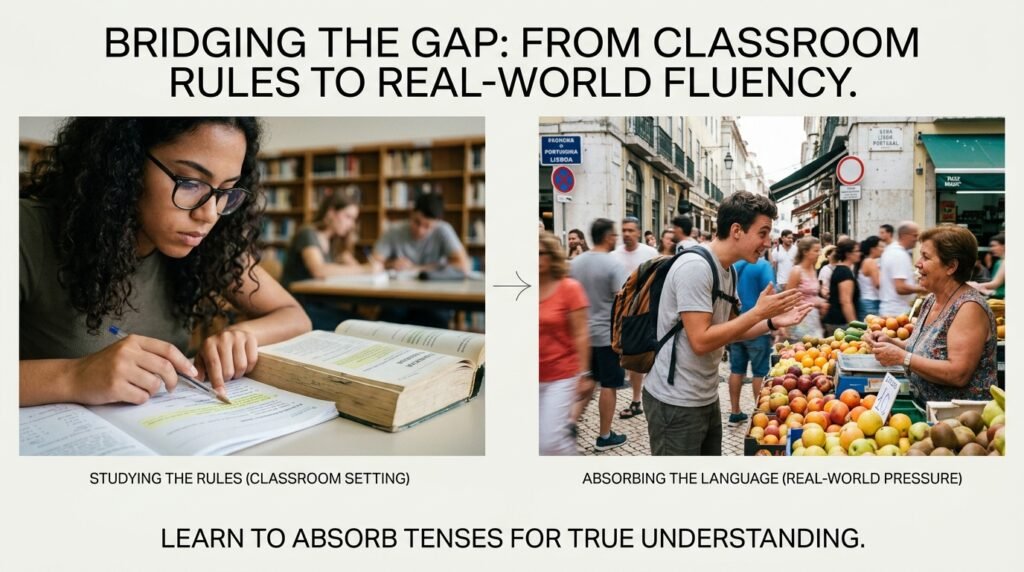
I realized my brain was entirely dependent on the sterile environment of my bedroom desk. When I removed the desk and added real world pressure, my ability to speak collapsed. I knew the rules intellectually. I did not know them physically. I had to bridge that massive gap. I started looking for ways to stop studying and start absorbing. If you struggle with this transition, I recommend reading about What Helped Me Understand Tenses for the First Time to help you build a stronger foundation.
The Park Bench Epiphany
A few weeks after the train station disaster, I was sitting in a public park. I was eating lunch and watching people walk by. I was not trying to study. I did not have a notebook or a flashcard app open. I was just resting.
Two native speakers sat on the bench next to me. They were having a very heated argument. They spoke incredibly fast. They interrupted each other constantly. They used wild hand gestures. I listened closely without trying to translate every single word.
One of the men suddenly yelled a long, complex sentence. He used the exact past perfect tense I had failed to use at the train station. He used it to express deep anger and betrayal.
In that exact fraction of a second, the grammar completely clicked in my head.
I did not think about the auxiliary verb. I did not think about the participle. I just felt the raw emotion behind his words. The tense suddenly carried a clear, vivid, physical meaning. It made absolute perfect sense. It was no longer a formula. It was a tool for expressing anger.
Why Emotion Matters More Than Logic
I walked home from the park and replayed that moment over and over. I realized why my textbooks were failing me so badly. Textbooks are completely empty of human emotion.
Your brain is a survival machine. It deletes information that it considers boring or useless. A sentence in a workbook about a man walking to the store is incredibly boring. Your brain has no reason to store it in long term memory.
When you hear a real person screaming in a park, your brain pays absolute attention. The intense emotional context acts as a permanent glue. It locks the grammar structure into your mind. You attach the complex syntax directly to the feeling of anger.
This realization forced me to completely abandon my old routines. I stopped reading artificial dialogues entirely. I threw away my stacks of grammar worksheets. I stopped trying to defeat the language with logic. I started treating it like a living, breathing organism. I explain this entire mental shift in The Method I Used to Learn Grammar Naturally so you can see how to stop fighting the rules.
Switching the Daily Input
I changed my daily input strategy entirely. I needed to find more emotional context. I needed to hear the language used by real people in real situations.
I stopped watching videos made specifically for language learners. Those videos are too slow. They are too clean. The teachers articulate every single syllable perfectly. That is not how normal people speak.
I started consuming media made strictly by native speakers, for native speakers. I watched intense drama series. I watched fast paced comedy shows. I listened to unscripted podcasts where people talked over each other and laughed loudly. I completely flooded my brain with authentic, messy human communication.
I exposed myself to the chaos. I let the rapid sentences wash over me. I focused entirely on the emotions of the speakers. I paid attention to their tone of voice. I paid attention to their facial expressions.
The Danger of Asking Why
When you start listening to authentic native media, you will hear very strange things. You will hear sentences that break the rules you learned in your textbook.
Your first instinct will be to stop the video and ask why. You will want to open a grammar book and find the academic justification for the strange sentence structure.
You must destroy this instinct completely. The question why is a massive trap. It forces you straight back into the analytical, math solving mindset.
When I heard a strange sentence structure, I stopped asking why. I simply accepted it as reality. I observed it carefully. I noted the emotional context. I trusted that the native speaker knew their own language better than my textbook did. I just accepted the sentence as an absolute truth. This is the only way to build true physical intuition.

Trusting the Silent Accumulation
The click moment on the park bench felt incredibly sudden. It felt like magic. But I quickly realized it was not magic at all. It was the direct result of a long, silent process.
You cannot force a breakthrough. Breakthroughs are the final result of massive pressure building up over a long period of time.
When the man yelled that sentence in the park, my brain was finally ready to catch it. I had seen the individual pieces of that tense in my books previously. I had heard fragments of it in movies. My subconscious mind had been quietly gathering data points for months. The intense emotional moment simply provided the final spark. It fused all the disconnected pieces together into a solid structure.
You have to trust this silent accumulation process completely. When you switch to a natural input method, you will feel entirely lost at first. You will float in a sea of noise. You must push through this uncomfortable phase. Your brain is a highly advanced pattern recognition machine. It is working constantly in the background. It is quietly sorting the massive amounts of data while you sleep.
Hunting for Full Phrases
To facilitate more of these click moments, I developed a brand new daily practice. I stopped isolating vocabulary words entirely.
A single word by itself is completely useless. It has zero context. If you learn the word for run, you still do not know how to tell someone to run away from danger. You still have to calculate the grammar.
I started hunting aggressively for full phrases and entire sentences. When I watched a movie and found a real sentence that expressed an idea perfectly, I wrote the whole thing down. I learned the grammar by absorbing the entire structure at once.
If I wanted to know how to order food, I did not learn the individual words. I went to a travel vlog and copied the exact sentence the native speaker used at the restaurant. I inherited their perfect grammar entirely for free. I completely bypassed the need to calculate the sentence myself.
The Physical Act of Shadowing
Listening and reading are passive skills. You can understand a complex rule without being able to speak it aloud. Speaking is a highly physical skill. It requires intense muscle memory.
I started shadowing native speakers every single day. I would take a short audio clip of a native speaker telling a fast, funny story. I would listen closely to the rhythm of their voice. Then I would try to speak out loud over the audio at the exact same time.
I tried to perfectly match their speed and their exact intonation. I forced my mouth to move rapidly. This intense physical practice bypasses the conscious, analytical brain entirely.
Shadowing builds deep muscle memory in your mouth and your throat. You force your physical body to produce correct, complex grammar at full speed. Your mouth gets entirely used to the physical feeling of the words in the correct order. Later, when you are in a real conversation, those exact structures pop out automatically. Your physical reflexes take over completely. You can find my full guide on destroying that mental hesitation in How I Stopped Overthinking Grammar Rules to help you speed up your speaking reflex.
Killing the Perfectionist
The blind pursuit of perfect grammar is a massive waste of your time. Textbooks train you to be a professional proofreader. They demand absolute perfection. If you make one small mistake on a test, you get a red mark.
This creates a terrible mental block. It makes you terrified to speak. I had to actively unlearn my deep fear of making mistakes. I had to fully accept that I would sound foolish for a while. That temporary embarrassment is the mandatory price of admission for real fluency.
I started speaking with native speakers and explicitly told them not to correct my minor grammar errors. I only wanted corrections if my sentence completely failed to convey my actual meaning.
This removed the heavy pressure entirely. I stopped stuttering. I started speaking with real momentum. I prioritized the flow of ideas completely over the strict adherence to academic rules. My confidence skyrocketed immediately.
Embracing the Messy Reality
When you remove the fear of mistakes, a beautiful thing happens. You start communicating like a real human being.
You realize that native speakers make mistakes all the time. They use double negatives. They mispronounce words. They start a sentence, forget where they were going, and start over completely.
The goal is not to speak like a printed legal document. The goal is to connect with another human being. When I finally embraced the messy reality of spoken language, the grammar rules stopped feeling like prison walls. They started feeling like flexible tools.
I stopped worrying about getting the past subjunctive perfectly right. I started worrying about making the other person laugh. I focused entirely on the message. The grammar naturally sorted itself out in the background.
Redefining Your Progress
Traditional study methods love artificial milestones. You finish a chapter in a book. You pass a weekly quiz. You move up a level in a gamified language app on your phone.
These specific milestones give you a completely false sense of security. They make you firmly believe you are progressing rapidly. But when you face a real conversation on the street, that security collapses instantly. You realize the app did not teach you how to handle a fast paced, unpredictable human interaction. It only taught you how to pass a basic test.
You must completely redefine what real progress looks like. Progress is not a high score on a multiple choice vocabulary test.
Progress is subtle and quiet. Progress is watching a YouTube video and realizing you did not look at the subtitles for five solid minutes. Progress is understanding a fast joke told by a native speaker without translating the punchline in your head first. Progress is speaking a complex sentence out loud and realizing your mouth did all the hard work automatically.

Letting Go of the Test
These real milestones cannot be tracked neatly on a spreadsheet. They cannot be forced on a strict schedule. They happen organically when you immerse yourself deeply enough into the content.
You have to become totally comfortable with a lack of clear metrics. You must surrender the need to constantly measure your daily growth. You must simply focus on the daily habit of exposure and completely trust that the growth is happening beneath the surface.
Language is fundamentally a vital tool for human connection. It is not a standardized test to pass. When you sit completely alone in a quiet room filling out grammar worksheets, you are missing the entire point of the exercise. You are heavily isolating the language from the messy humanity that actually created it.
The exact moment grammar finally clicks is the moment you completely stop looking at the rules and start looking at the people. It is the exact moment you realize the grammar is not just a column in a boring table. It is the highly specific sound a person makes when they are angry. It is the literal sound of heartbreak. It is the sound of joy.
You cannot find that raw feeling in a workbook. You have to go out and actually experience it. You have to read books that make you feel something real. You have to watch movies that make you laugh out loud. You have to talk to real people about things that genuinely matter to you.
If you are currently stuck behind a massive wall of confusing grammar rules, stop hitting your head against the brick. Close the textbook immediately. Walk away from the flashcards. Change your environment completely. Find a piece of native media that you actually care about. Watch it without taking any notes at all. Just listen to the rhythm. Let the language wash over you.
Do this every single day without fail. Trust your brain to do the heavy lifting in the dark. Be incredibly patient with yourself. Collect real examples from the real world. Build your physical muscle memory through loud, aggressive repetition. Prioritize real human connection completely over academic perfection.
The click will not happen when you are staring blindly at a conjugation table. It will happen when you are simply living your life. It will hit you completely out of nowhere. The confusing rules will vanish entirely, and only the pure, clear meaning will remain. That is the only level of fluency that actually matters. Keep showing up, keep listening, and simply wait for the pieces to finally fall into place.

Gabriel Henrique is a language enthusiast and productivity writer. After testing countless study methods, he became obsessed with mastering new languages efficiently. He achieves this without burnout, without endless grammar drills, and without losing focus. At Blog The Curious, he shares everything he has learned along the way.