
Staring at a blank screen is the most frustrating part of learning a language. You have the motivation. You have the free time. You just lack a map.
You open your internet browser and look for advice. Within ten minutes, you have twenty different tabs open. One website tells you to buy a heavy grammar textbook. Another website tells you to only watch foreign movies. A video tells you to download a specific application and tap buttons for an hour a day.
The noise is completely overwhelming. You feel paralyzed by the sheer volume of choices.
I experienced this exact paralysis. I wanted to learn, but I spent weeks just planning to learn. I hoarded resources. I downloaded every free PDF I could find. I organized nothing. I was confusing motion with actual progress.
I realized I needed a system. I needed to build a rigid structure that removed all the daily guesswork. I stopped looking for the perfect method and built a practical routine.
This is the exact blueprint I used to organize the chaos. I will show you how to audit your time, build a digital workspace, structure a physical notebook, and execute a daily plan without feeling lost.
Mini-Summary: The Planning Trap Researching how to study is not studying. Gathering resources creates a false sense of progress. To actually learn a language, you must stop hoarding information and build a rigid, executable daily system.
Phase One: The Brutal Calendar Audit
You cannot build a new routine without knowing where your time currently goes. You cannot simply tell yourself you will study when you have free time. Free time is a myth. Your daily schedule will always expand to fill the empty gaps.
I had to figure out exactly how I was spending my day.
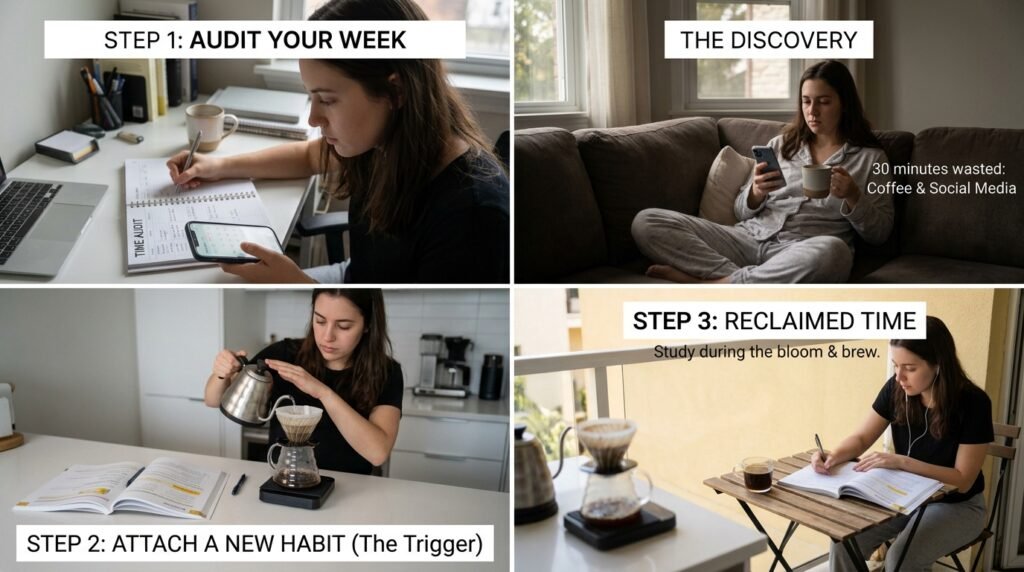
I opened a basic spreadsheet on my computer. I tracked my activities for three normal weekdays. I wrote down what I did every single hour. The results were incredibly humbling. I discovered a massive pocket of wasted time right after I woke up. I was spending thirty minutes drinking coffee and staring at social media.
I decided to reclaim that exact block of time.
I tied my new study routine directly to a physical habit I already performed. Every morning, I prepare a manual V60 pour over. I measure the Ethiopian Guji beans, heat the water, and pour slowly. This process takes exactly five minutes.
I placed my notebook and pen right next to my coffee scale. The coffee ritual became the trigger. While the coffee bloomed, I opened my book. I did not have to make a decision. The environment dictated my behavior.
You must find your hidden time. Audit your week. Find a daily anchor habit. Attach your language learning directly to that physical action.
Phase Two: The Digital Workspace Setup
Your computer is likely a graveyard of disorganized files. If your language materials are scattered across five different folders and three different cloud drives, you will never study. Friction will destroy your consistency.
I needed a central command station.
I use mobile productivity applications to track my daily habits and automate my tasks. I decided to bring that same level of ruthless organization to my language files. I created one master folder on my computer desktop. I named it “Language Hub.”
Inside that master folder, I created three strict subfolders:
-
01_Input: This folder holds all the reading materials, downloaded podcast episodes, and short stories.
-
02_Output: This folder holds my written essays, journal entries, and audio recordings of myself speaking.
-
03_Vocabulary: This folder holds spreadsheets of custom words and phrases I want to learn.
This structure eliminated the friction of starting. When I sat down to study, I knew exactly where everything lived. I did not waste ten minutes searching for a specific audio file.
You also have to control your mobile environment. Your phone is a massive distraction device. I gathered all my language applications and put them into a single folder on my home screen. I realized early on How I Use Apps Without Depending Only on Them by turning off all notifications. I control when I open the apps. The apps do not control me.
Mini-Summary: Eliminate Digital Friction Disorganized files kill your motivation. Create a single master folder for all language materials. Separate your input from your output. Turn off application notifications so you control your study schedule.
Phase Three: The Physical Notebook Strategy
Digital organization is necessary, but physical writing is mandatory. Typing a word on a keyboard does not build the same neural pathways as writing a word with a pen. You need a physical notebook.
I bought a single, high quality notebook. I refused to write study notes on random pieces of paper. Random paper gets lost.
I developed a strict rule for how I used the pages.
The left page was entirely for input. When I listened to a podcast or read a textbook chapter, I wrote down new grammar structures and vocabulary words on the left side. I kept it messy. I captured the raw information quickly.
The right page was entirely for output and processing. After the study session, I looked at the raw data on the left page. I used the right page to write my own original sentences using those new words. I drew small, terrible pictures next to the words to help my memory.
This two page system forced me to process the information twice. I captured it, and then I immediately applied it.
Do not treat your notebook like a museum. It should be messy. It is a workspace, not a final presentation.
Phase Four: Curating Niche Content
Beginner textbooks are incredibly boring. They force you to read dialogues about ordering a train ticket or describing the color of an umbrella. You struggle to pay attention because the material is completely irrelevant to your actual life.
I knew my routine would fail if I relied solely on textbooks. I needed content that I actually cared about.
I am highly interested in traditional Japanese tattoo art. I love the history behind the Irezumi style. I specifically focus on the folklore motifs. I love studying the legends behind the kitsune, the symbolic meaning of the hebi, and the history of the katana.
I used this deep personal interest to fuel my language routine.
Instead of reading a textbook chapter about a grocery store, I found foreign articles discussing the history of traditional ink techniques. I highlighted every word I did not know. I translated the articles line by line.
I learned the vocabulary for words like skin, needle, legend, snake, and history.
This is the secret to sustained focus. Your brain remembers information connected to your existing passions. Find your niche. If you love fixing cars, read foreign manuals about engine parts. If you love baking, read foreign recipes. When you tie the language to your identity, you discover The Strategy That Helped Me Stay Focused While Studying without needing massive amounts of willpower.
Mini-Summary: Ditch the Boring Textbooks General vocabulary is hard to memorize. Niche vocabulary sticks instantly. Find foreign content related to your deepest hobbies and translate it. Your brain will retain the words because you actually care about the topic.
Phase Five: The 45-Minute Daily Block
Having a clean workspace and interesting content is only the preparation. You still have to execute the daily work.
I committed to a strict forty five minute block every single morning. I did not study for two hours on Monday and skip Tuesday. I prioritized daily consistency over massive, exhausting sessions.
I broke the forty five minutes into highly specific segments. I used a simple digital timer on my desk. When the timer went off, I stopped what I was doing and moved to the next segment immediately.
Here is exactly how I structured the time:
-
Minutes 0 to 10: The Warm Up. I reviewed the right side of my notebook from the previous day. I read the sentences I had written out loud. I did not learn anything new. I just primed my brain to switch into the target language.
-
Minutes 10 to 30: The Core Work. This is where I tackled the heavy lifting. I read a new article about coffee origins or worked through a complex grammar lesson. I focused purely on input and comprehension. I wrote the new raw data on the left side of my notebook.
-
Minutes 30 to 40: The Active Output. I closed all my reading materials. I took the new vocabulary and forced myself to write three completely original sentences. Sometimes I stood up and summarized what I just read to the empty room. Output is uncomfortable, but it is where real acquisition happens.
-
Minutes 40 to 45: The Reset. I spent the last five minutes preparing for tomorrow. I cleared my desk. I opened the digital file I needed for the next day. I left my pen on the correct notebook page.
This rigid structure removed all decision fatigue. I never sat at my desk wondering what to do. I just started the timer and followed the sequence.

Phase Six: The Sunday System Reset
A daily routine will eventually break down if you do not maintain it. Files get messy. The notebook gets disorganized. You fall behind on your vocabulary reviews.
You need a weekly maintenance day.
I designated Sunday afternoon as my system reset. I scheduled thirty minutes simply to clean up my routine. I did not learn any new language concepts during this time. This block was purely administrative.
I cleared my physical desk completely. I threw away any stray sticky notes. I reviewed my mobile productivity apps and checked off my weekly habit trackers.
I then opened my master digital folder. I moved completed reading files into an archive folder. I queued up three new articles for the upcoming week. I transferred the most important vocabulary words from my physical notebook into a digital flashcard spreadsheet.
This weekly reset prevented my study system from collapsing. By organizing everything on Sunday, I guaranteed that Monday morning would be completely frictionless. I knew exactly The Weekly Study Plan That Finally Made Things Click for Me because I built the entire week in advance.
Mini-Summary: The Weekly Audit Routines degrade over time. Dedicate thirty minutes every Sunday to clean your physical desk, organize your digital files, and select your reading materials for the upcoming week. Preparation prevents Monday morning procrastination.
Phase Seven: Handling the Inevitable Disruptions
You can build a perfect study routine. You can have a clean desk and a beautiful notebook. Then reality will hit you.
You will get sick. You will have a family emergency. You will have to work a twelve hour shift. Your forty five minute morning block will become impossible.
Most people completely abandon their language goals when their perfect routine breaks. They miss three days in a row, feel immense guilt, and put the textbook in a drawer forever.
I had to build a contingency plan. I called it my baseline protocol.
When my life became chaotic, I did not quit. I simply dropped to the baseline. My baseline was exactly five minutes of study.
If I was exhausted, I did not attempt the full forty five minute block. I woke up, made my coffee, and spent exactly five minutes reviewing a single vocabulary list. I wrote one sentence in my notebook. Then I closed the book.
I gave myself permission to do the bare minimum. The bare minimum keeps the habit alive. Checking a tiny box on a habit tracker maintains your momentum. Doing five minutes of work prevents you from adopting the identity of a quitter.
A rigid system is powerful, but a brittle system will snap under pressure. You must have a baseline protocol to survive the chaotic weeks.
Phase Eight: Measuring Real Progress
When you learn a language, you do not notice your daily improvement. You stare at the notebook every day, and you constantly feel like a beginner. You try to watch a movie, you fail to understand the dialogue, and you feel defeated.
If you do not track your progress, your brain will convince you that your routine is not working.
I stopped measuring my progress by how fluent I felt. Fluency is an invisible metric.
I started tracking my raw input hours. I used a basic digital tracker to record how many minutes I spent actively studying. I watched the total number grow every single week. Ten hours. Fifty hours. One hundred hours.
I also recorded myself speaking. On the first day of every month, I turned on my phone camera and spoke for exactly two minutes about my current projects. I saved the video in my output folder and completely ignored it.
Three months later, I watched the first video. The difference was staggering. I could hear my own hesitation. I could hear the terrible pronunciation. I realized how much faster I was speaking currently.
You must manufacture your own proof of progress. Your brain cannot accurately remember how bad you used to be. Keep the old videos. Keep the messy notebook pages. Look back at them when you want to quit.

Putting the Pieces Together
Organizing a study routine from scratch feels intimidating. It requires upfront work. It requires you to stop researching and start building.
Do not try to implement all these phases in a single afternoon. Build the machine one piece at a time.
Tomorrow morning, start with the calendar audit. Track your time and find your anchor habit. The next day, build your digital folders. The day after that, buy a clean physical notebook.
Slowly construct your environment. Protect your morning block. Tie your vocabulary directly to your deepest personal interests.
The initial confusion will fade. The paralysis will disappear. You will stop wondering where to start, because the system will naturally guide you to the work. Grab a pen, clear your desk, and take the first step today.

Gabriel Henrique is a language enthusiast and productivity writer. After testing countless study methods, he became obsessed with mastering new languages efficiently. He achieves this without burnout, without endless grammar drills, and without losing focus. At Blog The Curious, he shares everything he has learned along the way.