
I spent my first six months of language learning running on a treadmill. I was sweating, working incredibly hard, and going absolutely nowhere.
Every single day, I would sit at my desk and randomly pick a study activity. One day I would review digital flashcards. The next day I would watch a foreign movie and pretend I was learning. The following day I would stare at a massive list of irregular verbs until my eyes burned.
I was studying every day. I had the discipline. But I lacked a roadmap.
Because I was deciding what to do in the moment, I always gravitated toward the easiest tasks. I avoided speaking. I avoided complex reading. I was confusing daily motion with actual progress. I realized that micro-level daily habits are useless if you do not have a macro-level weekly strategy.
I needed a rigid framework. I build digital content platforms and manage complex projects for a living. I know how to structure a workflow. I decided to stop treating my language learning like a casual hobby and start treating it like a serious weekly project.
This is the exact weekly study plan I built. It removed all decision fatigue, forced me to tackle the hard skills, and finally made the language click in my brain.
Mini-Summary: The Daily Trap Studying every day is not enough if your efforts are random. Without a weekly structure, you will naturally avoid difficult tasks and plateau quickly. You must plan your week in advance to ensure balanced progress.
Sunday: The Architect Phase
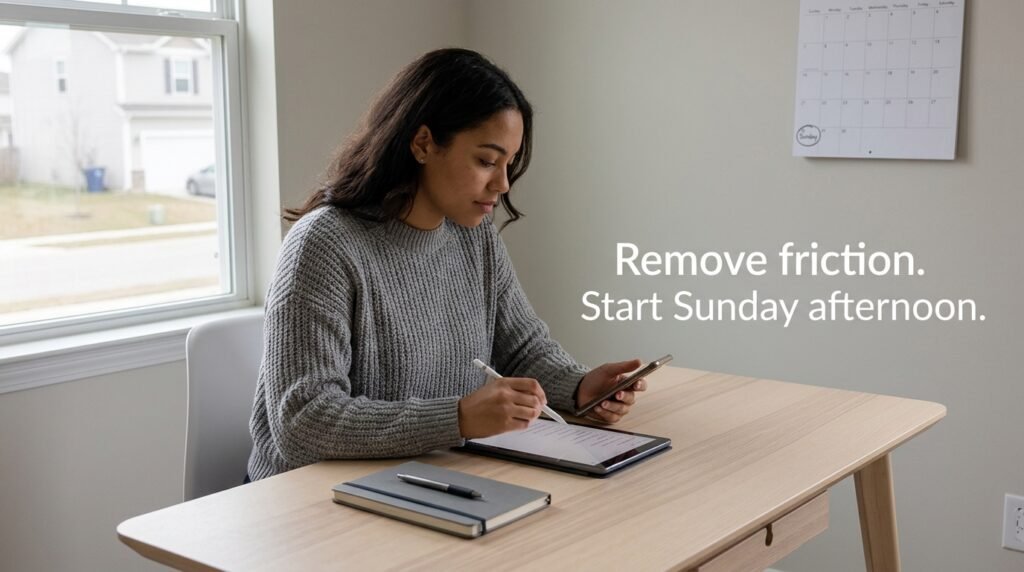
A successful week of language learning does not start on Monday morning. It starts on Sunday afternoon.
If you wake up on Monday and have to spend fifteen minutes searching for a podcast or deciding which textbook chapter to read, you will lose your momentum entirely. You will choose the path of least resistance. You must remove all friction before the week begins.
Every Sunday, I dedicate twenty minutes purely to administrative preparation. I do not learn any new vocabulary during this time. I act entirely as the architect of my upcoming week.
I open my task management app. I create a specific checklist for Monday through Friday.
I hunt down the exact materials I am going to use. I find three new articles and save them to my reading folder. I download two podcast episodes and queue them on my phone. I clear my physical desk. I place my notebook exactly where I need it.
I completely eliminate decision fatigue for the next five days. When my alarm rings on Monday, my only job is execution. The planning is already finished.
Monday: Deep Reading and Contextual Vocabulary
Monday morning is when my cognitive energy is at its absolute highest. I use this peak mental state to tackle the hardest task: deep reading and new vocabulary acquisition.
I do not read generic dialogues about ordering food at a restaurant. I refuse to use beginner textbooks. To force my brain to care, I read material directly related to my personal passions.
I am heavily invested in traditional Japanese tattoo art. I specifically study Irezumi folklore and the history behind specific designs.
On Monday morning, I brew my coffee. I prefer a manual V60 pour-over with a light-roasted Ethiopian Guji bean. While the coffee cools, I open a foreign article discussing the mythology of the kitsune or the symbolic meaning of the hebi serpent.
I read the text slowly. I highlight every single word I do not recognize.
I do not write down standalone words. I write down the entire sentence. I learned the hard way that The Method I Used to Learn Words in Context is the only reliable way to build a functional vocabulary. A word means nothing without its surrounding environment.
I spend thirty minutes pulling rich, highly specific vocabulary from a topic I genuinely love. By the end of the session, I have a list of new, high-value sentences ready for the rest of the week.
Mini-Summary: Monday Strategy Use your highest energy day to read complex, niche material. Do not read boring textbooks. Read about your specific hobbies. Extract entire sentences, not just isolated words, to build a contextual vocabulary.
Tuesday: Deconstructing Grammar in the Wild
For years, I believed grammar was a set of mathematical formulas you had to memorize from a table. I hated Tuesday study sessions.
I changed my approach entirely. I stopped studying grammar in isolation. Instead, I used Tuesday to deconstruct the exact sentences I extracted from my reading on Monday.
I call this “grammar in the wild.”
I look at the sentence about the katana blade I found the day before. I do not just translate the words. I look at how the sentence is built. Why did the author use that specific verb tense? How are the adjectives connecting to the nouns?
I play detective. If I notice a grammatical structure I do not understand, I look up that specific rule. I learn the rule simply to decode the sentence in front of me.
This approach changes everything. The grammar is no longer abstract. It is a necessary tool I need to unlock information I care about. Understanding How I Learned Grammar Through Real Examples completely removed the dread of studying grammar rules. I only learn the rules that appear naturally in my reading material.
Wednesday: Active Audio Processing
By Wednesday, the initial weekly motivation starts to fade. I need a change of pace. I shift my focus entirely from visual input to auditory input.
Most people misunderstand listening practice. They turn on a foreign podcast while washing the dishes, tune out the audio, and call it studying. That is passive immersion. It is helpful for building an ear for the language rhythm, but it does not aggressively improve your comprehension.
Wednesday is for active listening.
I take the podcast episode I queued up on Sunday. I sit at my desk with my notebook. I do not do chores. I do not look at my phone.
I listen to the audio in thirty-second bursts.
I hit play, listen to a speaker complete a thought, and immediately hit pause. I force myself to write down a quick summary of what they just said. I note any recurring phrases or interesting slang. If I miss a sentence entirely, I rewind it and listen to it three more times.
Active listening is exhausting. It requires massive concentration. But thirty minutes of active audio processing will improve your comprehension drastically faster than ten hours of passive background noise.
Mini-Summary: Wednesday Strategy Shift from reading to active listening. Do not multitask. Listen to short audio segments, pause, and force yourself to summarize the information. Treat audio like a puzzle you have to solve in real time.

Thursday: Forced Production and Shadowing
Input is comfortable. You can sit silently and read forever. But language is an active, physical skill. You have to move your mouth.
Thursday is my dedicated output day. This is the most uncomfortable day of the week, which means it is also the most important.
I start with shadowing. I take a short audio clip from Wednesday’s podcast. I play a single sentence, pause the track, and repeat the sentence out loud. I try to perfectly mimic the speaker’s intonation, speed, and emotion. I do this repeatedly until my mouth naturally forms the foreign sounds without hesitation.
Then, I force myself to produce original thoughts.
I take my phone, open a voice recording app, and talk continuously for two minutes. I do not script it. I summarize the articles I read on Monday. I talk about my plans for the weekend. I force my brain to search for the vocabulary in real-time under slight pressure.
I stumble. I make terrible grammar mistakes. I freeze entirely.
That is the entire point. You must locate your blind spots. Finding out How I Practiced Real Conversations by Myself using my phone camera and voice memos allowed me to build speaking confidence without the anxiety of a live audience. I save the audio file. I listen to it to hear my own errors, and then I delete it.
Friday: The Low-Friction Review
By Friday morning, my cognitive battery is low. My week of managing websites and writing content has drained my focus.
I do not attempt to learn complex new concepts on Friday. I respect my energy levels. I treat Friday as a consolidation day.
I open my notebook and review the week. I look at the vocabulary from Monday. I read the grammar notes from Tuesday. I look at the phrases I struggled with during Thursday’s speaking exercise.
I transfer the most critical, high-frequency sentences into a digital flashcard system. I use an application that utilizes spaced repetition. This takes exactly fifteen minutes.
Friday is designed to be frictionless. It is a soft landing at the end of a hard week. I check the boxes, secure the knowledge in my digital system, and close the books. The heavy lifting is done.
Mini-Summary: Friday Strategy Do not force deep learning at the end of the workweek. Use Friday purely for review and consolidation. Transfer your physical notes into digital systems for long-term retention. Keep the friction low.
Saturday: Pure, Unfiltered Immersion
Saturday is not a study day. It is an enjoyment day.
If you treat a language purely as an academic chore, you will eventually hate it. You have to remember why you started learning in the first place. You started because you wanted to experience a new culture, connect with people, or consume foreign media.
On Saturday, I completely drop the notebook and the flashcards.
I watch a movie in my target language. I do not pause it to look up words. I do not worry about the grammar structures. I turn on the target language subtitles and simply let the story play.
I listen to foreign music while I clean my house. I scroll through foreign social media accounts.
I interact with the language exactly how a native speaker would. I allow myself to be entertained by it. This passive immersion reconnects me to the joy of the language. It reminds me that the difficult grammar drills on Tuesday serve an actual, enjoyable purpose.
Sunday Morning: The Empty Space
I take Sunday morning completely off.
Rest is not a reward for hard work. Rest is a mandatory prerequisite for future hard work. Your brain needs empty space to consolidate the massive amount of data you fed it during the week.
If you aggressively study seven days a week, you will burn out. Your retention will actually drop.
I step away from the language entirely. I do not review flashcards. I do not listen to foreign podcasts. I let my mind wander. I go for a walk without headphones.
By Sunday afternoon, my energy returns. My brain feels fresh. I sit down with my calendar, open my task manager, and begin the Architect Phase for the next week. The cycle starts over, slightly sharper and slightly more capable than the week before.
The Psychology Behind the Structure
Why does this specific weekly structure work so well?
It works because it targets every single aspect of language acquisition systematically, while perfectly managing your natural energy levels.
-
It prevents plateaus. By dedicating specific days to specific skills, you cannot hide from your weaknesses. If you hate speaking, Thursday forces you to speak. If you hate grammar, Tuesday forces you to analyze it.
-
It matches your energy. It puts the heaviest cognitive load (deep reading and new vocabulary) at the beginning of the week when you are fresh. It shifts to review and passive immersion as your energy drops toward the weekend.
-
It creates momentum. Knowing exactly what you have to do every day eliminates the daily negotiation. You do not ask yourself if you feel like studying. You just look at the schedule and execute the Tuesday protocol.
Customizing the Plan to Your Reality
You do not have to copy my exact schedule. Your Monday might be your busiest day at work. Your peak energy might be on Thursday.
The exact days do not matter. The fundamental framework is what matters.
You need an architecture day. You need an input day. You need a grammar analysis day. You need a forced output day. You need a consolidation day.
If you work long shifts and can only study three days a week, combine the days. Do input and grammar on day one. Do active listening on day two. Do forced output and review on day three.
The goal is to build a machine that works for your specific life.

How to Start Your New Week Today
If your language routine feels stale, confusing, or entirely broken, stop what you are doing right now.
Do not open another flashcard app. Do not read another random article. Step back and become the architect of your process.
-
Open your calendar. Block out twenty minutes this coming Sunday purely for planning.
-
Define your core interest. Choose a topic you genuinely care about. Stop looking at generic beginner materials.
-
Assign your days. Write down exactly which skill you will focus on each day of the week.
-
Gather the materials. Find the articles, the podcasts, and the videos before Monday morning arrives.
Language learning is a massive, multi-year project. You cannot navigate a multi-year project simply by waking up and hoping you feel motivated.
You need a system. You need a structure that pulls you forward when you are tired. Build your weekly roadmap, trust the daily execution, and watch the language finally begin to click.

Gabriel Henrique is a language enthusiast and productivity writer. After testing countless study methods, he became obsessed with mastering new languages efficiently. He achieves this without burnout, without endless grammar drills, and without losing focus. At Blog The Curious, he shares everything he has learned along the way.