
I was standing on a busy street corner in a foreign city. I needed directions to a very specific camera store. I wanted to buy a vintage 35mm lens to study its specific glass geometry and retro flash mechanics. I pulled out my phone to open my favorite language translation application. The screen flashed black. The battery was completely dead.
Panic hit me instantly. I had spent eight solid months studying the local language. I had high scores on all my daily mobile quizzes. I maintained a massive streak on my digital flashcards. But without the glowing screen in my hand, my mind went entirely blank. I could not form a single basic sentence. I stared at the local shop owners walking past me and felt entirely helpless.
The application had become a massive crutch. I relied entirely on multiple choice buttons and colorful hints. When the buttons disappeared, my fluency disappeared directly with them. I realized a harsh truth that afternoon. Digital tools are fantastic for gathering basic data. They are absolutely terrible for building actual human fluency. If you never leave the digital sandbox, you will never survive the real world.
I had to completely restructure my relationship with my smartphone. I stopped treating the software as my primary teacher. I started treating it strictly as a temporary stepping stone. Here is exactly how I use language tools today without depending on them to hold my hand.
The Starter Motor Philosophy
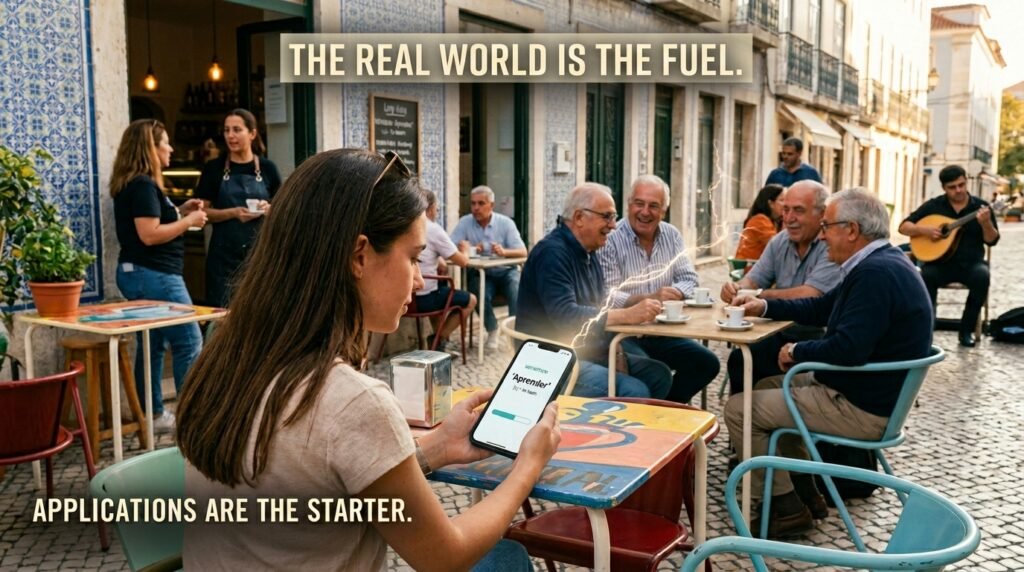
You must strictly define the actual purpose of your digital tools. An application is exactly like the starter motor of a car. It provides the initial electrical spark. It gets the heavy engine turning. But you cannot drive a car across the country using only the starter motor. It will burn out completely.
Applications are designed to give you a basic foundation. They teach you the alphabet. They teach you the top five hundred most frequent vocabulary words. They introduce you to the basic sentence structure.
Once that engine is running, you must switch over to the main fuel source. The main fuel source is the real world. You must read real articles. You must listen to real native speakers. I use an application to learn the raw definitions of a word. I immediately leave the application to see how that exact word behaves in a natural environment. The software is the starting line, never the finish line.
Imposing the Strict Time Cap
Digital companies hire highly skilled psychological engineers. They design the interfaces to keep you addicted. They want you to scroll and tap for hours. They use loud sound effects and digital rewards to flood your brain with dopamine.
You can spend three hours on a smartphone and learn absolutely nothing of value. You just get really good at playing a mobile game.
I instituted a ruthless time limit on my digital usage. I used the screen time settings on my phone to lock my language applications after exactly twenty minutes of daily use.
When the twenty minutes expire, the screen locks me out. I do not bypass the lock. I put the phone down immediately. This strict constraint forces me to be highly efficient. I do not waste time browsing menus or changing my avatar. I get in, I review my core vocabulary, and I get out. The remaining time in my daily study schedule is dedicated entirely to analog practice and real world listening.
Escaping the Multiple Choice Trap
The most dangerous feature of any digital learning tool is the multiple choice question. It builds a massive false sense of security.
When you see four possible answers on a screen, your brain does not have to work hard. You do not have to recall the word from your deep memory. You just have to recognize the correct option. Passive recognition is entirely different from active recall.
I had to completely change my approach after I realized The Mistake I Made When Using Language Apps was relying exclusively on this lazy passive recognition.
In a real conversation, nobody gives you four choices. You have to pull the word out of thin air. To fix this, I changed how I physically interacted with my screen. When a question popped up, I immediately covered the bottom half of my screen with my hand. I hid the multiple choice answers completely. I forced my brain to generate the foreign word out loud first. Only after I spoke the word aloud did I move my hand to check the digital answer.
Sourcing Wild Data for the Machine
Most people use the prepackaged curriculum provided by the software developer. They learn how to order an apple. They learn how to ask for directions to the library.
This is incredibly boring. It kills your motivation because the vocabulary is completely irrelevant to your actual life.
I treat my digital flashcards exactly like an empty notebook. I do not use their default vocabulary lists. I source my own wild data from my daily life. I run complex statistical models for professional basketball games. I track first action NBA playoff statistics like points, rebounds, and assists.
When I read a native article about basketball analytics, I harvest the specific terminology. I take those advanced, real world terms and I manually input them into my digital flashcard system. I feed the machine my own data. This guarantees that every single minute I spend tapping my screen is directly relevant to my deep personal passions.
The Digital and Physical Bridge
Information isolated on a glowing screen is incredibly fragile. Your brain categorizes it as abstract digital noise. You must build a permanent bridge between the software and your physical reality.
I built a strict system detailing How I Combine Apps With Real Practice to force the vocabulary out of the screen and into my actual life.
I use my morning routine to build this bridge. I am deeply obsessed with specialty coffee. I use a strict V60 pour over method. I use a digital scale to weigh my Ethiopian beans. While I am brewing my coffee, I open my digital flashcards.
If my screen shows me the foreign word for boiling water, I do not just tap the screen. I put the phone down. I look directly at my hot gooseneck kettle. I say the foreign word out loud while physically touching the metal handle. I anchor the digital data directly to a physical object and a physical sensation. The word becomes permanent because it now lives in my kitchen, not just in my microchip.

The Immediate Audio Shadow
Many applications have excellent native audio features. They play a crystal clear recording of a native speaker pronouncing a sentence. Most students just listen to the audio quietly and tap the next button.
This is a massive waste of high quality resources. Your ears get practice, but your mouth remains completely ignorant.
I turned the audio feature into an intense physical workout. Every single time the application played a sentence, I hit the pause button. I forced my mouth to physically echo the exact sentence out loud. I tried to match the exact pitch and the exact rhythm of the digital voice.
I repeated the audio shadow three times before I allowed myself to move to the next screen. This slows your progress through the software dramatically. You will earn fewer digital points. But you will build incredible physical muscle memory in your jaw and your tongue.
Shifting from Consumer to Creator
Applications train you to be a passive consumer. The software gives you a sentence. You translate it. You move on. You never actually create anything of your own.
Fluency is the ability to create spontaneous thoughts. You have to break the cycle of passive consumption.
I started using my software as a daily writing prompt. When the screen showed me a new vocabulary word, I did not just memorize the default definition. I pulled out a physical piece of paper and a pen. I forced myself to write three completely original sentences using that specific word.
I wrote sentences about my business. I wrote sentences about my weekend plans. I forced my brain to actively manipulate the new vocabulary and fit it into my own personal context. You must take ownership of the word. If you cannot build your own original sentence with it, you do not truly know it yet.
The Weekly Digital Fast
To truly test your independence, you must occasionally cut the digital cord entirely.
I instituted a mandatory digital fast every single Sunday. On Sundays, I refuse to open any language learning software. I do not use digital dictionaries. I do not use digital translators.
I documented exactly What I Learned After Using Apps Every Day for a Month to prove how deceptive this digital comfort zone truly is. Without the screen, you feel incredibly vulnerable.
On my fasting day, I force myself to interact strictly with analog materials. I read a physical book in my target language. I watch a movie without subtitles. I speak to a native language partner.
When I encounter a word I do not know, I cannot look it up instantly. I have to use context clues. I have to guess. I have to ask the native speaker to explain it using simpler words. This builds massive mental resilience. It trains you to survive the ambiguity and chaos of real human communication.
Designing Your Own Exit Strategy
You should never plan to use a basic language application forever. You must design a clear exit strategy from the very beginning.
An application is exactly like training wheels on a bicycle. Training wheels are fantastic for the first few weeks. They keep you from falling over and getting completely discouraged. But if you keep the training wheels on for five years, you look completely ridiculous. You never learn how to actually balance the bike yourself.
I set clear, measurable milestones for my software usage. I decided that once I mastered the top two thousand most frequent words in my flashcard system, I would delete the beginner application permanently.
Having a hard exit strategy prevents you from getting permanently trapped in the digital loop. It forces you to look forward to the real world.
Utilizing Automation for Focus
Smartphones are massive distraction machines. You open your phone to study a flashcard, and you immediately see a notification for a new email. You click the email. Twenty minutes later, your study session is ruined.
I use mobile software automation to protect my attention fiercely.
I built a specific digital shortcut on my device. When I tap the shortcut, my phone instantly enters a strict focus mode. It silences all incoming messages. It blocks my internet browser. It mutes every single social media notification. The only software allowed to open is my specific flashcard application.
This creates a clean, silent digital room. It removes the heavy burden of willpower. I do not have to fight the urge to check my messages because the automation makes it physically impossible. I highly recommend taking total control of your device before it takes total control of your study time.
Recognizing the Illusion of Progress
You must constantly audit your own progress. You must ask yourself brutal questions.
Are you getting better at the language, or are you just getting faster at tapping the correct colored box on your screen?
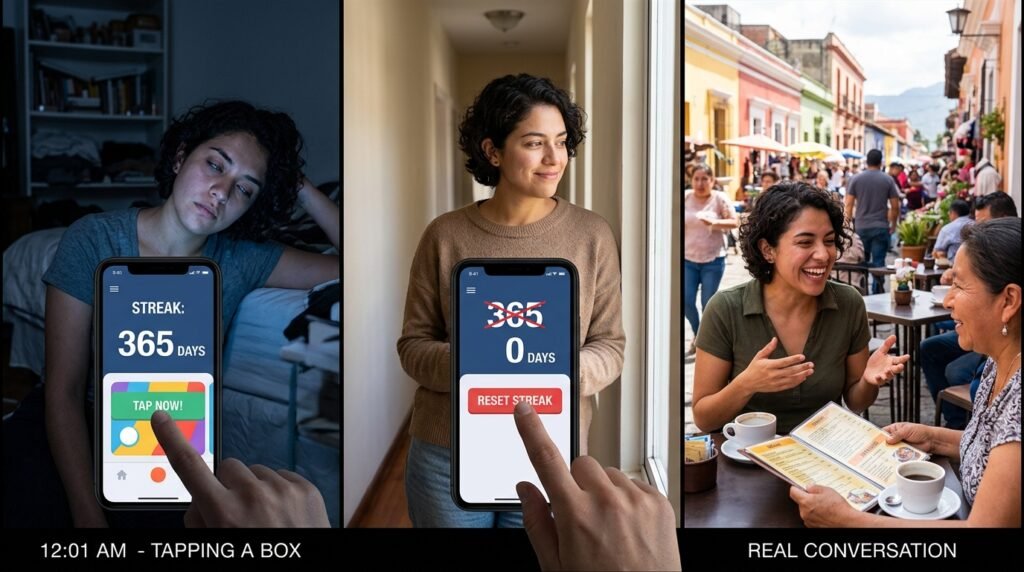
I realized I was falling for the illusion of progress when I cared more about my digital streak than my actual speaking ability. I was terrified of losing my streak, so I would log in at midnight, tap a few buttons mindlessly just to satisfy the algorithm, and go to sleep. That is not studying. That is digital slavery.
I broke my streak on purpose. I let the digital counter reset to zero. It felt incredibly liberating.
It reminded me that the software works for me. I do not work for the software. The only streak that actually matters is your daily physical interaction with the real language in the real world.
The Final Real World Shift
Your smartphone is a miracle of modern technology. It gives you instant access to every single word in human history. It is a powerful tool.
But it is entirely lifeless. It cannot replace the warmth, the humor, and the beautiful chaos of a real human conversation.
Do not hide behind the glowing screen. Use the software to gather your raw materials. Use the flashcards to sharpen your memory. Use the audio tracks to train your ear.
Then, put the device firmly in your pocket. Walk out your front door. Find a native speaker. Look them directly in the eye. Stumble through your sentences. Make terrible mistakes. Laugh at your own clumsy grammar. Rely entirely on your own brain to navigate the interaction. That raw, terrifying, unscripted human connection is the exact reason you started learning the language in the first place.

Gabriel Henrique is a language enthusiast and productivity writer. After testing countless study methods, he became obsessed with mastering new languages efficiently. He achieves this without burnout, without endless grammar drills, and without losing focus. At Blog The Curious, he shares everything he has learned along the way.