
I stay seated at a long wooden table during a loud dinner party. The room was packed with native speakers. I wanted to tell a funny story about my recent travel disaster. I built the sentence perfectly in my head. I gathered my courage and spoke out loud.
I hit a word with a complex, rolling consonant. My tongue completely froze. I produced a strange, choking sound instead of the correct letter.
The entire table went silent. A few people smiled politely. One person tried to guess what I was trying to say. My face burned hot with intense embarrassment. I quickly changed the subject and stayed quiet for the rest of the night.
That single moment of public failure completely paralyzed my speaking progress. I developed a deep fear of difficult sounds. I actively avoided using certain vocabulary words simply because I could not pronounce them correctly. I replaced them with simpler, less accurate words. I was hiding from the language.
I realized this fear was destroying my fluency. I could not become a confident speaker if I was terrified of my own voice. I needed to fix my pronunciation. But I needed to do it without an audience. I needed to do it without feeling that burning shame ever again.
Here is the exact private system I built to improve my pronunciation completely embarrassment free.
Pronunciation is a Physical Workout
You have to change how you view pronunciation. It is not a test of your intelligence. It is a strict physical workout.
You have dozens of small muscles in your face, lips, jaw, and throat. Your native language only requires you to use a very specific set of those muscles. You have been running the exact same physical routine since you were a child.
When you start learning a new language, you suddenly demand new movements. You ask your tongue to twist in unfamiliar directions. You ask your throat to vibrate at different frequencies.
Your muscles are completely unprepared for this. They are weak. They lack the necessary coordination. When you fail to pronounce a word, it is not a mental failure. It is a simple physical failure. You just lack the muscle memory.
You would never try to lift heavy weights in front of a massive crowd without practicing in private first. You should treat speaking the exact same way. You must build the physical strength in complete isolation.

The Power of Absolute Isolation
Embarrassment only exists when there is an audience. If you remove the audience, you completely remove the fear.
I decided to stop practicing difficult sounds in front of native speakers. I moved my entire pronunciation routine behind a locked door.
I found a quiet room in my house. I made sure nobody was home. I closed the windows. I created an environment of absolute isolation. In this room, I had total permission to sound completely ridiculous.
I made weird noises. I choked on consonants. I spat while trying to roll my tongue. I sounded exactly like a toddler learning how to talk. It was highly undignified. But because nobody was watching, the shame completely vanished.
You have to give yourself this safe space. You need a private laboratory where failure has zero social consequences. I explain exactly how to structure this solitary practice effectively in How I Practiced Speaking Even When I Had No One to Talk To because isolation is the absolute best tool for building raw vocal confidence.
The Bathroom Mirror Technique
You cannot fix a physical movement if you cannot see it.
I started doing my daily pronunciation drills standing directly in front of my bathroom mirror. I watched my mouth very closely.
I pulled up a video of a native speaker pronouncing a difficult word. I paused the video. I looked at the exact shape of their lips. I looked at the tension in their jaw. I looked at exactly where their tongue was positioned behind their teeth.
Then I looked at myself in the mirror. I forced my mouth to perfectly mimic their physical shape.
I realized my mouth was entirely too lazy. I was trying to make foreign sounds using my relaxed, native English mouth shape. It never worked. The new language required much wider lip movements. It required a much tighter jaw.
The mirror provides immediate visual feedback. You stop guessing what your mouth is doing. You start treating your face like a mechanical instrument. You adjust the parts until the sound finally comes out correctly.
The Exaggeration Protocol
When you practice in private, you must practice at extremes.
I developed a technique called the exaggeration protocol. I took a difficult target word. I did not try to say it normally. I tried to say it as loudly and as dramatically as physically possible.
I stretched the vowels out for five full seconds. I rolled the consonants until my throat hurt. I opened my mouth incredibly wide. I shouted the word at the bathroom mirror.
This extreme exaggeration forces your weak facial muscles to work incredibly hard. It is a heavy resistance workout for your tongue and lips.
When you exaggerate a sound in private, a beautiful thing happens in public. You build excess physical strength. When you go back out into the real world and try to speak normally, the sound feels incredibly easy. The regular pronunciation feels completely effortless because you just spent twenty minutes shouting it at maximum volume.
Shadowing With Heavy Headphones
Listening to a native speaker and then repeating their sentence is a good start. But it leaves a gap of silence. In that silence, your brain forgets the exact pitch and rhythm of the native sound.
I eliminated that silence. I bought a pair of heavy, noise canceling headphones.
I put the headphones on and played a fast audio clip of a native speaker. I played the clip on a continuous loop. I started speaking completely out loud at the exact same time as the audio.
I did not wait for them to finish. I spoke directly over their voice.
This technique is called shadowing. The noise canceling headphones block out the sound of your own voice. You only hear the perfect native audio in your ears. Your physical mouth is moving, but your brain thinks it is producing the perfect native sound.
This completely bypasses your internal critic. You absorb the exact rhythm, the exact melody, and the exact speed of the language. It builds deep physical intuition without triggering any self doubt.
The Brutal Reality of the Voice Recorder
You think you sound much better than you actually do. The bones in your skull distort the sound of your own voice. You hear a deep, resonant tone inside your head. The rest of the world hears something completely different.
To actually improve, you must face the brutal reality of the tape.
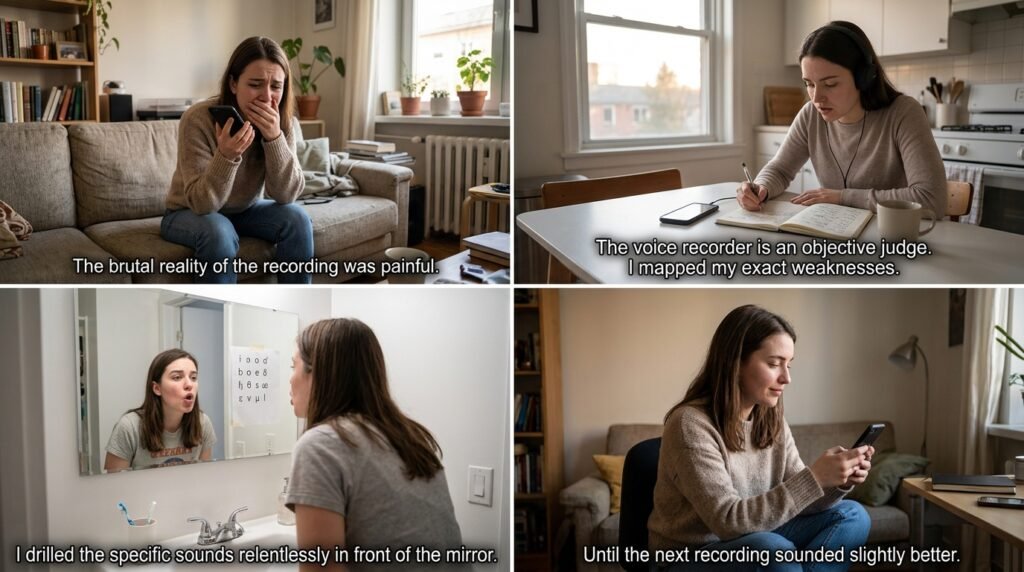
I started recording my solo practice sessions on my phone. I read a short paragraph out loud. Then I hit play.
The first time I did this, I wanted to throw my phone against the wall. The recording was terrible. My accent was thick and clunky. The vowels were entirely wrong. The rhythm was completely broken.
It is incredibly painful to listen to your own flaws. But it is entirely necessary. The voice recorder does not lie. It is an objective judge. I detail this exact painful process and how to survive it in How I Got Comfortable Hearing My Own Voice to help you push past the initial cringe factor.
I used the recordings to map my weaknesses. I found the exact syllables that sounded unnatural. I isolated those specific sounds and drilled them relentlessly in front of the mirror until the next recording sounded slightly better.
Working Backwards from the End
Some words are simply too long and complex to attack from the front. If you try to pronounce a massive seven syllable word from left to right, your tongue trips over the middle section.
I learned to work backwards.
I took the complex word and chopped it into small, individual pieces. I started with the very last syllable. I pronounced it perfectly.
Then I added the second to last syllable. I connected the two pieces smoothly. I repeated that chunk ten times.
Then I added the third to last syllable. I worked my way backward to the very front of the word.
This method is highly effective because it ensures you always end strongly. When you learn a word from left to right, you often trail off and mumble the ending because you run out of mental energy. Working backwards guarantees the ending is the most solid part of your pronunciation. It makes you sound highly confident.
The Problem with Vowels
Beginners obsess entirely over difficult consonants. They spend hours trying to roll their R sounds or clear their throats perfectly.
Consonants are important, but they do not carry the accent. The vowels carry the entire weight of your accent.
I realized my native English vowels were heavily infecting my target language. English vowels are lazy. They glide and shift around in the mouth. Many other languages demand incredibly crisp, rigid, pure vowels.
I stopped worrying about the difficult consonants for an entire month. I put all my focus entirely on fixing my vowels. I practiced making my mouth tight and tense. I refused to let my jaw slide around.
This single adjustment changed everything. My pronunciation immediately sounded significantly more authentic. The native speakers stopped asking me to repeat myself. I break down these exact vocal tweaks in The Small Changes That Improved My Accent so you can fix the actual root of your pronunciation problems.
Adopting a Foreign Alter Ego
There is a massive psychological barrier to good pronunciation.
When you finally pronounce a foreign word perfectly, it feels completely fake. It feels like you are mocking the culture. It feels like you are putting on a silly voice. Your brain rejects the sound because it does not match your core identity.
You have to trick your brain. You have to step outside of your normal identity.
I created a foreign alter ego. When I practiced speaking, I pretended I was an actor in a foreign movie. I adopted a different posture. I used different hand gestures. I allowed myself to be slightly dramatic.
I stopped being myself. I started playing a character.
This completely removes the feeling of feeling fake. Actors are supposed to put on voices. By acting out the language, I bypassed the identity filter completely. I allowed myself to lean heavily into the correct accent without feeling any personal shame. The alter ego took all the social risk.
The Whisper Technique for Speed
Sometimes your tongue simply cannot keep up with the speed of a native conversation. You know the correct pronunciation, but your muscles physically fail when you try to speak quickly.
I used the whisper technique to build pure physical speed.
I took a complex sentence. I completely removed my vocal cords from the equation. I whispered the sentence.
When you whisper, you remove the heavy burden of producing tone and volume. Your mouth only has to focus entirely on the mechanical movement of the lips and the tongue.
I whispered the sentence as fast as physically possible. I pushed my mouth to its absolute speed limit. I did this twenty times in a row.
Then, I turned my vocal cords back on. I spoke the sentence out loud at a normal volume. The speed carried over instantly. My mouth had already memorized the fast mechanical pathway. It felt incredibly fluid and completely effortless.
Slow Public Integration
You cannot stay locked in your private laboratory forever. Eventually, you have to take your new muscles out into the real world. You have to test them under actual pressure.
I did not jump straight into a massive dinner party. I started with incredibly low stakes environments.
I went to a coffee shop where nobody knew me. I ordered my drink using my new, highly exaggerated pronunciation. I watched the barista closely.
She did not laugh. She did not look confused. She just nodded and made my coffee.
That tiny interaction provided a massive boost of confidence. The new pronunciation actually worked in the wild. I started taking slightly bigger risks. I used the complex words I had previously avoided. I slowly integrated my private practice into my public life.
Treating Mistakes as Mechanical Errors
Even with intense private practice, you will still make mistakes in public. Your tongue will slip. You will choke on a consonant again.
The difference is how you handle the failure.
In the past, a mistake caused deep emotional shame. I felt stupid.
Now, I view mistakes purely as mechanical errors. If I mispronounce a word at a dinner party, I do not panic. I simply realize my tongue was slightly out of position. I make a quick mental note. I know exactly how to fix it later in front of my bathroom mirror.
I removed the heavy emotion from the process entirely. The mistake is just a piece of physical data. It is a sign that a specific muscle needs a little more resistance training.

The End of Embarrassment
Pronunciation is not a genetic gift. It is not a special talent reserved for musicians or actors. It is simply the final result of highly deliberate, private, physical repetition.
You must stop expecting your mouth to magically produce strange new sounds on command. You must put in the quiet, embarrassing work behind closed doors.
Lock your bedroom door tonight. Stand in front of the mirror. Look at your face. Stretch your mouth wide open. Make terrible, loud, dramatic noises. Exaggerate every single vowel until your jaw actually aches. Record your voice and face the brutal reality of the tape.
Do this completely alone. Do it without any fear of judgment. Build the physical strength in the dark.
When you finally step back out into the light, the embarrassment will be completely gone. You will open your mouth in a crowded room, and the words will flow out cleanly, sharply, and beautifully. You will speak with the absolute confidence of someone who has already done the hard work when nobody else was watching.

Gabriel Henrique is a language enthusiast and productivity writer. After testing countless study methods, he became obsessed with mastering new languages efficiently. He achieves this without burnout, without endless grammar drills, and without losing focus. At Blog The Curious, he shares everything he has learned along the way.